
Answers
Property care questions, answered
305 questions we are actually asked about tree care, landscaping, irrigation, fencing, cleanups, and snow removal in Missoula and the Bitterroot Valley, each answered plainly, with a link to the page that goes deeper.
- Licensed & insured
- ISA-certified
- Free 48-hour estimates
Western Montana asks its own questions. Rocky and variable soil, a short growing season, dry summers, heavy snow load, wind, and wildfire exposure all change what the right answer is, so these are written for conditions here rather than in general. If your question is specific to your property, send us the details or call (406) 215-7319 and we will look at it properly.
Estimates, Planning, and Property Access
What we need from you, what we look at on site, and how scope, access and scheduling actually work.
What information should I provide when requesting a property-care estimate?
Send us the property address, a short description of the work, the areas involved, and any timing concerns you already have. Photos are helpful for showing tree damage, drainage problems, damaged fencing, or restricted access, although we may still need to see the property before finalizing the scope. You can share the initial details through our service request form, and we’ll follow up to schedule the visit.
Can several outdoor projects be included in the same estimate?
Yes, we can look at several projects during the same visit and include them in one estimate. This is often helpful when tree work, irrigation, fencing, and landscaping affect the same part of the property because we can place the work in a sensible order. We’ll separate the costs clearly so you can approve the full project or decide which parts should be completed first. Our services overview shows everything that can be quoted in one visit.
Will someone inspect drainage, access, and site conditions before preparing the quote?
Yes, we inspect the conditions that could affect the work, including drainage, slopes, soil, gates, overhead obstacles, and the route our equipment would need to take. This is especially important for landscape projects, retaining walls, irrigation installation, and jobs involving heavy materials. Seeing the property allows us to prepare a quote based on the actual site instead of making assumptions from photographs or measurements alone.
How are changes handled after the project scope has been approved?
If you want to change the materials, layout, or amount of work after approving the project, let us know before that part begins. We’ll review how the change affects the cost, schedule, materials, and work already completed, then update the scope for your approval. Discussing changes early helps us avoid removing finished work or ordering materials that are no longer needed. If a change is large enough to alter the design, we revisit it against the original landscape plan before anything is rebuilt.
Does rocky soil or steep terrain affect the proposed work?
Yes, both can affect the equipment, materials, and installation method we use. Rocky ground may require more excavation time for irrigation trenches, planting areas, fence posts, or retaining walls, while a steep grade can add drainage, erosion, and equipment-access concerns. For hardscaping work, we also account for how the slope and soil will affect the base, finished surface, and movement of water.
What should be cleared or moved before the crew arrives?
Please move vehicles, furniture, toys, hoses, decorations, and pet items away from the work area when possible. Gates should be unlocked, pets kept in a secure area, and known underground features such as irrigation lines, invisible fencing, septic components, or landscape-lighting wires identified for us. Before tree work, we may also ask you to clear the driveway or another access route so we have enough room for equipment and debris removal.
Can work be completed if I am not home during the appointment?
Yes, we can usually complete the work while you are away once the scope, access instructions, and property boundaries are clear. We’ll need a way into the work area, pets must be secured, and someone should be available by phone in case we uncover something that requires a decision. If we need approval for work outside the agreed scope, we’ll contact you before moving forward. Leave access instructions with us through the contact form and we will confirm them before the visit.
Who is responsible for confirming permits, setbacks, or HOA requirements?
We’ll point out parts of the project that may require a permit, setback review, or additional approval, but the property owner is responsible for confirming the rules that apply to the address. This includes HOA requirements, recorded covenants, easements, property boundaries, and local restrictions on height, placement, or materials. These details should be confirmed before fence installation, retaining-wall construction, or work close to a road or neighboring property.
How are public utilities and private underground lines located before digging?
Before excavation begins, we make sure public utilities have been marked through Montana 811 and review those markings against the planned work area. Public locates may not include private irrigation pipes, septic components, propane lines, landscape-lighting wires, invisible pet fencing, or utility lines beyond the meter, so we’ll ask you to identify any private systems you know about. This information is especially useful before installing an irrigation system, fence posts, trees, or hardscape features.
How far ahead should I schedule a larger outdoor project?
Contact us as soon as you have a preferred season or completion date, especially if the project includes design work, ordered materials, or several stages. Spring and summer schedules can fill quickly, and weather or ground conditions may affect excavation and installation later in the year. We provide free estimates within 48 hours, but the project start date will depend on the scope, material availability, and our schedule when you approve the work. Send the details through our contact form as early as you can and we will tell you honestly what the season allows.
Tree Health, Risk, and Pruning
Reading the warning signs on a mature tree, and what pruning can and cannot fix.
What does a mushroom growing near the trunk suggest about the tree?
A mushroom near the trunk can indicate decaying roots or wood below ground, but it may also be growing from an old buried stump or other organic material. We look at the type and location of the growth along with the tree’s canopy, bark, root collar, and surrounding soil before drawing a conclusion. If possible, take a photo before the mushroom disappears and schedule a tree health assessment, especially if the tree also has thinning foliage, cavities, loose bark, or dying branches.
How can I tell if a leaning tree has recently started moving?
Fresh cracks or raised soil around the base, exposed roots, a lifting root plate, or a new gap where the trunk enters the ground can all point to recent movement. Older photos may also show if the angle has changed compared with a roofline, fence, or nearby tree. If the lean appeared after strong wind, saturated ground, or heavy snow, stay clear and contact us for emergency tree service, particularly if the tree could reach a house, driveway, or power line.
Are two trunks growing from the same base more likely to split?
Two main trunks, often called co-dominant stems, can be more likely to separate when bark is trapped inside the union instead of forming a strong connection. A narrow V-shaped union, visible cracking, sap movement, or a seam extending down the trunk can signal a weaker structure. During our tree services, we assess the union, the weight carried by each stem, and what could be struck before recommending pruning, support, monitoring, or removal.
Can soil compaction around a tree cause decline several years later?
Yes, and the delay is one reason root damage is easy to overlook. Vehicles, construction equipment, stored materials, or repeated foot traffic can compress the soil and reduce the air and water available to the roots, but canopy thinning may not appear until several growing seasons later. When planning landscape work near mature trees, we protect the root zone and limit grading, trenching, and equipment traffic around it.
What should I do if heavy snow bends branches without breaking them?
Keep people, pets, and vehicles away from the area until the snow drops or the tree has been checked. Do not shake the branch, strike it with a tool, or try to pull it back into place because frozen wood can split suddenly. If the branch remains bent after the snow melts, develops a crack, or hangs over an occupied area, contact us for an inspection and review our winter tree care information for additional storm precautions.
Can dead branches remain in a tree if they are not above a structure?
Small dead branches in an isolated part of the property may provide wildlife habitat without creating an immediate concern. We are more likely to recommend removal when the deadwood is large, shows advanced decay, or could fall into an area used for walking, mowing, parking, or recreation. Dead and weakened branches can also be identified during seasonal property care before winter snow adds more weight to the canopy.
How is structural pruning different from removing unwanted branches?
Structural pruning is planned around the tree’s future strength, not simply the branches that look crowded or inconvenient today. We select cuts that reduce competing leaders, weak attachments, excessive end weight, and branches likely to create conflicts as they grow, while preserving enough healthy canopy to support the tree. Timing also depends on the species, age, and reason for pruning, which are covered in our Montana tree pruning calendar.
Can a tree that was previously topped be made safer?
In some cases, yes, but the original structure cannot be fully restored. Topping often produces clusters of fast-growing shoots that are weakly attached around the old cuts, so we may gradually select stronger stems and reduce or remove the weakest growth across several pruning cycles. If the old cuts have developed extensive decay or the regrowth now threatens an occupied area, we may recommend removal instead of continued corrective work. Corrective work on a topped tree is judged case by case in a tree health and risk assessment.
When are cables or braces considered for a weak tree union?
We may consider a support system when a valuable tree has a weak union but still has enough sound wood and overall health to justify keeping it. Cables reduce movement between upper stems, while braces are used lower in the union to limit separation, but neither system repairs decay or guarantees that the tree cannot fail. We inspect the whole structure first, then explain the maintenance and future inspections the hardware will require. Support hardware is only recommended after a full tree health and risk assessment, never as a substitute for one.
How often should mature trees near a house or driveway be reassessed?
For a mature tree within falling distance of a house, driveway, play area, or regular foot traffic, a professional assessment every one to three years is a sensible starting point. We may recommend a shorter interval if the tree has known defects, previous storm damage, root disturbance, decay, or a history of dropping branches. It should also be checked after severe wind, heavy snow, nearby excavation, or any visible change in its lean, canopy, trunk, or root area. Our tree health and risk assessment page explains what an inspection covers and how findings are documented.
Tree Removal, Storm Damage, and Stumps
Removals in tight spaces, what happens to the wood, and where stump grinding fits.
How should I prepare the area before a large tree is removed?
Move vehicles, trailers, furniture, toys, planters, and anything portable out of the work area and the route we will use to reach it. Keep pets and children indoors, unlock any gates, and point out irrigation lines, septic components, landscape lighting, invisible fencing, or other private utilities that may not be marked. Before starting tree removal, we will establish the work zone and let you know if anything else needs to be cleared.
Can a tree be removed safely if equipment cannot reach the backyard?
Yes, limited access does not always prevent removal, but it changes how we approach the tree and move the debris. We may climb the tree, dismantle it in smaller sections, use rigging to lower material, and carry or transport the pieces through a narrow route. Restricted access usually adds labor and time, so we inspect gates, slopes, overhead obstacles, and finished surfaces before preparing the quote. Restricted-access removals are routine work for our tree services crew.
How is a tree taken down when there is no open space for it to fall?
We remove it in controlled sections instead of cutting it from the base. Branches and trunk pieces can be secured with ropes and lowered into a designated landing area to protect roofs, fences, landscaping, and nearby utilities. The size and order of each cut are planned around the tree’s structure, available clearance, and the weight the rigging system can safely manage. Sectional dismantling and rigging are covered on our tree services page.
What happens to the logs, branches, and wood chips after removal?
We confirm the cleanup and disposal plan before work begins so it is clear what will stay and what will be hauled away. Branches can be chipped, logs can be removed or left by request, and the work area is cleared of loose debris included in the approved scope. Stump grinding is a separate step unless it has been included in the estimate. Debris handling is agreed in writing before we start; see tree services for what a removal normally includes.
Can usable firewood be left at the property?
Yes, we can leave suitable wood onsite if you tell us before the removal begins. We will discuss where it should be placed and the approximate lengths that can be handled safely, since cutting every piece to stove length or splitting it requires additional labor. Diseased or pest-infested wood may not be suitable to store or move, and we will point that out during the assessment. Tell us when we quote the tree removal so the cut lengths and stacking location are part of the plan.
How soon after tree removal can the stump be ground?
A fresh stump can usually be ground as soon as the tree and surrounding debris have been removed. It does not need to dry or begin decaying first, although equipment access, ground conditions, and buried utilities still need to be checked. If you want the area prepared for grass or replanting, tell us before the stump grinding so we can match the grinding depth and cleanup to what will happen next.
Will stump grinding damage nearby irrigation lines or buried utilities?
Stump grinding can damage any unmarked line running through the stump or surrounding roots, so we check the area before bringing in the grinder. Public utilities must be marked, and we will also need your help identifying private sprinkler pipes, valve wires, lighting cables, septic components, and invisible pet fencing. If the stump sits close to an irrigation system, we may expose or reroute a line before grinding rather than risk cutting through it.
Can grass be planted directly over a ground stump?
Not directly over the loose wood chips left by grinding. Thick layers of chips settle as they decompose and tie up nitrogen, which can leave the new grass uneven, thin, or sunken below the surrounding lawn. We remove the excess material, add suitable topsoil, level the area, and leave enough soil depth for seed or sod to establish. Our stump grinding page covers grinding depth and preparing the area for seed or sod.
How long should I wait before planting another tree near the old stump?
There is no required waiting period if the old stump has been ground deeply enough and the planting area has been prepared properly. The better location is often a short distance from the original trunk, where the new tree will not be competing with a dense mass of old roots or sitting in wood-chip-filled soil. If the tree must go in nearly the same place, we can account for deeper grinding and soil replacement as part of the landscape plan.
What documentation should I collect when storm damage may involve an insurance claim?
Once the area is safe, take wide and close photographs of the fallen tree, its original location, the damaged property, and anything the tree struck before cleanup begins. Save dated photos, written estimates, invoices, arborist findings, and records of emergency measures taken to prevent additional damage, then ask your insurer what else is required under your policy. Our storm-response team can document the work completed, but the insurance company will decide which costs are covered.
Landscaping, Hardscaping, and Outdoor Lighting
Drainage first, then design: beds, sod, pavers, walls and low-voltage lighting.
How is poor drainage corrected before new landscaping is installed?
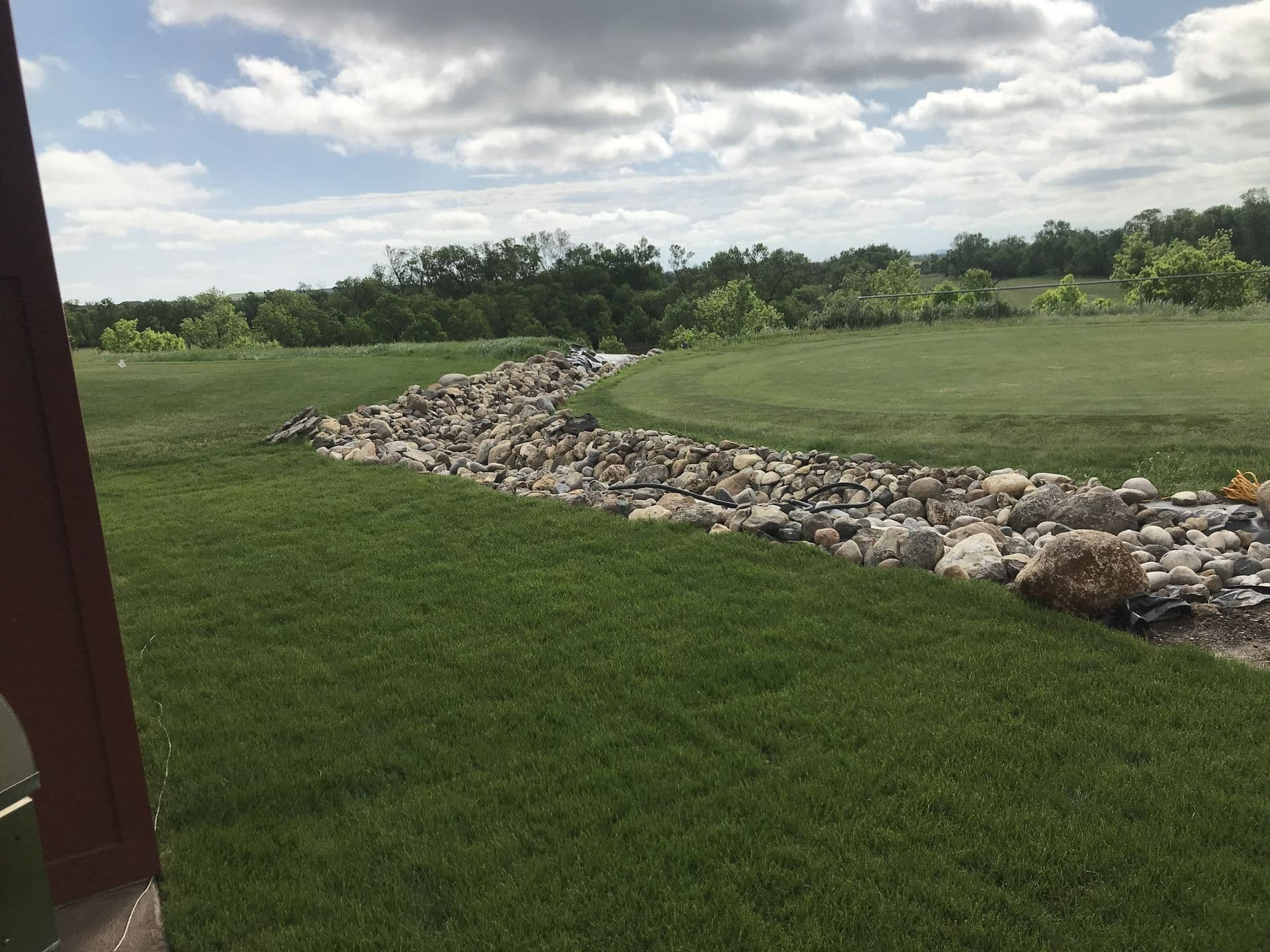
We first track where water enters the property, where it collects, and where it can be discharged without creating a problem somewhere else. The correction may involve reshaping the grade, adding swales or drain inlets, improving compacted soil, installing drainage pipe, or creating a dry creek channel that slows and directs runoff. We complete this part of the landscape design before installing hardscape, irrigation, sod, or planting beds so finished areas do not need to be taken apart later.
Can an existing yard be redesigned without removing every established plant?
Yes, we can design around healthy trees, shrubs, and perennials that still fit the space. We look at each plant’s condition, mature size, root area, sun exposure, and relationship to the new layout, then identify what should stay, be moved, or be removed. Our project gallery shows how new beds, edging, hardscape, and gathering areas can be added without making the entire yard feel newly built.
What soil preparation is needed before installing sod?
We remove debris, weeds, old turf, and loose material, then correct the grade so water moves away from buildings without leaving low spots. Compacted soil is loosened, suitable topsoil or amendments are added where needed, and the surface is leveled and lightly settled before the sod is laid. We also test the irrigation coverage first because repairing a buried line after the sod is installed creates unnecessary seams and disturbance. Ground preparation is the part of a landscape installation that decides how the lawn performs for years afterwards.
How can planting beds be designed around mature tree roots?
We keep deep excavation, raised soil, and heavy equipment away from the root collar and the main structural roots. Bed edges can be adjusted around visible roots, while mulch and carefully selected plants add interest without requiring extensive digging or competing heavily for water. If previous grading or construction has already affected the area, we may recommend a tree health assessment before changing the soil or irrigation around it.
Can xeriscaping still include flowering plants and seasonal color?
Yes, a low-water landscape can have flowers from spring through fall without relying on a large area of thirsty turf. We select cold-hardy plants with different bloom periods, group them by water needs, and use drip irrigation and mulch to support them during dry weather. Native and well-adapted perennials such as penstemon, yarrow, blue flax, and blanketflower can provide color while handling western Montana’s sun, cold, and limited summer rainfall. Our guide to native plants of the Bitterroot Valley lists species that carry color through the season on very little water.
What keeps weeds from growing through decorative rock beds?
We remove existing weeds and persistent roots before the rock is installed, then use defined edging, suitable fabric where appropriate, and enough rock depth to limit light at the soil surface. Fabric helps with weeds rising from below, but it cannot stop seeds carried into the bed by wind, birds, or runoff, so occasional maintenance is still needed. If weeds are already established throughout the property, our weed-control service can address the source before the bed is rebuilt.
How is a paver base prepared for repeated freeze-and-thaw cycles?
We excavate unstable soil and organic material, install a free-draining aggregate base, and compact it in separate lifts instead of trying to compact the full depth at once. The base depth is matched to the soil, drainage, intended use, and expected loads, then finished with a controlled slope, bedding layer, edge restraints, and joint material. This preparation is the part of hardscape construction that keeps the surface from heaving, spreading, or settling unevenly after winter.
What signs show that an existing retaining wall is beginning to fail?
Watch for leaning, bulging, widening joints, cracked blocks, sunken areas above the wall, washed-out soil, or water remaining behind it after rain or snowmelt. A blocked outlet or water seeping through new locations can indicate that the drainage system is no longer working as intended. We inspect these conditions during a retaining-wall assessment and determine if drainage repairs, partial rebuilding, or full replacement are needed.
Can landscape lighting be installed without disturbing established beds?
Yes, low-voltage wiring can usually be routed through existing beds with narrow trenches and careful hand digging near roots, irrigation lines, and established plants. We plan fixture locations around current growth, future plant size, snow storage, and maintenance access, then restore the mulch or soil after the wire is placed. Our landscape-lighting systems can also be installed in zones so additional fixtures can be added later without rebuilding the original system.
Can a landscape project be divided into phases across several seasons?
Yes, but we start with a complete plan so each phase prepares for the next one. Drainage, grading, major hardscape, and underground sleeves should come before irrigation, planting, and lighting, even if those later elements will not be installed until another season. Planning the sequence early lets us leave connection points in place, protect completed areas, and avoid running equipment across newly finished beds or patios. We sequence phased work so drainage and irrigation are settled first; see landscaping design.
Irrigation Systems and Water Management
Zones that will not start, heads that mist, leaks you cannot see, and controllers that forget.
Why does one sprinkler zone run while another does not start?
When one zone stays off while the rest of the system runs, the problem is usually limited to that zone’s valve, solenoid, wiring, or underground splice. We test the controller output and then work toward the valve so we can find the failed component instead of replacing parts at random. Our sprinkler repair service also covers valves that are stuck closed because of debris, diaphragm damage, or a flow-control setting that has been turned down.
What causes sprinkler heads to mist instead of producing full streams?
Fine mist usually means the pressure is too high for the installed nozzles, causing water to break into small droplets before it reaches the lawn. It can also happen when spray and rotor heads are mixed incorrectly, a nozzle is damaged, or the system pressure changes after part of the layout is modified. We check the pressure, nozzle type, head spacing, and zone design before deciding if the problem needs regulation, replacement parts, or a broader irrigation adjustment.
Why does water collect around a valve box after the system shuts off?
A small amount of water may enter a low valve box from surrounding soil, but repeated pooling can indicate a leaking valve, loose fitting, cracked pipe, or drainage problem around the box. We dry the area, operate the affected zones, and watch when the water returns so we can separate an irrigation leak from groundwater or surface runoff. A valve that continues passing water after shutdown should be repaired because it can leave the downstream zone wet even when the controller is off. A leaking or partially closing valve is a standard sprinkler repair job.
How are clogged drip emitters cleaned or replaced?
We begin by checking the filter and flushing the drip line because debris trapped upstream can clog several emitters at once. Removable emitters may be cleaned, but damaged or heavily mineralized pieces are usually replaced so the flow rate stays consistent across the bed. During irrigation winterization, we also clear drip zones at lower pressure to avoid damaging the tubing and fittings.
Will an irrigation controller retain its schedule after a power outage?
That depends on the controller and the condition of its backup battery or internal memory. Some models preserve the programmed days and run times but lose the current date and time, which can make the system water at unexpected hours after power returns. We check the clock, active programs, seasonal adjustment, and rain-delay settings after an outage instead of assuming the previous schedule resumed correctly. If yours has lost its program, a sprinkler repair visit can reset the zones correctly rather than guessing at run times.
Can a rain or soil-moisture sensor be added to an older system?
Yes, most older systems can accept a wired or wireless rain sensor if the controller has compatible sensor terminals. Soil-moisture sensors need suitable placement and calibration because readings from a shaded bed will not represent a sunny lawn zone. If the existing controller has limited programming options, we may recommend replacing it with a model that can use the sensor properly rather than adding equipment it cannot fully support. Retrofits are covered on our irrigation systems page, alongside the watering windows guide.
How should irrigation be adjusted as newly planted trees become established?
New trees need water concentrated around the original root ball while their roots begin moving into the surrounding soil. As the tree establishes, we reduce the watering frequency, increase the depth, and move or add emitters farther from the trunk so water reaches the expanding root area. We account for soil drainage, rainfall, heat, and species instead of leaving the tree on the same short schedule used immediately after planting. New plantings usually need their own zone or hand watering rather than the lawn schedule; see irrigation systems.
Can tree roots damage sprinkler pipes or valves?
Roots usually grow around sound irrigation pipe rather than breaking directly through it, but they can lift valve boxes, shift shallow lines, and enter joints that are already cracked or leaking. Problems also occur when a repair trench cuts across major roots or when a pipe has been installed too close to the trunk. If the tree is mature or already stressed, we may recommend a root-zone assessment before excavating around it.
How can an underground irrigation leak be found without digging up the whole yard?
We start by determining if the leak is on the continuously pressurized mainline or only appears when a specific zone runs. We then isolate zones, inspect valve boxes and heads, compare pressure and flow, and look for soft soil, unexplained green patches, or water surfacing away from the failed pipe. Once the likely area has been narrowed down, we expose only the section needed for repair instead of opening a long trench across the lawn. Leak location is part of our sprinkler repair service.
Should irrigation zones be changed after beds, sod, or hardscaping are added?
Yes, the system should be reviewed whenever the landscape layout changes. Heads that once watered turf may spray a new patio, while expanded beds or removed lawn can leave plants with very different water needs connected to the same zone. During a landscape redesign, we can move or cap heads, extend drip lines, and separate new planting areas so each part of the property receives an appropriate amount of water.
Fertilizer, Weed Control, and Lawn Health
Soil tests, timing around mowing and rain, and why the same patch keeps coming back.
What can a soil test reveal before a fertilizer program begins?
A soil test shows the pH, nutrient levels, organic matter, and conditions that may be limiting how well the grass uses fertilizer. It can reveal that a lawn already has enough of a certain nutrient or that the pH is preventing available nutrients from being absorbed. We use that information to build a more accurate fertilizer program instead of adding products the lawn may not need.
How should irrigation and mowing be coordinated with lawn treatments?
We coordinate the mowing and watering schedule with the product being applied because fertilizer and weed control do not have the same requirements. Granular fertilizer may need irrigation after application, while a foliar weed treatment usually needs time to dry and remain on the leaf before watering. Our lawn-care service allows us to plan mowing, irrigation, and treatments together instead of having one visit interfere with another.
What should I do if it rains shortly after a weed-control application?
Do not apply more product without checking with us first. The effect depends on the treatment, how long it had to dry, and the amount of rain, since a light shower after the required drying period is different from heavy rain immediately after application. We record what was used and when it was applied, then determine if the treatment had enough time to work or if the area needs to be checked later. Retreatment timing is handled as part of a fertilizer and weed control program.
How long should grass remain uncut after treatment?
The mowing interval depends on how the product works and the instructions on its label. Foliar weed control needs enough leaf surface to absorb the application, so cutting immediately before or after treatment can reduce its effect, while granular fertilizer is less affected by mowing once it has moved off the grass blades. We will tell you the specific mowing and watering window after each visit so there is no guesswork. Mowing and treatment are sequenced together in our lawn care schedules.
Why do weeds keep returning in the same section of the lawn?
Repeated weeds in one area usually point to an underlying condition that favors them, such as compacted soil, thin grass, poor drainage, weak irrigation coverage, heavy shade, or soil disturbed by traffic. Treating the visible weeds may clear the area temporarily, but they will continue returning if open soil and weak turf remain. We inspect the pattern, identify the weed, and correct the site condition along with treating the existing growth. Recurring patches usually need the underlying condition fixed as well as the weed treated; see fertilizer and weed control.
Can thin turf be repaired without replacing the entire lawn?
Yes, thin turf can often be improved if enough healthy grass remains and the cause of the thinning is corrected first. We may combine weed control, core aeration, overseeding, irrigation adjustments, and changes to mowing height rather than removing the full lawn. Our aeration and overseeding service is designed for areas where compaction and poor seed-to-soil contact are preventing the turf from filling in.
How are weeds treated near vegetable gardens, wells, or drainage areas?
We mark these sensitive areas before treatment and follow every buffer, rate, and application restriction listed on the product label. Depending on the site, we may use hand removal, targeted spot treatment, shielded application, or leave an untreated buffer instead of spraying the full area. Tell us about private wells, edible plants, drainage channels, ponds, and irrigation sources before we begin so they can be included in the treatment plan. Sensitive-area work is covered by our licensed fertilizer and weed control service.
What is the safest way to address herbicide-sensitive plants near treated turf?
We identify sensitive trees, shrubs, flowers, and garden plants before treating the surrounding grass. Applications may be postponed during wind or high temperatures, and we can use targeted equipment, physical shielding, or an untreated buffer to reduce drift and root-zone exposure. We would rather leave a narrow area untreated than risk damaging a valuable plant beside it. Buffer distances and product selection are part of how we plan a weed control visit.
Can noxious weeds on larger acreage be controlled in stages?
Yes, staged control is often more practical on larger properties, especially when weeds are spread across slopes, fence lines, drainage areas, and open ground. We prioritize patches that are flowering or producing seed, then work through the remaining areas according to the species and the point in its growth cycle when treatment will be most effective. Follow-up is part of the plan because established noxious weeds may regrow from roots or emerge from seed already present in the soil. Multi-season acreage programs are covered on our fertilizer and weed control page.
How can lawn treatments be planned around flowering plants and pollinator activity?
We keep lawn applications off flowering beds and avoid treating blooming weeds while pollinators are actively using them. Spot treatments, untreated buffers, careful timing, and removal of blooms before certain applications can reduce exposure without treating the entire property the same way. We can also coordinate lawn care with landscape planting so flowering areas remain clearly separated from regularly treated turf.
Bird Mitigation and Exclusion
Nests, droppings, deterrent choice, and the legal timing that governs all of it.
What should I do if birds are already nesting inside a vent or soffit?
Do not seal the opening or pull out the nesting material until the species and nest status have been checked. Closing an occupied entrance can trap adults or young birds inside the structure, while removing an active nest may conflict with federal protections. We begin bird mitigation by inspecting the access point, confirming what is using it, and deciding if the work can proceed immediately or must wait until the nest is inactive.
How can I tell if a nest is active before it is disturbed?
Watch the area from a distance for adults carrying food or nesting material, repeated entry and exit, calls from young birds, or fresh droppings below the opening. A nest that looks empty during a quick inspection may still be in use, especially when the adult birds leave as soon as someone approaches. We avoid reaching into enclosed spaces and use a closer visual inspection when the activity cannot be confirmed safely from the ground. Our bird mitigation page covers how timing is assessed before any work begins.
Can birds be excluded from solar panels without damaging the equipment?
Birds can usually be excluded with mesh designed to close the open space around the panel edges without drilling through the panels or roof. We inspect the panel frames, mounting system, wiring, drainage paths, and roof surface before choosing how the barrier will attach. The installation must keep birds out without restricting airflow, trapping debris, interfering with electrical components, or affecting access needed for future panel service. Panel exclusion is one of the situations covered on our bird mitigation page.
Will bird spikes damage roofing, masonry, signs, or painted surfaces?
Properly selected and installed spikes should not damage the surface beneath them, but the attachment method must match the material. Masonry, sheet metal, roofing, signs, and painted trim respond differently to adhesives, clamps, and mechanical fasteners, so we inspect the surface before installation. We also place the spikes to block the full landing area because an incomplete row may simply move the birds a few inches to an unprotected edge. Attachment method is chosen for the substrate; see bird mitigation.
How often should bird netting and exclusion barriers be inspected?
We recommend checking the system at least once a year and after heavy snow, strong wind, roof repairs, sign work, or building maintenance near the installation. Loose edges, broken fasteners, stretched netting, accumulated leaves, and new gaps can give birds a way back into the protected area. Finding a small opening early is much easier than removing another nest and rebuilding a larger section later. Inspection intervals are set when the system is installed; see bird mitigation.
Why does the bird species matter when selecting a deterrent?
Different birds use buildings in different ways and can fit through very different opening sizes. A ledge used by pigeons, a vent entered by starlings, and an eave used by swallows do not call for the same barrier, spacing, or timing. Species identification also matters because legal protections and nesting seasons vary, so we confirm what is present before selecting the exclusion method. Species-appropriate methods are explained on our bird mitigation page.
Should droppings and nesting material be removed before access points are sealed?
Yes, inactive nesting material and accumulated droppings should usually be removed before the opening is closed. Cleaning exposes hidden gaps, insects, moisture damage, and blocked ventilation that could be missed if a barrier were installed directly over the debris. We contain the material, limit airborne dust, clean the surface, and complete the exclusion so birds cannot return to the same sheltered space. Cleanout and exclusion are sequenced together in our bird mitigation service.
Can bird droppings permanently stain concrete, stone, or metal?
Yes, droppings can etch paint, corrode unprotected metal, and leave lasting discoloration on porous concrete, masonry, and natural stone. The longer the material remains, the more likely moisture and repeated deposits are to carry staining deeper into the surface. We remove the accumulation with methods suited to the material instead of dry sweeping or using aggressive pressure that could spread contamination or damage the finish. Cleaning and surface protection are covered under bird mitigation.
Why do birds return after a nest has been removed?
Removing the nest does not remove the sheltered opening, ledge, food source, or protected perch that attracted the birds. Birds may return to a successful nesting location and rebuild quickly if the access point remains open, especially when old nesting material and droppings are still present. We address the return route and surrounding landing surfaces at the same time as cleanup so the property does not offer the same conditions again. Lasting results come from exclusion rather than removal; see bird mitigation.
Can bird mitigation be completed around business hours or occupied areas?
Yes, we can plan the work around customer traffic, employees, residents, deliveries, and access requirements. Cleanup areas may need to be temporarily closed while we control dust and remove contaminated material, and lift work may require a protected area below. Contact our team through the service request form, and we’ll review the property and schedule the work to limit disruption without compromising safety.
Spring and Fall Property Cleanups
When to start after snowmelt, what to do with the leaves, and how cleanup sequences with winterization.
How soon after snowmelt can spring cleanup begin?
We can begin once the snow has cleared, standing water has drained, and the soil is firm enough to support foot traffic and equipment without creating ruts or compaction. Shaded areas and low spots often remain saturated longer than the rest of the yard, so we may start with dry areas and return to softer sections later. Scheduling spring cleanup early is helpful, but the ground condition determines when the work should actually begin.
Should fallen leaves be removed from planting beds or left as mulch?
A light layer of clean leaves can protect soil and plant crowns, but a thick, wet layer may mat down, block airflow, and hold too much moisture against sensitive plants. We remove leaves from turf, drainage paths, diseased beds, and areas where they have formed a dense layer, while leaving suitable material around established plants when it is still providing useful cover. Leaves affected by disease or mixed with noxious weeds should be removed instead of worked into the planting beds.
What causes gray or matted grass after the snow clears?
Grass may become gray and flattened after spending months beneath wet leaves, compacted snow, or ice. In some cases, the matted patches contain snow mold, while other areas are simply pressed down and slow to dry. We let the lawn dry, lightly lift the affected grass, and check for lasting crown damage before deciding if it needs routine lawn care, reseeding, or treatment.
Can a spring cleanup include repairing minor winter damage?
Yes, we can identify and address smaller problems such as displaced edging, washed-out mulch, fallen branches, damaged stakes, blocked drains, and minor surface damage. Broken irrigation components, leaning fence sections, damaged hardscape, or larger tree issues may need to be quoted separately because they require different materials or equipment. We will point out anything that falls outside the cleanup scope before adding repair work. Our spring cleanup checklist covers what to look for on the first walkthrough.
How is dormant pruning selected during a seasonal cleanup?
We choose dormant pruning based on the plant species, its structure, and the reason for making the cut. Dead, damaged, crossing, and poorly attached branches may be prioritized, while shrubs that bloom on old wood may be left until after flowering so we do not remove the season’s buds. Our Montana pruning calendar explains how the timing changes across common trees and shrubs grown in this area.
What happens to the leaves, branches, and debris removed from the property?
We confirm the debris plan when preparing the scope so you know what will be hauled away, chipped, or left onsite. Clean branches may be chipped and suitable leaves can sometimes be composted, while diseased plant material and seed-bearing noxious weeds should be kept separate from reusable organic material. Large logs, construction debris, and unusually heavy accumulations may require additional handling that will be noted in the estimate. The disposal plan is agreed before the visit; see seasonal clean-ups.
Can seasonal cleanup be completed on acreage or heavily wooded lots?
Yes, but we normally divide a larger property into priority areas instead of treating every acre the same way. We may begin around the house, driveway, drainage routes, fences, and frequently used areas, then address wooded edges or outlying sections in stages. Equipment access, slopes, debris volume, and disposal distance are reviewed before we estimate the labor needed. Larger and wooded properties are covered under seasonal clean-ups.
Should fall cleanup happen before or after irrigation winterization?
The two services can be completed in either order, but we often clear heavy leaves and debris first so valve boxes, sprinkler heads, and access points are easier to find. If freezing weather is approaching, the sprinkler blowout takes priority because water left in the system can damage pipes, valves, and the backflow assembly. We coordinate the schedule and mark components that could be hidden by leaves or snow.
When can bare lawn areas be reseeded after spring cleanup?
Bare areas can be seeded once the soil has thawed, drained, and warmed enough for germination, but we first check why the grass disappeared. Compaction, poor drainage, shade, snow damage, and weak irrigation coverage must be addressed or the new seed may fail in the same place. Spring seeding can work with consistent moisture, although early fall is usually the stronger window for aeration and overseeding in western Montana.
Can recurring cleanup visits be scheduled before the busiest part of the season?
Yes, we can place spring and fall visits on a recurring schedule so the property is already planned before seasonal demand increases. The exact date may shift with snowmelt, leaf drop, storms, and ground conditions, but reserving the work early gives us more room to choose a suitable window. Use our service request form to tell us which visits you want and any dates or access requirements we should account for.
Snow Removal and Storm Response
Trigger depths, where the snow goes, protecting the surface underneath, and commercial priority.
At what snowfall depth should plowing begin?
We set the trigger depth before the season based on the property, surface, traffic, and level of access that must be maintained. A commercial entrance or steep driveway may need attention sooner than a flat residential drive, and a long storm may require several passes instead of waiting for the full accumulation. Our snow-removal service is planned around the agreed trigger so the response does not have to be decided in the middle of a storm.
When does snow need to be hauled away instead of pushed into piles?
Hauling becomes necessary when piles begin taking up parking, narrowing drive lanes, blocking signs or sightlines, covering drainage areas, or leaving no safe place for the next storm’s snow. We also look at where each pile will drain because a large mound can create repeated ice across a walkway or parking area as it melts. Planning a hauling point before the site runs out of storage is more efficient than trying to move several frozen piles later. Hauling triggers are set in advance for contracted sites; see commercial snow removal.
Can a gravel driveway be plowed without removing the surface material?
Yes, but the approach changes with the condition of the driveway. Early in the season, before the gravel base freezes firmly, we leave a thin layer of snow and avoid scraping down to loose aggregate. Marked edges, controlled blade height, and slower passes help keep the gravel on the drive instead of pushing it into the lawn, where it would need to be collected in spring. Gravel drives are handled differently from paved ones; see snow and storm services.
How are paver driveways and decorative edges protected from plow damage?
We identify paver transitions, raised borders, drainage channels, and decorative edging before snowfall hides them. The plowing approach is then adjusted to avoid catching loose pavers or striking an edge from the side, and existing movement or damage should be documented before the season begins. If the surface has already shifted, our hardscaping team can assess the base and determine why the affected section is no longer level.
Which parts of the property should be marked before the first snowfall?
Mark the edges of gravel drives, curbs, culverts, drain grates, steps, retaining walls, low fencing, irrigation heads, utility boxes, septic risers, and any object that will disappear beneath the snow. We also need to know the location of landscape-lighting fixtures, decorative rocks, and narrow lawn areas beside the plowing route. Tall, visible markers should remain in place all winter instead of relying on paint or short flags that may be buried during the first large storm. Our fall leaf and storm prep guide covers what to mark and when.
Where should snow be stored to reduce drainage and refreezing problems?
We choose storage areas where the pile will not block visibility, cover a drain, narrow an entrance, or send meltwater across pavement. The ground should allow water to move away from buildings and frequently used surfaces without flooding planting beds or neighboring property. Snow storage is considered during landscape and drainage planning because the safest winter location often depends on the grade created during the original installation.
Can compacted snow and ice be cleared without damaging the pavement below?
In many cases, yes, although thick ice bonded to an uneven or damaged surface may not lift cleanly in one pass. We use controlled mechanical removal and ice-management materials suited to the surface and temperature instead of repeatedly striking or gouging the pavement. Clearing fresh snow before traffic compacts it remains the best way to prevent a hard ice layer from forming. Ice management is part of our snow and storm services.
What should be moved from a parking area before a snow-removal visit?
Move vehicles, trailers, garbage containers, portable signs, shopping carts, planters, extension cords, hoses, and loose equipment out of the clearing area. Items left between parked vehicles or along curbs are difficult to see after drifting and can prevent us from clearing the full space. If something cannot be moved, mark it clearly and let us know before the visit so we can plan around it. Commercial site preparation is covered on our commercial snow removal page.
How is access prioritized for commercial properties during a major storm?
We follow the sequence agreed upon before winter, beginning with entrances, fire and emergency access, accessible parking and routes, and the main paths used by customers and employees. Drive lanes, loading areas, secondary parking, and outer edges follow according to the property’s operating needs. Our commercial snow service also allows for repeat passes during long storms so priority routes remain open instead of being cleared only after the snow stops.
What should I inspect after winter to find snowplow or ice damage early?
Check driveway edges, curbs, pavers, drainage grates, fencing, irrigation heads, lighting fixtures, turf beside the plowing route, and areas where gravel or mulch has been displaced. Also look for standing water, low spots, loose retaining-wall blocks, salt-stressed plants, and damage hidden beneath former snow piles. These items can be reviewed during a spring property cleanup before small repairs turn into larger drainage or landscape problems.
Custom Fencing and Gate Installation
Property lines, buried lines, wind, slope, frost heave and gates wide enough for the equipment.
Should the property line be surveyed before an old fence is replaced?
A survey is a good investment when the boundary is unclear, the existing fence does not match recorded information, or the new fence will sit close to a neighboring structure or access route. An old fence is not proof of the legal property line, and rebuilding in the same place can carry an earlier mistake into the new installation. Before custom fence installation, we ask you to confirm the boundary and will flag any part of the layout that appears uncertain.
How are irrigation pipes, septic components, and private wires protected during post digging?
Public utilities are marked before excavation, but private systems require separate attention because they may not appear in the locate. We ask you to identify sprinkler lines, valve wires, septic tanks and drain fields, propane lines, landscape lighting, and invisible pet fencing before we finalize the post layout. If a planned post conflicts with an irrigation line or another private feature, we can adjust the spacing, expose the area carefully, or arrange for the line to be relocated.
Can a solid privacy fence be built on a property exposed to strong wind?
Yes, but a solid fence catches far more wind than an open design, so the post depth, spacing, bracing, and gate construction need to account for that load. We assess the direction of the prevailing wind, the length of each run, nearby buildings, and how exposed the property is before recommending the structure. A shadowbox or semi-private design may be a better fit in a highly exposed area because it reduces pressure while still blocking most sightlines. Wind-appropriate designs are covered on our custom fencing page and in our fence comparison guide.
How is a fence installed across sloped or uneven ground?
We can step the panels in level sections or rack them so they follow the slope more closely. The choice depends on the fence material, grade, appearance, and the amount of space that can remain beneath the lower edge. If grading or drainage work is also planned, we coordinate the fence with the landscape layout so future soil movement does not leave large gaps or bury the bottom of the panels.
What prevents fence posts from lifting during Montana freeze-and-thaw cycles?
We set posts to a depth suited to the soil and frost conditions, then use stable backfill and drainage that prevent water from collecting around the base. A shallow post in wet soil can rise a little during each freeze-and-thaw cycle until the fence begins to lean or wave. Corner, end, and gate posts receive additional attention because they carry more tension and movement than the posts along a straight run. Post depth and drainage are covered on our custom fencing page.
How wide should a gate be for trailers, mowers, or snow-removal equipment?
We measure the widest equipment that needs to pass through and add clearance for mirrors, mower decks, attachments, uneven approaches, and turning space. A small lawn gate may only need four or five feet, while trailers, vehicles, and snow equipment often need a ten- to twelve-foot opening or more. If the gate will support winter access, we also consider the space needed for snow removal and where the open gate will sit when snow is piled nearby.
Can fencing be designed to protect gardens from deer and elk?
Yes, but standard yard fencing is usually too low to protect a garden from deer or elk. We plan the height, post strength, visibility, gate design, and space on the landing side around the animals present on the property. Local height restrictions and the appearance of the fence should also be checked before choosing a tall exclusion design. Heights and configurations that actually work are covered under custom fencing.
Can storm-damaged sections be repaired without replacing the entire fence?
Yes, if the surrounding posts, rails, and panels remain structurally sound. We check how far the impact traveled through the fence because a fallen tree or heavy branch can loosen posts beyond the visibly broken section. If tree damage created an immediate access or safety problem, our storm-response service can address the tree first, then we can determine which fence components can be reused.
How close can fence posts be installed to mature trees?
There is no single distance that works for every tree because root spread, trunk size, species, soil, and the required post depth all affect the decision. We avoid cutting major roots or placing posts against the root flare, and we may shift the post spacing, span across a root area, or excavate carefully by hand. If the layout passes through a sensitive root zone, a tree health assessment can help protect the tree before digging begins.
How long should new cedar fencing dry before it is stained or sealed?
The moisture in the wood matters more than the number of days since installation. Dry cedar may be ready relatively soon, while wetter boards can need several weeks or longer depending on sun, airflow, temperature, and recent rain. We recommend waiting until the wood absorbs a small drop of water instead of leaving it beaded on the surface, then following the stain manufacturer’s moisture and weather requirements before application. Our fence comparison guide covers cedar maintenance over its life.
Choosing a Tree Service or Landscaper in Western Montana
Credentials that mean something, the ones that do not, and how to check before anyone climbs your tree.
What is an ISA Certified Arborist and why does the credential matter?
An ISA Certified Arborist has passed an International Society of Arboriculture exam covering tree biology, diagnosis, pruning, soils, and safe work practices, and has to earn continuing-education credits to keep the certification current. It is the difference between someone who owns a saw and someone trained to judge whether a tree can be kept. Justin Johnson holds certification RM-8889A along with line-clearance qualification; you can read more about the credential in our guide to ISA certification in Montana.
How do I verify that an arborist's certification is real?
Ask for the certification number, then look it up in the International Society of Arboriculture's public verification tool rather than taking a logo on a truck door at face value. A valid record shows the holder's name, the certification type, and the expiry date. Ours is RM-8889A. If a company cannot produce a number, or the number does not resolve to the person who will actually be on your property, treat that as your answer. Ours is explained in our guide to ISA certification in Montana.
Is a tree service required to be licensed and insured in Montana?
Insurance is the part that protects you. Ask for a certificate of liability insurance and workers' compensation coverage sent directly from the insurer rather than a photocopy, because if an uninsured worker is hurt on your property or a limb goes through your roof, the exposure can land on your homeowner's policy. We carry both and can provide current certificates on request before work begins. Ask us for current certificates through the contact form before work is scheduled.
What questions should I ask before hiring someone to remove a large tree?
Ask who will be on site and what their qualifications are, whether they carry liability and workers' compensation insurance, how they plan to get the tree down given the space available, what happens to the wood and the stump, and what the cleanup includes. Ask for the plan in writing. A company that cannot describe the rigging approach for a tight removal has not looked closely enough at the job. Our tree services page describes how we plan a removal, which is the level of detail worth expecting from anyone quoting.
Why do estimates for the same tree vary so much between companies?
Usually because the companies are not quoting the same work. One may plan to drop the tree whole while another has to dismantle it in sections over a roof, one may include stump grinding and hauling while another leaves the wood on site, and one may be carrying insurance the other is not. Ask each company to itemise the scope, the debris plan, and the stump so you are comparing the same job. Our tree removal cost guide sets out the variables that should appear in any honest quote.
Should I be careful about crews that show up door to door after a storm?
Yes. Storm chasing is common after a big wind event, and the pattern is recognizable: unmarked vehicles, pressure to sign immediately, a discount for paying cash up front, and no local address. Ask for a local phone number, a certificate of insurance, and a written scope before agreeing to anything. If a tree is genuinely dangerous, our emergency tree and storm response team can look at it without you signing under pressure.
Is the cheapest quote usually the right choice for tree work?
Not reliably, because the savings often sit in the things you cannot see on the day: insurance that is not carried, a stump left in the ground, wood left where it fell, or a topping cut that creates a weaker tree you pay to deal with again in five years. Compare what is actually included and what condition the property will be in afterwards, then judge the price against that. Our tree removal cost guide explains what tends to be missing from the lowest number.
Who owns HJ Property Care & Tree Service?
HJ Property Care & Tree Service LLC is owned by Adam Hurlbert, who founded the company in 2024, and co-owner Justin Johnson, an ISA Certified Arborist with line-clearance qualification. The business is based in Florence and works across Missoula and the Bitterroot Valley. You can read both owners' backgrounds on our team page.
How long has HJ Property Care been working in the Bitterroot Valley?
The company was founded in 2024 and has completed more than 200 projects across Missoula County and Ravalli County since then. That covers tree work, landscaping and design, irrigation, fencing, seasonal cleanups, and winter snow removal. Our project gallery shows finished work, and our reviews page collects what customers have said about it.
Do you provide references or examples of similar completed work?
Yes. For most projects the fastest way to see whether we are the right fit is to look at comparable work rather than a list of names: our gallery shows before-and-after results for tree removal, fencing, retaining walls, and full landscape installs. If you want to speak with a customer who had work similar to yours, ask when we visit and we will arrange it.
What does a free estimate actually include?
A visit to the property, a look at the conditions that affect the work such as access, slope, drainage, soil, and overhead obstacles, and a written scope with the price for the work described. There is no charge for the visit or the quote. We aim to get estimates back within 48 hours of seeing the property. You can start the process through our contact form or by calling (406) 215-7319.
Do you charge for a tree inspection if I decide not to have work done?
A visit to quote work you are considering is free. A formal tree health and risk assessment is a different service: it is a documented evaluation of a specific tree's condition, defects, and likely failure points, often used for insurance, a sale, or a neighbor dispute. Our tree health and risk assessment page explains what that report covers and when it is worth having.
Can I get an estimate from photos instead of a site visit?
Photos are useful for the first conversation and sometimes enough for straightforward work, but they hide the things that drive the price: ground conditions, gate widths, slope, what is under the tree, and how equipment reaches the area. For tree removal, irrigation installation, retaining walls, and fencing we will want to see the site before committing to a number, so the quote reflects the actual property. Send what you have through the contact form and we will tell you whether a visit is needed.
How far ahead do you book during the busy season?
Spring and early summer are the heaviest period for landscaping, irrigation startups, and fencing, and the first hard freeze compresses everyone's winterization schedule into a few weeks. Emergency tree work is handled separately and does not wait in that queue. If you have a target season or a completion date, tell us early through our contact form so we can plan the sequence around it.
What areas do you serve around Missoula and the Bitterroot Valley?
We work across the Missoula area and the Bitterroot Valley, including Missoula, Lolo, Clinton, Florence, Stevensville, Victor, Corvallis, Hamilton, and Darby. Our base is in Florence, roughly midway between Missoula and Hamilton, which keeps most of the valley within a short drive. Our service area page lists every community with a page for each.
What Outdoor Work Costs and What Drives the Price
Why a number over the phone is usually wrong, and which variables actually move a quote up or down.
How much does tree removal cost in Montana?
There is no single figure, because the price tracks the difficulty rather than the tree. Height and trunk diameter matter, but so do the drop zone, proximity to a house or power line, whether the crew can bring equipment to the trunk, the species and condition of the wood, and whether the stump and debris are included. Our tree removal cost guide for Montana breaks down each of those factors, and the estimate itself is free.
Why will a tree service not quote a price over the phone?
Because the variables that decide the price are the ones you cannot describe by phone: what is underneath the tree, how close the nearest structure or power line sits, whether a truck can reach it, and what condition the wood is in. A number given blind is either padded to cover the worst case or gets revised upward on the day. We would rather look at the property and give you a figure that holds. Our tree removal cost guide explains which variables move the number.
What makes one tree removal more expensive than another of the same size?
Access and consequences. A tree with open space around it can be sectioned and dropped quickly; the same tree between a house and a fence has to be climbed, rigged, and lowered piece by piece, which takes far longer and requires more crew. Slope, soft ground, narrow gates, overhead lines, and the distance debris has to be carried all push the same tree into a higher bracket. Each of those factors is broken down in our tree removal cost guide.
Is stump grinding included in the price of tree removal?
Not automatically. It is a separate step with separate equipment, so it appears as its own line unless you have asked for it to be included. It is usually cheaper to have it done in the same visit than to bring the grinder back later. Our stump grinding page explains grinding depth, what happens to the chips, and how to prepare the area for grass or a replacement planting.
What does an irrigation system cost to install?
It depends on the area covered, the number of zones, the water source and pressure available, the soil and rock you are digging through, and whether the design has to work around mature trees, hardscape, or an existing lawn. Rocky ground in the valley adds trenching time. Our irrigation system cost guide for Montana walks through the components and the variables before you request a quote.
Does rocky soil in the Bitterroot Valley increase project costs?
It can, particularly for anything that goes into the ground. Irrigation trenches, fence post holes, retaining-wall footings, and planting pits all take longer in rocky ground, and some sites need different equipment entirely. We look at the soil during the site visit rather than assuming, because conditions vary sharply between a river-bottom lot and a bench property a mile away. Ground conditions are assessed during the free site visit; book one through our contact form.
Do you charge extra for difficult access or steep ground?
Access and slope are priced into the scope rather than added as a surprise afterwards. If equipment cannot reach the work area, the job takes more hours and more hand labour, and the quote reflects that from the start. This is a large part of why we want to see gates, routes, grades, and overhead clearances before quoting, so the number you approve is the number that stands. Access and grade are assessed at the site visit; see our contact page to arrange one.
Is it cheaper to bundle several outdoor projects together?
Often, yes, because one mobilisation covers several pieces of work and the sequence can be planned properly. Trenching for irrigation before sod goes down, or removing a tree before a fence line is set, avoids taking finished work apart later. We can quote several projects from one visit and itemise them so you can approve all of it or stage it across seasons. Our services overview shows what can be combined into a single scope.
Do you offer free estimates?
Yes, estimates are free and we aim to return them within 48 hours of visiting the property. The visit includes a look at drainage, access, slope, soil, and anything else that affects the method, and the quote describes the scope in writing so you know what is and is not included. Start with our contact form or call (406) 215-7319.
What is the difference between an estimate and a final invoice?
The estimate prices the scope we agreed after seeing the property. The invoice should match it unless the scope changed with your approval, or something genuinely hidden turned up, such as an unmarked private line or extensive decay found once cutting began. We raise anything like that with you before continuing rather than adding it to the bill afterwards. Anything unexpected is raised with you before we continue; our contact page is the fastest way to reach us mid-project.
Do you require a deposit before starting work?
It depends on the project. Work that requires ordering materials such as fencing, retaining-wall block, plants, or irrigation components is usually staged differently from a straightforward removal or cleanup. Whatever applies to your project is set out in the written estimate before you approve it, so there are no payment terms you have not seen. Payment terms appear in the written estimate you approve; ask when you request a quote.
How is snow removal priced, per visit or by season?
Both arrangements exist and each suits a different property. A per-visit arrangement makes sense for occasional need; a seasonal contract gives priority in a big storm and a predictable budget line, which is why most commercial sites prefer it. Trigger depth, the areas covered, and whether hauling is included all change the figure. Our commercial snow removal page covers how contracts are structured.
Are cost guides on this site specific to western Montana?
They are written for Montana conditions and reflect what actually drives price here: rocky and variable soils, short shoulder seasons, wind exposure, and the access constraints of valley and bench properties. They describe the factors rather than publishing a fixed price list, because a number written once and left on a page goes stale and misleads people. The quote for your property comes from the site visit. See the tree removal cost guide and the irrigation system cost guide.
Can you match a competitor's quote?
We would rather show you what the quotes actually contain. Two prices for the same tree frequently cover different work, different insurance, and different cleanup, and the gap usually explains itself once both scopes are laid side by side. Bring us the other estimate and we will tell you plainly where they differ and whether ours is doing more. Send it through our contact form and we will go through it with you line by line.
Permits, HOAs, Boulevard Trees, and Property Rules
Who owns the tree by the curb, when a wall needs a permit, and what your covenants can override.
Do I own the tree between the sidewalk and the street?
In Missoula, generally not. Trees in the boulevard strip between the sidewalk and the curb are City property, and that remains true even if a previous resident paid to plant one. Pruning or removing a boulevard tree is handled through the City's Urban Forestry program rather than by the property owner. Our guide to Missoula tree permits and right-of-way trees explains who to contact before any work is scheduled.
Do I need a permit to remove a tree in my own yard in Missoula?
Trees on private property are treated differently from trees in the public right-of-way, and the rules that apply depend on where the tree actually stands. The safest step is to establish the boundary and the tree's position first, then confirm requirements with the City before work is booked. Our Missoula tree permit guide sets out how to check and who to ask.
Who do I contact about a boulevard or right-of-way tree in Missoula?
Missoula's Urban Forestry program administers trees in the public right-of-way, including pruning, removal, and planting approvals. They can be reached at citytrees@ci.missoula.mt.us or 406-552-6355. Contact them before scheduling any work on a boulevard tree, and before assuming a tree near the street is yours to deal with. We can help you identify where the boundary falls. Our Missoula tree permit and right-of-way guide covers the process in more detail.
Does a retaining wall need a permit in Missoula?
Height is the usual trigger, and it is measured from the bottom of the footing rather than from finished grade, which catches people out because a wall that looks modest above ground can sit well above the threshold once the footing is counted. A wall carrying a surcharge, such as a driveway or slope above it, can require review at any height. Confirm with the City's Building Division, and see our retaining wall installation page for how we handle design and drainage.
What is a surcharge on a retaining wall?
A surcharge is any additional load bearing on the soil behind the wall: a driveway, a parking area, a slope rising above it, a structure, or a pool. It changes the engineering substantially, because the wall is no longer holding back soil alone. Walls with a surcharge are treated differently by the building department regardless of how tall they look, so it is worth identifying early in the design. Our retaining wall installation page covers how a surcharge changes the design.
Do I need approval from my HOA before installing a fence?
Almost certainly, and the covenants often govern more than you expect: height, materials, color, setback from the property line, and which side the finished face has to point. Approval is normally required before installation, not afterwards, and removing a non-compliant fence is expensive. Our guide to HOA landscape and fence approvals in the Bitterroot covers what a submittal usually needs.
What does an HOA architectural submittal usually require?
Typically a site plan showing the location and dimensions, the materials and colors, the height, and sometimes a photograph or product sheet for what you intend to install. Some boards meet monthly, so the review itself can add weeks before work can start. Building that lead time into the schedule is the single most useful thing you can do; our HOA approval guide explains the sequence.
Who is responsible for confirming setbacks and property lines?
The property owner. We will flag parts of a project that look likely to need a permit, a setback check, or HOA approval, but confirming the rules that apply to a specific address, along with easements, covenants, and recorded boundaries, sits with the owner. For fences and walls close to a boundary, a survey is the only reliable way to avoid building in the wrong place. Our HOA landscape and fence approval guide covers what to confirm before installation.
Should I have the property surveyed before replacing an old fence?
If the existing fence is old, if you are not certain it was installed on the line, or if a neighbor has ever questioned it, yes. Replacing a fence on the footprint of one that was already in the wrong place repeats the error in new materials and can create a dispute or a removal order. A survey is cheap relative to rebuilding a fence twice. Our custom fencing page covers how the line affects layout and post placement.
Are utility locates required before digging in Montana?
Yes. Public utilities are marked through Montana 811 before excavation, and that request needs to go in ahead of the work rather than on the day. Locates cover public lines only, so private irrigation pipe, septic components, propane lines, landscape lighting cable, and invisible pet fencing will not be marked. Tell us what private systems you know about before we dig. Locates are arranged before any irrigation installation or fence-post work begins.
What is not covered by a Montana 811 utility locate?
Anything on your side of the meter. That includes irrigation mainlines and valve wiring, septic tanks and drain fields, propane lines to a fire pit or garage, low-voltage landscape lighting cable, invisible pet fencing, and any service line a previous owner installed. These are the lines most often cut during fence-post and irrigation work, which is why we ask about them before starting. Tell us about private lines when we quote your irrigation or fencing work.
Are there restrictions on when trees with nesting birds can be pruned or removed?
Active nests of most native bird species are federally protected, which means timing matters more than convenience: work that would destroy an active nest needs to wait until the young have fledged. In practice this shapes the pruning and removal calendar through spring and early summer. We check the canopy before starting and will tell you if a tree needs to be rescheduled. Our Montana tree pruning calendar covers how nesting season shapes the timing.
Does Missoula restrict lawn watering hours?
Missoula publishes recommended watering hours rather than mandatory restrictions, generally from May 1 through September 30, in the morning between 6 and 11 and in the evening between 5 and 10. Watering in those windows reduces evaporation loss and is better for the lawn regardless of whether it is required. Our water-wise irrigation and watering windows guide explains how to set a controller around them.
Do I need approval to remove a tree that is on the property line?
A tree whose trunk straddles a boundary is generally considered jointly owned, which means removal is not a decision one owner can make alone. Cutting it without the neighbor's agreement can create real liability. Establish where the trunk actually sits, talk to the neighbor before scheduling anything, and get the agreement in writing if the tree is coming down. A documented tree health and risk assessment is often the most useful basis for that conversation.
Can my neighbor make me remove a tree that overhangs their property?
The general position is that a neighbor may trim growth that crosses the boundary, at their own cost and without damaging the tree's health or entering your land, but that is different from compelling removal. Where a tree is genuinely hazardous the conversation changes, and a documented tree health and risk assessment is usually the most productive way to settle what is actually true about its condition.
Who is liable if a tree falls onto a neighbor's property?
Liability commonly turns on whether the owner knew, or should have known, that the tree was hazardous. A healthy tree brought down by an exceptional storm is treated very differently from one with visible decay, a documented lean, or dead limbs that had been raised before. That is the practical value of having a hazard assessment on file: it shows what was known and what was done about it. Our tree health and risk assessment page explains how findings are documented.
Missoula, Lolo, and Clinton
What changes about the work as you move from in-town lots to the canyon and the Bitterroot's north end.
Who does tree removal in Missoula, MT?
We do, across Missoula and the surrounding area, with an ISA Certified Arborist on the ownership team. Missoula work is frequently constrained rather than complicated: mature boulevard and yard trees on tight in-town lots, overhead lines, and neighbors close on both sides, which usually means dismantling in sections rather than felling. See emergency tree removal in Missoula or our Missoula service area page.
Do you offer tree service near me in Missoula?
Yes. Our base is in Florence, about twenty minutes south of Missoula, and Missoula is one of our two core markets alongside the Bitterroot Valley. We handle removal, pruning, hazard assessment, stump grinding, and storm response there. Start at our Missoula page or call (406) 215-7319 to arrange a free estimate.
What makes tree work in Missoula different from the rest of the valley?
Density and infrastructure. Many Missoula properties have mature street and yard trees planted decades ago on lots that are now surrounded by houses, driveways, fences, and overhead utilities, so there is rarely open ground to drop into. Boulevard trees add a second layer, because those belong to the City. Our guide to Missoula tree permits and right-of-way trees covers that distinction.
Do you handle landscaping design in Missoula?
Yes, from full front-yard redesigns to drainage correction, planting beds, sod, and low-water conversions. Missoula's mix of older in-town lots and newer subdivisions means the starting conditions vary widely: compacted construction soil in one, decades of accumulated planting in another. Our Missoula landscaping design page covers how we approach both.
Who installs irrigation systems in Missoula?
We design and install systems throughout Missoula, and repair and winterize existing ones. Most of the work is matching zones to how the property actually dries out, since a south-facing slope and a shaded side yard should never run on the same schedule. See irrigation systems in Missoula, and our sprinkler blowout and winterization page for the autumn side of it.
Do you plow snow in Missoula?
Yes, for both residential driveways and commercial properties, with 24-hour storm response through the winter. Commercial sites are prioritized by contract during a large storm so that access and parking are cleared in a defined order. See snow removal in Missoula or our commercial snow removal page for how seasonal contracts work.
Who builds fences in Missoula, MT?
We install cedar, vinyl, and chain link fencing across Missoula, along with gates sized for the equipment that actually needs to get through. In-town work usually turns on the property line and the alley: old fences are often not on the boundary, and replacing one on the same footprint repeats the error. See custom fencing in Missoula.
Do you do spring and fall cleanups in Missoula?
Yes, including leaf removal, bed cleanup, dormant pruning, and clearing winter debris once the ground has dried enough to work without damaging the turf. Timing in Missoula usually runs slightly ahead of the upper valley. See seasonal clean-ups in Missoula for what a visit covers.
Do you serve Lolo, MT?
Yes. Lolo sits between Missoula and Florence, so it is close to our base and covered for every service we offer: tree work, landscaping, irrigation, fencing, cleanups, and snow removal. Our Lolo service area page links to each one, including tree services in Lolo and custom fencing in Lolo.
What are the common landscape problems on Lolo properties?
Lolo has a mix of older established yards and newer builds on larger lots, and the two fail in different ways: mature plantings that have outgrown their space and irrigation designed for a garden that no longer exists, against new construction with compacted soil and thin topsoil over fill. Our page on signs a Lolo landscape needs professional care covers what to look for.
Do you install irrigation in Lolo, MT?
Yes, both new systems and repairs to existing ones. Lolo properties often run larger than in-town Missoula lots, which changes the zone design and sometimes the water source. We check available pressure and flow before designing, because a system laid out beyond what the source can deliver produces weak coverage everywhere. See irrigation systems in Lolo.
Do you plow driveways in Lolo?
Yes, including the longer rural driveways common there. Long approaches change the plan: where the snow can be pushed matters more when there is a season's accumulation to store, and marking the edges before the first snowfall prevents damage to culverts, posts, and beds. See snow removal in Lolo.
Do you serve Clinton, MT?
Yes. Clinton is east of Missoula up the Clark Fork, and we cover it for tree work, landscaping, irrigation, fencing, seasonal cleanups, and snow removal. Properties there tend to be larger and more exposed than in-town lots. Our Clinton service area page links to each service, including tree services in Clinton.
What should Clinton property owners know about wind and tree risk?
Exposure is the defining condition. Properties along the canyon catch wind that in-town lots never see, which loads trees and fences differently and finds every existing defect. Trees that have grown in the open develop differently from sheltered ones, and a tree suddenly exposed by nearby clearing is at higher risk. A tree health and risk assessment is worth having before storm season rather than after.
Do you build fences in Clinton, MT?
Yes. Wind exposure drives the design more than anywhere else we work: a solid privacy fence acts as a sail, and the load goes straight into the posts, so post depth, spacing, and bracing matter more than the material. A shadowbox pattern lets air through while keeping most of the privacy. See custom fencing in Clinton.
Do you clear snow in Clinton and up the canyon?
Yes. Clinton typically holds snow longer than town and drifts more, so trigger depths and the plan for where snow is stored matter. Marking driveway edges, culverts, and beds before the first snowfall is worth the twenty minutes it takes. See snow removal in Clinton.
How far from Missoula will you travel for work?
We cover the Missoula area and the Bitterroot Valley from Missoula down to Darby, which is roughly a sixty-mile corridor with our base in Florence near the middle. If you are near the edge of that, call and ask rather than assuming; the answer usually depends on the size of the job. Our areas we serve page lists every community.
Do you work in both Missoula County and Ravalli County?
Yes, and it is worth knowing that the two counties, and the municipalities inside them, do not have identical rules on permits, setbacks, and right-of-way trees. We will flag where a project looks likely to need approval, but confirming the requirements for a specific address is the owner's responsibility. Our service area page covers both counties.
Hamilton, Stevensville, Corvallis, Victor, Darby, and Florence
Town by town through the Bitterroot, and the ground conditions that change with each one.
Who does tree service in Hamilton, MT?
We do, covering removal, pruning, hazard assessment, stump grinding, and storm response. Hamilton work often means mature trees on established in-town lots with rocky soil and limited room to work, which usually calls for sectional dismantling rather than felling. See tree services in Hamilton or our Hamilton service area page.
Do you do landscaping in Hamilton?
Yes, including design, installation, drainage correction, planting, sod, and hardscape. Hamilton's combination of rocky ground and tight in-town lots shapes most projects: excavation takes longer, and the layout has to work in a smaller footprint than the same design would occupy elsewhere. See custom landscaping design and installation in Hamilton.
Do you install and repair irrigation in Hamilton, MT?
Yes, both new installations and repairs, plus autumn winterization. Rocky ground affects trenching time and sometimes the routing, so we look at the soil during the site visit rather than pricing it blind. See irrigation systems in Hamilton and our sprinkler repair page for common faults.
Do you plow snow in Hamilton?
Yes, residential and commercial, with storm response through the winter. Commercial contracts set the trigger depth, the areas covered, and where snow is stored, which matters on smaller Hamilton lots where there is limited room to pile it. See snow removal in Hamilton.
Who builds fences in Hamilton, MT?
We install cedar, vinyl, and chain link across Hamilton and the surrounding area. Rocky ground is the main variable for post setting, and in-town lots make the property line worth confirming before an old fence is replaced. See custom fencing in Hamilton.
Do you serve Stevensville, MT?
Yes, for every service we offer. Stevensville has a distinctive mix of river-bottom ground and historic properties, and both affect the work: high water tables and seasonal saturation in the bottoms, mature trees and older infrastructure on the historic lots. Our Stevensville service area page links to each service.
When is the best time to schedule tree removal in Stevensville?
Frozen or firm ground is easier to work on and does less damage to turf and beds, which is one argument for late autumn and winter. Against that, active bird nests restrict spring and early summer work, and storm damage sets its own timetable. Our page on when to schedule tree removal in Stevensville works through the trade-offs.
What should Stevensville river-bottom properties watch for?
Saturated ground and a high water table change what is possible. Root plates in soft ground hold less well, which raises failure risk in wind; trenching and post holes can fill with water; and drainage correction has to account for where water is already going rather than simply moving it next door. We look at the ground conditions before designing anything that goes below grade. Our Stevensville service area page covers the work we do there.
Do you install irrigation in Stevensville, MT?
Yes, including systems that have to account for variable soil across a single property, which is common in the bottoms. Zones should follow how each area actually dries, not the shape of the lawn. See irrigation systems in Stevensville and our water-wise watering guide.
Do you serve Corvallis, MT?
Yes, for tree work, landscaping, irrigation, fencing, cleanups, and snow removal. Corvallis properties are often larger and more agricultural in character than the in-town lots further north, which changes both the equipment and the design. Our Corvallis service area page links to each service.
Do you do landscaping design in Corvallis?
Yes. On larger Corvallis parcels the useful question is usually where to concentrate the designed space rather than how to treat the whole property, since a defined outdoor area near the house maintains well while acreage beyond it is managed differently. See landscaping design in Corvallis.
Do you serve Victor, MT?
Yes, for every service we offer: tree work, landscaping, irrigation, fencing, seasonal cleanups, and snow removal. Victor sits between Stevensville and Hamilton, well inside our service area from the Florence base. Our Victor service area page links to each one, including tree services in Victor, landscaping design in Victor, and custom fencing in Victor.
How do I know if my irrigation system needs repair in Victor?
Dry patches that persist after a full cycle, heads that mist instead of throwing a stream, water pooling around a valve box after shutoff, a zone that will not start, or a water bill that climbs without a change in schedule are the usual signals. Our page on irrigation repair signs in Victor covers how to tell which is which.
Do you serve Darby, MT?
Yes. Darby is the southern end of our service area, and properties there tend to be larger, more wooded, and more exposed to both wind and wildfire risk than those further north. Our Darby service area page links to each service, including tree services in Darby.
What should Darby property owners know about wildfire risk?
Wooded lots close to the forest edge carry more exposure, and the most useful work is usually in the first few feet around the structure rather than deep in the trees. Removing ladder fuels, thinning crowded conifers, clearing needle litter from roofs and gutters, and keeping the zone immediately against the house free of flammable material all matter. Our defensible space guide covers the zones in detail.
Do you serve Florence, MT?
Yes, and it is our home base, so response times there are the shortest we offer. Every service is available: tree work, landscaping, irrigation, fencing, cleanups, and snow removal. Our Florence service area page links to each one.
Who does tree pruning in Florence, MT?
We do, with pruning planned around the tree's structure and species rather than simply cutting back what looks crowded. Structural pruning on a young tree prevents problems that are expensive to correct at maturity. See tree pruning and trimming in Florence and our Montana tree pruning calendar for timing.
Do you handle snow removal and storm response in Florence?
Yes, and being based in Florence means we can usually reach properties there quickly during a storm. Marking driveway edges, culverts, and beds before the first snowfall makes the whole winter go better. See snow removal and storm response for Florence homeowners.
Which Bitterroot Valley towns do you cover?
Florence, Stevensville, Victor, Corvallis, Hamilton, and Darby in Ravalli County, plus Missoula, Lolo, and Clinton in the Missoula area. Our Bitterroot Valley regional page covers the valley as a whole, with pages for irrigation, landscaping design, fencing, cleanups, and snow removal.
Does the work change between the north and south ends of the Bitterroot Valley?
Enough to matter. The southern end holds snow longer and sits closer to forested ground, which raises both wildfire exposure and the amount of conifer work. The northern end has more in-town density and more mature deciduous trees. Soil varies sharply across short distances everywhere in the valley, particularly between river-bottom and bench ground, which is why we look at the site rather than assuming. Our Bitterroot Valley regional page covers the valley as a whole.
Every page for these towns
Trees, Plants, and Pests of Western Montana
What grows well here, what struggles, and what is actually killing the conifer in your yard.
What trees grow well in the Bitterroot Valley?
Species already thriving nearby are the most reliable guide, because they have proven they can handle the cold, the dry summers, and the local soil. Ponderosa pine, Douglas-fir, western larch, quaking aspen, and cottonwood are all native to the region and widely established. The harder question is usually mature size against the space available, since a conifer planted three meters from a house becomes a problem decades later. Our native plants guide covers species suited to valley conditions, and landscaping design covers placing them well.
What are good native plants for a Bitterroot Valley landscape?
Native and well-adapted perennials handle our sun, cold, and limited summer rainfall with far less water than turf: penstemon, yarrow, blue flax, and blanketflower are dependable performers with staggered bloom periods. Grouping plants by water need and mulching well matters as much as the species list. Our guide to native plants of the Bitterroot Valley goes through the options.
What is killing the pine trees in western Montana?
Mountain pine beetle is the usual suspect on pines, and the early signs are pitch tubes on the trunk, boring dust in the bark crevices, and needles fading from green through yellow to red over a season. By the time the whole crown is red the tree is dead and the beetles have often moved on. Our mountain pine beetle guide covers identification, prevention, and what can still be done.
How can I tell if a conifer is dying or just stressed?
Look at where the browning starts and how it spreads. Interior needles yellowing and dropping in autumn is normal; browning that begins at the top or moves outward along whole branches is not. Check the trunk for pitch tubes, boring dust, cracks, and loose bark, and look at the ground for a lifting root plate. If the crown is thinning year over year, book a tree health and risk assessment.
Why are the needles on my spruce turning brown and falling off?
Spruce commonly declines from the lower branches upward, and the pattern is worth photographing over a season because it points to the cause. Fungal cankers, drought stress, poor drainage, and root damage from nearby construction all produce similar symptoms at different speeds. Watering habits are frequently involved, since spruce dislikes both drought and sitting in saturated soil. A tree health and risk assessment identifies which cause is at work before anything is treated.
Do deer and elk damage landscaping in the Bitterroot Valley?
Regularly, and the damage takes two forms: browsing on foliage, and bucks rubbing antlers on young tree trunks, which can girdle and kill a new planting in a single autumn. Fencing is the only fully reliable answer for a garden, though plant selection reduces the pressure. Our custom fencing page covers heights and designs that actually work against deer.
What plants do deer tend to leave alone here?
Aromatic, fuzzy, and resinous foliage is browsed less: yarrow, lavender, catmint, Russian sage, and many ornamental grasses tend to survive where hostas and tulips do not. That said, deer-resistant is not deer-proof, and a hard winter changes what they will eat. In heavy-pressure areas the practical approach is fencing the things you care about and planting the rest for resilience. Our native plants guide covers resilient choices, and custom fencing covers the reliable answer.
When should I plant a new tree in western Montana?
Spring after the ground has thawed and early autumn are both workable, with autumn giving roots time to establish before the following summer's heat, provided the planting happens early enough for root growth before the ground freezes. What matters more than the month is the planting itself: the right depth with the root flare visible, a wide rather than deep hole, and consistent water through the first two growing seasons. Planting is part of our landscaping design work, and our pruning calendar covers care afterwards.
How deep should a tree be planted?
The root flare, where the trunk widens into the roots, should be visible at or just above finished grade. Planting too deep is one of the most common causes of slow decline in young trees, and it is often invisible because the tree looks fine for years before thinning. Nursery stock is frequently potted too deep, so it is worth excavating the top of the root ball to find the flare before setting the tree. Correct planting depth is part of every install we do under landscaping design.
Should I stake a newly planted tree?
Only if it genuinely needs it, and then not for long. Some movement in the trunk is what builds taper and strength, so a tree staked rigidly for years develops a weaker stem than one allowed to flex. Where wind exposure requires staking, use a flexible tie that will not girdle the bark and plan to remove the hardware after the first growing season. Staking decisions are made per tree during a landscape installation.
How much should I water a newly planted tree?
Deep, infrequent watering at the root ball beats frequent light sprinkling, which encourages shallow roots. New plantings need attention through the first two growing seasons, and lawn irrigation is rarely enough on its own because it wets only the surface. Adjust as the tree establishes rather than leaving the original schedule running for years; our summer watering guide covers the principle.
Is mulch actually good for trees?
Yes, when it is applied correctly: a layer a few inches deep spread out to the drip line, conserving moisture and moderating soil temperature. What harms trees is mulch piled against the trunk, which holds moisture against the bark, encourages decay and rodent damage, and can produce girdling roots. Keep it clear of the trunk itself and the benefit is real. Mulch rings are standard in our landscaping design installs and in seasonal clean-ups.
What is girdling and why does it kill trees?
Girdling interrupts the layer just under the bark that moves sugars from the leaves to the roots. It happens when a root circles the trunk and tightens as both grow, when a tie or wire is left on too long, or when a rodent or a string trimmer strips the bark around the base. The canopy can look fine for a season or two before declining, which is why the damage is often missed. Girdling roots and old ties are among the things checked in a tree health and risk assessment.
Can a tree damaged by a string trimmer recover?
Superficial bark scuffing on one side often heals. Damage that rings most of the trunk usually does not, because the transport layer is cut. The practical fix is prevention: keep turf back from the trunk with a mulch ring so nothing mechanical needs to come close. If the base of a tree has been repeatedly hit, have the extent of the damage assessed before assuming it will grow out of it. If the base has been repeatedly hit, have it looked at in a tree health and risk assessment.
Why is the grass not growing under my big tree?
Turf and a mature tree are competing for the same light, water, and nutrients, and the tree usually wins. Rather than fighting it, the durable answer is to stop asking that area to be lawn: a mulched bed out to the drip line, or shade-tolerant plantings, will look better and reduce the root damage caused by mowing and trimming close to the trunk. Converting that area to a mulched bed is straightforward landscaping design work.
Are cottonwoods a problem tree near houses?
They are fast, large, and structurally weaker than many alternatives, and they shed limbs. That is not a reason to remove a healthy one, but it is a reason to have mature cottonwoods within falling distance of a house or driveway inspected on a regular cycle rather than only after a storm. Our tree health and risk assessment page explains what an inspection covers.
What is the white or orange growth on my tree's bark?
Flat gray-green or orange patches are usually lichen, which grows on the bark surface and does not feed on the tree. Lichen on a declining tree is a symptom of a thinning canopy letting more light in, not the cause. Growth that is soft, shelf-like, or mushroom-shaped is a different matter, since it can indicate internal decay and is worth having looked at. Shelf or mushroom-shaped growth is worth a tree health and risk assessment.
Can a tree be saved once it has started to lean?
It depends entirely on whether the lean is old and stable or new and moving. A tree that has grown at an angle for decades, with straight upward growth from the lean, is usually fine. Fresh cracks in the soil, a lifting root plate, or exposed roots on the opposite side indicate active movement, which is a different situation. If the lean appeared after wind or saturated ground, stay clear and call emergency tree and storm response.
Wildfire and Defensible Space
The work that actually reduces risk, and where on the property it matters most.
What is defensible space and how much do I need?
Defensible space is the treated area around a structure that reduces the chance of fire reaching it and gives crews room to work. It is usually described in zones moving outward from the building, with the treatment intensity highest closest to the structure. The first few feet against the walls matter more than anything further out. Our defensible space guide for Montana covers each zone.
What should go in the first five feet around my house?
As little flammable material as possible. That means no bark mulch against the siding, no firewood stacked on the deck or against a wall, no dense shrubs under windows, and nothing stored under the deck. Gravel, hard surfaces, and irrigated low plantings are better choices. This zone gives the highest risk reduction per hour of work of anything on the property. Our defensible space guide covers the near zone in detail.
What are ladder fuels and why do they matter?
Ladder fuels are the vegetation that lets a ground fire climb into the tree canopy: low branches, tall shrubs beneath trees, and small conifers growing under bigger ones. Breaking that vertical continuity by pruning low limbs and clearing the growth beneath is one of the more effective things you can do on a wooded lot, and it is work we handle as part of tree services.
How far apart should trees be spaced for wildfire safety?
Crown separation is the goal, so that fire cannot move directly from one canopy to the next. The spacing needed increases on slopes, because fire moves faster uphill. On a densely stocked lot this usually means selective thinning rather than clearing, keeping the healthiest and best-placed trees and removing crowded, suppressed, or defective ones. Selective thinning is tree services work; the spacing logic is in our defensible space guide.
Does removing all the trees around my house make it safer?
No, and it usually makes the property worse in other ways. Well-spaced, healthy, pruned trees can slow wind-driven embers and provide shade that reduces the drying of surrounding vegetation. The evidence points to structure hardening and the immediate zone around the building doing more than clearing everything. Thinning and pruning is the useful work, not removal for its own sake. Our defensible space guide covers what the evidence actually supports.
Should I clear pine needles off my roof and out of my gutters?
Yes, and it is among the highest-value tasks on the list. Most structures lost in wildfire are ignited by embers rather than a wall of flame, and accumulated needles in gutters and roof valleys are exactly what embers land in. This is routine work in a seasonal cleanup and worth doing before fire season rather than after.
When is the best time to do defensible space work?
Before fire season rather than during it, which in practice means autumn through spring. Spring work has to account for active bird nests, and late-season cutting in hot, dry conditions carries its own ignition risk from equipment. Autumn is often the best window: the ground is firm, the nesting season is over, and the work is done before the following summer. Timing is covered in our defensible space guide and our pruning calendar.
Can defensible space work be done without making the property look bare?
Yes. Thinning to give the best trees room, pruning low limbs, and replacing flammable plantings close to the house with irrigated, low-growing, well-spaced ones changes the fire behavior without stripping the property. Done with a design in mind the result usually looks better than the crowded starting condition, because the trees worth keeping become visible. We plan fuel reduction alongside the landscape design rather than against it.
Does irrigation help with wildfire resilience?
Irrigated, green vegetation close to a structure ignites less readily than dried-out material, so a maintained landscape in the near zone helps. It is a supporting measure rather than a substitute for spacing, fuel reduction, and roof and gutter clearance. Where water is limited, concentrate it near the structure. Our irrigation systems page covers zone design that supports this.
What do I do with the slash and debris from thinning work?
It has to leave the property or be processed, because piles of cut material sitting in the trees are worse than what you removed. Branches can be chipped on site, and material can be hauled away as part of the scope. We agree the debris plan before starting so there is no ambiguity about what stays and what goes. Debris handling is agreed up front as part of tree services.
Is it worth pruning lower branches on ponderosa pines?
Raising the canopy on ponderosa is a common and effective treatment on wooded lots, since it removes the ladder that carries fire from the ground into the crown. The limits are how much live crown the tree can lose in one operation and the timing relative to the tree's health. This is judgement work rather than a fixed rule, which is why we look at the stand before quoting. Crown raising is tree services work, and our defensible space guide covers why it matters.
Should firewood be stored away from the house?
Yes, and the recommendation is consistent across fire-safety guidance: stacked wood belongs well away from the structure and out of the immediate zone, not against a wall, on a deck, or underneath one. A woodpile against siding is a large volume of ready fuel in the exact location where it does the most harm, and moving it costs nothing but an afternoon. Our defensible space guide covers storage placement alongside the other near-zone measures.
Watering, Drought, and Water-Wise Landscaping
How much water a Montana lawn actually needs, when to apply it, and how to use less without losing the yard.
When should I water my lawn in Missoula?
Early morning is the best window, because water applied before the heat has time to soak in rather than evaporate, and the blades dry through the day rather than staying wet overnight. Missoula publishes recommended hours from May 1 through September 30, in the morning between 6 and 11 and in the evening between 5 and 10. Our watering windows guide covers setting a controller around them.
Are Missoula's watering hours mandatory?
They are published as recommendations rather than enforced restrictions. Following them still makes sense on the merits: watering in the heat of the afternoon loses a significant share to evaporation and wind drift, and watering late at night leaves the turf wet for hours, which favours disease. The recommended windows are simply when watering works best. Our watering windows guide covers how to program a controller around them.
How often should I water a lawn in western Montana?
Less often and more deeply than most schedules are set for. Frequent light watering keeps roots shallow and makes the lawn less able to handle heat; longer cycles spaced further apart drive roots deeper. The right interval changes through the season and between a south-facing slope and a shaded area, which is why zones should be set independently. Our summer watering guide covers the adjustments.
How can I tell if my lawn is getting enough water?
Two checks tell you most of it. Push a screwdriver into the soil after a cycle: if it goes in easily to a few inches, the water reached the root zone. And watch for footprints staying visible on the grass, which shows the blades have lost enough moisture to stop springing back. Both beat guessing from the surface, which dries first and misleads. Our summer watering guide covers the checks through the season.
What is a catch-cup test and why does it matter?
It is the only reliable way to know what a zone is actually applying. Set straight-sided containers around the zone, run it for a set time, and measure the depth collected in each. The result usually shows both how much water is going down and how unevenly it is distributed. Uneven distribution is why one part of a lawn browns while the rest is fine, and it is fixed at the heads, not on the controller. Uneven distribution is corrected at the heads during a sprinkler repair visit.
What is hydrozoning?
Grouping plants with similar water needs onto the same irrigation zone so each group can be watered correctly. Mixing thirsty and drought-tolerant plants on one zone guarantees that something is wrong: either the low-water plants are overwatered, which often kills them faster than drought, or the thirsty ones are underwatered. It is one of the first decisions in a landscape design.
Is drip irrigation better than sprinklers for planting beds?
For beds and shrubs, usually yes. Drip puts water at the root zone with very little evaporation or wind loss, keeps foliage dry, and does not water the mulch between plants. Spray heads are better suited to turf, where uniform coverage across an area is the point. Many properties are best served by both, on separate zones with different schedules. Zone design for both is covered on our irrigation systems page.
What is xeriscaping and does it mean gravel and cactus?
No. Xeriscaping is designing for low water use, which in western Montana means well-adapted plants grouped by water need, generous mulch, efficient irrigation, and turf limited to the areas actually used. A well-executed low-water landscape here has flowers from spring through autumn. Our landscaping design page and the native plants guide cover the plant palette.
How much can I reduce water use without losing the lawn?
Often substantially, and the first savings come from fixing what is already wrong rather than watering less: leaking heads, misaligned spray hitting pavement, zones running longer than the soil can absorb, and a controller still on its spring schedule in September. After that, reducing turf area to what is actually used delivers the largest structural saving. Start with our sprinkler repair page.
Should I water differently on rocky or sandy soil?
Yes. Coarse, rocky, and sandy soils drain quickly and hold less, so they need shorter, more frequent cycles; heavier soils hold more but absorb slowly, so long single runs produce runoff. Many valley properties have both across one lot, which is a strong argument for separating them onto different zones rather than compromising with one schedule. Soil-appropriate zoning is part of how we design an irrigation system.
What is cycle-and-soak watering?
Splitting a zone's run time into two or three shorter cycles with a gap between them, so water has time to soak in instead of running off. It is the standard fix for slopes and for compacted or clay-heavy soil, where a single long run puts more water down than the surface can take. Most modern controllers can do it without extra hardware. Our summer watering guide covers scheduling on slopes and heavy soil.
Should I water the lawn in autumn before the ground freezes?
Trees and shrubs particularly benefit from a deep watering late in the season, before the ground freezes, because they enter winter with moisture in the root zone and dry winter winds continue to draw moisture from evergreens. Time it before winterization, since once the system is blown out the irrigation is done for the year. Our sprinkler blowout and winterization page covers the sequence.
Does a rain sensor actually save water?
Yes, mainly by preventing the situation everyone recognizes: sprinklers running during a rainstorm. Sensors and soil-moisture devices can usually be retrofitted to an existing controller, and the payback is straightforward on a property with an irrigated lawn. They need occasional checking, since a sensor that has failed in the wrong position either blocks watering entirely or stops doing anything. Sensors can be retrofitted during an irrigation service visit.
Why is part of my lawn always dry no matter how long I water?
Almost always a distribution problem rather than a duration problem. A blocked or tilted head, mismatched nozzle types on one zone, pressure too low to reach the design radius, or a head buried by turf growth will all leave a persistent dry area that more run time cannot fix, since the rest of the zone is being overwatered in the meantime. A sprinkler repair visit finds the cause.
The Western Montana Property Calendar
What needs doing when, from the first thaw to the first hard freeze, and what happens if you miss the window.
What outdoor work should be done first in spring?
Wait until the ground has dried enough that walking and working on it will not compact the soil or tear the turf, then clear winter debris, cut back perennials, and look for damage that happened under the snow. Irrigation startup and the first fertilizer application follow once the risk of a hard freeze has passed. Our spring lawn and landscape startup guide sets out the order.
When can I start my sprinkler system in spring?
Once the risk of a hard freeze has passed, because charging a system and then having the water in it freeze is how backflow devices and above-ground components get destroyed. Startup is more than opening a valve: it means pressurising slowly, checking every zone for leaks and broken heads that appeared over winter, and resetting the controller for spring rather than leaving last summer's schedule running. Our spring startup guide covers the sequence, and irrigation systems covers the service.
When should I fertilize a lawn in Montana?
Timing follows the grass rather than the calendar, and the applications that matter most are made while the turf is actively growing. Feeding a dormant lawn in high summer heat or too late in autumn wastes product and can damage the grass. Our fertilizer and weed control page explains how a program is sequenced across the season.
When is the best time to aerate a lawn in western Montana?
Only while the turf is actively growing, so it can recover and fill the holes; aerating a dormant or heat-stressed lawn does more harm than good. Cores should be roughly a quarter to three eighths of an inch across and three to four inches deep. Our aeration and overseeding page and the guide to when to aerate cover the timing.
Do spike aerators work?
No, and they can make the problem worse. Solid-tine and spike aerators push soil sideways and compress it around each hole, adding compaction rather than relieving it. Core aeration, which pulls plugs of soil out and leaves them on the surface, is the process that actually works. If someone is offering aeration with a spike roller, it is not the same service. Our aeration and overseeding page explains what core aeration actually does.
How do I know if my lawn needs dethatching or aerating?
Cut a small wedge out of the turf and look at the spongy brown layer between the green blades and the soil. Under about half an inch is normal and beneficial; substantially more starts blocking water and nutrients from reaching the soil. Compaction shows up differently, as water pooling or running off, hard ground, and thin turf in the areas that get the most traffic. Our guide to when to aerate and overseed covers how to tell them apart.
When should I prune trees in Montana?
It depends on the species and the reason. Dead, damaged, and hazardous wood can be removed at any time. Most structural pruning on deciduous trees is done in the dormant season when the structure is visible and the tree is not actively growing, while some species and some objectives call for different timing. Our Montana tree pruning calendar works through it species by species.
Is it bad to prune trees in spring?
It is more complicated in spring than in dormancy. Active bird nests restrict what can be done, some species bleed heavily from spring cuts, and fresh wounds coincide with the period when certain pests and pathogens are most active. Removing a hazard does not wait for a better season, but planned structural work is usually better scheduled outside it. Our Montana tree pruning calendar covers timing species by species.
When should I overseed a thin lawn?
When soil temperatures and moisture support germination and the new seedlings have time to establish before either summer heat or winter arrives, which in practice points to late summer into early autumn for most western Montana lawns. Overseeding straight after core aeration gives the seed the soil contact it needs. Our aeration and overseeding page covers the combination.
When should I winterize my irrigation system?
Before the first hard freeze, and earlier rather than later, because the cost of guessing wrong is a cracked backflow assembly or split pipe rather than an inconvenience. Every provider's schedule compresses into the same few weeks once the forecast turns, so booking ahead matters. Our sprinkler blowout and winterization page explains what a proper blowout involves.
What happens if I skip sprinkler winterization?
Water left in the lines expands as it freezes. The damage typically shows up in the backflow assembly, valves, and any pipe with a low point that could not drain, and it is usually not discovered until spring startup, when it appears as a flooded valve box or a zone that will not hold pressure. It is among the more expensive avoidable repairs on a property. Our sprinkler blowout and winterization page covers what a proper blowout involves. Our guide to winterizing an irrigation system in Montana covers the timing and what gets damaged when it is missed.
What should be done in autumn before winter?
Leaves cleared off turf before they mat down, beds cut back, irrigation winterized, gutters cleared, deep watering of trees and shrubs before the ground freezes, and driveway edges and beds marked ahead of the first plow. Our fall leaf and storm prep guide covers the sequence, and the seasonal clean-ups page covers what a visit includes.
Should I mark my driveway before the first snowfall?
Yes, and it takes twenty minutes. Markers along driveway edges, at culvert ends, around irrigation heads near the drive, and at the corners of beds tell a plow operator where the hard edges are once everything is under snow. It prevents the most common winter damage we see, and it is far cheaper than repairing turf, heads, and edging in spring. Our fall leaf and storm prep guide covers the full pre-winter list.
When does snow removal season usually start here?
Contracts are typically set well before the first storm, because arranging service after snow is already on the ground means joining a queue. The first plowable snowfall varies by year and by where you are in the valley, with the southern end and higher ground usually seeing it earlier. Our snow removal page covers residential service and commercial snow removal covers contracts.
What should I check after winter for hidden damage?
Look for plow scarring at turf edges, broken or buried irrigation heads near driveways, fence panels and posts pushed by snow load or drift, branches cracked but still attached, and beds crushed by piled snow. Finding these in early spring means they can be folded into the first cleanup rather than discovered piecemeal through the season. Our spring cleanup checklist covers the walkthrough.
Is there anything worth doing in midwinter?
Dormant-season structural pruning on many deciduous species is best done then, when the structure is visible and the ground is firm enough to work on without damaging turf. It is also the practical window for planning: design work, quotes, and scheduling for spring projects all move faster in winter than they will once the season starts and everyone books at once. Dormant pruning is covered in our pruning calendar, and winter tree care covers snow load.
Emergencies, Storms, and After-Hours
What counts as an emergency, what to do in the first ten minutes, and what not to touch.
What counts as a tree emergency?
A tree or large limb that has fallen on a structure, vehicle, or across access; a tree that has shifted, cracked, or partially uprooted and could come down; and anything involving contact with a power line. Damage that is contained and stable, such as a broken branch hung up away from where people go, is usually next-day work rather than an emergency. Our emergency tree and storm response page explains the difference.
A tree just fell on my house. What should I do first?
Get everyone out of the affected part of the building and stay clear, then call emergency services if there is any injury, gas smell, or contact with power lines. Do not go onto the roof or try to move anything. Once people are safe, photograph the scene before anything is disturbed for your insurer, then call us at (406) 215-7319 for emergency storm response.
What should I do if a tree is touching a power line?
Stay away from it and keep everyone else away, including from any fence, wire, or wet ground near it, and call the utility and 911. Do not attempt to move the tree, and do not assume a line is dead because nothing is arcing. Utility clearance is not homeowner work and it is not general tree-service work either; the line has to be dealt with before anyone can approach the tree. Once the utility has made it safe, call us for emergency tree and storm response.
Do you offer 24-hour emergency tree service?
Yes, storm response runs outside normal hours, because a partially failed tree over a driveway or roof does not wait for Monday. Call (406) 215-7319. What we can do on arrival depends on the situation: making the area safe and removing the immediate hazard usually comes first, with full cleanup and any remaining removal scheduled once conditions allow. Our emergency tree and storm response page covers what we can do on arrival.
My tree is leaning after a storm. Is it going to fall?
Treat it as if it might. Fresh soil cracking or heaving around the base, a lifting root plate, exposed roots on the side opposite the lean, or a visible gap where the trunk meets the ground all indicate the root system has moved. Keep people, vehicles, and pets out of the fall zone in every direction and call for an assessment rather than waiting to see what happens. Our page on signs a tree is about to fail covers what to look for from a safe distance.
Should I try to remove a hanging branch myself?
No. A broken limb held in the canopy is under load in ways that are not visible from the ground, and it can release suddenly in an unpredictable direction, which is a common cause of serious injury. This is exactly the situation rigging exists for. Keep the area below it clear and have it taken down properly. Call emergency tree and storm response instead and keep the area below it clear.
Will my insurance cover storm tree damage?
That is between you and your insurer, and policies differ considerably, particularly on removal of a tree that fell without hitting anything. What helps is documentation: photograph the scene widely and closely before cleanup, keep dated estimates and invoices, and record any emergency work done to prevent further damage. We can document the work we complete, but coverage is the insurer's decision. Our storm season preparation guide covers documentation worth keeping.
What should I photograph before storm cleanup starts?
Wide shots showing the tree's original position and what it struck, close shots of the damage, the root plate or break point, and anything that shows the condition of the wood. Include something for scale. Take them before anything is moved, because once the site is cleared the evidence is gone and an adjuster is working from your description rather than the scene. Our storm season preparation guide covers what to record and when.
How quickly can you respond to a storm call?
It depends on where you are and how much of the valley is affected at once, since a widespread wind event generates many calls in the same hours. Being based in Florence puts us within a short drive of most of our service area. Situations involving structures, access, or immediate danger are prioritized over cleanup work. Call (406) 215-7319 or see emergency tree and storm response.
What do you do first when you arrive at a storm-damaged property?
Assess what is still moving or loaded before touching anything, because the hazard is often not the part that already fell. That means identifying leaning trees, partially detached limbs, tension in fallen wood, and any utility contact, then establishing a work zone. Making the area safe comes before cleanup, and we will tell you plainly if something needs the utility company before we can proceed. Our emergency tree and storm response page covers how a call is handled.
Can you clear a driveway blocked by a fallen tree?
Yes, and restoring access is usually the first priority once safety is established, particularly where someone needs to get out or emergency vehicles need to get in. Clearing the access route and removing the remaining hazard can be handled together or staged, depending on conditions and what else on the property is unstable. Call (406) 215-7319 for emergency storm response.
What should I do about damaged fencing after a storm?
Photograph it before repairs, check whether the damage is limited to panels or has moved the posts, and secure any section that could blow further or let pets out. Individual sections can often be repaired without replacing the run, provided the posts are sound. Our fence repair page covers what can be repaired against what is better replaced.
Commercial, HOA, and Property Manager Questions
Contracts, priorities, documentation, and the liability questions boards actually ask.
Do you work with commercial properties and HOAs?
Yes, including grounds maintenance, seasonal cleanups, tree work, irrigation, and winter snow and ice service. Commercial work differs mainly in documentation and scheduling: defined scopes, agreed response times, and work planned around business hours and occupied areas. Our commercial landscaping and commercial snow removal pages cover both sides.
How are commercial snow removal contracts structured?
A contract sets the trigger depth at which service begins, the areas covered and in what order, whether ice control is included, where snow is stored, and when hauling is triggered. It also sets priority during a large storm, which is the part that matters most when everyone needs service in the same six hours. Our commercial snow removal page explains the options, and there is a contract checklist to review before signing.
What should be in a commercial snow and ice contract?
Trigger depth, a map of the areas covered and their priority order, response time expectations, ice-control products and where they are applied, snow storage locations, hauling triggers, service documentation, and how the work is billed. Ambiguity in any of those turns into a dispute in February. Our snow and ice contract checklist walks through each item.
How is priority decided during a major storm?
By contract, agreed before the season rather than negotiated during the storm. Sites with early opening times, medical or emergency access, or high traffic are typically served first, and within a site the priority order usually runs entry and exit routes, then main parking, then overflow and pedestrian areas. Setting that order in advance is why contracted sites are handled predictably. Priority order is set in the contract; see commercial snow removal.
Where should snow be stored on a commercial lot?
Away from drainage inlets, entrances, sightlines at exits, and anywhere meltwater will run across pavement and refreeze overnight. Storage location also has to account for the volume a whole season can produce, not the first storm. Piles that block sightlines or send meltwater across a walkway create the slip and collision exposure the service was meant to reduce. Storage planning is part of setting up a commercial snow removal contract.
When does snow need to be hauled off site instead of piled?
When the piles no longer have anywhere to go without taking parking spaces, blocking sightlines, or draining across traffic areas. On constrained urban lots that point arrives sooner than owners expect. Hauling is normally a separate line item triggered by accumulated volume, and agreeing the trigger in advance avoids arguing about it mid-season. Our snow and ice contract checklist covers agreeing the trigger in advance.
Can work be scheduled outside business hours?
Yes, and for most commercial sites it is the sensible arrangement. Snow service frequently runs overnight so lots are clear before opening, and noisier work such as tree removal or bird mitigation can be scheduled around occupancy. Tell us the constraints when we quote so the schedule is built around them rather than adjusted afterwards. Tell us the constraints when we quote your commercial grounds maintenance or snow contract.
Do you provide documentation of completed service visits?
Yes. For commercial and HOA work, records of what was done and when are part of the service, and for winter work they matter beyond billing: documentation of service timing supports a property's position if a slip claim is made. We agree the reporting format when the contract is set up. Reporting format is agreed when the contract is set up; see commercial snow removal.
Who is responsible for tree risk on common-area HOA property?
The association, generally, for trees in common areas, which is why boards benefit from documented inspections rather than responding only after a failure. Liability commonly turns on whether a hazard was known or should have been known. A periodic tree health and risk assessment across common-area trees creates the record that shows what was known and what was done about it.
Can you provide a written scope for a board or committee to review?
Yes. Board and committee approval usually needs a document that can be circulated and voted on, so scopes for HOA work are written to be read by people who were not at the site visit: areas covered, work included, exclusions, timing, and cost. That also reduces the risk of the approved work drifting from what the board thought it approved. Our commercial landscaping page covers how recurring scopes are structured.
How much lead time do HOA approvals usually need?
More than most owners expect. Some architectural committees meet monthly, so a submittal that misses a meeting waits for the next one, and requests for additional information restart the clock. Build that into the project timeline from the start. Our guide to HOA landscape and fence approvals covers what a complete submittal contains.
Do you handle grounds maintenance contracts for commercial sites?
Yes, covering recurring maintenance across the season rather than one-off visits: mowing and turf care, bed maintenance, seasonal cleanups, irrigation management, and tree care on a planned cycle. A defined schedule generally produces better results at a lower total cost than reacting to problems. See our commercial landscaping page.
Can bird mitigation be done at an occupied commercial building?
Yes, and most of it is, since the buildings that attract nesting are usually in use. The work is scheduled around occupancy and access, and it has to account for the legal protection of active nests, which affects timing rather than method. Our bird mitigation page covers exclusion methods and what determines the approach.
Do you carry insurance certificates for commercial clients?
Yes, and we can have current liability and workers' compensation certificates sent from the insurer directly, which is what most property managers and boards require before a vendor starts. Ask when we quote so the paperwork is in place rather than holding up the start date. Ask when we quote through the contact form so the paperwork is in place before the start date.
Which Should I Choose?
The trade-offs behind the decisions people get stuck on, answered for Montana conditions.
Cedar, vinyl, or chain link: which fence is best in Montana?
Cedar gives the best appearance and natural weather resistance but needs periodic sealing and will move with the seasons. Vinyl is the lowest maintenance and holds its finish, though it is less forgiving of impact in deep cold. Chain link is the workhorse for containment and costs least over its life. Our fence comparison guide covers each against wind, snow load, and freeze-thaw.
Is a privacy fence or a shadowbox fence better on an exposed property?
On an exposed site a shadowbox is often the better engineering choice. A solid privacy fence works like a sail, and that wind load transfers straight into the posts, which is why the same fence that stands for years on a sheltered lot leans on an open one. Shadowbox lets air through while blocking most sightlines. Our custom fencing page covers the design options.
Sod or seed: which is better for a Montana lawn?
Sod gives an immediate result, holds soil on a slope straight away, and can be installed across a wider part of the season, but costs more and still needs attentive watering to root. Seed costs less and develops a deeper root system over time, but requires a good germination window and patience, and it is vulnerable to washing on any grade. Soil preparation matters more than the choice between them. Ground preparation for either is covered on our landscaping design page.
Drip irrigation or spray heads: which do I need?
Both, usually, on separate zones. Drip belongs in planting beds and around shrubs and trees, where it puts water at the roots with minimal evaporation and keeps foliage dry. Spray and rotor heads belong on turf, where the point is even coverage across an area. Running beds and lawn on one zone guarantees one of them is watered wrong. See irrigation systems.
Rock mulch or bark mulch: which is better here?
Bark improves the soil as it breaks down, holds moisture, and moderates temperature, which suits planting beds, but it needs topping up and it is fuel close to a structure. Rock does not decompose or need replacing and is the safer choice in the immediate zone around a building, but it holds heat and adds nothing to the soil. Many properties use rock near the house and bark further out. Near-structure choices are covered in our defensible space guide.
Should I repair my old fence or replace it?
Look at the posts. Panels, rails, and pickets are straightforward to replace piecemeal, but if the posts are rotten at grade, heaved, or leaning along the run, repairs are temporary and you will be back within a season or two. A handful of failed posts in an otherwise sound fence is a repair; a run of them is a replacement. Our fence repair page covers the assessment.
Is it better to remove a problem tree or try to save it?
It depends on what is wrong, what the tree is worth, and what it could hit. Structural defects in a young tree are often correctable with pruning over several cycles; extensive decay in the trunk or root collar of a mature tree usually is not. The presence of a target underneath changes the calculation, because the same defect matters more over a driveway than over open ground. A risk assessment settles it on evidence.
Stump grinding or full stump removal: what is the difference?
Grinding uses a cutting wheel to reduce the stump and major surface roots to chips below grade, leaving the deeper root system to decay in place. Full excavation pulls the root mass out, which disturbs a much larger area and costs considerably more. Grinding is the right answer for nearly all residential situations. Our stump grinding page covers grinding depth and what to do with the hole.
Aeration or dethatching: which does my lawn need?
They solve different problems. Dethatching removes the spongy organic layer between blades and soil when it exceeds roughly half an inch. Core aeration relieves compaction and improves water and air movement into the root zone. A lawn on heavy traffic or construction-compacted soil usually needs aeration; a lawn with a thick thatch layer needs that addressed first. Our aeration and overseeding page explains how to tell.
Retaining wall or regrading: which fixes my slope?
Regrading is usually cheaper and lower maintenance where there is room to reshape the slope, and it avoids a structure that has to be engineered and drained. A wall makes sense where you need to gain usable flat area, where space is too tight to lay the grade back, or where you are holding soil against a fixed feature. Our retaining wall installation page covers when each applies.
Pavers or concrete for a patio in a freeze-thaw climate?
Pavers flex with ground movement and individual units can be lifted and reset if something settles, which suits our freeze-thaw cycles. Concrete is a single monolithic surface, so when it cracks it stays cracked. The critical variable for either is the base: an inadequately prepared or poorly drained base heaves regardless of the surface on top. See hardscaping.
Timber, block, or stone for a retaining wall?
Segmental block is the most common choice for its consistency, engineering data, and built-in setback. Natural stone looks best and lasts indefinitely but costs more to source and set. Timber is cheapest up front and has the shortest life, since wood in contact with wet soil eventually fails. Our retaining wall materials comparison covers each against Montana conditions.
Low-voltage or line-voltage landscape lighting?
Low-voltage is the standard for residential landscape lighting: safer to work around, easier to modify or extend later, and installable without the trenching depth and conduit that line voltage requires. Line voltage still has uses for long runs and high-output fixtures. Our landscape lighting page covers fixture placement, and the design ideas guide covers the effects.
Should I hire a landscaper or a designer first?
For a straightforward planting or repair, one visit from a company that does both is enough. For a property being reworked substantially, the design should come first, because drainage, grading, irrigation routing, and hardscape all have to be decided before anything is installed. Installing in the wrong order is the most expensive mistake on a landscape project. Our landscaping design page covers how we sequence it.
Seasonal contract or per-visit snow removal?
A seasonal contract gives priority during a large storm and a predictable budget line, which is why most commercial properties use one; per-visit suits properties with occasional need and flexible timing. The difference matters most in the storm where everyone wants service at once, since contracted properties are served in an agreed order. See commercial snow removal.
Is it better to water in the morning or the evening?
Morning. Water applied early soaks in before the day's heat, and the blades dry as the day warms. Evening watering leaves turf wet through the night, which favours fungal disease, and midday watering loses a large share to evaporation and wind. Missoula's recommended windows cover both morning and evening, but morning is the better of the two. See our watering windows guide.
Diagnosing Common Property Problems
Start here when something looks wrong and you are not sure what you are looking at.
Why is there a wet patch in my lawn that never dries out?
The usual causes are an irrigation leak, a drainage low spot collecting runoff, or compacted soil that will not let water move down. A leak often shows as a persistently soft area that stays wet between watering cycles and may have unusually lush growth. Check whether it dries when the system is switched off for a few days; if it does not, the source is drainage rather than irrigation. If it persists with the system off, it is a drainage question for landscaping design; if not, see sprinkler repair.
Why does my water bill jump in summer without a schedule change?
Most often an underground leak, a valve that is not closing fully, or a head that has been broken off at ground level and is now discharging directly into the soil. A meter test tells you quickly: with all indoor water off and the irrigation system off, the meter should not move. If it does, the leak is on the irrigation side. See sprinkler repair.
Why is water pooling around a valve box after the system shuts off?
Usually a valve that is not closing completely, a failed diaphragm, or a leak in the fitting inside the box. Debris caught in the valve seat is a common and simple cause. Left alone it wastes water continuously and can saturate the surrounding soil enough to affect nearby plantings and hardscape. It is a straightforward repair once the box is opened. Valve repairs are routine sprinkler repair work.
Why do my sprinkler heads mist instead of spraying properly?
Misting is a pressure problem: too much pressure atomises the water into a fine fog that drifts and evaporates before it reaches the ground. It looks like good coverage and delivers very little. The fix is pressure regulation at the heads or the zone rather than shortening run times, which only reduces an already inadequate application. Pressure regulation is fitted during a sprinkler repair visit.
Why is one irrigation zone not starting?
Common causes are a failed solenoid on that zone's valve, a broken or corroded wire between the controller and the valve, a controller output that has failed, or debris holding the valve shut. Testing the zone manually at the valve separates an electrical fault from a mechanical one, which is the first thing worth establishing. See sprinkler repair.
Why does my lawn have brown patches in summer?
Uneven irrigation coverage is the most frequent cause, followed by heat and drought stress, compaction, thatch, disease, and pet damage. The shape tells you a lot: sharply defined circular or crescent patches suggest disease or a coverage gap, while a large area browning uniformly is more likely heat or scheduling. A catch-cup test on the zone settles the irrigation question first. Start with coverage; our sprinkler repair page covers distribution faults and lawn care covers the rest.
Why is moss or heavy weed growth taking over part of my lawn?
Both usually indicate that conditions favour something other than turf: too much shade, poor drainage, compaction, low fertility, or mowing too short. Treating the symptom without changing the condition means it returns. Where the cause is shade under a mature tree, the durable answer is often to stop asking that area to be lawn. See fertilizer and weed control.
Why do the same weeds keep coming back in the same spot?
Because the source has not been addressed. Perennial weeds regenerate from root systems that a surface treatment does not reach, and a recurring patch often marks a seed bank, a drainage condition, or thin turf that keeps giving weeds an opening. Persistent recurrence in one location is a signal to look at what is different about that area rather than simply re-treating it. Our fertilizer and weed control service treats the source rather than the visible growth.
Why is my new sod turning brown at the seams?
Seams dry out first because the edges are exposed on both sides, so browning there usually points to insufficient water in the establishment period or gaps where pieces were not butted tightly. It can also indicate the sod was laid on inadequately prepared or dry soil, so the roots have not knitted into the base. Consistent moisture through establishment is what closes the seams. Establishment watering is covered in our summer watering guide.
Why is water running off my slope instead of soaking in?
The application rate is exceeding what the soil can absorb, which is normal on grades and on compacted or clay-heavy ground. Cycle-and-soak scheduling, splitting the run into shorter cycles with gaps between them, is the standard fix and requires no new hardware on most controllers. Persistent runoff also points to compaction that aeration would help. Cycle-and-soak scheduling and aeration are covered under irrigation systems and aeration and overseeding.
Why is my retaining wall bulging or leaning forward?
Almost always water. A wall without adequate drainage behind it accumulates hydrostatic pressure that pushes it outward, and freeze-thaw amplifies it. Other causes are an inadequate base, insufficient setback, or a surcharge the wall was never designed to carry. Bulging is a structural warning rather than a cosmetic one; our retaining wall installation page covers drainage design.
Why are my pavers settling unevenly?
The base rather than the pavers. Inadequate depth, compaction done in one lift instead of several, organic material left under the base, or water moving through and washing out the bedding layer all produce settlement, and freeze-thaw finds every weakness. Individual pavers can be lifted and reset, but if the base is the problem the settlement continues. See hardscaping.
Why is my fence leaning after only a few years?
Post depth, post spacing, or wind load, and usually a combination. A solid fence on an exposed property transfers substantial wind load into the posts, and posts set too shallow, spaced too far apart, or set in ground that stays saturated will move. Frost heave lifts posts that were not set below the frost line. Our fence repair page covers what can be corrected.
Why are my fence posts lifting out of the ground?
Frost heave. Water in the soil expands as it freezes and lifts anything the frozen layer can grip, and posts set too shallow, or set in a hole that traps water, ratchet upward a little each winter until the fence is visibly out of line. Setting below the frost depth and providing drainage at the base of the hole is what prevents it. Our fence repair page covers resetting posts below frost depth.
Why is my gate dragging or no longer latching?
Either the posts have moved, or the gate itself has sagged. Post movement from frost heave, wet ground, or wind load changes the opening dimensions, while a gate that has racked out of square usually needs a diagonal brace or tension cable. Which one it is determines whether the fix is at the post or on the gate, and it is worth establishing before adjusting the latch. Gate and post corrections are covered on our fence repair page.
Why are there mushrooms growing at the base of my tree?
It can mean decay in the roots or lower trunk, or it can be fungi feeding on an old buried stump or other organic material in the soil. The distinction matters, so photograph it before it disappears and note exactly where it is growing. Combined with canopy thinning, cavities, or loose bark it is worth a tree health and risk assessment.
Why are branches dying at the top of my tree?
Dieback that begins at the top is a warning sign, because the crown is the hardest part for the tree to supply. Root damage, compaction, drought stress, disease, and decay in the trunk can all produce it. Since the causes are mostly below ground or inside the trunk, it is not something to diagnose from the ground; have the whole tree assessed rather than just removing the dead wood. Crown dieback warrants a full tree health and risk assessment.
Why has my tree suddenly dropped a large limb on a calm day?
Sudden limb failure without wind happens, particularly on large horizontal limbs in hot weather, and it is one reason a tree that looks healthy can still be a hazard. Internal decay, included bark at the attachment, and excessive end weight are the usual underlying factors. A limb failure is a strong signal to have the rest of the canopy inspected rather than treated as a one-off. Have the rest of the canopy inspected; see tree health and risk assessment.
Why does my lawn feel spongy underfoot?
Usually thatch. A layer of undecomposed organic material between the green blades and the soil that exceeds roughly half an inch gives that springy feel and starts blocking water and nutrients from reaching the root zone. Cut a small wedge out and measure it. Persistent sponginess with standing water after irrigation points instead to drainage or compaction. Our aeration and overseeding page covers thatch and compaction.
Why do birds keep coming back after I removed the nest?
Because the site still suits them. Removing a nest does not remove the ledge, vent, gap, or sheltered corner that attracted the birds, and many species return to the same location repeatedly. Lasting results come from exclusion, physically closing or modifying the access point, after any droppings and material have been cleaned out. See our bird mitigation page.
Ready to transform your outdoor space?
Get a free, no-obligation estimate within 48 hours. Locally owned and ISA-certified.