
Keep your lawn lush and green
Irrigation installation & repair in Missoula and Ravalli County
Custom sprinkler and drip irrigation installation, repair, and seasonal blowouts designed for Montana's climate in Missoula and the Bitterroot Valley.
- Licensed & insured
- ISA-certified
- Free 48-hour estimates
Irrigation Systems
Keep your lawn lush and green
Maintaining a healthy lawn requires a reliable irrigation system. HJ Property Care & Tree Service LLC offers expert irrigation installation and repair services to ensure your lawn stays vibrant. With over 10 years of experience, we handle both residential and commercial systems with precision and care. Our service will leave you with a consistent, even watering of your lawn, keeping it lush and green throughout the seasons.
Serving the Missoula area, including the Florence area, we build every system with high-quality, professional-grade components for reliable, long-lasting performance. Whether you're installing a new system or need repairs on an existing one, our team is ready to assist with expertise and efficiency. Trust us to keep your property looking its best with a properly functioning irrigation system.
Book your irrigation system inspection or installation today.
Request ServiceHow our process works
Our irrigation services are designed to ensure your system operates at peak efficiency. From installation to repair, we focus on delivering quality and reliability:
- Initial property and system assessment
- Customized irrigation design and layout
- Expert installation with professional-grade components
- Precision repairs using high-quality parts
- Regular maintenance and system checks
Backflow prevention and why it is not optional
An irrigation system sits in soil, fertilizer, and whatever else is on the ground, and a drop in supply pressure can pull that water backwards toward the drinking supply. The backflow preventer is the device that makes that impossible, and it is required equipment rather than an upgrade, the specific assembly type and any testing requirement depend on your supply and local rules, so confirm those with your water provider.
It is also the most expensive single component on most residential systems, because it is brass and it is exposed. The way it fails is almost always freeze damage: water left inside over winter expands and splits the body. That is the practical reason a fall blowout matters more than any other single piece of maintenance in this climate.
Anything downstream that has been modified over the years is worth checking at the same time. Systems extended piecemeal often end up with connections nobody documented, and the point of an annual startup is partly to confirm the system is still what everyone thinks it is.
How a system should be zoned and scheduled
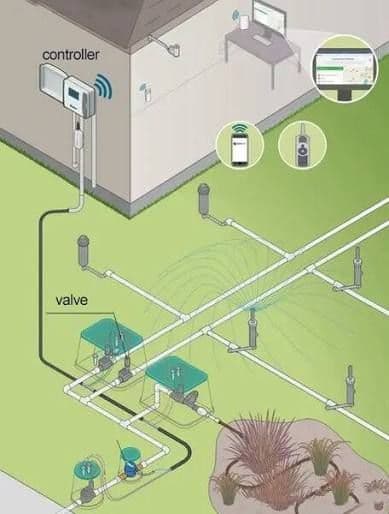
Zones should be drawn by what the plants need and what the ground does, not by what was closest to the valve when the system went in. Lawn wants relatively frequent watering across an area; established trees want infrequent deep watering out at the root zone; beds want something different again. Serving them from one zone guarantees at least one is wrong all season.
Head type matters as much as zone boundaries. Spray heads apply water considerably faster than rotors covering the same ground, so mixing the two on a zone means any run time is wrong for one of them; this is one of the most common faults we find on systems that were extended over time. Sun exposure and slope split zones further, and on a slope the answer is cycle-and-soak scheduling: several shorter runs with gaps, so water is absorbed rather than running downhill.
On scheduling itself, deep and infrequent beats short and daily. Daily cycles keep moisture in the top inch of soil, which produces shallow roots and a lawn that browns as soon as the schedule slips. Early morning is the right window, least wind, so water lands where the head aimed it, and far lower evaporation than midday. Missoula publishes water conservation guidance and in some years seasonal restrictions, so check what currently applies and we will program around it.
The seasonal cycle we run systems on
Spring startup is more than opening a valve. Lines are charged gradually, because hitting a dry system with full pressure can damage components, and then every zone is run in turn to find what winter did, cracked heads and laterals, valves that will not seat, and wire faults that developed underground. It is also when coverage is corrected, since heads sink below grade and get knocked out of alignment by mowing and foot traffic across a season.
Mid-season is when the system should be watched rather than assumed. Dry arcs, soggy patches, misting heads, and a water bill that climbs without a schedule change are all early signals, and all of them are cheaper to address in June than to explain in August.
Fall winterization closes the year. Compressed air is pushed through each zone until the heads run dry, at the correct pressure for the pipe material, then the backflow assembly is drained and isolated and the controller shut down. Gravity draining is not equivalent unless a system was built with manual drains at every low point, and most were not.
Good to know
Irrigation Systems questions
Common questions about our irrigation systems in Missoula and the Bitterroot Valley.
We start with a property and water-pressure assessment, then design a custom zone layout matching your lawn's sun, shade, and plant zones. Different areas get different heads and run times, think of it like wiring a house, but for water instead of electricity.
Your lawn's water pressure can only push a limited number of heads at once, and a sunny front yard needs different watering than a shaded flowerbed. Zones are like separate circuits; each one gets exactly the water its plants need.
Yard size, number of zones, soil type (rocky Bitterroot soil takes longer to trench), water source, and whether it's new construction or a retrofit all matter. HJ Property Care provides a detailed breakdown after assessing your property firsthand.
Schedule a spring startup inspection before heavy watering season and a fall blowout before freezing temperatures. Mid-season warning signs (dry patches, geysers, low pressure, or a spiking water bill) mean something's cracked, clogged, or misaligned underground.
In Montana, an untouched system can crack when water freezes and expands inside the lines. The fix is a fall "blowout"; we push compressed air through each zone to clear every line, valve, and head before the first hard freeze. Schedule it in early fall, and a spring startup the following season, to protect your investment year after year.
Specific jobs
Irrigation Systems: specialist services
Read before you hire
Irrigation Systems guides
Written by our own crew: the questions Montana property owners ask us most.
Local coverage
Irrigation Systems in your area
We run crews across Missoula and the Bitterroot Valley. See what irrigation systems looks like in your town.
More from HJ Property Care
Explore our other services
Ready to transform your outdoor space?
Get a free, no-obligation estimate within 48 hours. Locally owned and ISA-certified.