
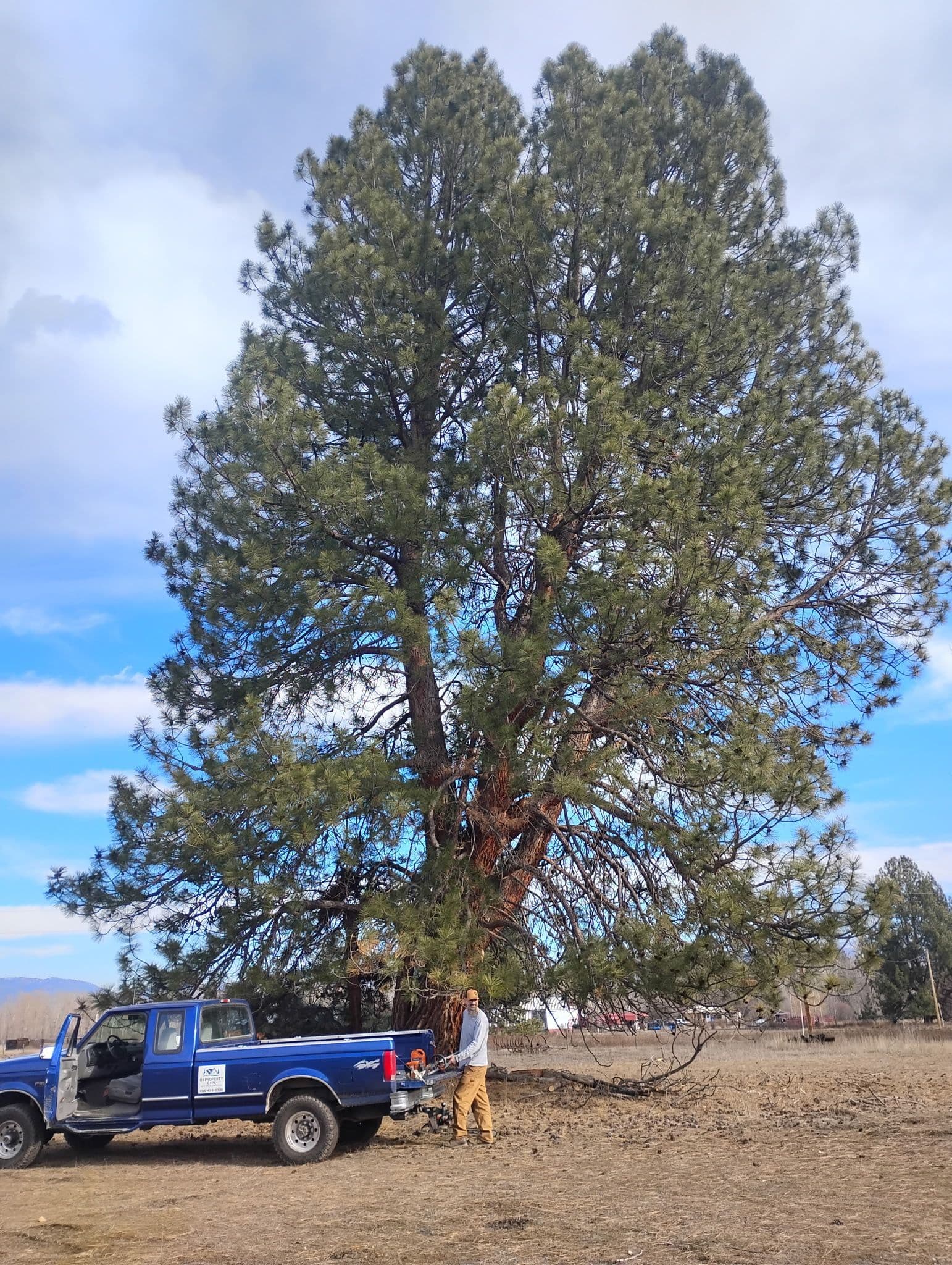
Signs a Tree Is About to Fail – and When It Is a Real Emergency
Most trees that come down give warning first. The difficulty for a homeowner is that the warnings look ordinary: a lean that has always been there, a crack you assumed was bark, mushrooms you took for garden decoration. This guide sorts the signs that mean call today from the ones that can wait for a scheduled visit.
What does tree failure actually look like before it happens?
Failure is rarely instant. A tree loses structural capacity over months or years while it still looks green and healthy from the street, because foliage is powered by a thin layer of living tissue just under the bark, and that layer can keep working long after the wood inside it has started to break down. This is why a fully leafed-out tree can still drop a major limb in a summer thunderstorm.
What an arborist is really reading is the relationship between three things: how much sound wood is holding the tree up, how much load the tree catches in wind and snow, and what sits underneath it. A hollow trunk in the middle of an open field is a curiosity. The same hollow trunk leaning over a bedroom is a problem. Risk is always a combination of likelihood and target.
Which warning signs mean call today, not next month?
Treat these as same-day: a tree that has shifted position recently, soil heaving or cracking on one side of the base, a limb that has broken but is still hanging in the canopy, a split where two main stems meet, or any tree in contact with a power line. A hanging limb in particular has no predictable timeline; it can sit for a week and come down in a light breeze, and it is directly over wherever it happens to be.
Fresh soil movement is the one homeowners most often miss. When the root plate starts to lift, you sometimes see a low crescent-shaped ridge of soil or cracked turf on the side opposite the lean. That means the anchoring roots are already tearing, and the tree is being held up by whatever is left.
Is a leaning tree always dangerous?
No, and this is the most common false alarm. Many western Montana trees have leaned their whole lives, growing toward light at a stand edge or away from prevailing wind. A tree that grew into its lean usually shows corrective growth, extra wood laid down on the compression side, and a trunk that curves so the crown is more or less upright above the base.
A tree that has recently started leaning looks different. The lean is straight rather than curved, the crown points off at the same angle as the trunk, and the ground at the base shows disturbance. If you have photographs of the yard from previous years, comparing them is genuinely useful evidence.
What do cracks in the trunk or a major limb tell you?
Vertical cracks that run deep into the wood are a structural finding, not a cosmetic one; they mean the trunk is no longer acting as a single solid column. Cracks matter most where two stems of similar size join, because that junction may contain included bark, where bark has grown into the union instead of wood knitting together. Included bark unions are the classic failure point in storm work.
A useful field distinction: shallow surface fissures in the outer bark are normal for many mature species and vary hugely between them. A crack you can slide a coin into, that runs with the grain and continues for a meter or more, is a different matter and is worth an assessment through our tree health and risk assessment service.
Why do mushrooms at the base matter so much?
Fungal fruiting bodies at the root collar or on the lower trunk usually mean decay is already well advanced inside. The mushroom is the reproductive structure; the organism itself has been consuming wood for some time before it appears. Shelf or bracket fungi attached directly to the trunk are the ones that most concern an arborist, because they indicate decay in the structural wood rather than in the surrounding soil.
Mushrooms in the lawn nearby are not the same thing; plenty of soil fungi are harmless or beneficial. The distinction is whether the fruiting body is growing out of the tree itself or out of the ground near it, so note exactly where it is attached before you call.
What should you do the moment a tree comes down on a power line?
Stay away and call 911 and the utility. Do not approach the tree, do not move branches, and do not attempt to clear anything, even if the line looks dead. Energised lines can charge the ground around them, so the hazard extends well beyond what you can see, and a downed conductor can re-energise without warning when a system attempts to restore itself.
This is a legal and safety boundary, not a preference. Line-clearance work near energised conductors requires specific qualification, and our crews will not work inside that space until the utility has confirmed the line is de-energised. Everything on our emergency tree and storm response page starts after that clearance.
What can safely wait for a scheduled assessment?
Deadwood high in the canopy with nothing valuable underneath, minor dieback at branch tips, sparse leaf cover compared with previous years, small trunk wounds that are closing over, and surface roots appearing in the lawn are all worth looking at, but they are planning items, not emergencies. So is a tree that is simply too close to the house but structurally sound.
Booking these in a normal appointment rather than an after-hours call is also the cheaper path, because emergency work carries the cost of mobilising a crew outside scheduled hours.
How does an arborist decide between pruning and removal?
The question is whether the defect can be engineered around. A single overextended limb over a driveway can often be reduced, shifting load back toward the trunk and away from the target. Decay confined to one stem of a multi-stem tree may be removable. Support systems can sometimes hold a valuable tree that would otherwise be taken down.
Removal becomes the answer when the defect is in the main stem or the root plate, because there is no way to reduce load on the part of the tree that holds up everything else. A credential matters here; an ISA Certified Arborist is trained in exactly this judgement, and the City of Missoula publishes a list of local certified arborists you can check anyone against.
What happens after a storm in Missoula?
For trees on your own property, the assessment is yours to arrange. For a boulevard tree (the strip between the sidewalk and the curb) the tree is city property, and Missoula runs a street tree debris removal request specifically for storm-damaged boulevard trees. Reporting it there is the correct first step rather than hiring anyone yourself. Our guide to tree permits and the public right-of-way covers where that line falls.
If you are unsure which category a tree falls into, or you want a professional read on something that has started to worry you, we would rather look at it early. Call HJ Property Care & Tree Service at (406) 215-7319 or request an estimate and we will walk the property with you.
Need help?
HJ Property Care & Tree Service is locally owned and ISA-certified. Call for a free estimate.
Explore our tree services.
Sources
We cite primary sources: Montana State University Extension, the City of Missoula, and the ISA, so you can verify anything here yourself.
- What an ISA Certified Arborist credential covers (International Society of Arboriculture). Last checked August 20, 2026.
- Local Certified Arborists List (City of Missoula). Last checked August 20, 2026.
- Street tree debris removal request for storm-damaged boulevard trees (City of Missoula). Last checked August 20, 2026.
Ready to transform your outdoor space?
Get a free, no-obligation estimate within 48 hours. Locally owned and ISA-certified.