
For HOAs, business parks & property managers
Commercial landscaping & grounds maintenance in Missoula
Year-round commercial grounds maintenance for HOAs, business parks, and property managers across Missoula and the Bitterroot Valley, MT.
- Licensed & insured
- ISA-certified
- Free 48-hour estimates
Commercial Landscaping & Grounds Maintenance
For HOAs, business parks & property managers
A commercial property is judged on a different standard from a back yard. The turf is the first thing a tenant, a customer, or a prospective buyer sees, and a walkway that has heaved or a shrub that has grown across a doorway stops being an appearance question and becomes a liability one. What a property manager actually needs is rarely a crew that turns up when the grass looks long; it is a defined scope, a schedule that can be planned around, and one person to call when something changes.
HJ Property Care & Tree Service LLC already runs commercial accounts through the winter, plowing and managing ice on lots, drives, and walkways on seasonal contracts with agreed trigger depths and priority sequencing. Grounds maintenance is that same discipline applied to the other three seasons: scope settled before the season starts, a visit pattern you can budget against, and a crew that already knows where your irrigation heads and drain grates are because they marked them last fall.
We take commercial work across Missoula and the Bitterroot Valley (Florence, Lolo, Stevensville, Hamilton, and the towns between) and we perform it ourselves rather than coordinating separate trades, which is why accountability never turns into a conversation between vendors.
Ask us to walk your property and scope the season.
Request ServiceWhat a grounds maintenance account covers
Scope is agreed up front and written down, so both sides know what happens and when:
- Recurring mowing, trimming, and edging on an agreed schedule
- Spring startup and fall cleanup, including leaf and debris removal
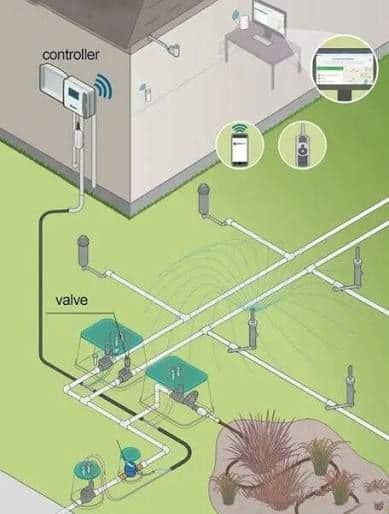
- Irrigation startup, in-season repairs, and fall blowout
- Licensed fertilizer, weed, and pest applications by a certified applicator
- Core aeration and overseeding where the turf needs it
- Tree and shrub pruning and risk assessment by an ISA Certified Arborist
- Bed maintenance, mulch refreshes, and edge definition
- Snow plowing and ice management on the same account through winter
What a commercial scope should settle before the season starts
The difference between a residential job and a commercial account is that the account is a schedule rather than an event, and most of what goes wrong later traces back to something nobody agreed at the start. Visit frequency is the first item, and one number for the whole season is usually the wrong shape, turf in western Montana grows at very different rates in late May and mid-August, so a fixed cadence either over-services the property in the heat or lets it get away from you in the flush.
The second is the standard being maintained rather than the list of tasks performed. Cut height, how crisply bed lines are held, how quickly clippings and debris come off hard surfaces; that is what someone walking the property actually notices, and it is what a scope should describe. A task list can be completed in full on a property that still looks neglected.
Then the exceptions and the practicalities. What triggers a visit outside the schedule, who authorises it, and how it gets reported afterwards; storm debris, a failed zone flooding a bed, or a limb across a walkway are not schedule items, and the time to agree how they are handled is before one happens. The same goes for the practicalities that quietly slow a crew down: gate codes, the hours equipment can run without disrupting tenants, and who receives our report.
The maintenance items that become liability on shared property
On a private lot an overgrown shrub is an appearance problem. On a property the public parks on and walks across, several ordinary maintenance items carry a consequence that has nothing to do with how the place looks. Planting that has filled in near an exit obscures a driver's view of traffic. Roots lift slabs and pavers settle into an edge that catches a toe. Growth crowds a ramp handrail, so a route that is nominally open becomes hard to use with a wheelchair or a walker. All of it develops slowly enough that the people who see the property daily stop registering the change.
Irrigation deserves specific attention because its failure mode changes with the season. A head throwing spray across a sidewalk is a nuisance in July and a sheet of ice in October and April, when overnight temperatures cross freezing but nobody is plowing yet. Adjusting overspray away from hard surfaces is a routine task with a real safety consequence attached, and it is one of the most commonly skipped.
Trees are where the commercial setting changes the arithmetic outright. Risk is the combination of how likely a tree is to fail and what sits beneath it, so the same defect means something different over an empty field than over an occupied parking row or the walkway to an entrance. On a commercial property that target is occupied almost continuously, which is why assessment is worth doing deliberately rather than after a storm. Justin Johnson holds ISA Certified Arborist credential RM-8889A along with line-clearance qualification, and a record of what was inspected and when is worth keeping for the property file.
Why the seasons work better as one account than four
Commercial properties commonly end up with a mowing contractor, an irrigation contractor, a tree company, and a plow operator, each competent, none of them talking to the others. The failures tend not to happen inside any one of those scopes; they happen in the seams. Whoever winterises the irrigation knows where the heads, valve boxes, and drain grates are, and whoever plows in January is the one most likely to catch one under a blade. Same crew, and the marking done in fall gets read all winter; different companies, and it either never happens or means nothing to the person who needs it.
Accountability is the second seam. Damage that surfaces at spring startup (a sheared head, a gouged bed edge, a broken fence rail) is straightforward to resolve when one contractor covered the property all year, and becomes a dispute between vendors when four did. The shoulder seasons are the third and most underrated: the weeks too cold to mow and too early to plow are exactly when the final cleanup, the irrigation shutdown, the marking, and dormant-season pruning all need to happen, and under separate contracts those weeks belong to nobody.
None of this is an argument that a bundled account always beats four specialists on price per line item, and we would rather say so than pretend otherwise. It is an argument that the expensive failures on a commercial property tend to sit in the gaps between scopes, and that closing the gaps is usually worth more than optimizing each scope on its own.
Good to know
Commercial Landscaping & Grounds Maintenance questions
Common questions about our commercial landscaping & grounds maintenance in Missoula and the Bitterroot Valley.
Both. We already run commercial snow and ice accounts on seasonal contracts, and we take year-round grounds maintenance for commercial properties across Missoula and the Bitterroot Valley, HOAs, business parks, multi-family properties, churches, and similar.
Around an agreed scope for the season rather than a per-visit arrangement: visit frequency by season, the standard being maintained, what triggers work outside the schedule, and how findings get reported back to you. What that looks like depends on the property, which is why we walk it before quoting rather than applying a template.
Yes, and that is the arrangement we would suggest. One scope, one point of contact, and no gap in the shoulder weeks when the last cleanup and the first plow fall close together. It also means the crew clearing your lot in January already knows where the irrigation heads and bed edges are, because they marked them in the fall.
Yes. Applying fertilizer, herbicide, and pesticide commercially is regulated work that requires certification rather than just a spreader, and HJ is certified and licensed for it. On a commercial site that matters more than on a lawn, because applications happen near parking, walkways, and entrances people use the same day.
It is our own crew. Justin Johnson holds ISA Certified Arborist credential RM-8889A along with line-clearance qualification, which is also why we can take on work near energised conductors that many companies have to refuse.
There is no acreage threshold we apply. The practical constraints are access and scheduling: where equipment can get in, what hours it can run without disrupting tenants, and how the property fits alongside the routes we already run in that part of the valley. Call and we will walk it.
Yes. Managed properties usually add an approval step, a board or committee that signs off on scope, and sometimes on visible changes like plantings, fence work, or hardscape before installation. We are used to working to that rhythm, including providing the description of works a board needs in order to approve it.
Read before you hire
Commercial Landscaping & Grounds Maintenance guides
Written by our own crew: the questions Montana property owners ask us most.
Local coverage
Commercial Landscaping & Grounds Maintenance in your area
We run crews across Missoula and the Bitterroot Valley. See what commercial landscaping & grounds maintenance looks like in your town.
More from HJ Property Care
Explore our other services
Ready to transform your outdoor space?
Get a free, no-obligation estimate within 48 hours. Locally owned and ISA-certified.