
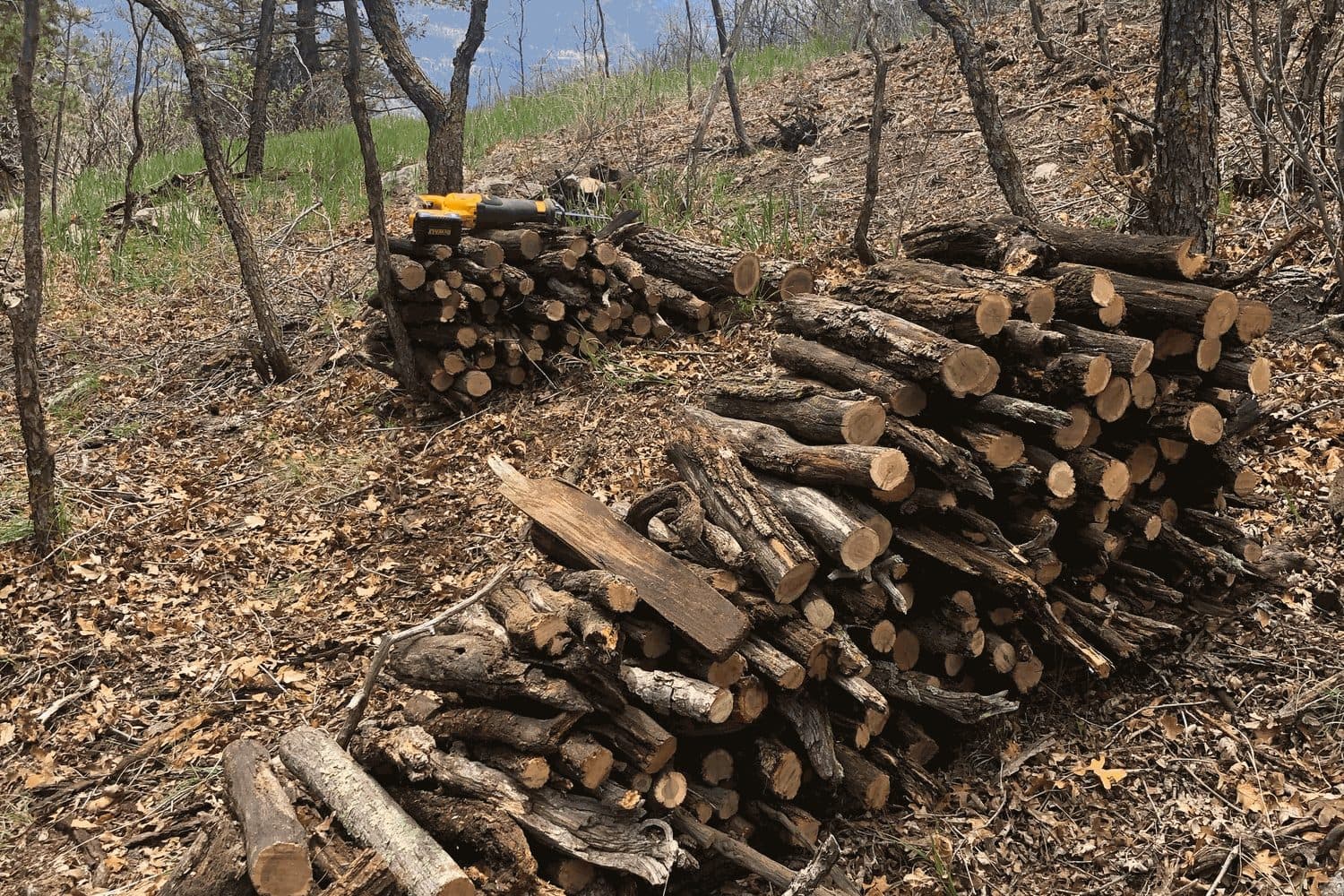
Reduce what a fire has to burn
Defensible space & fuel reduction in Missoula and the Bitterroot
Defensible space, ladder-fuel removal, and selective conifer thinning by ISA-certified arborists across Missoula and the Bitterroot Valley, MT.
- Licensed & insured
- ISA-certified
- Free 48-hour estimates
Fire Mitigation
Reduce what a fire has to burn
Fire mitigation is the work that reduces what a wildfire has to burn before it reaches a building: thinning crowded conifers, cutting the ladder fuels that carry a ground fire up into the canopy, pruning low limbs, and clearing needle litter and dead material off the ground and out of the roof. HJ Property Care & Tree Service LLC does this work across Missoula County and the Bitterroot Valley, where seven of our ten service areas sit in or against the wildland-urban interface and defensible space is part of ordinary maintenance rather than a special project.
Most of it is tree work, which is why it belongs with a crew qualified to do tree work. Justin Johnson holds ISA Certified Arborist credential RM-8889A along with line-clearance qualification, so selective thinning around a house, along a driveway, or near energized conductors is work we can take on rather than refuse. We plan fuel reduction alongside the landscape rather than against it: a property stripped bare is neither the goal nor what the evidence supports.
Book a defensible space walkthrough before the next fire season.
Request ServiceWhat's included in this service
Fuel reduction is planned from the structure outward, so the hours go where they reduce the most risk rather than where the trees are thickest:
- Ladder-fuel removal and crown separation
- Selective conifer thinning, not clear-cutting
- Low-limb pruning to ANSI A300 standards
- Needle litter, duff and dead-material clearing
- Roof, gutter and near-structure zone cleanup
- Slash chipped on site or hauled away
What fuel reduction removes, and what it deliberately leaves
The target is continuity, not vegetation. Fire spreads where fuel is continuous, so the work breaks that continuity in two directions: vertically, by removing the low branches and understory growth that let a ground fire climb into the crowns, and horizontally, by opening enough space between crowns that fire cannot move directly from one canopy to the next. The spacing that achieves this has to widen on a slope, because fire moves faster uphill.
On a densely stocked lot that means selective thinning rather than clearing. The trees that stay are the healthiest and best placed; the ones that come out are crowded, suppressed, defective, or growing where they close a gap that needs to stay open. That is a judgment made tree by tree on the ground, which is why the walkthrough matters more than the quote.
The highest return per hour is not out in the trees at all. It is the first few feet against the building, where embers land and where most structures are actually lost: no bark mulch against the siding, no firewood stacked on the deck or against a wall, nothing dense under the windows, nothing stored under the deck, and needles cleared out of gutters and roof valleys. We treat that zone as the first job rather than the last one.
Thinning is tree work, and that is where the credential matters
Fuel reduction done badly leaves a property worse off than it started. Topping, which is cutting main stems back to stubs to bring a tree's height down, is not pruning and we do not do it: it forces dense regrowth that is weakly attached at the cut and leaves large wounds that decay inward, so a topped tree is more hazardous a decade later and no less flammable. Limbing up is bounded by the same standard as any other pruning, ANSI A300, because a conifer stripped too far up the stem is a stressed conifer and stress is what invites bark beetle.
Wooded lots in the wildland-urban interface also tend to have power lines running through them, and the trees closest to those conductors are frequently the ones a fuel-reduction plan wants thinned. Work near energized conductors requires specific qualification and specific approach distances, and our crew carries that certification. It is one of the reasons we can take on utility-adjacent fuel work that a general crew has to decline and leave for someone else.
What Montana actually requires, and what it does not
There is no statewide defensible space mandate in Montana. Nobody is going to cite you for an unthinned lot. Where obligations do exist they are local and specific: a fire district's own requirements, county zoning, and the wildland-urban interface construction code, which applies to new building and additions in areas a local jurisdiction has designated rather than to existing landscaping. Increasingly the pressure comes from a property insurer's inspection instead of a code at all.
So the honest reason to do this work is risk and insurability, not compliance, and any contractor telling you the state requires it is selling you something. What is worth knowing is that free assessment is available before you spend anything with us. The Missoula Fire Department provides free defensible space consultations in the Missoula wildland-urban interface, reachable on 406-552-6210 during business hours, and Montana DNRC offers a free wildfire risk assessment for property owners.
We are not a substitute for either of those, and we will say so on the phone. An assessment tells you what your property needs and puts it in a priority order; our job is doing the work it points at, on the properties where the owner would rather not do it themselves. Coming to us with an assessment in hand usually makes the estimate faster and the scope tighter.
When the work should happen
Autumn through early spring is the working window, and autumn is usually the best of it. The ground is firm enough for equipment, the bird nesting season is over, and the work is finished well before the following summer rather than during it. Spring fuel reduction has to account for active nests in the material being cut, which can stop a job partway through.
The one season to avoid is the one that prompts the phone call. Cutting in hot, dry, windy conditions carries a genuine ignition risk from the equipment itself, and during fire season the work is constrained by the same conditions it is meant to protect against. Fuel reduction is preparation, so it has to be booked ahead of the season rather than into it.
What happens to everything that comes down
Slash left where it falls is simply the fuel you have just created, lying at ground level in the zone you were trying to clear, and a job that stops at the cutting is half a job. Material is chipped on site or hauled away as part of the work rather than quoted separately after the fact.
Chip has a use, but not everywhere. Spread away from the building it is ordinary mulch; banked against siding or laid through the first few feet around the structure it puts a continuous bed of fine fuel exactly where the near-structure zone is supposed to have none. Where chip stays on the property we place it accordingly. Piles held back for burning later are their own hazard in the meantime, and open burning is separately regulated and seasonal in Montana, so we plan disposal into the job rather than leaving it to the owner to resolve.
Good to know
Fire Mitigation questions
Common questions about our fire mitigation in Missoula and the Bitterroot Valley.
No, and clearing everything usually makes a property worse in other ways without making it meaningfully safer. Well-spaced, healthy, pruned trees slow wind-driven embers and shade the ground so surrounding vegetation dries out more slowly. The work is selective: thin the crowded, suppressed and defective trees, keep the best-placed ones, break the vertical and horizontal continuity between them, and do the near-structure zone properly.
There is no statewide requirement. Obligations, where they exist, come from your local fire district, county zoning, or the wildland-urban interface construction code, which governs new building and additions in designated areas rather than existing landscaping. Many owners are prompted by a property insurer's inspection rather than by any code. We will not tell you the state requires this work, because it does not.
If you can, yes, and it costs nothing. The Missoula Fire Department offers free defensible space consultations in the Missoula wildland-urban interface on 406-552-6210, and Montana DNRC provides a free wildfire risk assessment. An assessment tells you what your property needs and in what order; we do the work it recommends. Arriving with one usually makes our estimate faster and the scope tighter.
It should not. Thinning to give the best trees room, pruning low limbs, and replacing flammable plantings close to the house with irrigated, low-growing, well-spaced ones changes how fire behaves without stripping the place. Done with the design in mind the result usually looks better than the crowded starting condition, because the trees worth keeping finally become visible.
Autumn is usually ideal: firm ground, nesting season over, and the work finished before the following summer. Winter and early spring both work. The season to avoid is high summer, when cutting in hot, dry, windy conditions carries a real ignition risk from the equipment and the work is restricted by the same conditions it is meant to protect against.
Yes. Work near energized conductors requires specific qualification and specific approach distances, and our crew carries that certification, which is why we can take on utility-adjacent work that many companies have to refuse. On wooded lots in the interface the trees nearest the lines are often exactly the ones a fuel-reduction plan needs thinned.
They are chipped on site or hauled away as part of the job. Slash left lying is the fuel you just created, sitting in the zone you were clearing. Where chip stays on the property we place it away from the building rather than through the first few feet around it, because a continuous bed of fine fuel against the siding defeats the point.
All ten of our service areas: Missoula, Lolo and Clinton on the Missoula side, and Florence, Stevensville, Victor, Corvallis, Hamilton and Darby through the Bitterroot Valley. The southern end of the valley sits closest to forested ground and carries the most conifer work, and properties on the west bench are in the interface throughout.
Read before you hire
Fire Mitigation guides
Written by our own crew: the questions Montana property owners ask us most.
More from HJ Property Care
Explore our other services


Ready to transform your outdoor space?
Get a free, no-obligation estimate within 48 hours. Locally owned and ISA-certified.