
ISA Certified Arborist RM-8889A
Tree health & risk assessment in western Montana
ISA Certified Arborist tree health and risk assessment across Missoula and the Bitterroot Valley. Find out if a tree is hazardous or treatable.
- Licensed & insured
- ISA-certified
- Free 48-hour estimates
Tree Health & Risk Assessment
ISA Certified Arborist RM-8889A
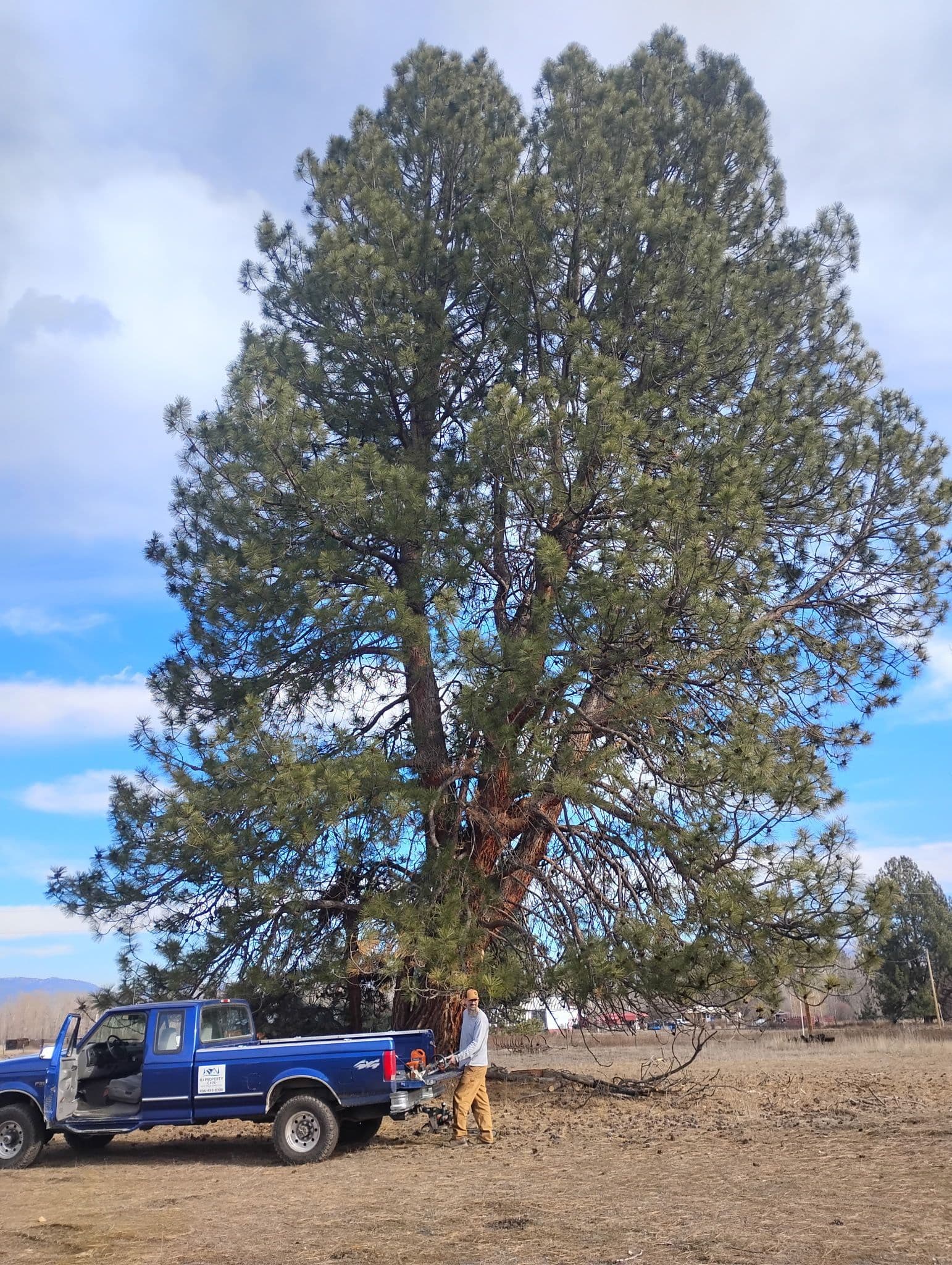
Not every worrying tree needs to come down, and not every healthy-looking tree is safe. The difference is not something you can reliably judge from the ground without training, which is why removal decisions are so often made on a guess, and why mature trees that could have been kept get taken out every year.
An assessment is a structured inspection by an ISA Certified Arborist. Justin Johnson holds ISA certification RM-8889A along with line-clearance qualification, and the assessment looks at the whole tree and its setting: species and age, crown condition and dieback, trunk and root-collar defects, decay and cavities, included bark and weak unions, lean and any recent change in it, root-zone disturbance from construction or grading, soil and drainage, signs of pest or disease pressure, and what sits within falling distance.
What you get is a plain-language verdict: whether the tree presents a real risk, what specifically is driving that risk, whether it can be reduced by pruning or cabling or by changing what happens around the root zone, and what the realistic outlook is. Sometimes that means recommending removal. Often it means the tree is fine, or it is treatable, and you now have a reason rather than an uneasy feeling.
Get an ISA-certified opinion before you remove a tree.
Request ServiceWhat an assessment covers
A structured inspection of the tree and the site around it:
- Species identification, age class, and expected structure
- Crown condition: dieback, deadwood, thinning, and canopy balance
- Trunk and root-collar inspection for decay, cavities, and wounds
- Structural defects: included bark, weak unions, co-dominant stems
- Lean assessment, including whether it is established or recent
- Root-zone condition and any construction, grading, or compaction damage
- Pest and disease indicators, including bark beetle pressure
- Target assessment: what the tree would hit, and how often people are there
- A clear recommendation: monitor, prune, treat, or remove
Good to know
Tree Health & Risk Assessment questions
Common questions about our tree health & risk assessment in Missoula and the Bitterroot Valley.
It is a professional credential from the International Society of Arboriculture, earned by examination across tree biology, diagnosis, pruning standards, safety, and risk assessment, and maintained through continuing education. It is a certification rather than a state license; the two are different things, and a contractor being licensed and insured does not mean anyone on the crew is a certified arborist. Justin Johnson holds ISA certification RM-8889A.
Risk is a combination of two things: how likely the tree is to fail, and what it would hit if it did. A hollow tree in an open field is a low risk; a smaller tree with a weak union directly over a driveway may be a higher one. Warning signs worth an inspection include mushrooms or conks at the base, a crack or seam in the trunk, a lean that has changed recently, soil lifting on one side of the root plate, large deadwood in the crown, and dieback that is getting worse year over year.
Often, yes. A tree that has grown at an angle its whole life and has adapted its wood accordingly is very different from a tree that has started leaning recently. The recent lean is the concerning one, particularly with heaving or cracked soil on the uphill side, which suggests the root plate is moving. That distinction is a central part of what an assessment establishes.
No. The whole point of the assessment is to make that call on evidence. Where risk can be brought down to an acceptable level by pruning, reducing end weight, cabling, or changing what is happening in the root zone, we will say so. Where the tree genuinely needs to come out, we will explain exactly what is driving that.
Yes, and it is worth doing. A tree that survived a storm intact can still have hidden damage (cracked unions, a partially failed root plate, torn branch attachments) that makes it likelier to fail in the next event. If a tree is in immediate danger of falling, or anything is contacting a power line, treat it as an emergency and see our emergency page first.
Read before you hire
Tree Health & Risk Assessment guides
Written by our own crew: the questions Montana property owners ask us most.
Local coverage
Tree Health & Risk Assessment in your area
We run crews across Missoula and the Bitterroot Valley. See what tree health & risk assessment looks like in your town.
More from HJ Property Care
Explore our other services
Ready to transform your outdoor space?
Get a free, no-obligation estimate within 48 hours. Locally owned and ISA-certified.