
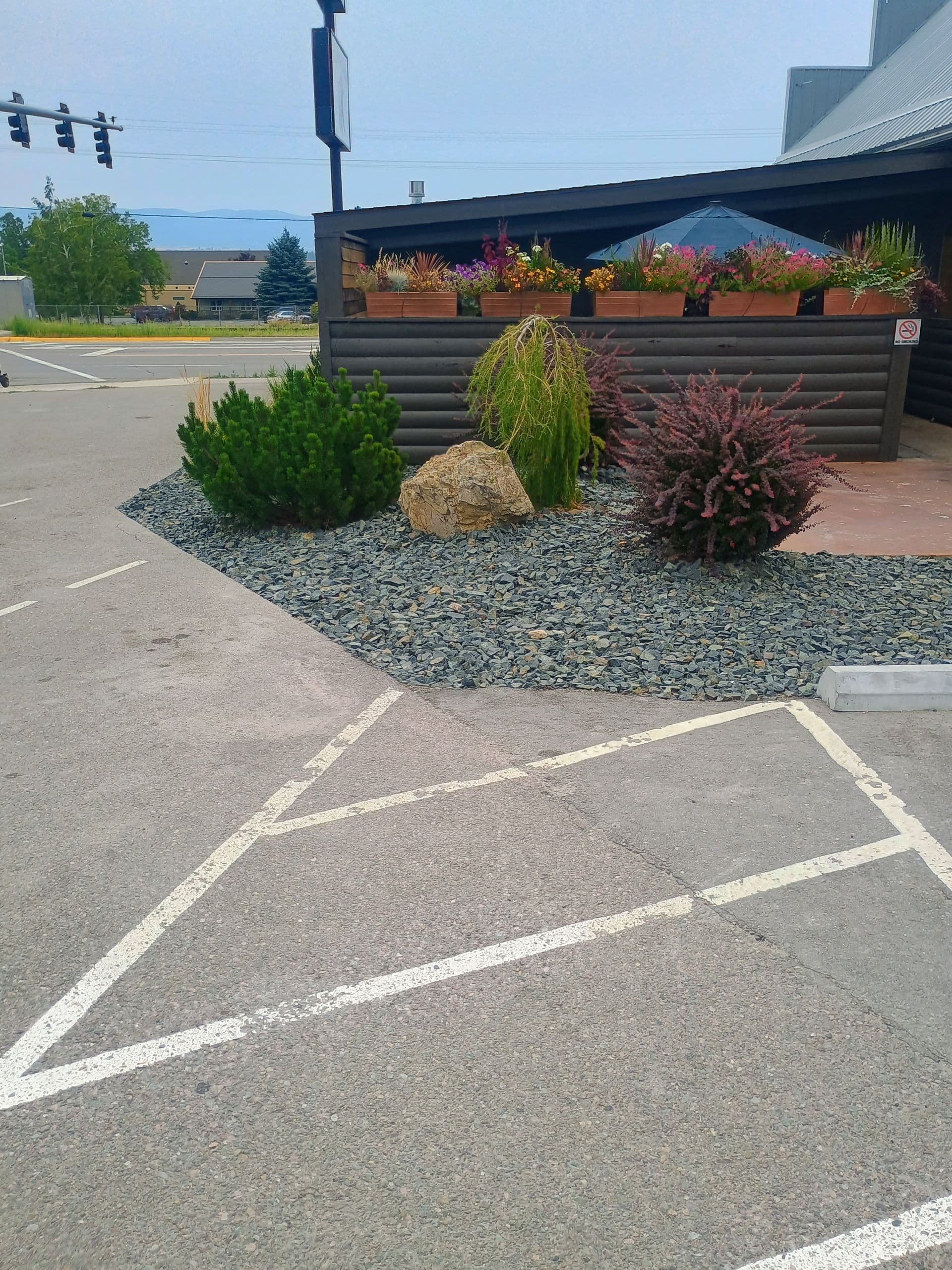
Low-Maintenance Landscaping That Holds Up in Montana
Reviewed by Adam Hurlbert, Owner & Founder, 15+ years in landscape & property care
Most people asking for a low-maintenance yard are really asking for fewer weekends spent mowing, weeding, hand-watering and cutting back plants that outgrew their spot. In western Montana there is a second goal: a yard that still looks deliberate after a dry August and a long winter. No yard is maintenance free, but a lot of the work in a typical landscape is created by the design itself. This guide goes through where that work comes from and what to change, drawing on Montana State University Extension and USDA NRCS guidance.
Where does yard maintenance actually come from?
In most Missoula and Bitterroot yards the hours go to five things: mowing and watering turf, pulling weeds out of bare or thinly mulched ground, pruning shrubs that are too big for their space, fixing irrigation that waters the wrong places, and fall and spring cleanup. Each of those has a design cause. Turf placed where nobody walks still needs mowing. Bare soil between young plants grows weeds. A shrub planted by its nursery size gets sheared every year for the rest of its life.
The NRCS booklet Creating Native Landscapes in the Northern Great Plains and Rocky Mountains cites an American Water Works Association estimate that 85 percent of all landscape problems are caused by overwatering. That is a useful reminder that a lot of maintenance is caused by the irrigation, not by the plants. This guide is part of our Montana Landscaping, Lawn & Irrigation Guide.
Is less lawn always lower maintenance?
Less irrigated, mowed lawn usually is, as long as what replaces it is planned. MSU Extension's xeriscaping article recommends keeping irrigated turf to functional, heavily used areas and avoiding it in full shade, narrow strips, poor soils and steep slopes, which are the places where lawn is hardest to keep and gives the least back. Those strips and slopes are where many yards lose the most time.
Replacing turf with gravel and weed fabric is not low maintenance in the long run. MSU notes that plastic, sheet mulches and weed fabrics are not recommended in permanent plantings, and rock mulch reflects heat onto plants. Windblown soil settles into the rock, weeds root on top of the fabric, and the bed becomes harder to weed than the lawn was. A planted bed with organic mulch, or a low groundcover, is usually easier. See replacing some lawn with native plants for the conversion steps.
What can replace lawn without adding work?
Low groundcovers and native grasses, chosen for the site. MSU Extension's xeriscaping article names creeping juniper, bearberry (kinnikinnick) and creeping thyme as groundcover alternatives to turf that need much less water; keep the juniper well away from the house in fire country, because MSU's fire-resistant plants MontGuide calls junipers highly flammable. For areas that still need to be walked on, the NRCS booklet Creating Native Landscapes rates blue grama and buffalograss as short, infrequently mowed warm-season grasses, with the trade-off of late spring green-up, and lists sheep and hard fescue as fine-leaved, drought tolerant choices.
Whatever replaces the lawn, the first two seasons are the work: weeding until it fills in and watering to establish. After that the mower stays in the shed far more often. See Kentucky bluegrass, fescue or a blend for the turf you keep.
What makes a plant low maintenance in Montana?
Four things: it is hardy here, it fits the space at mature size, it suits the water it will get, and it does not need regular spraying or staking. MSU's deer damage MontGuide offers a rule of thumb for hardiness, suggesting perennial species adapted to Zones 4 and 5 for western Montana gardens. The 2025 MSU MontGuide on native plants says natives have cold and drought hardiness and are adapted to local soils and growing seasons, which is why they feature in most low-input designs.
Some plants create work by design. MSU's perennials MontGuide flags tall plants and those with heavy blooms as likely to need staking in wind, plants that self-sow and can become intrusive unless deadheaded, and several groundcovers it marks as potentially invasive. Choosing compact, upright, clump-forming species avoids most of that. Our guides to shrubs, perennials and ornamental grasses note which choices are low input.
How much space should plants get?
Their mature size, measured at planting time. MSU's perennials MontGuide says to space plants according to their mature size unless you plan to move or divide them sooner. NRCS figures show why it matters for shrubs: chokecherry can reach 10 to 15 feet and sucker to an 8 foot spread, Woods rose suckers to a 4 to 10 foot spread, and serviceberry ranges from 2 to 16 feet with a spread up to 10 feet. Planted three feet from a walk, any of those becomes an annual pruning job.
A newly planted bed at the right spacing looks sparse for two or three seasons. Mulch and a few short-lived fillers cover the gap without committing you to overcrowding later.
Does mulch reduce maintenance?
It is the biggest single labor saver in planted beds. MSU's perennials MontGuide recommends a 4 to 6 inch layer of organic mulch to conserve moisture, impede weeds and add nutrients, and notes that mulch insulates plants in winter against warm spells that break dormancy and against frost heave. MSU's xeriscaping article recommends arborist wood chips at about 4 inches around beds.
Two cautions. Mulch also suppresses desirable self-sowers, and in fire country MSU's fire-resistant plants MontGuide warns that embers can ignite bark mulch near a house. Keep wood mulch out of the first five feet of a building and use rock or bare soil there; our guide on mulch and wildfire covers the options. Mulch needs topping up every year or two as it breaks down.
What irrigation setup is lowest maintenance?
Drip in beds, spray or rotors only on turf, and a controller that adjusts itself. MSU Extension recommends drip, soaker hoses or bubblers over overhead spray, rain sensors on automatic systems, and grouping plants by water need. The MSU water management MontGuide says soaker hoses can reduce water use by 60 percent or more and that drip and micro-spray suit areas that dry out fast, such as foundation and border plantings along walks and drives.
A properly zoned system mostly runs itself after spring startup and fall blowout. A badly zoned one creates dry spots, soggy spots and a homeowner standing with a hose. See drip irrigation for Montana beds, smart irrigation controllers and our sprinkler repair service.
How do edges and hardscape cut work?
Clean edges stop grass creeping into beds and give the mower a path. A mowing strip of pavers or a solid edging along each bed means the trimmer comes out less often. Paths of stone, pavers or compacted gravel where people actually walk prevent worn turf and muddy shortcuts. Our guide to landscape edging options compares materials, and walkway materials covers which surfaces survive freeze and thaw.
Hardscape is not maintenance free either. Pavers need joint sand topped up and the occasional reset, and gravel needs raking and weeding. But it is predictable work rather than weekly work. Our hardscaping service builds these on bases designed for frost.
How do you keep weeds down without spraying everything?
Start clean and keep ground covered. The NRCS pollinator guide notes that most native plants do not compete well with weeds and recommends starting with a weed-free area and keeping weeds to a minimum for the first two to three years. After that, a dense, mulched planting shades out most seedlings. Pulling small weeds monthly is far less work than fighting a seeded crop in August.
Noxious weeds are a legal duty, not a preference. Montana law makes it unlawful for any person to permit a noxious weed to propagate or go to seed on their land, unless they follow their weed district's program or a management agreement. Spotted knapweed, Canada thistle, houndstongue and leafy spurge are all on the state list. We handle spot treatment through our licensed fertilizer and weed control service.
What maintenance is still left in a low-maintenance yard?
A short, predictable list. Spring: a cleanup, cutting back last year's perennial stems, checking the irrigation, topping up mulch. Summer: occasional weeding and a look at drip emitters. Fall: cutting back what you do not want to leave standing (MSU suggests 2 to 4 inches above the ground for most perennials), leaves off the lawn, and the sprinkler blowout before hard freezes. Every three to five years, MSU says many perennials need dividing as they lose vigor.
New plantings are the exception. The 2025 native plant MontGuide warns that newly planted natives still need regular water until established, which can take a growing season or longer for trees and shrubs. Our Montana landscape maintenance calendar lays out the year month by month.
Can a low-maintenance yard still look good?
Yes, and it usually looks better in August than a high-input yard does. Structure carries it: a few well-placed shrubs and evergreens, grasses that hold their form into winter, perennials in drifts rather than one of everything, and clear edges. Pick a limited palette and repeat it.
The xeriscaping guide covers the water side of the same idea, and our front yard ideas apply it to the part of the property the street sees.
Can HJ build or convert a yard for low maintenance?
Yes. Our landscaping design work includes planting, sod, mulch, xeriscaping and irrigation, and we offer lawn care and seasonal cleanups for the maintenance that remains. We can rework a whole yard or just the parts that cost you the most time.
Call HJ Property Care & Tree Service at (406) 215-7319 or request a free estimate and we will walk the property with you.
Need help?
HJ Property Care & Tree Service is locally owned and ISA-certified. Call for a free estimate.
This article is part of the Montana Landscaping, Lawn & Irrigation Guide, our complete guide for western Montana property owners.
Explore our landscaping & design.
Sources
We cite primary sources: Montana State University Extension, the City of Missoula, and the ISA, so you can verify anything here yourself.
- Xeriscaping and Other Thoughtful Landscaping Practices to Conserve Water (Lives and Landscapes, Fall 2022) (Montana State University Extension). Last checked November 2, 2026.
- Perennials & Biennials for Montana Gardens, MontGuide MT199903AG (revised January 2019) (Montana State University Extension). Last checked November 2, 2026.
- Native Plants for Montana's Home Gardens, MontGuide MT202503AG (new August 2025) (Montana State University Extension). Last checked November 2, 2026.
- Minimizing Deer Damage in Residential Settings, MontGuide MT202308AG (Montana State University Extension). Last checked November 2, 2026.
- Yard and Garden Water Management, MontGuide MT198915AG (revised July 2020) (Montana State University Extension). Last checked November 2, 2026.
- Fire-Resistant Plants for Montana Landscapes, MontGuide MT200101AG (revised April 2022) (Montana State University Extension). Last checked November 2, 2026.
- Creating Native Landscapes in the Northern Great Plains and Rocky Mountains (USDA Natural Resources Conservation Service, Plant Materials Program). Last checked November 2, 2026.
- Montana Native Plants for Pollinator-Friendly Plantings (March 2012) (USDA Natural Resources Conservation Service). Last checked November 2, 2026.
- Montana Noxious Weed List (effective June 21, 2019) and County Weed Control statutes, in the October 2025 Environmental Quality Council packet (Montana Legislature, Environmental Quality Council). Last checked November 2, 2026.
Ready to transform your outdoor space?
Get a free, no-obligation estimate within 48 hours. Locally owned and ISA-certified.