
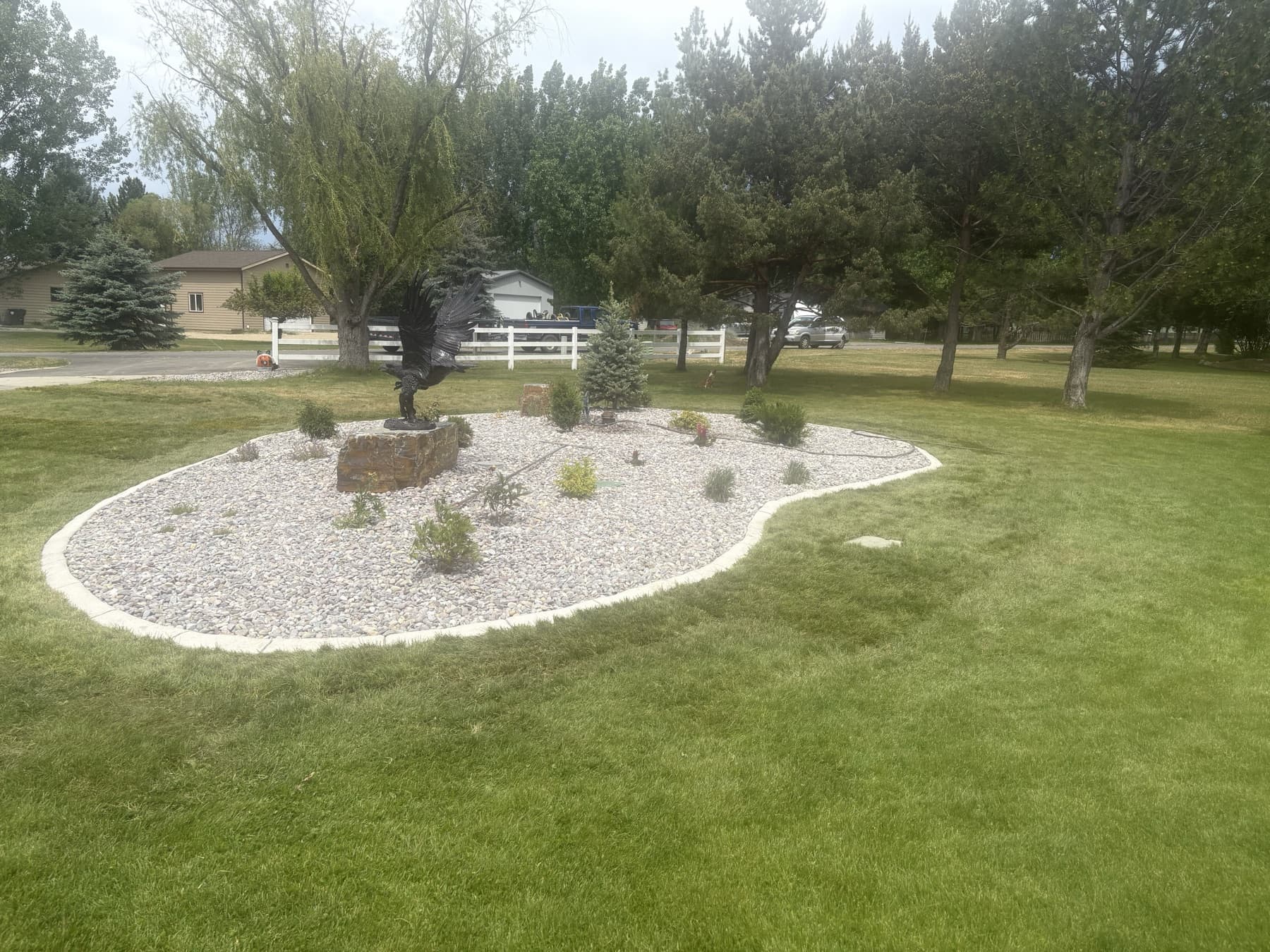
Montana Landscape Maintenance Calendar, Month by Month
Reviewed by Adam Hurlbert, Owner & Founder, 15+ years in landscape & property care
Landscapes in western Montana run on a short, predictable clock. Most of what keeps a yard healthy happens in a few windows, and missing one, a fall blowout, an early fall seeding, a dry winter watering, can cost you the following season. This calendar lays out the year for Missoula and the Bitterroot Valley, with each task linked to the guide that explains it. Treat the months as a starting point: elevation and the weather in a given year can move everything by a couple of weeks.
What should I do in the yard in January?
Mostly plan, and watch for dry spells. Colorado State University Extension notes that trees, shrubs, perennials and lawns can be damaged in dry fall and winter conditions without supplemental water. When there is no snow cover in an extended dry period, CSU suggests watering about once or twice a month, only when air and soil temperatures are above 40 degrees, at midday so water soaks in before night. Young trees and evergreens come first. Average lows at Missoula airport in January run about 15 degrees, so those days are few in a normal winter.
January is also the time to plan projects, because design and installation calendars fill up. Keep an eye on heavy snow on evergreen branches; our guide to winter tree care and snow load explains what to leave alone.
What landscape work can be done in February?
Dormant pruning season is in full swing for many trees and shrubs, while their structure is easy to see. Our Montana tree pruning calendar shows which species to prune when, and our dormant pruning service covers it. Order seed, sketch bed changes and book spring work. Keep up winter watering if the winter is dry and open.
What should I do in March?
Watch the melt. March is when you learn where water sits in your yard. Walk the property during a thaw and note low spots, downspout problems and anything flowing toward the foundation; our guide to yard drainage during spring melt covers the common fixes. Finish dormant pruning before buds swell. Stay off wet lawns and beds, because working saturated soil causes compaction that lasts all year.
What should I do in April?
April is cleanup month in most of the valley. Rake out matted leaves and thatch from snow, check for snow mold and winter kill, cut back perennials and ornamental grasses, and clear debris from beds. Our spring yard cleanup checklist has the full list, and our seasonal cleanups crews can take it on.
If you want a soil test, this is the time. MSU Extension says soil is ideally sampled in spring, and potassium reads most accurately just after thaw; our soil testing guide explains how. Early planting of hardy trees and shrubs can start once the ground is workable. Average lows at Missoula airport are still around 32 degrees, so tender plants stay indoors.
What should I do in May?
May is the start of the real season, and frost dates set the pace. Weather records put the median last 32 degree freeze at about May 24 in Hamilton, May 25 at Missoula airport, May 29 in Darby and May 30 in Stevensville, so tender annuals and vegetables wait until late May at the earliest. Our frost dates guide has the odds.
Start the sprinkler system when hard freezes are unlikely; our spring sprinkler startup guide walks through the checks. Begin mowing, and remember the one-third rule from our lawn care page: do not remove more than about a third of the blade at once. Treat weeds as they appear, and mulch beds before summer.
What should I do in June?
June is usually the wettest month of the year in the valley, with about 2 inches on average at Missoula airport and about 1.7 inches at Hamilton, according to Western Regional Climate Center summaries. It is the best month to get new plantings settled before the dry stretch. MSU's standard lawn fertilizer timing starts around Memorial Day, so the first feeding should be down by early June; our guide to lawn fertilizer rates and timing has the details.
Keep row cover handy for tender plants until the end of the month, since late frosts are in the record at every station. Audit the irrigation system while it is easy to see: broken heads, misaligned sprays and dry spots.
What should I do in July?
July is about water. Average precipitation drops to about 0.9 inch at Missoula airport and 0.8 inch at Hamilton. The EPA's WaterSense program suggests timing how long your sprinkler takes to put down half an inch, watering that long about twice a week, and adjusting for conditions. Our summer watering guide and watering windows guide go further.
Raise the mower and let the lawn slow down in the heat rather than pushing it with fertilizer. Water new trees and shrubs deeply. Keep defensible space up as fire season peaks; our guide to keeping defensible space up through fire season covers what to do.
What should I do in August?
Keep watering, and get ready for the second big window of the year. August precipitation is only about 1 inch at Missoula airport and 0.9 inch at Hamilton. Late August is the time to line up aeration and seed, order fall plants, and plan any lawn renovation. Noxious weeds that have gone to flower should be dealt with before they set seed; see our Ravalli County noxious weeds guide.
What should I do in September?
September is the most valuable month for a Montana lawn. Early fall is the strongest window for core aeration and overseeding, and MSU's standard lawn fertilizer timing has another application around Labor Day. Fall planting of trees and shrubs works well in the cooling weather; see our guide to fall planting.
Expect first frost. The median first 32 degree freeze is about September 10 in Stevensville, September 12 in Darby and September 21 at Hamilton and Missoula airport. Bring in containers and cover what you want to extend.
What should I do in October?
Close down the irrigation system before a hard freeze. The median first 28 degree freeze is about September 22 at Stevensville, September 25 at Darby, October 3 at Missoula airport and October 4 at Hamilton, so do not leave it late; our irrigation winterization guide explains why, and our sprinkler blowout service handles it. MSU's last standard lawn feeding falls around Columbus Day.
Rake or mulch leaves, cut back what needs cutting, and do your fall yard cleanup. Give evergreens and young trees a deep watering before the ground freezes. In fire country, late fall is also a good time to start thinning and limbing; see why fall and winter are best for fuel reduction.
What should I do in November?
Finish up before snow. Wrap up leaf removal, store hoses, protect young tree trunks from deer and elk rubbing, and give young evergreens and shrubs protection from wind if they are exposed. Our guides to deer and elk damage and protecting shrubs over winter cover how. If the fall has been dry, CSU's guidance on fall watering applies: water when air and soil temperatures are above 40 degrees and there is no snow cover.
Mark driveway edges and plantings so plow operators can see them; our guide to preventing snow plow damage lists what to mark.
What should I do in December?
Mostly watch. Gently lift snow off small, flexible branches you can safely reach, never shake frozen ones, and keep salt and de-icer away from beds. Our ice melt guide covers products that are easier on plants and concrete. If it is an open, dry December, keep up the winter watering for young trees when the weather allows. Then take stock of the year and start planning what comes next.
How much should I shift this calendar for my location?
The dates above fit the main valley floor. WRCC station records show a difference of about a week in median last freeze between Hamilton and Stevensville, and far more in the side valleys, where Seeley Lake's median last freeze is June 29 and Sula's is July 17. If you live on a high bench, up a canyon or in a cold pocket, push spring tasks later and fall tasks earlier. Above all, blow out the sprinklers by your own weather rather than a date on a calendar, because one hard freeze can do the damage.
A simple notebook helps: write down the date the snow leaves, the first mowing, the last and first frosts and the first plowable snow. After a few years you will have a calendar made for your own yard. Our hardiness zone guide covers the other half of reading your site.
Can someone handle this calendar for me?
Yes. HJ Property Care & Tree Service handles most of the tasks on this calendar across Missoula and Ravalli counties, including seasonal cleanups, mowing, fertilizer and weed control, irrigation startups and blowouts, pruning and snow removal, and our landscape design team takes on new plantings and hardscape. This calendar is part of our Montana Landscaping, Lawn & Irrigation Guide.
Call (406) 215-7319 or request a free estimate and tell us which parts of the year you would like off your list.
Need help?
HJ Property Care & Tree Service is locally owned and ISA-certified. Call for a free estimate.
This article is part of the Montana Landscaping, Lawn & Irrigation Guide, our complete guide for western Montana property owners.
Explore our landscaping & design.
Sources
We cite primary sources: Montana State University Extension, the City of Missoula, and the ISA, so you can verify anything here yourself.
- Fall and Winter Watering (fact sheet 7.211) (Colorado State University Extension). Last checked November 2, 2026.
- Home Garden Soil Testing & Fertilizer Guidelines, MontGuide MT200705AG (reviewed 10/18) (Montana State University Extension). Last checked November 2, 2026.
- Watering Tips (WaterSense) (U.S. Environmental Protection Agency). Last checked November 2, 2026.
- Missoula Intl AP (245745): Spring freeze probabilities (Western Regional Climate Center). Last checked November 2, 2026.
- Missoula Intl AP (245745): Fall freeze probabilities (Western Regional Climate Center). Last checked November 2, 2026.
- Hamilton (243885): Spring freeze probabilities (Western Regional Climate Center). Last checked November 2, 2026.
- Hamilton (243885): Fall freeze probabilities (Western Regional Climate Center). Last checked November 2, 2026.
- Stevensville (247894): Spring freeze probabilities (Western Regional Climate Center). Last checked November 2, 2026.
- Stevensville (247894): Fall freeze probabilities (Western Regional Climate Center). Last checked November 2, 2026.
- Darby (242221): Spring freeze probabilities (Western Regional Climate Center). Last checked November 2, 2026.
- Darby (242221): Fall freeze probabilities (Western Regional Climate Center). Last checked November 2, 2026.
- Seeley Lake Ranger Station: Spring freeze probabilities (Western Regional Climate Center). Last checked November 2, 2026.
- Sula: Spring freeze probabilities (Western Regional Climate Center). Last checked November 2, 2026.
- Missoula Intl AP: period of record monthly climate summary (Western Regional Climate Center). Last checked November 2, 2026.
- Hamilton: period of record monthly climate summary (Western Regional Climate Center). Last checked November 2, 2026.
Ready to transform your outdoor space?
Get a free, no-obligation estimate within 48 hours. Locally owned and ISA-certified.