
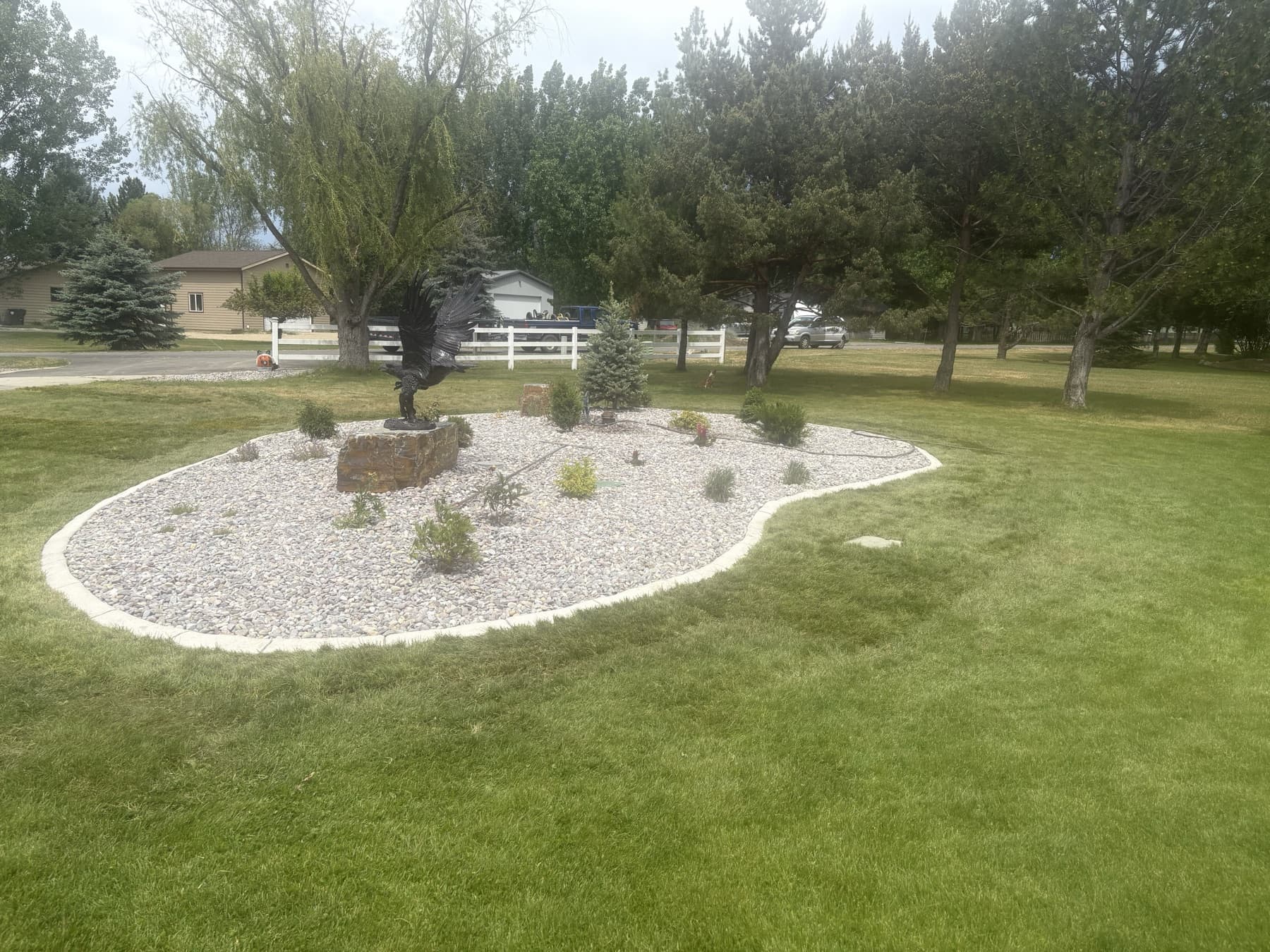
Xeriscaping in Western Montana: The Seven Principles, Applied Here
Reviewed by Adam Hurlbert, Owner & Founder, 15+ years in landscape & property care
Xeriscaping is not a gravel yard with three yuccas in it. It is a way of designing a landscape so that it fits the water it will realistically get, and in the semi-arid valleys of western Montana that is a practical idea, not a style. Montana State University Extension describes it as landscaping for greater water-use efficiency and resilience to seasonal shortages, which can also lower outdoor water costs. This guide walks through the seven principles the method is built on and what each one means on a Missoula or Bitterroot Valley lot, from soil to mulch to how much lawn to keep.
What does xeriscaping actually mean?
The term comes from the Greek word for dry. MSU Extension notes that xeriscaping was originally developed by Denver Water, and the USDA NRCS booklet Creating Native Landscapes in the Northern Great Plains and Rocky Mountains adds that Denver Water holds the trademark and developed the seven Xeriscape principles. The NRCS booklet is direct about the misconception: the word conjures up a dry, desert-like landscape when the real focus is how to landscape appropriately where seasonal water supply is short.
In practice that means a yard can still have shade trees, flowering beds and a patch of lawn. What changes is that every part of it is placed and watered according to what it needs, and the parts that need the most water are kept to the places where they earn it. This guide is part of our Montana Landscaping, Lawn & Irrigation Guide, which covers soils, irrigation, lawns and planting in more depth.
What are the seven principles of xeriscape?
The NRCS booklet lists them in this order: plan and design comprehensively; improve soil with amendments; reduce lawn areas; use appropriate plants and group them according to water and environmental needs; irrigate efficiently; use mulches; and maintain the landscape. They work as a set. A yard full of drought-tolerant plants on the same spray zone as the lawn will still be overwatered, and the best drip system cannot save a bed of thirsty plants on a hot south wall.
The same booklet cites studies (from the Xeriscape Colorado publication At Home with Xeriscape) reporting up to 50 percent water savings compared with traditional landscapes, along with lower maintenance, fertilizer and fuel use. Those are figures from other projects, not a promise for any one yard. They do show where the savings come from: less turf, less overspray and less wasted water.
Why does xeriscaping make sense in Missoula and the Bitterroot?
Western Montana summers are dry, and outdoor watering is where most of the summer water goes. The EPA WaterSense program says residential outdoor water use across the country totals nearly 8 billion gallons a day, mainly for landscape irrigation, and that the average household uses more water outdoors than for showering and washing clothes combined. The NRCS booklet says that in many parts of the West landscaping accounts for half of all residential water use.
Locally, the City of Missoula asks residents to water lawns only when needed, to deep-soak rather than sprinkle, to choose climate-adapted, water-efficient landscaping and to keep sprinklers off sidewalks and streets. From May 1 to September 30 the city lists recommended watering hours of 6 to 11 a.m. and 5 to 10 p.m. On a well or a ditch the cost is pump time and shares rather than a utility bill, but the logic is the same: water applied where nothing needs it is wasted.
How do you plan a xeriscape?
Planning starts with the site, not a plant list. The NRCS booklet recommends a site inventory first: soil texture, depth and pH; how the land has been used before; slope, aspect and exposure to wind; and where utilities, septic fields and structures sit. MSU Extension adds a point that matters here: south and west facing areas get intense sun and the highest plant water demand, so that is where thirsty plants should be reduced and where shade from trees can help.
From the inventory you sketch use areas: where the family actually walks, plays, parks and sits. Those areas decide where turf and hardscape belong. Everything else becomes planting or low-water groundcover. Our guide to the landscape design process covers the planning steps in order, and phasing a project over several seasons explains how to build it in stages.
Does the soil need to be amended for a xeriscape?
Usually some, but less than people expect. MSU Extension recommends aerating compacted soil and adding compost to improve texture and moisture retention. The MSU MontGuide on yard and garden water management explains why: clay soils absorb water slowly and run off if it is applied too fast, while sandy soils drain so quickly plants cannot use the water, and organic matter helps both.
Native and drought-adapted plants often do not want rich, heavily amended beds. The NRCS booklet notes that most soils in the region are alkaline, and that most native species will not do well in heavy, poorly drained or saline soil. A soil test is the honest starting point. See our guides to soil testing for Montana yards and alkaline soil before buying amendments.
How much lawn should a xeriscape keep?
As much as you actually use, and no more. MSU Extension says Kentucky bluegrass, especially when mowed low, has some of the highest irrigation needs of any landscape planting. Its advice is to reduce irrigated turf to functional, heavily used areas, avoid turf in full shade, narrow strips, poor soils and steep slopes, and replace it with beds or water-efficient groundcovers. Fine fescues need less water than bluegrass and can look similar, and MSU suggests mowing at about 3 inches and watering deeply and infrequently.
The narrow strips are the easiest win. The NRCS booklet points out that narrow grass strips too often result in watering pavement as well as grass. For lawn areas you keep, our guide to Montana lawn grasses compares the options, and replacing some lawn with native plants covers the conversion itself.
Which plants work in a western Montana xeriscape?
Natives adapted to the valley climate are the backbone. The 2025 MSU MontGuide Native Plants for Montana's Home Gardens says native plants have cold and drought hardiness and are adapted to local climates, growing seasons and soils. Its list includes perennials such as blanketflower, Lewis flax, prairie smoke, sulphur-flower buckwheat and several penstemons, and shrubs such as serviceberry, rubber and yellow rabbitbrush, skunkbush sumac and golden currant. For groundcovers in place of turf, MSU's xeriscaping article names creeping juniper, bearberry (kinnikinnick) and creeping thyme.
Non-natives are allowed. MSU's advice is to choose drought-tolerant plants with low supplemental irrigation needs that match the local environment and soil. Our separate guides go species by species: shrubs for western Montana, hardy perennials and ornamental grasses. Near a house in fire country, check the plant against our guide to fire-resistant plants too.
What is hydrozoning?
Hydrozoning is grouping plants by how much water they need so each irrigation zone runs for what is in it. MSU Extension lists grouping plants with similar water needs together as an irrigation practice, and the NRCS booklet makes it one of the seven principles. A typical yard ends up with three zones: a small high-water zone (lawn, vegetables, a few thirsty favorites near the house), a moderate zone, and a low-water zone that is watered to establish and then only in drought.
This is the single most important design decision in a xeriscape, and it is free at the planning stage. It is also hard to fix afterward, because it means moving plants or re-piping valves. Our guide to laying out irrigation zones explains how zones map onto valves and heads.
How should a xeriscape be watered?
Efficiently and deeply. MSU Extension recommends drip, soaker hoses or bubblers over overhead spray, which loses more water to evaporation and wind, along with rain sensors on automatic systems, early morning watering, and an irrigation audit to confirm water lands where it is intended. The MSU water management MontGuide says soaker hoses can reduce water use by 60 percent or more, and that lawns watered under the hot midday sun can lose as much as 30 percent of the water to evaporation.
New plants still need water. The 2025 native plant MontGuide warns that a common mistake is failing to water young natives because they are labeled drought tolerant, and that trees and shrubs may take a growing season or longer to establish. See drip irrigation for Montana beds and our irrigation systems service for the hardware side.
What mulch should a xeriscape use?
MSU Extension recommends organic mulch such as arborist wood chips around beds, at about 4 inches, because it supports soil health. Rock and gravel can work between beds or around some drought-tolerant and native plants, but MSU notes that inorganic mulch increases heat reflection and can stress sensitive plants. Plastic, sheet mulches and weed fabric are not recommended in permanent plantings because they block oxygen and water to roots and soil life.
Fire changes the answer near the house. MSU's fire-resistant plants MontGuide warns that embers can ignite bark mulch, and suggests keeping wood mulch moist during a nearby fire or replacing it with rock. Our guide to mulch and wildfire covers what to use in the first few feet around a building.
Is a xeriscape low maintenance?
Lower, not zero. MSU Extension says water-wise landscapes can be low maintenance and can support plant diversity and pollinators. The seventh principle exists because the first two or three years still need weeding, establishment watering and some replacement of plants that did not suit the spot. Weeds are the main risk: bare ground between young drought-tolerant plants is exactly where knapweed and cheatgrass move in.
After establishment, the work shifts to a spring cleanup, occasional division of perennials and checking the drip system. Our guide to low-maintenance landscaping goes into where yard labor actually comes from.
What are the common xeriscaping mistakes?
The ones we see most are predictable from the principles. Rock everywhere with weed fabric underneath, which heats the yard and fails as the fabric fills with windblown soil. Drought-tolerant plants on the same spray zone as the lawn. Plants placed by their nursery size instead of their mature size. Natives planted and never watered in. And no plan for the transition areas, so the edges of the lawn become the weediest part of the yard.
The fix for almost all of them is the first principle: plan the whole yard, including irrigation, before buying plants.
Can HJ design and install a xeriscape?
Yes. Low-water xeriscaping and drought-tolerant design are part of our landscaping design service, alongside sod, planting, mulch, hardscaping and irrigation. We work in Missoula, Lolo, Florence, Stevensville, Corvallis, Victor, Hamilton, Darby and the rest of the Bitterroot Valley, and we can convert part of a yard or plan the whole thing in phases.
Call HJ Property Care & Tree Service at (406) 215-7319 or request a free estimate and we will walk the property with you.
Need help?
HJ Property Care & Tree Service is locally owned and ISA-certified. Call for a free estimate.
This article is part of the Montana Landscaping, Lawn & Irrigation Guide, our complete guide for western Montana property owners.
Explore our landscaping & design.
Sources
We cite primary sources: Montana State University Extension, the City of Missoula, and the ISA, so you can verify anything here yourself.
- Xeriscaping and Other Thoughtful Landscaping Practices to Conserve Water (Lives and Landscapes, Fall 2022) (Montana State University Extension). Last checked November 2, 2026.
- Creating Native Landscapes in the Northern Great Plains and Rocky Mountains (USDA Natural Resources Conservation Service, Plant Materials Program). Last checked November 2, 2026.
- Yard and Garden Water Management, MontGuide MT198915AG (revised July 2020) (Montana State University Extension). Last checked November 2, 2026.
- Native Plants for Montana's Home Gardens, MontGuide MT202503AG (new August 2025) (Montana State University Extension). Last checked November 2, 2026.
- Fire-Resistant Plants for Montana Landscapes, MontGuide MT200101AG (revised April 2022) (Montana State University Extension). Last checked November 2, 2026.
- WaterSense: Outdoors (U.S. Environmental Protection Agency). Last checked November 2, 2026.
- Conservation (Missoula Water) (City of Missoula). Last checked November 2, 2026.
Ready to transform your outdoor space?
Get a free, no-obligation estimate within 48 hours. Locally owned and ISA-certified.