
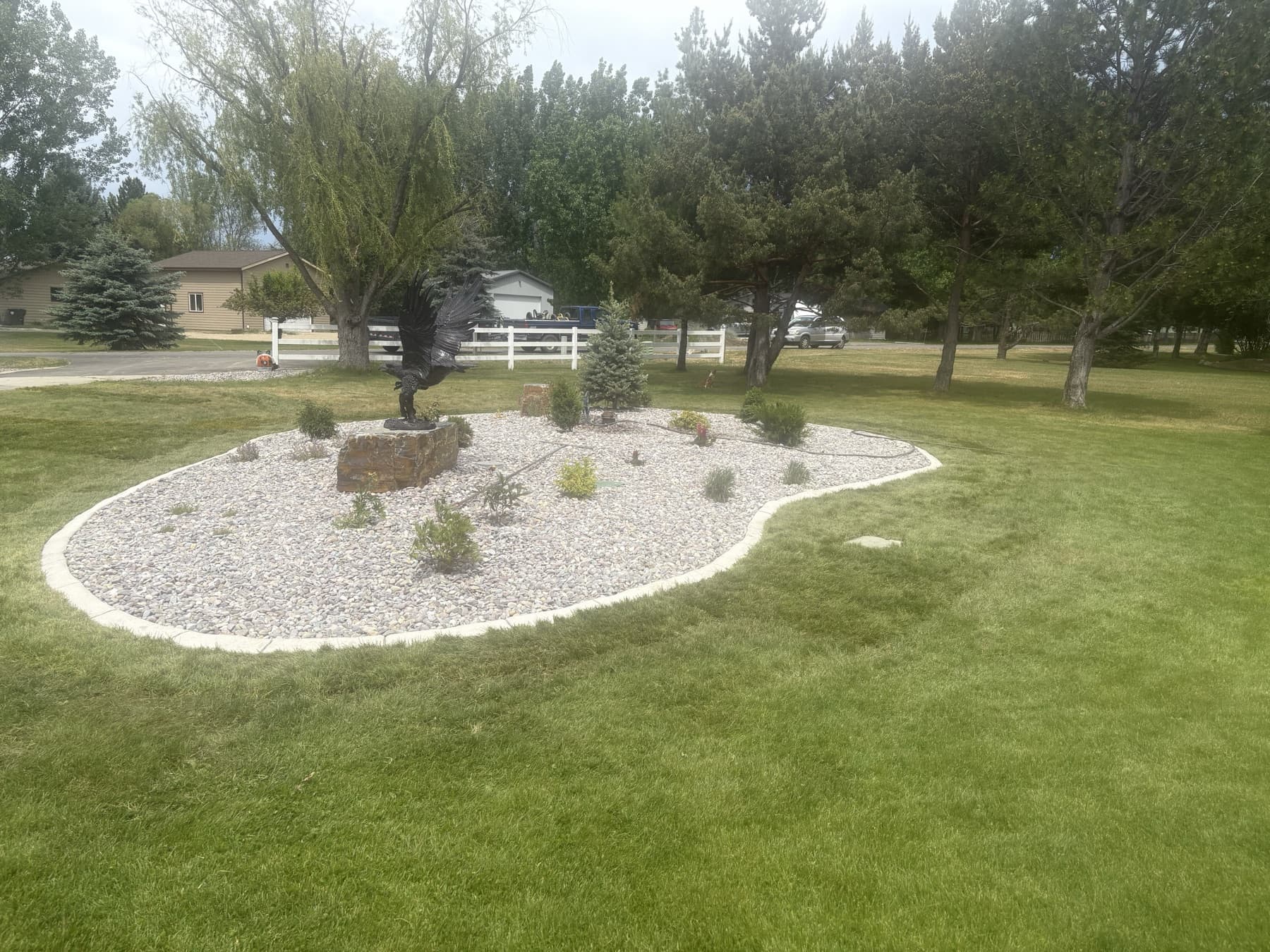
Hardy Perennials for Missoula and the Bitterroot Valley
Reviewed by Adam Hurlbert, Owner & Founder, 15+ years in landscape & property care
A perennial that thrives in Missoula or Hamilton has to handle a short season, cold snaps in May and September, a dry midsummer, alkaline soil and winters that swing between subzero and chinook thaws. Plenty of plants do, and Montana State University Extension has done the sorting: its MontGuide Perennials and Biennials for Montana Gardens lists herbaceous plants that do well in most Montana climates, and its 2025 MontGuide on native plants adds a list of natives rated for drought resistance and pollinator value. This guide pulls the most useful choices for western Montana yards out of both, then covers the care that keeps them coming back.
How hardy does a perennial need to be here?
MSU's deer damage MontGuide gives a rule of thumb: for western Montana gardens, plant perennial species adapted to Zones 4 and 5, and ask the local MSU Extension office for more specific zone information. Our guide to hardiness zones in Missoula and the Bitterroot explains the map, and frost dates covers the season length.
Hardiness is not the only filter. A plant rated for the cold can still fail in wet clay over winter or in a hot, reflective bed against a south wall. Site matters as much as zone. This guide is part of our Montana Landscaping, Lawn & Irrigation Guide.
Where should a perennial bed go?
In sun, with drainage. MSU's perennials MontGuide says that apart from shade lovers, most perennials need at least six hours of sun a day in well-drained soil, and that many plants do not like wet feet, so low, wet spots are a poor choice. In western Montana the hot afternoon side of a building is a second trap: MSU's xeriscaping article notes that south and west facing areas have the highest water demand. Put the thirstier perennials on the east side and the dry-country ones on the south and west.
Which perennials handle dry, sunny beds?
MSU's perennials MontGuide marks drought tolerance in its table. Plants it lists as drought tolerant include yarrow (including fernleaf yarrow 'Coronation Gold'), giant hyssop (Agastache), pussytoes, butterfly milkweed (Asclepias tuberosa), blue wild indigo (Baptisia), snow-in-summer, tickseed (Coreopsis 'Moonbeam'), cottage pinks, the narrow-leaved, pale and common purple coneflowers, blanketflower, false sunflower (Heliopsis), evergreen candytuft, Shasta daisy, gayfeather (Liatris), perennial flax, catmint ('Walker's Low'), beardtongue (Penstemon barbatus), Russian sage and creeping phlox.
Several of those carry notes worth reading before planting. MSU marks narrow-leaved purple coneflower as suited to clay, dry and rocky ground, blanketflower and purple coneflower as tolerating poor soil, and Russian sage, false sunflower and gayfeather as tolerating clay. Perennial flax and pale purple coneflower will self-sow.
Which native perennials are best for western Montana?
The 2025 MSU MontGuide Native Plants for Montana's Home Gardens lists natives with hardiness zones. Dependable choices for valley yards include common yarrow (zones 4 to 8), blue giant hyssop (3 to 8), nodding onion (4 to 8), pasqueflower (4 to 7), prairie smoke (3 to 7), sulphur-flower buckwheat (4 to 8), blanketflower (3 to 10), sticky purple geranium (2 to 10), Lewis flax (3 to 9), silvery and silky lupine (4 to 9 and 4 to 8), wild bergamot (3 to 8), Rocky Mountain beardtongue (3 to 8), waxleaf penstemon (3 to 9), upright prairie coneflower (3 to 8), Missouri goldenrod (3 to 8) and smooth blue aster (3 to 8). Bitterroot (Lewisia rediviva, 3 to 8) is on the list too.
MSU's guide points out that some species on its list are native to adjacent states rather than Montana itself, and marks them. It also notes that pasqueflower is an early nectar source and narrowleaf purple coneflower blooms in midsummer, which helps build a long season. See native plants for the Bitterroot Valley and the pollinator garden guide for how to combine them.
Which perennials grow in shade?
Fewer, but there are good ones. MSU's perennials MontGuide marks these for part shade to shade: astilbe, bergenia (pigsqueak), Siberian bugloss (Brunnera), bleeding heart, hosta, spotted dead nettle (Lamium), lady fern and ostrich fern, sweet woodruff, Jacob's ladder and lily of the valley. Columbines, coral bells, cranesbill geraniums, daylilies, peonies and garden phlox are listed for sun to part shade.
MSU flags several shade plants with cautions: snow on the mountain (Aegopodium) and creeping jenny can be invasive, lily of the valley and monkshood are poisonous in all parts, and foxglove leaves are poisonous. Plan for pets and children accordingly. Moisture-lovers such as ligularia and ostrich fern need consistently damp soil, which in western Montana usually means drip irrigation.
Which perennials resist deer and fire?
No list is perfect. MSU's deer MontGuide says deer-resistant does not mean deer-proof, and plants with strong aromas, prickles or spines, tough or leathery leaves, or milky sap are usually left alone when other food is available. Our deer-resistant plants list gives MSU's ratings, with catmint, penstemon, Russian sage, bee balm, iris and blue flax among the most resistant.
MSU's fire-resistant plants MontGuide lists many perennials and groundcovers it considers fire-resistant, including blanketflower, coreopsis, columbine, coral bells, cottage pinks, daylily, flax, geraniums, iris, lupine, lamb's ear, sedums, Shasta daisy, thrift, snow-in-summer and yarrow. Moist, low-growing perennials make better plantings near a house than shrubs that hold dead material; see fire-resistant plants.
How should a perennial bed be prepared?
Prepare the whole bed, not just the holes. MSU recommends a soil test first, then amending with organic matter at 2 to 4 cubic yards per 1,000 square feet, worked 6 to 12 inches deep, with nutrients added as the soil test indicates. It warns that many perennials will not survive past the first year in poorly prepared soil.
Natives are the exception to heavy amendment. The 2025 native plant MontGuide still recommends a soil test and compost to address compaction and drainage, but many dry-country natives grow best in lean soil. Our guides to soil testing, spring bed prep and rocky soil go further.
How much water do perennials need?
MSU's perennials MontGuide gives a general rule of 1 inch of water per week, applied deeply and infrequently, with more during hot, windy spells and for new plants until they establish. Sandy soil needs water more often than clay. MSU says overhead watering is not recommended because it promotes foliage disease and wastes water to evaporation, and that drip or a soaker hose is best.
For a bed of dry-country natives, water to establish, then taper off. Grouping perennials by water need, and putting each group on its own drip zone, is what makes that possible; see drip irrigation for Montana beds.
When should perennials be fertilized and mulched?
Lightly, and not late. MSU says top-dressing with organic matter or a general-purpose fertilizer in early spring is enough for most herbaceous ornamentals, with heavier feeders such as astilbe, daylilies, peonies, delphinium and garden phlox needing more. Its firm rule is not to fertilize after July 1, because late growth will not harden before winter.
MSU recommends a 4 to 6 inch layer of organic mulch, which conserves moisture, suppresses weeds and insulates plants against warm spells that break dormancy and against frost heave. Keep wood mulch away from the house in fire country; see mulch and wildfire.
When should perennials be cut back and divided?
MSU's perennials MontGuide says most perennials should be cut back in fall after the foliage dies, to 2 to 4 inches above the ground, except those with winter interest such as sedums and plants with attractive seed heads, which can wait until spring. MSU's pollinator guidance adds a reason to leave more standing: stems and leaf litter shelter overwintering bees and butterflies. Many gardeners split the difference, cutting the front of the bed in fall and the rest in spring.
Division keeps perennials vigorous. MSU says plants often show reduced flowering or dead centers three to five years after planting. Spring bloomers are usually divided in fall and others in spring, with exceptions: peonies, Oriental poppies and daylilies are best divided in fall. Spring division is easiest when plants have 2 to 4 inches of new growth. Fall division should be early enough for roots to establish before the ground freezes. Our fall cleanup service can handle the cutting back.
What about staking, deadheading and peonies?
MSU recommends staking tall or heavy-flowered plants early, when they are about a third of mature size, with a stake about 6 inches shorter than the mature plant. Deadheading keeps beds tidy, often brings a second bloom and controls self-seeders. Shearing some perennials back to 4 to 6 inches before bud formation produces sturdier, bushier plants. Peonies will not bloom if planted too deep: MSU says the eyes should be 2 inches or less below the soil surface.
Can HJ plant and maintain perennial beds?
Yes. Bed design, soil preparation, planting, mulch and drip irrigation are part of our landscaping design service, and we handle seasonal cleanups afterward. For lower-input planting ideas see low-maintenance landscaping and xeriscaping.
Call HJ Property Care & Tree Service at (406) 215-7319 or request a free estimate and we will walk the property with you.
Need help?
HJ Property Care & Tree Service is locally owned and ISA-certified. Call for a free estimate.
This article is part of the Montana Landscaping, Lawn & Irrigation Guide, our complete guide for western Montana property owners.
Explore our landscaping & design.
Sources
We cite primary sources: Montana State University Extension, the City of Missoula, and the ISA, so you can verify anything here yourself.
- Perennials & Biennials for Montana Gardens, MontGuide MT199903AG (revised January 2019) (Montana State University Extension). Last checked November 2, 2026.
- Native Plants for Montana's Home Gardens, MontGuide MT202503AG (new August 2025) (Montana State University Extension). Last checked November 2, 2026.
- Minimizing Deer Damage in Residential Settings, MontGuide MT202308AG (Montana State University Extension). Last checked November 2, 2026.
- Fire-Resistant Plants for Montana Landscapes, MontGuide MT200101AG (revised April 2022) (Montana State University Extension). Last checked November 2, 2026.
- Xeriscaping and Other Thoughtful Landscaping Practices to Conserve Water (Lives and Landscapes, Fall 2022) (Montana State University Extension). Last checked November 2, 2026.
- Building and Maintaining a Pollinator-Friendly Garden Landscape (Lives and Landscapes, Summer 2022) (Montana State University Extension). Last checked November 2, 2026.
Ready to transform your outdoor space?
Get a free, no-obligation estimate within 48 hours. Locally owned and ISA-certified.