
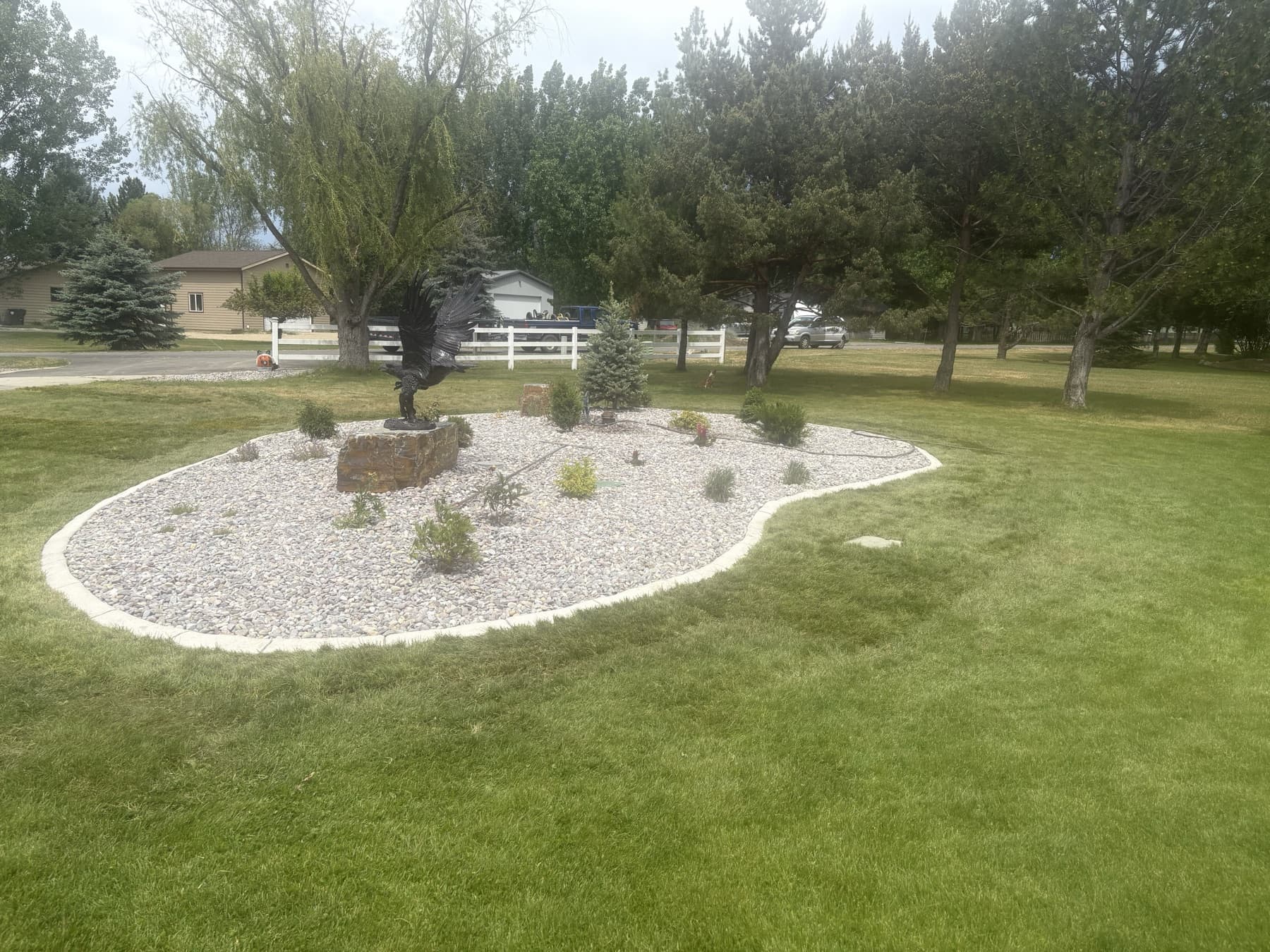
Front Yard Landscaping Ideas for Montana Homes
Reviewed by Adam Hurlbert, Owner & Founder, 15+ years in landscape & property care
The front yard does more jobs than any other part of a western Montana property. It has to look cared for from the street, get people to the door safely in January, store the snow the driveway sheds, survive the deer that walk through at dusk, and, in much of the Missoula and Bitterroot valleys, not hand a wildfire ember a fuel bed against the house. It also sits next to public right-of-way, which comes with rules in town. This guide works through front yard ideas with those jobs in mind, including the City of Missoula boulevard and corner visibility rules we checked in the municipal code.
What should a Montana front yard be designed around?
Start with the functional layer before plants: the walk from the driveway to the door, where plowed and shoveled snow goes, where the downspouts drain, sight lines for backing out, and the first five feet around the house. Then decide how much lawn you really use out front. Most front lawns are looked at, not played on, which makes them the easiest place to cut turf and water. MSU Extension's xeriscaping advice is to keep irrigated turf to functional, heavily used areas and to avoid it in narrow strips and on steep slopes.
This guide is part of our Montana Landscaping, Lawn & Irrigation Guide. For the full planning sequence see the landscape design process.
What are the rules for planting a boulevard in Missoula?
Missoula's municipal code defines the boulevard as the public right-of-way between the edge of the street and the private property line, and makes the adjoining owner responsible for maintaining it, which the code defines as watering trees, shrubs, plants, grass and vegetation, mowing, eliminating weeds, and following the city's rules on trimming and removing trees. Boulevards next to residential property are to contain grass, trees, shrubs, flowers or other ornamental plants, and may include sidewalks, paths and other customary improvements. Gravel, chips and bark are listed as allowed on boulevards next to commercial or industrial property outside residential areas; a homeowner wanting another type of landscaping can petition the design review board for a boulevard variance.
The code also bars structures of any kind on the boulevard other than government signs and what regulations allow. Trees are a separate process: the city's Urban Forestry pages say not to plant any vegetation in the right-of-way without an approved planting permit, that tree planting permits go in at least five working days ahead, and that the city publishes a street tree list. Rules in Hamilton, Stevensville and other towns differ, and HOA covenants can add more; see HOA landscape and fence approval.
How tall can plants be near a corner or driveway?
In Missoula, generally no taller than 30 inches inside the sight triangles. The city code treats signs, fences, hedges, walls, shrubbery and natural growth higher than 30 inches above curb grade as visibility obstructions and public nuisances when they sit within intersection sight triangles defined by AASHTO guidance, or within a ten-foot isosceles triangle where an alley or private drive meets the sidewalk (or the curb line if there is no sidewalk). Trees trimmed clear to at least eight feet above the curb are excepted. The owner or tenant has the duty to trim or remove them.
In practice that means low plantings beside the driveway apron and on corner lots, and lifting the lower limbs of boulevard trees. It is good practice outside the city too, because a hedge that hides a child on a bike from a car backing out is a hazard anywhere. This is general information, not legal advice; confirm specifics with the city or town.
What should go in the first five feet around the house?
In fire country, as little fuel as possible. MSU Extension's fire-resistant plants MontGuide names junipers as highly flammable plants that should not be used as foundation plantings in the wildland-urban interface, because their foliage contains volatile oils and old dead material builds up underneath. It says most deciduous shrubs are fire-resistant and should be considered for foundation plantings, and warns that embers can ignite bark mulch near a house.
A front foundation bed that works here looks like low perennials, deciduous shrubs set back from the siding, and rock or noncombustible mulch in the strip nearest the wall. Our guides to Zone 0, the first five feet, junipers and arborvitae and mulch near the house go into detail, and our fire mitigation service handles fuel reduction around the rest of the property.
How do you plan a front yard around snow?
Decide where the snow goes before planting. The strips beside the driveway and walk take plowed and shoveled snow, de-icer splash and the occasional plow blade, so they want tough, low groundcovers or rock rather than shrubs that break under a snow pile. Keep trees and specimen shrubs out of the throw zone of a snow blower. Mark bed edges with stakes before the first storm.
Our winter guides cover this in detail: where to pile snow, salt-tolerant plants for drivesides and protecting shrubs from snow load and plow spray. Our residential snow removal crews work to the bed markers you set.
What front yard plants hold up to deer?
Fewer than nurseries suggest. MSU's deer damage MontGuide says deer-resistant does not mean deer-proof, that newly planted and well-fertilized plants are more attractive to deer, and that planting preferred trees and shrubs closer to the home, or protecting them with barriers, helps. In a front yard that usually means the most deer-tolerant plants near the street and anything deer love close to the house or caged for the first winters.
Our deer-resistant plants list gives MSU's ratings, and deer browse in winter covers protection.
What are good low-water front yard ideas?
Replace the hardest-to-water turf first. MSU's xeriscaping article notes that south and west facing areas have the highest water demand, and that narrow strips and slopes are poor places for lawn; the NRCS booklet Creating Native Landscapes adds that narrow grass strips too often mean watering pavement. A planted parkway or side strip of perennials, grasses and a few shrubs on drip, edged cleanly, often looks better than the turf did and uses a fraction of the water.
Other ideas that suit western Montana front yards: a widened, well-lit front walk with a landing at the door; a few boulders and native grasses on a slope instead of mowed grass; a single multi-season tree set back from the house and lines; and a seat by the entry where the winter sun hits. See xeriscaping, low-maintenance landscaping and boulders and native rock.
Which plants give a front yard year-round interest?
Western Montana front yards spend five months in snow or brown, so winter structure matters. Grasses such as feather reed grass, whose flower spikes persist into winter according to Colorado State University Extension, hold their form, MSU's perennials MontGuide marks purple coneflower and globe thistle for winter interest, and conifers set back from the house give green. In spring, early shrubs such as serviceberry and golden currant and lilacs carry the yard; MSU's lilac MontGuide warns against planting lilacs against warm, light-colored walls that force early buds.
See shrubs for western Montana, hardy perennials and ornamental grasses.
How should front yard irrigation change?
Most front yards were irrigated for wall-to-wall turf, with spray heads throwing water onto the walk, the drive and the siding. MSU Extension's water management MontGuide says to position sprinklers so they do not water the side of the house, the sidewalk or the street, and recommends drip, soaker hoses or micro-spray for areas that dry out quickly, naming foundation and border plantings along sidewalks, driveways and streets. The City of Missoula asks residents to keep sprinklers off sidewalks and streets as well.
When turf comes out of the front yard, the spray zone should be capped or converted to drip rather than left running onto new beds. See drip irrigation for Montana beds and our sprinkler repair service for conversions.
Should the front walk and steps be rebuilt?
If they heave, crack or hold ice, usually yes, and it is the change people notice most. A front walk here needs a base built for frost, enough width for two people and a shovel, and drainage that keeps meltwater from sheeting across it and refreezing. See walkway materials that survive Montana winters, patio base preparation and our hardscaping service.
Is landscape lighting worth adding out front?
For safety on dark winter evenings, path and step lighting is one of the most useful upgrades. Keep fixtures low and shielded so they light the walk rather than the sky and the neighbors. Our guide to dark-sky friendly lighting explains shielding, and our landscape lighting service installs it. Lighting, irrigation and boulevard trees all sit underground or overhead near the street, so call Montana811 before any digging; the service is free.
Can HJ redesign a front yard?
Yes. Front yard redesign is one of the most common landscaping design jobs we do: removing tired turf and overgrown foundation shrubs, rebuilding walks, planting, drip irrigation and lighting. We work in Missoula, Lolo, Florence and the Bitterroot Valley.
Call HJ Property Care & Tree Service at (406) 215-7319 or request a free estimate and we will walk the property with you.
Need help?
HJ Property Care & Tree Service is locally owned and ISA-certified. Call for a free estimate.
This article is part of the Montana Landscaping, Lawn & Irrigation Guide, our complete guide for western Montana property owners.
Explore our landscaping & design.
Sources
We cite primary sources: Montana State University Extension, the City of Missoula, and the ISA, so you can verify anything here yourself.
- Missoula Municipal Code Title 12: Streets, Sidewalks and Public Places (Chapters 12.28 Obstructions and 12.48 Boulevards) (City of Missoula). Last checked November 2, 2026.
- Urban Forestry services (City of Missoula). Last checked November 2, 2026.
- Fire-Resistant Plants for Montana Landscapes, MontGuide MT200101AG (revised April 2022) (Montana State University Extension). Last checked November 2, 2026.
- Minimizing Deer Damage in Residential Settings, MontGuide MT202308AG (Montana State University Extension). Last checked November 2, 2026.
- Xeriscaping and Other Thoughtful Landscaping Practices to Conserve Water (Lives and Landscapes, Fall 2022) (Montana State University Extension). Last checked November 2, 2026.
- Creating Native Landscapes in the Northern Great Plains and Rocky Mountains (USDA Natural Resources Conservation Service, Plant Materials Program). Last checked November 2, 2026.
- Growing Lilacs in Montana, MontGuide MT199805AG (revised July 2020) (Montana State University Extension). Last checked November 2, 2026.
- Perennials & Biennials for Montana Gardens, MontGuide MT199903AG (revised January 2019) (Montana State University Extension). Last checked November 2, 2026.
- Ornamental Grasses, Fact Sheet 7.232 (Colorado State University Extension). Last checked November 2, 2026.
- Yard and Garden Water Management, MontGuide MT198915AG (revised July 2020) (Montana State University Extension). Last checked November 2, 2026.
- Conservation (Missoula Water) (City of Missoula). Last checked November 2, 2026.
- Montana811: call or click before you dig (Montana811). Last checked November 2, 2026.
Ready to transform your outdoor space?
Get a free, no-obligation estimate within 48 hours. Locally owned and ISA-certified.