
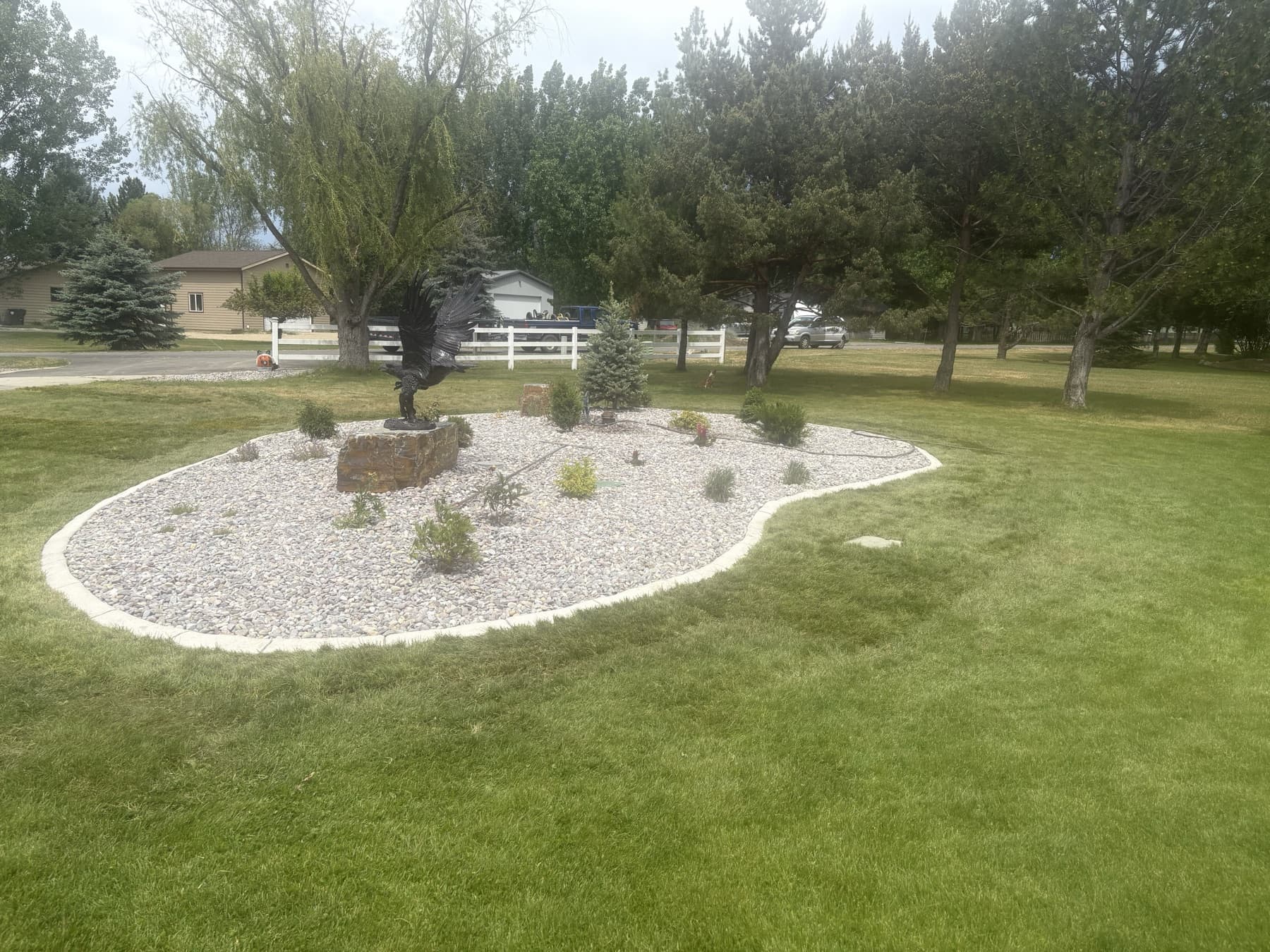
Landscaping with Boulders and Native Rock in Montana
Reviewed by Adam Hurlbert, Owner & Founder, 15+ years in landscape & property care
Rock suits western Montana. It ties a yard to the hillsides around it, it never needs water, and a well placed boulder can do more for a plain lot than a dozen shrubs. Rock also has real downsides that get overlooked: it stores heat, it does not stop weeds on its own, and it is very hard to move once it is in the wrong place. This guide covers where rock can legally come from, how to set it so it looks like it belongs, and how it affects the plants around it.
Can you collect rock from public land in the Bitterroot?
In some places, with a permit. When we checked, the Bitterroot National Forest's non-wood forest products page listed two community rock sources. Railroad Creek, about a mile up Railroad Creek on the Darby Ranger District, offers hard, angular quartzite from 6 inches to 4 feet, generally open April 1 through October 30 depending on snow and road conditions, with a minimum of 1 ton and a maximum of 5 tons per individual per year. Ambrose Creek, nearly 13 miles up Ambrose Creek on the Stevensville Ranger District, offers rock in the same size range, open June 15 to October 30 depending on conditions, with a maximum of 5 tons per individual per year.
The page says there is no charge for the permit at either site and that permits are available at any Bitterroot National Forest office. It also lists the Alta Shale Pit about 34 miles south of Darby, used for road surfacing and landscaping, which charges a fee per cubic yard and has a 50 cubic yard limit. The Forest Supervisor's Office in Hamilton is at 406-363-7100. Confirm current seasons and terms before you drive out, and ask how the forest treats commercial versus personal use, because the page refers that question to the local office.
What about rock from other land?
Do not assume anything. We did not verify rules for other national forests, state land or other public land, so ask the managing agency first. On private land, get the owner's permission. Most homeowners buy from a landscape supply yard or quarry, or use rock already on the property, which is often the best match for the site. Rock that came out of your own excavation has the same color and character as the ground around it.
Moss-covered and lichen-covered rock looks established, so handle it gently and place it facing the same way it sat in the ground if you can. Check any load for weed seeds and soil. Our guide to noxious weeds as wildfire fuel explains why weeds matter here.
How deep should a boulder be buried?
Deep enough to look like it grew there. A boulder sitting on top of the ground looks delivered. Landscaping Network reports one designer's recommendation to bury boulders one-third below grade for the most natural look, and designer Troy Bankord tells Sunset to bury a boulder by at least a few inches, up to a third. Burying also makes a stone more stable, which matters for anything people might climb or sit on.
Look for the stone's natural base, its widest and flattest side, and set that down. Keep any visible layering running the same direction from one rock to the next, as it would in a natural outcrop. Vary the depth, so that the group does not look like a row of identical stones.
How should boulders be grouped?
Odd groupings of mixed sizes usually look more natural than evenly spaced single stones: one large anchor, a medium stone close against it, and smaller ones trailing off. Landscaping Network notes that boulders can be grouped among plantings or used to divide areas in a garden, and it describes large, flat-topped boulders chosen as informal seating. Look at how rock sits on the hillside nearby and copy that. Rock tends to cluster at the toe of a slope or along a drainage rather than appearing at random in the middle of a lawn.
Think about mowing and snow. A boulder in the lawn means trimming around it forever, so tie it into a bed where you can. A boulder at the edge of a drive or on a corner gets hit by plows unless it is marked, so see snow stakes and markers.
Does rock heat up the plants around it?
Yes, and this is the most common mistake with rock. North Dakota State University Extension says bluntly that rock mulch is a heat trap, that it will scorch plants during the summer and make plants uncomfortable in winter, and that for heat-sensitive plants like birch, mountain ash and hosta it may contribute to premature death.
Colorado State University Extension adds that gravel mulch transfers more heat to the soil than wood chips. In a cold climate that can be useful, but it can also cause tender plants to begin growing too early in spring. So group rock with plants that like it hot and dry, and do not surround a thirsty tree with a sea of stone. Our guides to xeriscaping in western Montana and rocky soil landscaping cover suitable plants.
Is decorative rock a good mulch?
It depends on the size. Colorado State University Extension says stones must be no more than around a half inch in diameter to function as mulch, that larger stones do not confer the benefits of mulch and can actually inhibit plant growth, and that gravel smaller than one centimeter has been shown to suppress weeds. Larger cobble may provide landscape interest, which is a fair reason to use it, but it should not be expected to protect the soil the way mulch does.
Should landscape fabric go under the rock?
Extensions disagree, so it depends on what the bed is for. University of Nevada, Reno Extension says a layer of landscape fabric under a two inch layer of rock is sufficient. Colorado State says woven plastic weed barrier fabrics are not recommended beneath mulch in landscape areas, that they eventually clog, and that weeds germinate on top of the fabric and root into or through it.
A reasonable reading is that fabric can help under a rock-only area with no plants, such as a utility strip, and is much less useful in a planted bed. Either way, windblown soil builds up in rock over time, weeds follow, and rock beds still need weeding. For alternatives near the house, see fire-resistant mulch alternatives.
How does rock help with wildfire safety?
Stone does not burn, and that gives it a job close to a house. The Firewise USA fact sheet from the National Fire Protection Association recommends using crushed stone or gravel instead of flammable mulches in the immediate zone, 0 to 5 feet around the house. Colorado State notes the trade-off: gravel can transfer heat to buildings. Keep plants in that strip minimal in any case. Our guide to Zone 0, the first five feet explains what belongs there.
Can boulders hold back a slope?
Yes, but then it is a retaining wall and has to be treated as one. We build natural boulder walls through our retaining wall installation service, with a proper base and drainage. Height and load rules apply to boulder walls as they do to block, as explained in retaining wall permits, and slope design is covered in landscaping slopes and hillsides. A few boulders set for looks on a gentle grade are a different thing, but do not stack them where a slip could reach a person, a drive or a building.
What should you know before the truck arrives?
Boulders are heavy, and placing them usually takes machinery. Check for access: gate width, soft ground, irrigation lines, septic areas and low limbs. Decide placement first, with stakes or a sketch. Moving a boulder twice is expensive and tears up the yard, and a machine can compact soil over tree roots, so route it away from trees you want to keep. Our tree health and risk assessment can look at trees near a planned route.
Call before you dig. Montana 811 says you can simply dial 811 and that the service is free, and it warns that private underground facilities may not be located through the system, so sprinkler lines and private power need separate attention.
Placing rock with HJ
Rock beds, boulder placement and dry creek drainage features are part of our hardscaping work, and we plan them with the planting and irrigation around them through our landscaping and design service. This guide is part of the Montana Landscaping, Lawn & Irrigation Guide.
Call HJ Property Care & Tree Service at (406) 215-7319 or request a free estimate and we will walk the site with you.
Need help?
HJ Property Care & Tree Service is locally owned and ISA-certified. Call for a free estimate.
This article is part of the Montana Landscaping, Lawn & Irrigation Guide, our complete guide for western Montana property owners.
Explore our landscaping & design.
Sources
We cite primary sources: Montana State University Extension, the City of Missoula, and the ISA, so you can verify anything here yourself.
- Non-Wood Forest Products (community rock sources) (USDA Forest Service, Bitterroot National Forest). Last checked November 2, 2026.
- Landscaping with Boulders (Landscaping Network). Last checked November 2, 2026.
- Landscaping with Boulders (Sunset). Last checked November 2, 2026.
- Choosing Mulch for Trees and Shrubs (North Dakota State University Extension). Last checked November 2, 2026.
- Mulching (Colorado State University Extension). Last checked November 2, 2026.
- Mulches for Nevada Landscapes (University of Nevada, Reno Extension). Last checked November 2, 2026.
- How to Prepare Your Home for Wildfires (Firewise USA fact sheet) (National Fire Protection Association (NFPA)). Last checked November 2, 2026.
- Montana 811: call before you dig (Montana811). Last checked November 2, 2026.
Ready to transform your outdoor space?
Get a free, no-obligation estimate within 48 hours. Locally owned and ISA-certified.