
Zone 0: The First Five Feet Around a House
Reviewed by Justin Johnson, ISA Certified Arborist (RM-8889A)
If you only have one weekend to prepare a house for wildfire, spend it on the first five feet. That narrow strip around the walls, under the deck and beneath the eaves is where embers pile up, where small fires start, and where a small fire becomes a burning house. Research from the Insurance Institute for Business & Home Safety (IBHS) calls a fully noncombustible Zone 0 one of the most effective, science-based mitigation steps available. This guide explains why, and goes through the strip item by item for a typical western Montana home.
What is Zone 0?
Zone 0 is the 5-foot area immediately around a home. IBHS notes that it goes by several names, Noncombustible Zone 0, the home ignition zone and the ember-resistant zone, and describes it as the place where embers, flames and radiant heat from a wildfire reach the home. The Colorado State Forest Service calls the same band Zone 1 in its home ignition zone guide, running from 0 to 5 feet, and says it requires the most vigilant work to reduce or eliminate ember ignition and direct flame contact.
Montana DNRC's guidance for west-central Montana landowners states it as a single rule: create and maintain an area 5 feet away from a home that is free of anything that will burn, such as wood piles, dried leaves and lawn furniture. The measurement starts at the outermost part of the building. An older Colorado State University fact sheet measures from the outside edge of the eaves and any attached structure such as a deck, so a deck's 5-foot zone runs around the deck, not the wall behind it.
Why do the first five feet matter so much?
Because that is where the most common ignition pathway ends. CSFS describes embers as the most common source of home ignition during wildfires and says they can travel more than a mile ahead of the flaming front. An ember landing on a gravel strip goes out. An ember landing in bark mulch, a juniper or a pile of needles against the siding starts a small fire right where it can do the most damage.
IBHS says laboratory testing and post-fire investigations have consistently shown that removing all combustible materials from the 5-foot zone is the most effective defensible space action homeowners can take. Without vegetation, combustible mulch, wood fences, outdoor furniture or other fuels next to the house, embers have little to ignite, flames are less likely to spread to the structure, and radiant heat from nearby burning materials is less likely to cause ignition. In IBHS's words, the goal is not just to stop embers but to eliminate anything next to the home that could become a source of flames. Our guide to how homes catch fire in a wildfire explains the pathways in more detail.
Can I keep plants in Zone 0 if I water them?
IBHS's testing says watering does not make them safe. In a series of 17 controlled experiments on vegetation within the first five feet, IBHS found that plants in Zone 0 increase the heat exposure the building experiences and amplify damage. It reported that even well-hydrated plants ignite and burn under conditions common in a suburban wildfire, and that higher plant moisture only delays ignition, which lets the wall preheat longer and makes the structure more susceptible when the plants do ignite. Its conclusion: Zone 0 vegetation, regardless of species or moisture, poses a significant ignition risk.
That is a stricter standard than older advice. The CSU fact sheet, written in 1999, said to plant nothing within 3 to 5 feet of a structure with wood or log siding, and allowed widely spaced low shrubs against noncombustible siding. Newer research has moved toward an empty strip. If you want green near the house, put it in containers you can move, or start planting at the 5-foot line, and see our guide to fire-resistant plants for western Montana yards for what to use beyond it.
What should replace bark mulch next to the house?
Noncombustible ground cover. CSFS lists rock, gravel, sand, cement, bare earth and stone or concrete pavers for this zone, and specifically says to remove mulch and other woody debris. IBHS's early findings from the August 2026 Old Trails Fire in Spokane County, Washington, highlight combustible fences and mulch as connective fuels that created pathways for fire to reach homes.
In practice that means pulling bark or wood chip mulch back to at least 5 feet and replacing it with crushed rock or river rock over landscape fabric, or with pavers or a concrete walk. Our guide to mulch and wildfire compares bark, rubber, rock and other options. HJ installs rock beds and hardscaping and can convert foundation beds as part of a fire mitigation job.
What about the deck?
Treat the deck as part of the house. CSFS says many deck designs let embers accumulate between board gaps and at the joists, that embers can fall through and ignite material underneath, and that it is critical to remove everything stored under a deck. It recommends screening or walling in decks and stilt foundations with 1/8-inch metal mesh. The CSU fact sheet adds extending gravel coverage under decks.
The landscape side of that is ours: clearing needles, leaves and stored items out from under the deck, laying rock under it, and keeping the 5 feet around its outer edge clear. Screening and deck construction belong with a building contractor. Our guide to decks and the space under them goes further.
What else commonly sits in Zone 0 that should move?
Walk the perimeter and look for anything that would burn. The usual list on Montana homes includes firewood stacked against a wall or on the porch, a wood fence or gate tied into the house, doormats, cushions and wood or plastic patio furniture, a juniper or arborvitae under a window, a garbage can or recycling bin against the siding, a stack of lumber or a kayak along the side of the garage, and needles and leaves blown into corners.
CSFS recommends replacing combustible fencing or gates at least within 5 feet of the home, keeping 6 inches of vertical clearance between the ground and the siding, and never storing firewood in this zone. IBHS adds that accessory structures must be hardened to the same standard as the main building. Our guides on wood fences attached to a house, firewood storage and high-risk shrubs near homes cover the bigger items. HJ builds custom fencing, including metal or masonry transitions where a fence meets a wall.
What about trees and branches over Zone 0?
Overhead fuel counts too. DNRC recommends removing branches overhanging or touching the roof to a distance of at least 10 feet, and CSFS says to prune branches hanging over the roof and remove all fuels within 10 feet of the chimney. Branches over the roof drop needles into gutters and valleys and can carry fire to the roof directly.
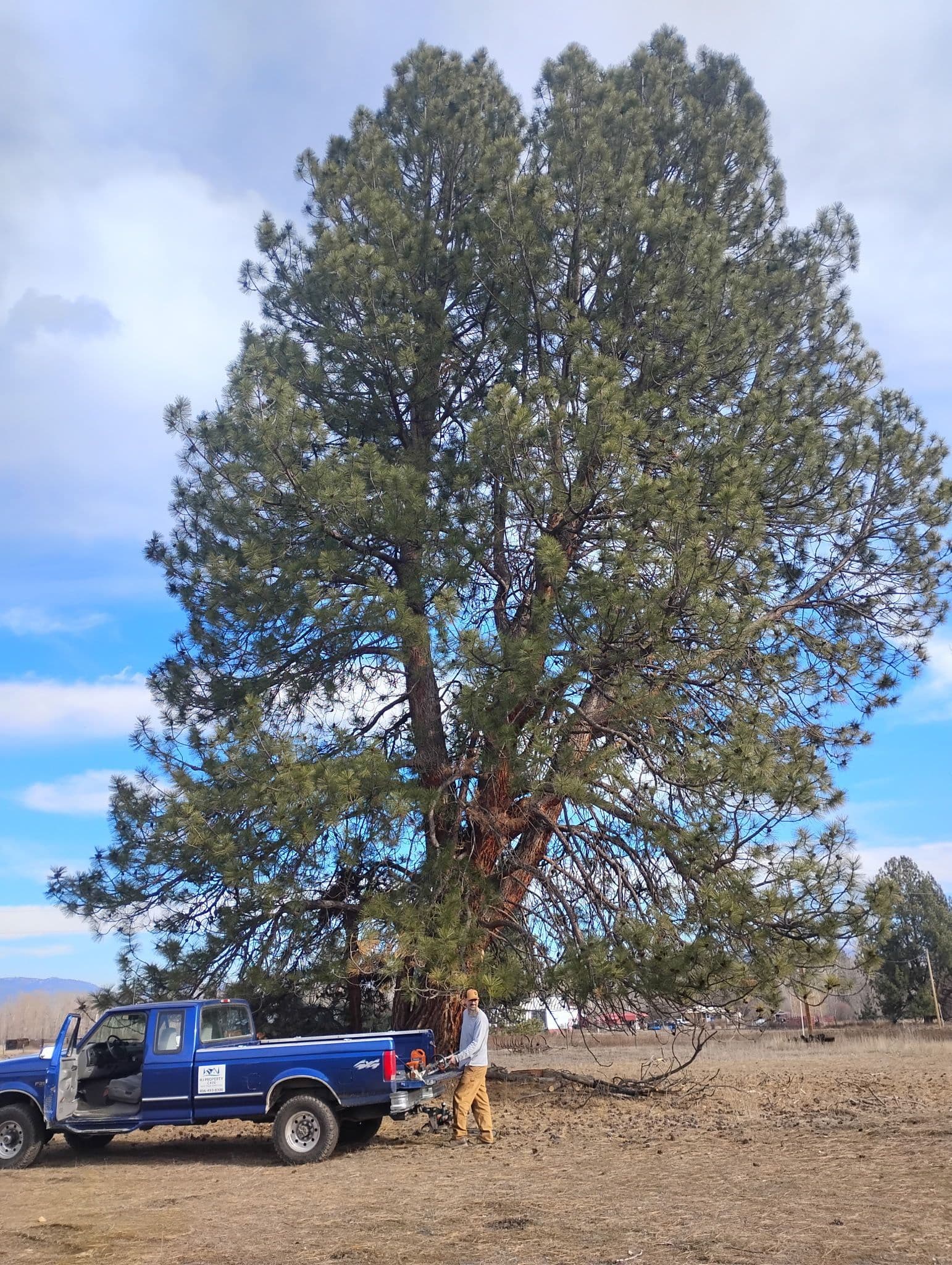
The older CSU fact sheet says that ideally no trees should stand in this innermost band, and that if one is kept, it should be treated as part of the structure: isolated from other trees, pruned to at least 10 feet, cleared of ladder fuels beneath, with the whole defensible space extended accordingly. A large ponderosa beside a house is often worth keeping on those terms. Lifting its limbs and clearing beneath it is tree work our ISA Certified Arborist plans, and see roofs, gutters and valleys for the roof side.
How do you keep Zone 0 clear through the season?
Zone 0 is maintenance, not a one-time project. CSFS lists clearing roof, deck and gutters of needles and raking and removing needles and debris from 5 feet around the foundation and deck among the tasks that may need doing more than once a year. In ponderosa country, needles fall heavily in fall and blow into corners all winter, so a spring check and a mid-summer check before the hottest weeks are sensible.
The CSFS checklist also says that beyond 5 feet from structures, raking will not significantly reduce ignition and can harm trees. So concentrate the raking on the strip against the house and under the deck, not the whole lot. Our pine needle cleanup guide and seasonal cleanups cover the routine.
What does a Zone 0 conversion involve?
Usually less than people fear. The typical job on a Missoula or Bitterroot home is pulling foundation shrubs and bark mulch, laying fabric and rock in a 5-foot band, clearing under the deck, relocating the woodpile, lifting branches off the roof, and cleaning gutters and valleys. Irrigation heads that watered the old beds are capped or moved out to the planted area. Nothing about it requires removing the trees you like.
HJ Property Care does this as part of our fire mitigation service across Missoula and Ravalli counties, alongside landscaping and irrigation changes that move the green space outward. We do not do roofing, siding, vents or deck framing. This guide is part of our Montana Wildfire Guide; the next band out is covered in defensible space zones for western Montana.
Call HJ Property Care & Tree Service at (406) 215-7319 or request a free estimate and we will walk the property with you.
Need help?
HJ Property Care & Tree Service is locally owned and ISA-certified. Call for a free estimate.
This article is part of the Montana Wildfire & Defensible Space Guide, our complete guide for western Montana property owners.
Explore our fire mitigation.
Sources
We cite primary sources: Montana State University Extension, the City of Missoula, and the ISA, so you can verify anything here yourself.
- Noncombustible Zone 0: Minimizing Pathways to Home Ignition (Insurance Institute for Business & Home Safety). Last checked November 2, 2026.
- Vegetation in Zone 0 (17 controlled experiments) (Insurance Institute for Business & Home Safety). Last checked November 2, 2026.
- 2026 Old Trails Fire: Early Insights from a Post-Fire Investigation (Insurance Institute for Business & Home Safety). Last checked November 2, 2026.
- Wildland Fire Embers and Flames: Home Mitigations That Matter (Insurance Institute for Business & Home Safety). Last checked November 2, 2026.
- The Home Ignition Zone: a guide to preparing your home for wildfire and creating defensible space (2021) (Colorado State Forest Service). Last checked November 2, 2026.
- Creating Wildfire-Defensible Zones, Fact Sheet 6.302 (1999 edition, copy hosted by Jefferson-Como Fire Protection District) (Colorado State University Cooperative Extension). Last checked November 2, 2026.
- Forest Landowner Guide, West-Central Montana (home ignition zone and fire ecology sections) (Montana Department of Natural Resources and Conservation). Last checked November 2, 2026.
Ready to transform your outdoor space?
Get a free, no-obligation estimate within 48 hours. Locally owned and ISA-certified.