
Landscaping Rocky, Cobbly Ground in Western Montana
Reviewed by Adam Hurlbert, Owner & Founder, 15+ years in landscape & property care
Put a shovel in the ground on many Bitterroot properties and it stops at the first cobble. That is not bad luck. By our tally of USDA soil survey data, about two thirds of the mapped acreage in the Bitterroot Valley is in soils classed as skeletal, meaning dominated by gravel, cobbles or stones. You cannot sift a whole yard, and you do not need to. This guide explains what rocky ground does to water and roots, what is worth fixing, and how to plant, seed and build on it.
Why is my yard so rocky?
Because the valley was built from material washed out of the mountains. The U.S. Geological Survey's study of the Bitterroot describes coarse deposits along the valley edges and coarse channel deposits from the ancestral Bitterroot River near the center. NRCS soil descriptions show the result: Sheafman soils, formed in coarse gravelly outwash or colluvium from igneous rock, carry 15 to 60 percent rock fragments in one layer and 35 to 80 percent in another, with gravel, cobbles and some stones.
Chereete, the largest series in the Bitterroot Valley Area survey, starts as a gravelly coarse sandy loam and turns sandy-skeletal within about 9 to 18 inches of the surface. In the same survey, about 241,800 of roughly 369,500 mapped acres are in skeletal soil families by our count of the NRCS data. Our guide to Bitterroot Valley soils shows how to look up your lot.
What does rocky soil do to plants?
It mostly limits water. Rock holds no water, so a soil that is half cobble by volume has about half the soil to store it in. NRCS rates Chereete and Sheafman as excessively drained, and gives Chereete rapid and very rapid permeability below its top layer. Water moves through quickly and soon drops below shallow roots.
Nutrients go with it. MSU Extension notes that nitrate can be lost to leaching in shallow or sandy soils, and that sulfur is most likely to be short on coarse, shallow soils. MSU also says slow-release fertilizers should leach less, especially nitrogen, which suits this ground, and it pays to test the soil before buying anything. Rock itself is not a problem for roots, which grow between stones. Many of the region's native plants do well in exactly this ground.
Should I remove the rocks from my yard?
Rarely across the whole yard. Screening a lot is slow, the fine soil left behind is a fraction of what you started with, and more rock often sits just below the depth you cleaned. What usually makes sense is targeted work: pulling the rocks that interfere with a planting hole, the surface cobbles under a lawn so a mower can run, and the trench line for irrigation.
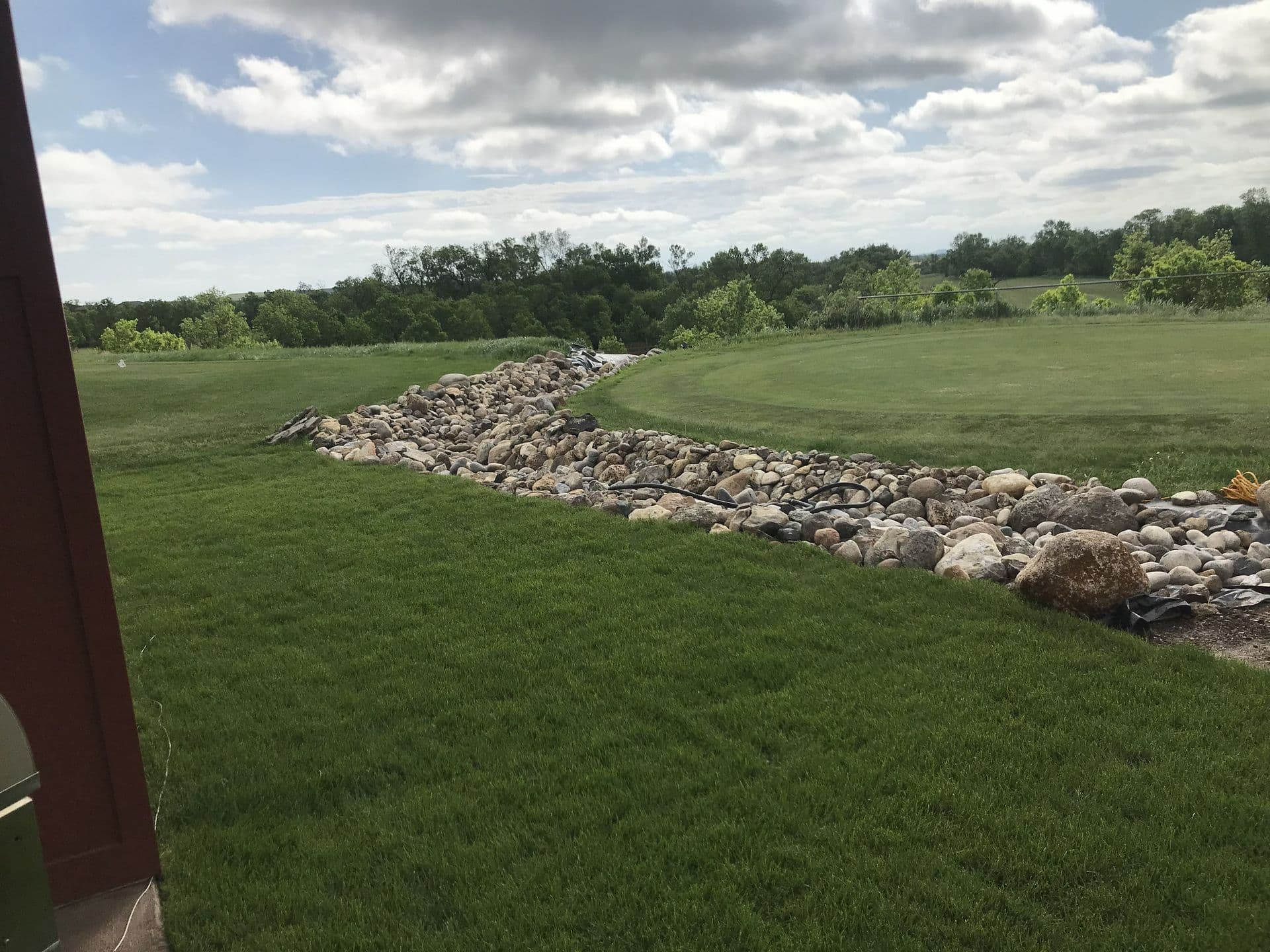
Where you need deeper soil, it is usually better to bring it in and build up than to dig down. Any rock you do pull is a free resource. Larger pieces can become a border, a dry creek bed, a seat wall or part of a boulder and native rock feature.
How do I plant a tree in rocky soil?
Dig wide, not deep, and keep the tree at the right height. The goal is a loosened area around the root ball, cleared of the biggest cobbles, backfilled with the soil that came out of the hole. Our guide on how to plant a tree in Montana covers depth and backfill. Plan access too; on cobbly ground a hole that takes minutes elsewhere can take far longer, or call for equipment.
Watering matters more than the hole. Colorado State University Extension says trees take water best when it soaks in slowly to about 12 inches, spread under the dripline and beyond, and gives a general survival rule for winter watering of 10 gallons for each inch of trunk diameter per watering. MSU's ornamental guide recommends two to three inches of compost mulch to conserve soil moisture, and removing turf from the base of the tree to cut competition for water. Our guide to watering trees in drought goes further.
Can I grow a good lawn on rocky ground?
Yes, with the right base, but the base decides everything. Grass roots mostly work the upper layer of soil, so a thin skin of topsoil over cobble dries out fast and browns first, usually in strips and patches where the rock comes closest to the surface. If you are starting new, bringing in a real depth of screened soil before seeding or sodding is the single most useful thing you can do. Check imported soil for rock and for weeds, since brought-in soil can carry weed seed onto a property; our Ravalli County noxious weeds guide names the ones to watch.
On an existing lawn, irrigate for the soil you have. The EPA's WaterSense program suggests timing how long a sprinkler takes to put down half an inch using empty cans, watering that long twice a week, and adjusting by how the landscape responds. On fast-draining ground you will likely need to split that into shorter, more frequent cycles. Our guides on Montana lawn grasses and renovating a tired lawn cover the rest, and our fertilizer and weed control programs account for soils that leach.
How much water do shrubs need on fast-draining ground?
More often, and in smaller amounts, than the same plant in loam, particularly while it establishes. As a reference point for the dry months, Colorado State University Extension's winter guidance for mulched shrubs is 5 gallons twice a month for a newly planted shrub, 5 gallons a month for small established shrubs under 3 feet, and 18 gallons a month for large ones over 6 feet, reduced for any precipitation, applied within the dripline and around the base. Those are Colorado figures for winter, not a summer schedule, but they show how much a single plant uses.
Mulch makes a real difference on this ground, because bare cobble dries quickly. Keep it a few inches back from stems and trunks, and check new plants by digging down beside the root ball rather than going by how the surface looks.
Are raised beds a good idea on rocky soil?
Often the best idea. A raised bed skips the digging, gives you known soil and keeps a vegetable or flower bed productive where the native ground is mostly stone. Rock or block edging from the site can make the frame. Keep the bed connected to the native soil beneath so water can drain and deep roots can explore.
For bed soil, compost is the main tool. MSU's MontGuide considers 5 to 8 percent organic matter suitable and estimates that three inches of plant compost worked into the top 6 inches can raise it by about 20 percent, compared with about 5 percent for manure compost, so do not overdo it. It also warns that too much manure can leave excess phosphorus and potassium, and that high carbon materials such as bark and straw tie up nitrogen. Our guide to spring garden bed prep walks through getting beds ready.
How does rock affect irrigation and fence posts?
It changes how the job is built. Irrigation trenches in cobble are slow to dig, and sharp rock against poly pipe is a leak waiting to happen, so backfill around pipe matters as much as depth. Drip works well on these soils because it can run on short, frequent cycles right at the root zone; see our drip irrigation guide. Because water moves so fast, group plants by water need into separate irrigation zones.
Fence post holes and footings often need more than an auger can give in cobble, which is worth asking about up front when you price a custom fence. Our guide to frost depth and fence post footings covers how deep posts should go. A cemented layer is a different problem: NRCS describes an indurated silica and lime hardpan 50 to 100 centimeters down in Woodchuck soils, which behaves like rock and affects drainage.
What plants do best in rocky Montana soil?
Start with plants that already live on this ground. NRCS lists bluebunch wheatgrass, basin wildrye, prairie sandreed, Sandberg bluegrass, snowberry and woods rose among the potential native vegetation of the gravelly Riverrun soils, with cottonwoods and willows in places. Our native plants guide and our guide to xeriscaping in western Montana build on that idea.
Drought-tolerant shrubs, ornamental grasses and sun-loving perennials suit a rocky bed, and exposed rock can become part of the design instead of something to hide. Keep thirsty plants near each other and close to the house, on their own zone, and let the rest of the yard get by on less.
Should I use rock mulch on rocky ground?
It looks natural and does not blow away, and it is often the sensible choice in fire-prone areas near a house. The tradeoffs are that rock mulch can get hot in summer sun and adds no organic matter. Around young trees and in planting beds, a layer of compost or shredded wood usually does more for the plant. Keep rock mulch for pathways, steep banks, and areas planted with sun-loving, drought-tolerant species.
Getting rocky ground landscaped
We work on properties from Lolo and Florence down through Hamilton and Darby, and we plan for rock from the first site visit: where to bring in soil, where to reuse rock, and how to set up irrigation so it fits how fast the ground drains. That is part of our landscape design and installation and hardscaping work. This guide is part of our Montana Landscaping, Lawn & Irrigation Guide.
If your yard stops every shovel, call HJ Property Care & Tree Service at (406) 215-7319 or request a free estimate and we will walk it with you.
Need help?
HJ Property Care & Tree Service is locally owned and ISA-certified. Call for a free estimate.
This article is part of the Montana Landscaping, Lawn & Irrigation Guide, our complete guide for western Montana property owners.
Explore our landscaping & design.
Sources
We cite primary sources: Montana State University Extension, the City of Missoula, and the ISA, so you can verify anything here yourself.
- Soil Data Access (SSURGO), Bitterroot Valley Area, Montana survey MT645 (USDA Natural Resources Conservation Service). Last checked November 2, 2026.
- Geology and water resources of the Bitterroot Valley, southwestern Montana (Water Supply Paper 1889) (U.S. Geological Survey). Last checked November 2, 2026.
- Official Soil Series Description: Chereete (USDA Natural Resources Conservation Service). Last checked November 2, 2026.
- Official Soil Series Description: Sheafman (USDA Natural Resources Conservation Service). Last checked November 2, 2026.
- Official Soil Series Description: Riverrun (USDA Natural Resources Conservation Service). Last checked November 2, 2026.
- Official Soil Series Description: Woodchuck (USDA Natural Resources Conservation Service). Last checked November 2, 2026.
- Home Garden Soil Testing & Fertilizer Guidelines, MontGuide MT200705AG (reviewed 10/18) (Montana State University Extension). Last checked November 2, 2026.
- Leaf Chlorosis (Guide to Pests, Problems, and Identification of Ornamental Shrubs and Trees in Montana) (Montana State University Extension). Last checked November 2, 2026.
- Fall and Winter Watering (fact sheet 7.211) (Colorado State University Extension). Last checked November 2, 2026.
- Watering Tips (WaterSense) (U.S. Environmental Protection Agency). Last checked November 2, 2026.
Ready to transform your outdoor space?
Get a free, no-obligation estimate within 48 hours. Locally owned and ISA-certified.