
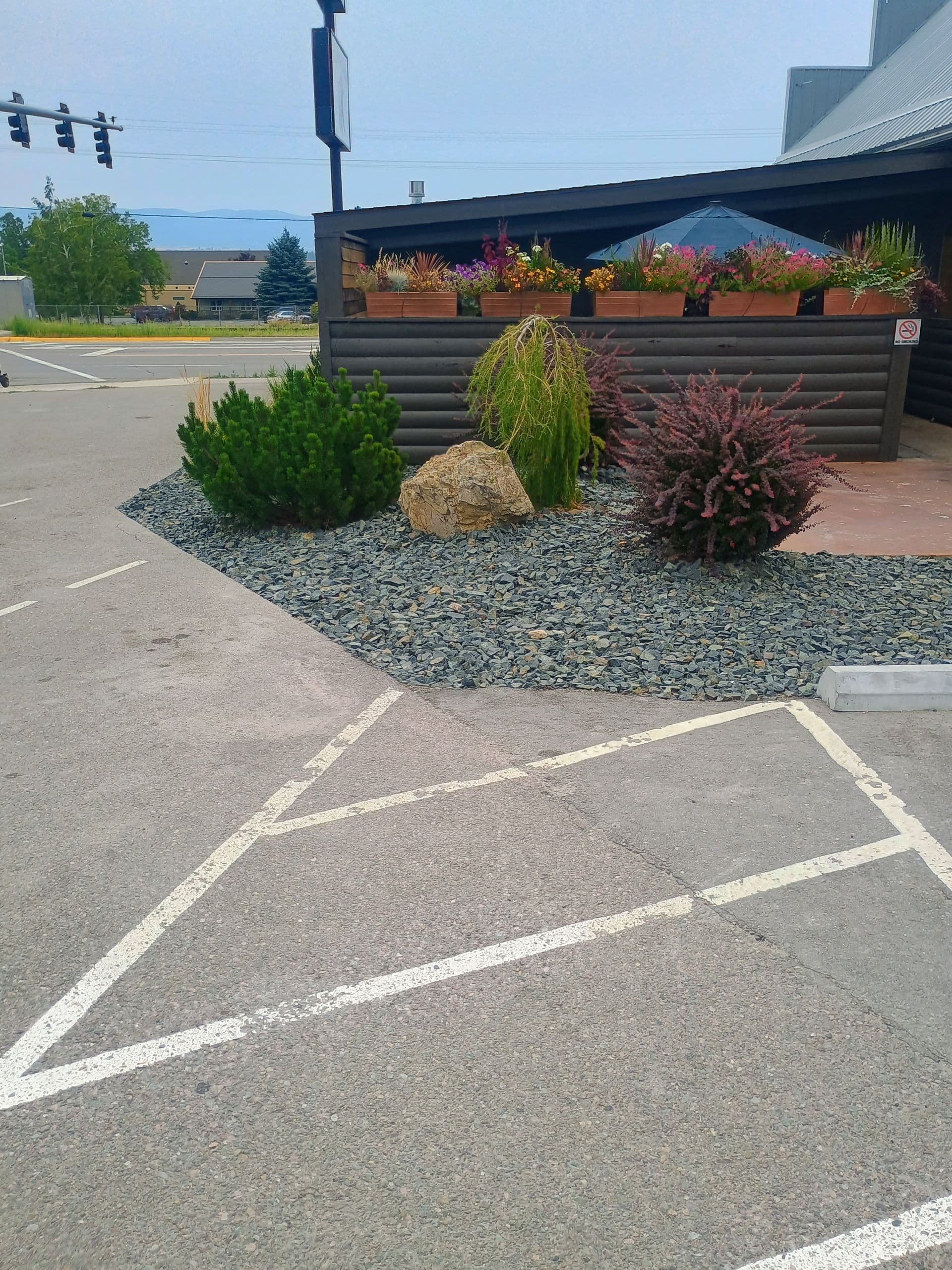
Landscaping Design in Lolo, MT
Reviewed by Adam Hurlbert, Owner & Founder, 15+ years in landscape & property care
Lolo is an unincorporated community in Missoula County, home to 4,399 people at the 2020 census, sitting where Lolo Creek meets the Bitterroot River at the junction of US 12 and US 93. That position shapes landscaping here more than most places we work: creekside lots sit under county floodplain rules, and the foothills to the west are fire country. Here is how we plan a Lolo landscape around both.
What makes landscaping in Lolo different?
Three things. First, Lolo is not an incorporated city, so land use questions go to Missoula County rather than a town hall. Second, Lolo Creek and the Bitterroot River put a share of properties in or near mapped floodplain and riparian areas. Third, the 2017 Lolo Peak Fire showed how close wildfire can come to homes here.
None of that stops a good landscape. It changes the order of questions: what rules apply to this lot, where the water and fire risks are, and only then what the yard should look like. Our landscaping design process starts with that site review.
Do I need a permit to landscape near Lolo Creek?
Possibly, and it is worth asking before work starts. Missoula County administers floodplain permitting outside Missoula city limits, which includes Lolo. The county's floodplain page says a floodplain permit application must be submitted and approved by the floodplain administrator before any development activity, and it asks people planning work within or near a flood hazard area to call the office at (406) 258-4657.
The county also points to riparian resource protection buffers for certain streams and wetlands in Chapter 7 of the Missoula County Zoning Regulations, with an online Riparian Resource Explorer to show how they apply. Grading, fill, walls and patios are the kinds of work to ask about. This is general information, not legal advice: confirm with the county what applies to your parcel. We plan the design around whatever the county tells you, and our guide to retaining wall permits covers the wall side of that question.
Can a creekside Lolo yard be landscaped for the stream?
Yes, and it often looks better for it. Along a creek, a band of native shrubs and grasses holds the bank, filters runoff from the lawn and gives wildlife cover. We would rather design that band in than mow to the water's edge. When we checked, Missoula County's floodplain page also pointed to Missoula Conservation District planting mini-grants for projects involving maintenance or restoration of riparian areas; programs change, so confirm with the district.
Inside the yard, low spots that collect water can become a feature instead of a problem. Our guides to rain gardens and dry creek beds explain how, and standing water in the lawn covers what causes it.
How should a Lolo landscape account for wildfire?
The Lolo Peak Fire started from lightning on 15 July 2017 southwest of Lolo, and the incident record on InciWeb lists it at 53,902 acres. NBC Montana places the start about ten miles from Lolo and reports two homes and several outbuildings destroyed on 17 August. That month the Bitterroot Star reported a mandatory evacuation order for both sides of Highway 12 between Bear Creek and Fort Fizzle, with about 160 households notified. For homes on the forested benches and up the Highway 12 corridor, wildfire belongs in the design brief.
In practice that means keeping the first five feet around the house free of mulch and flammable plants (see Zone 0), spacing shrubs and trees farther from the house, choosing lower-risk plants (see fire-resistant plants for western Montana), and keeping junipers and similar shrubs away from walls; our guide to junipers, arborvitae and other high-risk shrubs explains why. Irrigated lawn and hardscape can act as breaks in fuel. For thinning, limbing and fuel reduction beyond the yard, see our fire mitigation service and the defensible space zones guide.
What grows well in Lolo's climate?
Lolo sits at about 3,576 feet. The PRISM data behind the 2023 USDA Plant Hardiness Zone Map puts the 59847 ZIP in zone 5b, an average coldest night between minus 15 and minus 10 degrees Fahrenheit. That lookup is not the official USDA map and creek bottoms can trap cold air, so we design with plants rated comfortably into zone 4 for anything structural.
We did not find a NOAA normals station in Lolo itself. The 1991 to 2020 normals put Missoula International Airport, to the north, at about 14.1 inches of precipitation a year and Stevensville, to the south, at about 12.5 inches, so a summer landscape depends on irrigation or on plants that can go without it. Montana natives and proven water-wise shrubs and perennials do much of the work; see shrubs for western Montana and hardy perennials for Missoula and the Bitterroot. Where deer are an issue, MSU Extension's deer MontGuide rates plants such as penstemon, blue flax, Oregon grape and shrubby potentilla among the most deer resistant, while warning that no plant is deer-proof.
How much water should a Lolo landscape use?
Many Lolo homes are served by the community water and sewer system, which Missoula County operates as Rural Special Improvement District 901, funded by residents within the district; the county's page lists a contact for water emergencies. Others irrigate from private wells. Either way, follow any watering guidance the district or the county issues, and design so the landscape does not need much.
MSU Extension's lawn MontGuide puts a Montana bluegrass lawn's use at about 1 to 1.5 inches a week early and late in the season and up to about 2.5 inches a week in mid-summer, minus rainfall. Beds on drip use far less: MSU's Yard and Garden Water Management MontGuide says soaker hoses can cut water use by 60 percent or more. Grouping plants by water need, so each zone runs for what is in it, is the biggest single saving. See irrigation systems in Lolo for the system side and drip irrigation for beds and trees.
Can you landscape a sloped lot in the Lolo foothills?
Yes. On a slope the job is mostly about holding soil and slowing water: terraces or retaining walls where the grade is steep, deep-rooted planting where it is not, and irrigation run in short cycles so water soaks in instead of running off. Our guides to landscaping a slope and erosion control on slopes go into detail.
HJ Property Care designs and installs landscapes in Lolo and across Missoula and Ravalli counties: planting, sod, beds, rock, hardscape, fencing and irrigation. For more planning guidance, see our Montana Landscaping, Lawn & Irrigation Guide. Call (406) 215-7319 or request a free estimate.
Need help in Lolo, MT?
HJ Property Care & Tree Service is locally owned and ISA-certified. Call for a free estimate.
Explore our landscaping & design, or see everything we handle in Lolo, MT.
Sources
We cite primary sources: Montana State University Extension, the City of Missoula, and the ISA, so you can verify anything here yourself.
- Lolo census-designated place, 2020 Census population (POP100), TIGERweb (U.S. Census Bureau). Last checked November 2, 2026.
- Floodplain and Shoreline Administration (Missoula County Planning, Development and Sustainability). Last checked November 2, 2026.
- Lolo Peak Fire incident overview (archived InciWeb page, September 2018) (U.S. Forest Service, Lolo National Forest, via InciWeb). Last checked November 2, 2026.
- Plant hardiness zone for ZIP 59847 (PRISM data behind the 2023 USDA map; not the official USDA map) (PHZM API / PRISM Climate Group, Oregon State University). Last checked November 2, 2026.
- Minimizing Deer Damage in Residential Settings (MontGuide MT202308AG) (Montana State University Extension). Last checked November 2, 2026.
- Lolo Rural Special Improvement District #901 (Lolo water and sewer) (Missoula County Public Works). Last checked November 2, 2026.
- Maintaining Successful Lawns in Montana (MontGuide MT202004AG, revised 08/23) (Montana State University Extension). Last checked November 2, 2026.
- Yard and Garden Water Management (MontGuide MT198915AG) (Montana State University Extension). Last checked November 2, 2026.
Ready to transform your outdoor space?
Get a free, no-obligation estimate within 48 hours. Locally owned and ISA-certified.