
Controlling Erosion on a Sloped Montana Yard
Reviewed by Adam Hurlbert, Owner & Founder, 15+ years in landscape & property care
A slope that is bare, freshly graded, or covered in thin turf will move. In western Montana it moves in two bursts: during the spring melt, when water runs across frozen ground, and during summer thunderstorms that drop a lot of rain on dry, hard soil in a few minutes. Every gully, silt fan at the bottom of a hill and exposed root on a bank is soil that left. The fixes are well understood and mostly cheap if they are done in the right order: cover the soil now, slow the water coming from above, then plant something with roots that will hold the slope for good. This guide covers each step, including the blanket ratings that matter on steep ground and the state permit that applies if your slope runs down to a creek or river.
Why do sloped yards erode so fast here?
Bare soil is the starting point for almost all of it. Erosion happens when water moving across the surface has enough speed to pick up soil, and on a slope with nothing growing on it, nothing slows the water or holds the soil. The Building America Solution Center, the Department of Energy's building guidance site run by Pacific Northwest National Laboratory, lists rainstorms, flooding and wind as the causes, and notes that unchecked erosion can ruin landscaping and even destabilize a site.
Our climate adds a twist. Snowmelt runs off frozen ground that cannot absorb it, so a slope that looks fine all summer can cut a channel in March. Aspect matters too. The same guide points out that south-facing slopes warm up and dry out more quickly than other areas, while north-facing slopes stay cooler, which means the sunny face of a hill is usually the hardest to keep covered. Disturbed ground after construction, a septic install, utility trenching, or fuel reduction work is especially vulnerable until something grows back.
What is the first thing to do on a bare slope?
Cover it, even temporarily. The Building America erosion guide recommends seeding bare soil with a quick temporary cover such as annual ryegrass or barley and covering it with 2 to 4 inches of straw. For newly seeded areas it suggests 2 to 3 bales of straw per 1,000 square feet. On flat or gently sloping ground the straw can be anchored by crimping it 2 to 4 inches into the soil. On steep slopes, the guide says to anchor mulch with netting or tackifiers, or use erosion control blankets instead.
Two practical notes for Montana. Use certified weed-free straw if you can find it, so you are not seeding the slope with weeds along with your cover crop. And timing matters: a slope seeded in late fall may not germinate until spring, so the straw or blanket is doing all the work through the melt. If the slope is next to a driveway or walk, put a straw roll or wattle at the bottom to catch what moves before it reaches the pavement, as the same guide recommends for the base of slopes during construction.
Which erosion control blanket should I use?
The one rated for your slope. Blankets are woven or stitched mats of straw, coconut fiber, jute or synthetic material laid over seeded soil and pinned down. The Building America guide lists maximum recommended gradients for temporary biodegradable products: mulch control netting up to 5:1, netless blankets up to 4:1, single-net blankets up to 3:1, double-net blankets up to 2:1, and slowly degrading blankets and open weave textiles up to 1.5:1. A 3:1 slope means 3 feet of horizontal distance for every foot of rise; a 2:1 slope is steeper.
For channels and areas that carry concentrated water, the guide describes turf reinforcement mats, which are permanent, non-degradable synthetic mats that give long-term protection in high-flow conditions while vegetation grows through them. On a homeowner slope, the most common mistake is using a light blanket on ground that is too steep for it, or not pinning it well enough to stay in contact with the soil. Water that gets under a blanket erodes just as well as water on bare ground.
Is grass or shrubs better for holding a slope?
On steep ground, deeper-rooted plants that you never need to mow. The Building America guide says to plant vegetation on any ground that slopes more than 25 percent, and on slopes greater than 50 percent (1 foot of rise for every 2 feet of run) to use plants that do not need mowing. It also notes that operating a mower may not be safe on slopes steeper than 2:1. That alone rules out turf on a lot of steep hillsides.
The same guide explains why: trees and shrubs create a tight network of roots and stems that binds soil and slows water, while turf grass binds soil but may not slow runoff, and heavy rain can wash turf away roots and all. Taller grasses, wildflowers, shrubs and trees do a better job. In practice that means native bunchgrasses, groundcovers and shrubs suited to the aspect. Our guides to native plants for the Bitterroot, shrubs for western Montana and landscaping a slope or hillside cover plant choice in detail; this guide is about keeping the soil in place while they establish.
When should a slope be terraced or walled?
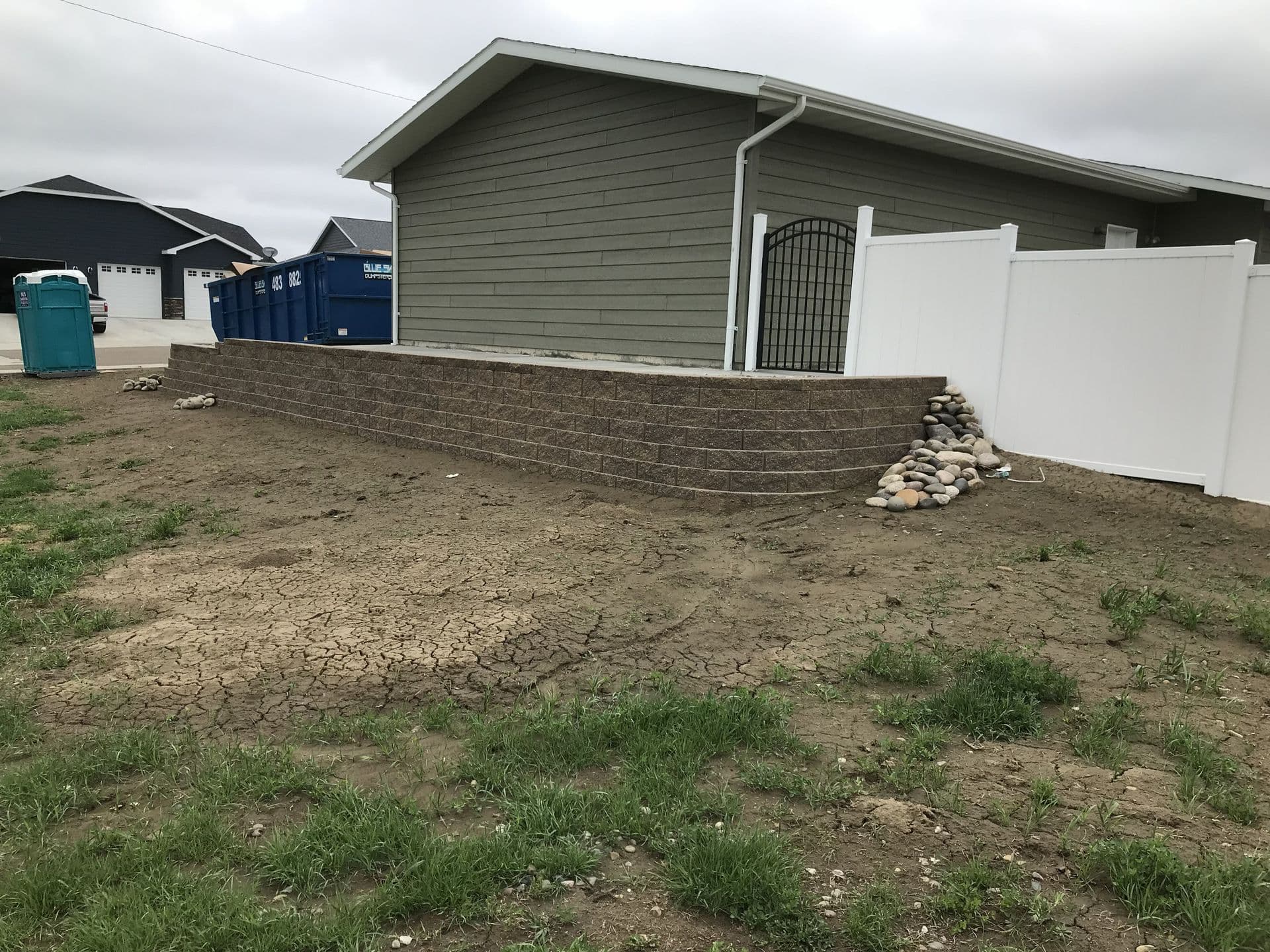
When it is too steep or too long to hold with plants alone, or when you need usable flat ground. The Building America guide describes terraces as steps cut into the slope, with the cut soil used as fill and a low berm at the front edge of each step to slow water. It lists terracing and retaining walls as options for steep slopes. Terraces also make planting and maintenance possible on ground you cannot otherwise stand on.
A terrace held by a wall is a structure, and the wall has to handle soil, water and frost pressure behind it. Drainage behind the wall is not optional in this climate. Our retaining wall installation work covers that, and our guide to when a retaining wall needs a permit or engineer explains where the line is. If an existing wall is leaning or bulging, read our guide on retaining wall failure signs before adding more soil above it.
How do I slow down water coming from above the slope?
Intercept it before it reaches the face. A slope that erodes every spring is often taking water from a driveway, roof or field uphill. The Building America guide describes building a swale and berm together across a slope to slow the downhill flow of water, and recommends swales with side slopes no steeper than 3 to 1 and a channel fall of 2 to 4 percent. A properly built swale at the top of a slope turns sheet flow into a controlled channel that can be led around the steep part.
Roof water is the other big contributor. Downspouts that empty at the top of a bank cut gullies quickly. The erosion guide recommends directing drainage away from bare soils and fill areas, dispersing flow over vegetated areas, and placing rocks at the base of drainage outlets to dissipate the energy of the water. Our guide to downspout extensions covers where roof water should go, and our guide to dry creek beds covers a rock-lined channel that carries water down a slope without cutting it.
Should I water an eroding slope?
Carefully. New seed and plantings need water to establish, but spray irrigation on a steep, bare slope can start the erosion you are trying to stop, because water runs off before it soaks in. The Building America guide says only irrigation methods suitable for slopes should be used. On most slopes that means drip lines on the contour, run in short cycles so water soaks in between runs. Our guide to drip irrigation explains how it is laid out.
Check the slope after the first few waterings and after every heavy storm until plants fill in. Small rills are easy to fix with a rake and a little more straw. Ignored, they become gullies that need fill and a blanket.
Do I need a permit to work on a creek or river bank?
Very likely, if the stream runs year round. MSU Extension's overview of Montana's Natural Streambed and Land Preservation Act, known as the 310 Law, says anyone planning a project that will affect the bed or immediate banks of a perennial stream, on public or private land, must first get a 310 permit from the local conservation district, and that there is no fee for the permit. It notes natural stabilization options such as willow lifts, woody debris and biodegradable fabric wraps as alternatives to riprap, and that emergency work to protect life or property must be reported to the district within 15 days.
Around Missoula the jurisdiction splits. Missoula County's 310 page says that within the 1946 Missoula city limits, the County Commissioners administer the law for the Clark Fork River and Rattlesnake Creek, and that a permit is needed for disturbing a streambank and may be needed for removing vegetation within 50 feet of a river or creek. Outside that area, the Missoula Conservation District handles it, and in Ravalli County, the local conservation district does. We do not design streambank projects. If your eroding slope ends at a creek, talk to the conservation district first.
Can fire mitigation work cause erosion?
Any work that exposes soil can. Thinning, limbing and clearing brush for fire mitigation can leave drag paths, burn pile scars and raked areas bare for a season. On steep ground, treat those patches like any other bare slope: seed them, cover them, and check them after the first big melt or storm.
We handle grading and surface drainage, rock drainage features, retaining walls and planting for long-term cover as part of our landscaping design work across Missoula and the Bitterroot Valley. This guide is part of our Montana Landscaping, Lawn & Irrigation Guide. Call (406) 215-7319 or request a free estimate and we will walk the slope with you.
Need help?
HJ Property Care & Tree Service is locally owned and ISA-certified. Call for a free estimate.
This article is part of the Montana Landscaping, Lawn & Irrigation Guide, our complete guide for western Montana property owners.
Explore our landscaping & design.
Sources
We cite primary sources: Montana State University Extension, the City of Missoula, and the ISA, so you can verify anything here yourself.
- Erosion Control for Slopes, Stream Banks, and Dunes (Building America Solution Center (U.S. Department of Energy, Pacific Northwest National Laboratory)). Last checked November 2, 2026.
- Swales, Drains, and Site Grading for Stormwater Control (Building America Solution Center (U.S. Department of Energy, Pacific Northwest National Laboratory)). Last checked November 2, 2026.
- Working in Montana's Streams and Rivers: An overview of the 310 Law (Lives and Landscapes, Summer 2026) (Montana State University Extension). Last checked November 2, 2026.
- 310 Permits (Missoula County Planning, Development and Sustainability). Last checked November 2, 2026.
Ready to transform your outdoor space?
Get a free, no-obligation estimate within 48 hours. Locally owned and ISA-certified.