
Standing Water in the Lawn: Causes and Fixes
Reviewed by Adam Hurlbert, Owner & Founder, 15+ years in landscape & property care
A puddle in the lawn is a symptom, not a diagnosis. The same soggy patch can come from soil packed hard by traffic, a spongy thatch layer, a low spot that collects runoff from the rest of the yard, ground that is still frozen in March, or a sprinkler zone that runs too long. Each has a different fix, and the wrong fix (a drain where the problem was compaction, or aeration where the problem was a hollow) wastes a season. This guide walks through how to tell the causes apart in a western Montana yard and what actually helps each one.
Why does water stand on my lawn?
Water stands when it arrives faster than the ground can take it in, or when it has nowhere to drain to. In a lawn there are five usual reasons: the soil is compacted, a thick thatch layer is shedding water, the area is a low spot that collects water from elsewhere, the ground underneath is frozen, or irrigation is putting down more than the soil can absorb. Often two of these stack up, such as a low corner of the yard that also gets the most foot traffic.
Start by noticing when the water appears. Puddles that only show up during the spring melt point to frozen ground and grading. Puddles after every summer watering point to irrigation or compaction. Puddles after a thunderstorm that drain within an hour are normal. Water that sits for a day or more, kills the grass, or leaves a silt crust is worth fixing.
How do I know if my lawn soil is compacted?
Compaction is soil squeezed so tight that the pore spaces water and air move through are crushed. UMass Amherst's turf program lists the effects plainly: less total pore space, less oxygen in the soil, slower water infiltration and percolation, harder and denser soil, and more water held at the surface. In a home lawn it comes from foot traffic, dogs running the same path, vehicles parked on the grass, and construction equipment, which is why new-build lawns are so often compacted from the start.
The easiest field check is a long screwdriver or a soil probe. Push it into the lawn in the wet spot and in a healthy area nearby, both a day or two after watering. If it slides in easily in one place and stops after an inch or two in the other, you have found compaction. Shallow roots are the other clue: dig a small plug and look at how far the roots go down. Worn paths, bare spots along fences where dogs patrol, and the strip where the trash cans roll are classic places to find it.
What fixes a compacted lawn?
Core aeration. Montana State University Extension's MontGuide on maintaining lawns in Montana says aeration is best done with coring machines that remove cores 1/4 to 3/8 inch in diameter and 3 to 4 inches deep, that it should happen when the turf is growing vigorously in spring and fall and never when it is dormant, and that the soil should be moist so the tines can penetrate. The same guide warns that devices using solid spikes are not effective and can add to compaction.
UMass adds that coring is not a cure-all. Compaction also has to be managed by changing the traffic that caused it, and turf needs 3 to 4 weeks of good growth to recover after coring before summer heat or winter cold. MSU suggests that on poor soils, a thin 1/4 inch layer of compost after aerating can help. Our guide on when to aerate and overseed a Montana lawn covers timing in more detail, and our aeration and overseeding service handles the equipment.
Can thatch cause standing water?
It can. Thatch is the layer of dead, undecomposed stems and roots between the green blades and the soil. MSU Extension says a thatch layer thicker than half an inch interferes with the penetration of air, water and nutrients, and that a healthy layer is no more than that. A thick mat acts like a thatched roof: water beads and runs across it, collects in low spots, and the soil underneath can be dry while the surface is soggy.
MSU says most thatch problems come from overly vigorous growth and can be corrected by cutting back nitrogen and irrigation, that aeration reduces heavy thatch faster than dethatching, and that mechanical dethatchers do severe damage and should be reserved for thatch that has become excessive. Clippings left on the lawn do not cause thatch, according to the same MontGuide. Our guide to thatch and dethatching goes deeper.
What if the puddle is a low spot?
Then the soil may be fine and the shape of the yard is the problem. Water from roofs, driveways and the rest of the lawn runs downhill and stops in the lowest place, which is often a hollow over an old trench, a settled area over a buried utility line, or the edge where a lawn meets a patio or walk that is a little high. Check it with a string line, or simply watch where water flows during a rain or melt.
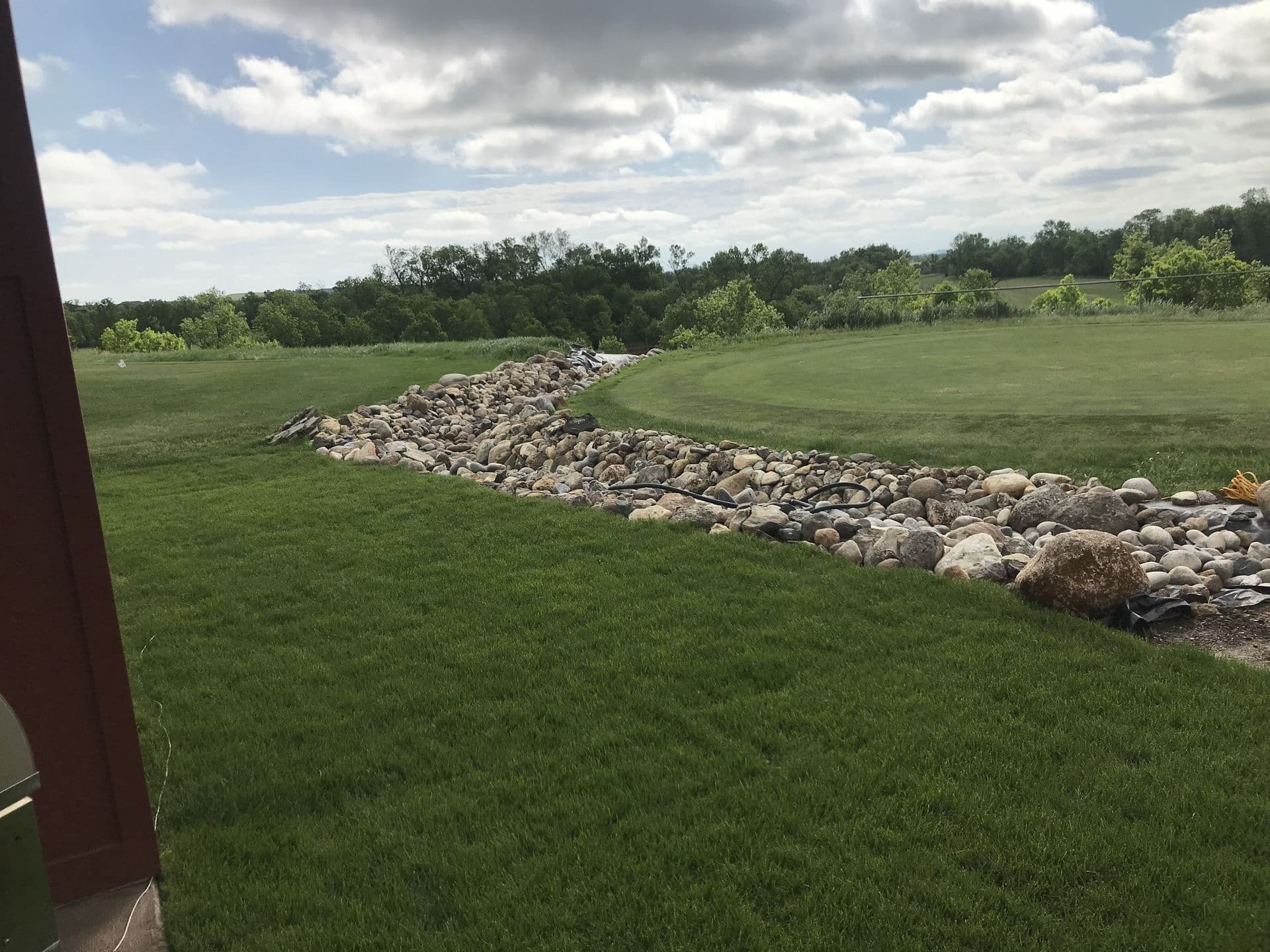
Shallow hollows can be fixed by topdressing a little at a time, spreading a thin layer of soil or compost and letting the grass grow up through it, repeated over a season. Deeper ones need the sod lifted, the base filled and compacted, and the sod relaid. If the low spot is next to the house, it is a grading problem, and our guide to grading away from the foundation is the right place to start. If the low spot is the natural drainage path for the whole yard, the fix is to give the water a route out, with a swale, a French drain or a planted rain garden.
Why is my lawn flooded in March but dry in July?
Because in March the soil is still frozen under the thawing snow. Frozen ground takes in almost nothing, so snowmelt runs across it and pools in every low spot, even in a yard that drains fine in summer. That water often refreezes overnight into ice sheets on the lawn. Our guide to yard drainage during spring melt explains how to read it, and where to put plowed snow so you are not creating the puddle yourself.
Snow cover also brings snow mold. Matted, straw-colored or pinkish patches that show up as the snow leaves are usually a disease problem made worse by long snow cover and wet conditions, not just a drainage one. MSU's fall checklist recommends mowing shorter, about 1.5 inches, for the last cut in areas that get plenty of snow cover, to discourage snow mold. Our guide to snow mold and winter kill covers recovery.
Could my sprinklers be causing the puddles?
Very often. MSU's lawn MontGuide says to water deeply and as infrequently as the soil allows, early in the morning, and points out that clay soils take in water slowly and must be watered more slowly, while sandy soils absorb fast and dry out fast. A spray zone that dumps water on clay faster than it soaks in will puddle every time, no matter how good the soil structure is. UMass describes cycling irrigation, applying the water in several shorter runs, as one way to manage compacted turf.
Look for heads that are tilted, sunk or spraying the same spot from two directions, a zone that runs much longer than the others, or a wet spot that stays wet even on days the system did not run, which can mean a leak. Our guides to irrigation leak signs and irrigation zone design cover the system side, and our sprinkler repair crew can find and fix it.
Does standing water hurt the grass?
Yes, if it lasts. Waterlogged soil runs out of oxygen, and roots need oxygen. Grass that sits in saturated soil for long stretches thins out, and the bare patch that follows fills with weeds that tolerate wet, compacted soil. Ice is its own hazard: Colorado State University Extension notes that a solid layer of ice persisting on a lawn for more than a month can suffocate or mat the grass. UMass lists restricting traffic during soggy conditions as part of managing compaction, so stay off wet turf when you can.
Once the cause is fixed, the damaged area usually needs core aeration and overseeding, or new sod in a badly affected spot. Our guide to renovating a tired lawn explains the options short of starting over.
What should I do first?
Watch, probe and measure. Note when the water shows up, push a screwdriver into the wet spot and a dry one, check the slope with a string line, and look at what the sprinklers are doing in that zone. Those four checks usually point to one or two causes. Fix the cheapest likely cause first: adjust irrigation, aerate, and change traffic patterns before digging a drain.
We aerate, overseed, regrade, repair sprinklers and build drainage across Missoula and the Bitterroot, and our licensed lawn care and weed control program keeps the turf healthy once the water is sorted out. This guide is part of our Montana Landscaping, Lawn & Irrigation Guide. Call (406) 215-7319 or request a free estimate and we will look at the wet spot with you.
Need help?
HJ Property Care & Tree Service is locally owned and ISA-certified. Call for a free estimate.
This article is part of the Montana Landscaping, Lawn & Irrigation Guide, our complete guide for western Montana property owners.
Explore our fertilizer & weed control.
Sources
We cite primary sources: Montana State University Extension, the City of Missoula, and the ISA, so you can verify anything here yourself.
- Maintaining Successful Lawns in Montana (MontGuide MT202004AG, revised August 2023) (Montana State University Extension). Last checked November 2, 2026.
- Management of Compaction: Coring (UMass Amherst Center for Agriculture, Food, and the Environment). Last checked November 2, 2026.
- Fall Garden Care and Winter Preparation Checklist (Lives and Landscapes, Fall 2021) (Montana State University Extension). Last checked November 2, 2026.
- Fall and Winter Watering (fact sheet 7.211) (Colorado State University Extension). Last checked November 2, 2026.
Ready to transform your outdoor space?
Get a free, no-obligation estimate within 48 hours. Locally owned and ISA-certified.