
Defensible Space Zones, Zone by Zone, for Western Montana
Reviewed by Justin Johnson, ISA Certified Arborist (RM-8889A)
Defensible space is usually described in three rings around a house. The rings are easy to draw and harder to apply on a real western Montana lot, where the ground tilts, the trees are ponderosa pine, Douglas-fir and lodgepole rather than a generic forest, and the house has a deck, a shop and a woodpile. This guide is the practical version: what to do in each zone, using Montana DNRC and Colorado State Forest Service guidance written for ponderosa pine and Douglas-fir country, how to adjust on a slope, and what changes in aspen, lodgepole and grass.
What are the defensible space zones?
The Colorado State Forest Service home ignition zone guide uses three zones: Zone 1 from 0 to 5 feet, Zone 2 from 5 to 30 feet, and Zone 3 from 30 to 100 feet on relatively flat ground. IBHS and others now call the first band Zone 0, but the distances are the same. CSFS notes that its spacing guidelines are written for ponderosa pine, Douglas-fir and mixed conifer forests, which is exactly what surrounds most homes in the Missoula and Bitterroot valleys.
Montana DNRC's landowner guide for west-central Montana gives the core numbers for our region in four lines: keep 5 feet around the home free of anything that will burn, clean the roof and gutters, remove branches over or touching the roof to at least 10 feet, prune branches 10 feet high and keep at least 18 feet between trees or clumps of trees in the area 5 to 30 feet from the home. The rest of this guide expands on those.
What do you do within 5 feet of the house?
Remove everything that can burn. CSFS's list for this zone is to remove flammable vegetation including shrubs, slash, mulch and woody debris; use hard surfaces such as rock, gravel, cement or pavers; store no firewood or combustibles; prune branches over the roof and remove fuels within 10 feet of the chimney; keep roof, deck and gutters clear; and keep the space under decks empty. It also says raking needles matters within 5 feet of structures and decks, but that farther out raking does not significantly reduce ignition and can harm trees.
That last point saves a lot of wasted effort. Raking an entire wooded lot bare is hard on the trees and does little for the house. Raking the strip against the walls and under the deck does a great deal. This zone has its own guide, Zone 0: the first five feet.
What do you do between 5 and 30 feet?
Reduce fuel so that a fire arriving near the house is small. CSFS's critical steps for this zone are to mow grass to 4 inches or less; avoid large accumulations of logs, branches, slash and mulch; thin trees to at least 10 feet between crowns, measured from the outermost branch of one tree to the nearest branch of the next; allow small groups of two or three trees if 30 feet is kept between groups; remove ladder fuels; prune branches to 6 to 10 feet or a third of the tree's height, whichever is less; and remove stressed, diseased, dead or dying trees and shrubs.
DNRC's numbers for this band are a little more conservative: branches pruned 10 feet high and 18 feet between trees or clumps. Read the two together: the goal is gaps between crowns big enough that fire cannot pass from one to the next, and nothing low enough to let a ground fire climb. Shrubs can stay in this zone if they are isolated and not under trees; CSFS recommends keeping shrubs at least 10 feet from the edge of tree branches and spacing shrub clumps at least two and a half times their mature height apart. It also singles out common ground juniper for removal where possible because it is highly flammable and holds dead material beneath it. Our guide to junipers, arborvitae and other high-risk shrubs has more.
What do you do between 30 and 100 feet?
Keep fire on the ground. In this outer zone CSFS suggests 6 to 10 feet between tree crowns, openings or small meadows between clumps of trees so that fire has to drop to the ground to keep moving, and attention to ladder fuels. Mowing is not necessary out here. Any approved slash treatment is acceptable, though CSFS prefers treatments that remove woody material over lop-and-scatter or mulching, and says the farther the material is from the home, the better.
This zone is also where forest health and fire overlap. CSFS describes a healthy forest as one with trees of multiple ages, sizes and species with adequate growing room. Oregon State, Idaho and Washington State extension's guide for forest owners, Reducing Fire Risk on Your Forest Property, recommends keeping larger trees of more fire-resistant species, and names ponderosa pine, western larch and Douglas-fir as species that develop thick, insulating bark. Thinning in this zone is usually a matter of removing the small, crowded and suppressed trees and keeping the big ones. See thinning conifers for defensible space for spacing by slope.
How does slope change defensible space?
It stretches the zones, especially downhill. An older Colorado State University Extension fact sheet gives a worked example: on a 20 percent slope, the minimum defensible space would be 90 feet uphill and to the sides of the home and 104 feet downhill. CSFS's newer guide says its horizontal spacing figures are minimums that can be increased, particularly on slopes, and the PNW forest owner guide lists steep slopes and high winds among the factors that increase the crown spacing needed.
The reason is that fire spreads faster uphill, because heat rising ahead of the flames preheats and dries the fuel above it. A house at the top of a slope, or on a bench above a draw, takes the brunt of a fire running up from below. Much of the Missoula County landscape is steep: its 2018 wildfire plan reports that 47 percent of the county has slopes over 30 percent. Our guide to slope, aspect and wind explains how to read your own lot.
What changes for aspen, lodgepole and grass?
CSFS gives forest-type exceptions that apply here. Its spacing and ladder fuel guidelines do not apply to mature aspen stands, and it generally recommends no thinning in aspen because the thin bark is easily damaged and prone to fungal infection; instead, remove dead trees on the ground and young conifers growing up into the aspen. Older lodgepole pine stands do not respond well to selective thinning and can blow down when opened; CSFS suggests removing no more than 30 percent of trees in a mature stand at a time, or leaving clumps.
Spruce and fir have crowns that reach the ground, so removing the lower branches that act as ladder fuels is recommended, but heavy thinning invites windthrow. Grass is the opposite of trees: CSFS notes that grass fires catch easily and spread rapidly but burn out quickly, though grass can still ignite a structure directly next to it. That is why mowing in the inner 30 feet matters so much on the open benches of the Bitterroot. See cheatgrass and dry grass for more.
What about driveways, woodpiles, tanks and outbuildings?
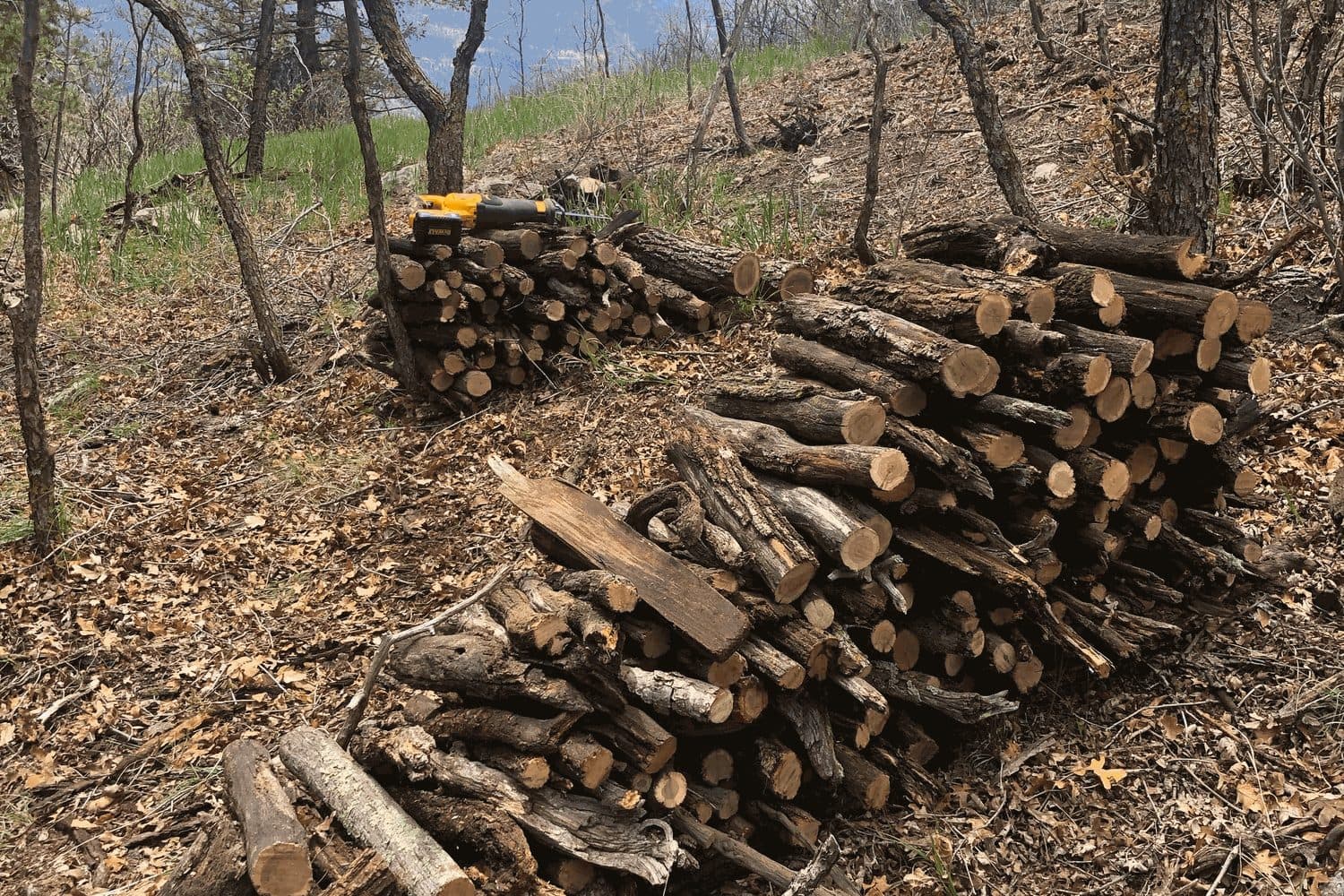
They need their own clearances. CSFS recommends keeping firewood at least 30 feet from the home, uphill from or level with structures, with flammable vegetation cleared within 10 feet of woodpiles; keeping aboveground fuel tanks at least 30 feet from the home with vegetation cleared 10 feet around tanks and gas meters; and thinning to at least 10 feet between crowns for 30 feet on each side of the driveway from the house to the main road. It also recommends treating each building on the property as the center of its own zones.
We cover these in separate guides: firewood storage, propane tanks and fuel, sheds and outbuildings and driveway access for fire engines.
What do you do with all the cut material?
Get it out of the zones near the house. CSFS says slash from thinning should be chipped, hauled to a disposal site or piled in open areas for later burning, that any accumulation should be 30 feet or more from the home, and that chips should not form a continuous layer: break them up with nonflammable material or leave gaps of at least 3 feet between chip areas. A thinning job that leaves a carpet of chips or a slash pile beside the house has moved the fuel, not removed it.
In pine stands, timing matters too. The PNW guide warns that green pine slash larger than three inches in diameter created from winter through mid-July can breed Ips bark beetles, which may then attack healthy trees. Our guides to slash disposal options and pine engraver beetles and slash cover the details.
How often does defensible space need to be redone?
Some of it every year, some of it every few. CSFS says needles in gutters and grass and weed mowing may need attention several times a year, while other actions are annual or one-time. Trees grow, shrubs fill in and needles fall every season. Our guide to how often defensible space needs maintenance sets out a schedule.
HJ Property Care does this work across Missoula and Ravalli counties as part of our fire mitigation service: ladder fuel removal, limbing to ANSI A300 standards, selective thinning, needle and debris cleanup, and chipping or hauling the slash. We plan the zones around the trees you want to keep. This guide is part of our Montana Wildfire Guide.
Call HJ Property Care & Tree Service at (406) 215-7319 or request a free estimate and we will walk the property with you.
Need help?
HJ Property Care & Tree Service is locally owned and ISA-certified. Call for a free estimate.
This article is part of the Montana Wildfire & Defensible Space Guide, our complete guide for western Montana property owners.
Explore our fire mitigation.
Sources
We cite primary sources: Montana State University Extension, the City of Missoula, and the ISA, so you can verify anything here yourself.
- The Home Ignition Zone: a guide to preparing your home for wildfire and creating defensible space (2021) (Colorado State Forest Service). Last checked November 2, 2026.
- Forest Landowner Guide, West-Central Montana (home ignition zone and fire ecology sections) (Montana Department of Natural Resources and Conservation). Last checked November 2, 2026.
- Creating Wildfire-Defensible Zones, Fact Sheet 6.302 (1999 edition, copy hosted by Jefferson-Como Fire Protection District) (Colorado State University Cooperative Extension). Last checked November 2, 2026.
- Reducing Fire Risk on Your Forest Property, PNW 618 (Oregon State University, University of Idaho and Washington State University Extension). Last checked November 2, 2026.
- PNW 618 Appendix B: The Effects of Topography, Weather, and Fuel on Fire Behavior (Oregon State University, University of Idaho and Washington State University Extension). Last checked November 2, 2026.
- Missoula County Community Wildfire Protection Plan, February 2018 Update (Missoula County). Last checked November 2, 2026.
Ready to transform your outdoor space?
Get a free, no-obligation estimate within 48 hours. Locally owned and ISA-certified.