
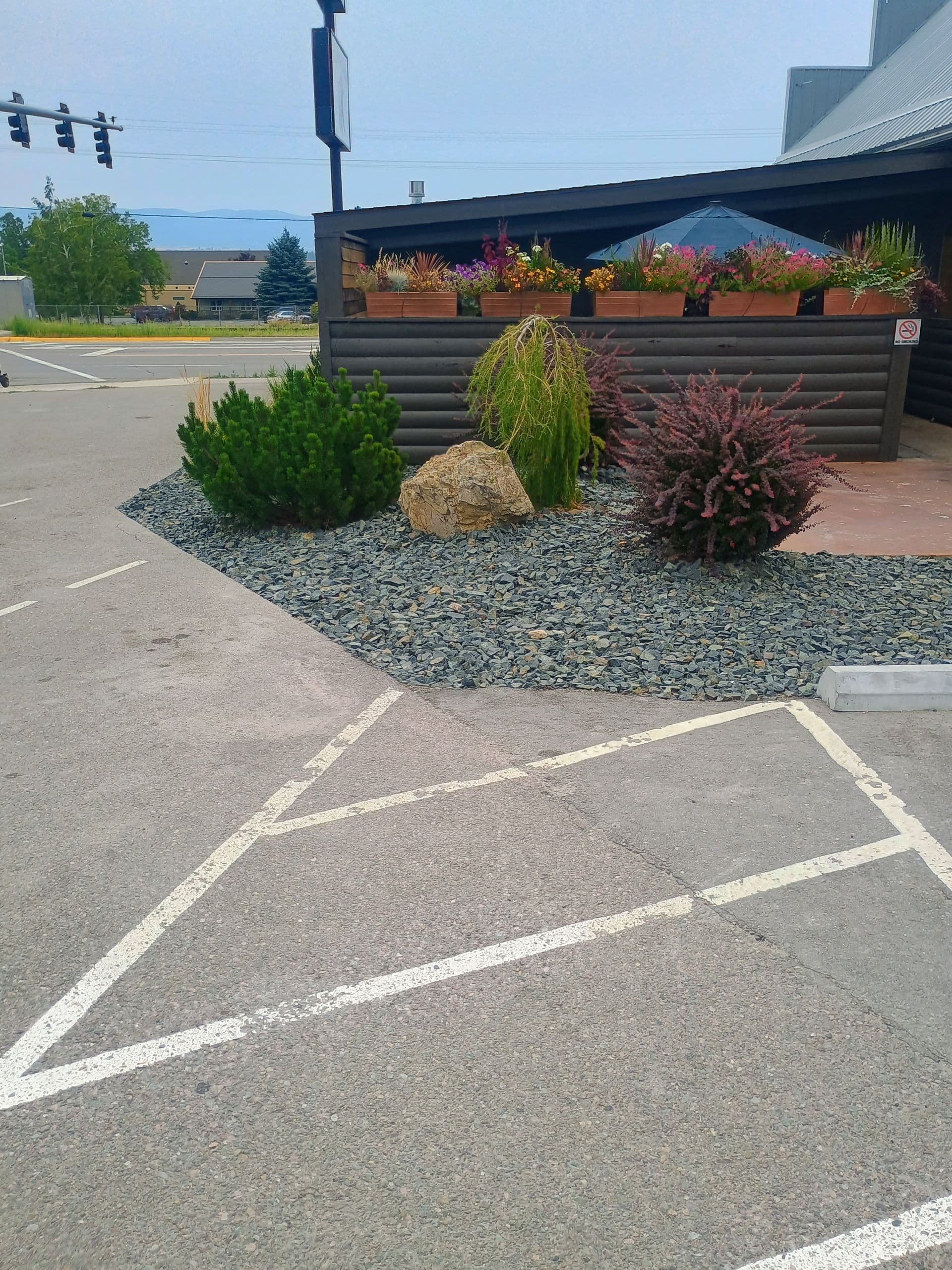
What Drives Landscaping Costs in Western Montana
Reviewed by Adam Hurlbert, Owner & Founder, 15+ years in landscape & property care
Two neighbors can ask for what sounds like the same front yard and get quotes that are nowhere near each other. Usually neither quote is wrong. The difference is underneath the yard: the soil, the slope, the rock, how a skid steer gets in, where the water goes, and how much of the work is invisible once it is finished. This guide walks through the factors that actually move the cost of a landscaping project in Missoula and the Bitterroot Valley, so you can read a quote, compare two of them fairly, and decide where your budget does the most good. We do not publish prices here, because a number without a site visit is a guess, and the point of this page is to explain why.
Why do landscaping quotes vary so much?
Because most of the cost is set by the site, not by the plan drawing. A landscape is mostly labor and material moved across ground, and the ground decides how much moving there is. A flat, open lot with loamy soil and a wide gate is a different job from a sloped lot on cobble with access through a side yard, even if the finished plan looks the same on paper.
Quotes also differ in what they include. One contractor prices soil preparation, irrigation changes, haul-off and cleanup; another prices plants and sod and leaves the rest vague. Before comparing totals, line the scopes up. Our guide to choosing a landscaping company covers how to ask for a scope you can compare.
How much does the soil change the cost?
More than most owners expect, and it is the line most often trimmed. Montana State University Extension notes that Montana soils typically run around pH 7 to 8, which is alkaline, and recommends a soil test at least every three to four years so amendments are based on numbers rather than guesses. A test is a small cost that can save buying material the ground does not need.
Soil texture matters as much as chemistry. MSU's lawn establishment MontGuide describes an ideal lawn soil as a sandy loam and says that working about 2 inches of composted organic material into the top 6 inches of soil will substantially improve soil structure. On a new build where the topsoil was stripped or buried under construction fill, that amendment step is real material and real hours. It is also the step that decides whether the planting looks good in five years. See soil testing for Montana yards and Bitterroot Valley soils for what to look for.
Grading and drainage: the work you never see
Water gets settled first on any project we build, and it is often the largest share of the hours on a lot that has a problem. MSU Extension recommends at least a 1 percent slope away from the house for a lawn, which it describes as about one foot of drop per 100 feet, or about an inch every 8 feet. If the existing grade runs toward the foundation, correcting it means moving soil before anything else happens.
MSU also advises that when the grade of a lawn has to change, the top 6 inches of soil should be stripped, the grade changed, and the topsoil put back. That preserves good soil instead of burying it, but it is two handlings of the same material instead of one. Drainage features such as a French drain or dry creek bed add trenching, rock and fabric. Our guides to grading away from the foundation and French drains explain when those are needed.
Does slope make a project cost more?
Yes, in several ways at once. Equipment is slower and less safe on a grade, material has to be carried rather than driven, and soil wants to move downhill until something holds it. MSU's lawn guide says slopes as steep as 33 percent will support turf but that mowing and runoff will cause problems, and that steeper grades are better planted with a low-maintenance ground cover.
On a hillside lot, part of the budget goes to holding the slope: terracing, boulders, erosion matting, or a retaining wall, which carries its own cost drivers. Our guide to landscaping a slope covers the design options.
How does rock and cobble affect the price?
Plenty of lots in the Missoula and Bitterroot valleys have gravel and cobble in the ground, and you rarely know how much until you dig. Digging a planting hole, a trench for irrigation pipe or a footing for a wall in that ground is slower than digging in loam, and the rock that comes out has to go somewhere. Sometimes it can be reused as a feature, which is the cheapest way to deal with it. Our guide to landscaping rocky ground has the design side.
We price rocky sites after digging a test hole or two, not from a satellite photo. If a quote on a cobbly lot looks much lower than the others, ask how the contractor plans to dig.
Access, equipment and haul-off
Access is one of the quiet cost factors. A compact track loader that fits through the gate moves material in minutes that a crew with wheelbarrows moves in hours. A fenced back yard with a narrow side path, a lawn that cannot be driven on, or a long carry from the street all add labor. Removing a section of fence for access and putting it back is sometimes cheaper than hand-carrying a project's worth of soil and rock.
Haul-off is the other half. Old sod, broken concrete, overgrown shrubs and excess soil all have to leave the site, and disposal is charged by the load. A quote that does not mention removal either includes it silently or leaves it for later.
Which plant choices change the budget?
Size is the biggest one. A larger nursery container gives an instant look but costs more to buy, takes more labor to plant and needs more water to establish. Smaller stock is cheaper, establishes well and catches up faster than most people expect. Plant count matters too: a design that relies on mass planting of perennials uses many plants per bed.
Choosing plants that suit the site saves money twice: at installation and every summer after. The EPA WaterSense program recommends choosing plants defined as low water use or drought tolerant for your area, which can survive with minimal supplemental watering. Our guides to xeriscaping in western Montana, shrubs for western Montana and hardy perennials list proven choices.
Lawn, sod or seed?
Turf is often the largest single area in a yard, so the way it goes in changes the total. Sod costs more up front and gives a finished surface right away. Seed costs less in material and asks for patience and careful watering. MSU Extension says a Montana lawn can be seeded in late April and May but that seeding from mid-August to mid-September is better, because annual weeds do not have time to set seed and the grass has fall and early spring to establish. Our sod or seed comparison goes into the tradeoffs.
Less lawn is also a cost decision. Replacing a strip that is hard to water or mow with planting beds can raise the installation number and lower the yearly upkeep.
How does irrigation fit into the cost?
Almost every new landscape in this climate needs water delivered to it, so irrigation work belongs in the same budget conversation, not after it. Adding zones, converting beds from spray to drip, or relocating heads that a new patio will cover are all common line items. The EPA says the average American household uses more water outdoors than for showering and washing clothes combined, which is why zoning by plant need is worth paying for.
We cover system pricing separately in our irrigation system cost guide, and zone layout in how irrigation zones should be laid out.
Hardscape, walls and fences change the scale
Patios, walkways, retaining walls and fences are each their own cost category, driven mostly by excavation, base preparation and material. They are also the parts of a landscape where cutting corners shows up after the first winter. Each has its own guide: patio and hardscape cost factors, retaining wall cost factors and fence installation cost factors.
Do utilities and locates affect a project?
They affect the schedule and occasionally the design. Montana law requires notice through the one-call center before excavation, and under the Montana Code the owners of underground lines have two business days to mark them once notified. Montana811 also warns that private underground facilities may not be located through its system, which on a residential lot often means sprinkler lines, low-voltage lighting, and power or water run to a shop or outbuilding.
If those private lines are in the way, finding them takes time, and a design sometimes shifts to avoid them. Telling the contractor what you know about buried lines on your property saves both.
Does timing or season change the cost?
Timing changes availability more than anything. Spring is the busiest stretch for landscape crews here, and projects designed over the winter are first in line when the ground thaws. Fall is a good planting window for many trees and shrubs, and it is often easier to schedule. Splitting a large project into seasons spreads the cost and lets each phase be done in the right weather; our guide to phasing a landscape project shows how that works.
Where should the budget go first?
Spend first on the things that are hard to redo: grading, drainage, soil preparation, irrigation mains and the base under any hard surface. Plants, mulch, lighting and decor can be added or upgraded later without tearing anything out. A plan that puts money into the surface and skimps underneath tends to cost more within a few years.
If you are not sure how to split the budget, ask the contractor to price the project in phases, with the infrastructure in phase one. That gives you a clear picture of what the full plan involves and lets you build it at your own pace.
How we quote landscaping work
We start with a property walk and measurements, then give a written scope with a cost breakdown, and adjust the design with you before anything is built. Our landscaping design and installation work covers sod, planting, beds, hardscaping and xeriscaping across Missoula and the Bitterroot Valley, and estimates are free. This page is part of our Montana Landscaping, Lawn & Irrigation Guide, where the planning, planting and hiring guides are collected.
Call HJ Property Care & Tree Service at (406) 215-7319 or request a free estimate and we will walk the property with you and put the scope in writing.
Need help?
HJ Property Care & Tree Service is locally owned and ISA-certified. Call for a free estimate.
This article is part of the Montana Landscaping, Lawn & Irrigation Guide, our complete guide for western Montana property owners.
Explore our landscaping & design.
Sources
We cite primary sources: Montana State University Extension, the City of Missoula, and the ISA, so you can verify anything here yourself.
- Home Garden Soil Testing and Fertilizer Guidelines (Montana State University Extension). Last checked November 2, 2026.
- Planning and Planting Successful Lawns in Montana, MontGuide MT202003AG (Montana State University Extension). Last checked November 2, 2026.
- WaterSense: Outdoors (U.S. Environmental Protection Agency). Last checked November 2, 2026.
- WaterSense: What to Plant (U.S. Environmental Protection Agency). Last checked November 2, 2026.
- Montana Code Annotated 2025, 69-4-503 (excavation notice and locate marking) (Montana Legislature). Last checked November 2, 2026.
- Montana811: call before you dig, homeowner requests and private lines (Montana811). Last checked November 2, 2026.
Ready to transform your outdoor space?
Get a free, no-obligation estimate within 48 hours. Locally owned and ISA-certified.