
What Drives Patio and Hardscape Cost in Western Montana
Reviewed by Adam Hurlbert, Owner & Founder, 15+ years in landscape & property care
Most of what you pay for in a patio is buried. The pavers or stone on top are the part you choose and see, but the excavation, the compacted gravel base, the edge restraint and the drainage underneath decide whether the surface is still flat after a few Montana winters. That hidden work is also where quotes differ most. This guide explains the factors that drive patio, walkway and hardscape cost in Missoula and the Bitterroot Valley, why freeze-thaw country costs more to build in properly, and what to ask so two quotes describe the same project. We do not give prices; every site is measured first.
What makes up the cost of a patio?
Think of a patio in layers: excavation and haul-off, the compacted base, a bedding layer, the surface material, the edges, and the finish details such as steps, borders and joint sand. On top of that sit the site factors: soil, slope, drainage and access. The surface material is often a smaller share of the total than people expect, and the base is often larger.
Patio size matters, but not linearly. A small patio still needs equipment brought in, a base built and edges set, so the cost per square foot tends to fall as the area grows.
Why does the base matter so much here?
Because water in the ground freezes. A base that holds water lifts when it freezes and settles unevenly when it thaws, and after enough cycles a patio that was flat in September is heaved by April. A deep, well-compacted, free-draining base is what prevents that. Our guide to patio base preparation in frost country explains the mechanics, and hardscaping and freeze-thaw covers the damage patterns.
The paver manufacturer Unilock says base thickness depends on three things: how compacted the site soil is, how well it drains, and whether the surface carries foot traffic or vehicles. For patios and walkways it suggests 6 to 8 inches of base in established areas and 8 to 10 inches in newer developments, where the soil has been disturbed. For clay soils, which usually drain poorly, it recommends a minimum of 8 inches of gravel for pedestrian areas. Those are one manufacturer's guidelines, not a building code, but they show why the same patio can need very different amounts of digging and gravel.
How does soil type change the price?
Clay and silty soils hold water, so they need more base and sometimes a drainage outlet. Sandy and gravelly soils drain well and often need less. Unilock notes that well-drained sandy soil resists frost movement while clay needs extra base to build a frost-resistant layer. More base means more excavation, more material hauled in and more soil hauled out, so soil type can change a patio quote noticeably.
Disturbed ground around new houses is its own case. Backfill around a foundation can keep settling, and a patio built on it without extra compaction or depth can follow it down. If your house is new, tell the contractor; it changes how the base should be built. Our guide to Bitterroot Valley soils explains what is typically under a yard here.
Does drainage add to a patio project?
Often, and it should. A patio replaces ground that used to absorb water with a hard surface that sheds it, and that water has to go somewhere other than your foundation. Montana State University Extension recommends at least a 1 percent slope away from the house for lawns, about an inch every 8 feet, and a patio needs a similar fall built into its surface. If the yard already drains toward the house, fixing that comes first.
Where water has nowhere to go, the project may need a drain line, a dry creek bed or a French drain. Those are extra line items, but they are cheaper than a heaved patio or a wet basement. See grading a yard away from the foundation.
Which surface materials cost more?
Concrete pavers, natural flagstone, cut stone, poured concrete and gravel each have different material costs and, more importantly, different labor. Pavers go down quickly in a running pattern; complex patterns, borders and curves need more cutting. Irregular flagstone is fitted piece by piece, which takes time and skill. Our comparison of pavers and poured concrete and our guide to flagstone patios explain how each performs in freeze-thaw.
Simple shapes cost less than curves. Every curve, angle and obstacle such as a downspout or a utility box means cuts, and cuts are labor and waste.
What about steps, walls and fire features?
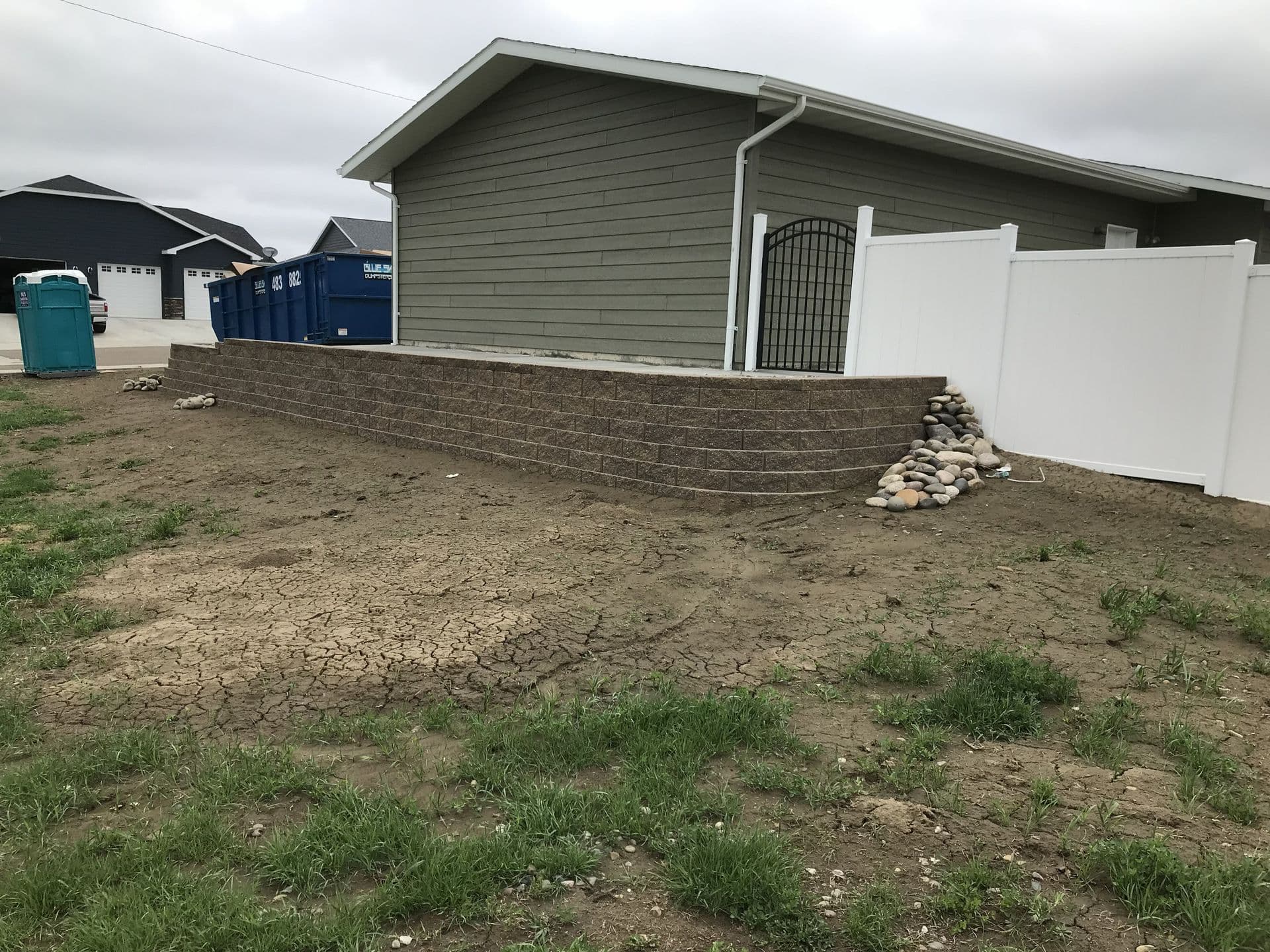
Anything with height costs more than flat paving. Steps need solid footings and precise rise and run. Seat walls and raised patios need a base, a wall and drainage behind it, and above a certain height become retaining walls, which have their own cost drivers. Fire pits add a feature and a set of rules; read fire pit rules in Missoula and Ravalli County before you plan one. In wildfire country, a patio can also serve as part of the noncombustible area near the house; see using patios, paths and rock as firebreaks.
How do access and excavation affect cost?
A patio project moves a lot of material: soil out, gravel and pavers in. If a compact loader can reach the work area, that goes quickly. If everything has to come through a narrow side gate in wheelbarrows, labor goes up sharply. Removing an old patio, a concrete slab or a lawn adds tear-out and disposal.
Excavation also triggers the utility locate. Montana law requires notice through the one-call center before excavation, and Montana811 cautions that private lines such as sprinkler pipe and landscape lighting wire may not be located through its system. Irrigation heads or lines under a planned patio usually have to be moved, which is another line item; see how irrigation zones should be laid out.
Does a parking pad or driveway apron cost more than a patio?
Yes, because vehicles load the base far more than feet do. Unilock's guidance is that a 10 inch base is generally sufficient for a driveway in established areas, that 12 to 14 inches of gravel may be required in newer developments, and that clay soils need at least 12 inches under vehicles. Compare that with the 6 to 8 inches it suggests for patios in established areas and the extra excavation and gravel are easy to see.
If there is any chance a paved area will carry a truck, a trailer or a snow plow, say so before it is quoted. Building a patio base and then parking on it is one of the most common reasons pavers rut and sink. Our guide to gravel driveway maintenance covers the unpaved option.
What ongoing costs come with a patio?
Pavers and flagstone need occasional attention: topping up joint sand, resetting a paver that has settled, and pulling weeds from joints. Poured concrete needs less routine work but is harder to repair when it cracks. De-icers can damage some surfaces, so ask what is safe on the material you choose before the first winter. These costs are small compared with the installation, but they belong in the decision.
Walkways and paths: same factors, smaller scale
A walkway follows the same rules as a patio: base, edges, drainage and material. Narrow paths have more edge per square foot, so edge restraint and cutting make up a bigger share. Paths that carry snow shovels and de-icer every winter need materials that tolerate both; our guide to walkway and path materials compares the options, and landscape edging options covers what holds a path in place.
What should a hardscape quote include?
Ask for the patio area and shape, excavation depth, base material and compacted thickness, bedding layer, surface material and pattern, edge restraint, how drainage is handled, what happens to existing irrigation, tear-out and haul-off, and cleanup. Also ask what the contractor does if the soil turns out worse than expected once the digging starts.
Two quotes with the same surface material and very different base depths are not the same patio. In this climate the cheaper one is usually the one with less gravel under it.
How do you keep a patio budget under control?
Keep the shape simple, choose a standard paver size and pattern, plan for good access, and do not cut the base. If the full plan is more than the budget, build the patio now and add the fire pit, lighting or seat wall in a later season; phasing a landscape project explains how to sequence it. The base is the one part you cannot add later.
How we build and quote hardscape
Our hardscaping work covers paver and flagstone patios, walkways, steps, seat walls, fire pits and rock work, built on compacted, free-draining bases with drainage planned in. We design hardscape together with planting and irrigation as part of our landscaping design and installation service, and estimates are free across Missoula and the Bitterroot Valley. More planning guides are in the Montana Landscaping, Lawn & Irrigation Guide.
Call HJ Property Care & Tree Service at (406) 215-7319 or request a free estimate and we will walk the property with you and put the scope in writing.
Need help?
HJ Property Care & Tree Service is locally owned and ISA-certified. Call for a free estimate.
This article is part of the Montana Landscaping, Lawn & Irrigation Guide, our complete guide for western Montana property owners.
Explore our landscaping & design.
Sources
We cite primary sources: Montana State University Extension, the City of Missoula, and the ISA, so you can verify anything here yourself.
- How Much Base Is Required for Paving Stone Installation (Unilock). Last checked November 2, 2026.
- Planning and Planting Successful Lawns in Montana, MontGuide MT202003AG (Montana State University Extension). Last checked November 2, 2026.
- Montana Code Annotated 2025, 69-4-503 (excavation notice and locate marking) (Montana Legislature). Last checked November 2, 2026.
- Montana811: call before you dig, homeowner requests and private lines (Montana811). Last checked November 2, 2026.
Ready to transform your outdoor space?
Get a free, no-obligation estimate within 48 hours. Locally owned and ISA-certified.