
Thinning Conifers for Defensible Space: Crown Spacing by Zone and Slope
Reviewed by Justin Johnson, ISA Certified Arborist (RM-8889A)
Most wooded lots around Missoula and in the Bitterroot have more conifers than the ground historically carried, and the trees closest to the house are usually the ones with their crowns touching. Thinning is how defensible space gets built on a lot like that: you take out enough trees that a fire in one crown cannot jump straight into the next. The hard part is the numbers. Montana DNRC, NFPA's Firewise program and the Colorado State Forest Service each publish spacing figures, they are not identical, and all of them say the distance has to grow on a slope. This guide lays the figures side by side, explains how to measure, and covers what to keep, what to remove and how to do it without creating a beetle problem.
What does crown spacing actually mean?
Crown spacing is the open gap between the outer branches of neighboring trees, not the distance between trunks. Colorado State University's fact sheet on defensible zones is explicit about it: do not measure between stems, measure between the edges of the tree crowns. Two pines planted 20 feet apart with 12-foot-wide crowns have only about 8 feet of crown spacing, and as they grow that gap closes.
That is why spacing work is never a one-time number. A thinning that meets the target this year will be short of it in a decade unless someone comes back. It also explains why the figures below are minimums: every agency that publishes them says to widen them where the fire would be more intense. Thinning handles the horizontal gaps. The vertical gap, from the ground to the lowest branches, is a separate job covered in our guide on how high to limb up trees, and the two work together as part of the wider Montana Wildfire Guide.
How far apart should trees be near a Montana home?
The Montana figure to start from is in DNRC's Forest Landowner Guide for west-central Montana, which covers Missoula and the Bitterroot: maintain a minimum of 18 feet between trees or clumps of trees in the area 5 to 30 feet from your home. NFPA's Firewise guidance uses the same 18 feet for its intermediate zone (5 to 30 feet), with the distance increasing with the percentage of slope, and says tree placement should keep the mature canopy no closer than 10 feet to the edge of the structure.
Farther out, NFPA steps the spacing down: trees 30 to 60 feet from the home should have at least 12 feet between canopy tops, and trees 60 to 100 feet out at least 6 feet. NFPA notes these crown spacings are suggestions based on its standard NFPA 1144, and that the spacing needed to prevent crown fire could be significantly greater because of slope, species and other site conditions.
The Colorado State Forest Service's 2021 Home Ignition Zone guide uses smaller baseline numbers: at least 10 feet between crowns in its 5 to 30 foot zone, and 6 to 10 feet in the zone beyond 30 feet. It flags all of its horizontal figures as minimums that can be increased, particularly on slopes. For a house in Montana timber we use DNRC's 18 feet as the working target close to the house, because it is the Montana number and it matches Firewise.
Inside the first 5 feet there is no spacing figure, because the goal there is no fuel at all. DNRC says to keep that area free of anything that will burn. Trees growing right against a wall are a separate decision covered in Zone 0: the first five feet, and the zone system as a whole is explained in defensible space zones for western Montana.
How does slope change tree spacing?
Fire runs uphill faster and preheats the fuel above it. MSU Extension's MontGuide on fire-resistant landscaping puts it plainly: fire moves rapidly uphill, heating everything upslope through radiant and convective heat, so the distance between trees and structures should be increased on a steep slope. The Montana guide does not give a slope table. The most widely reproduced one comes from Colorado.
Colorado State University's fact sheet 6.302 (2003, written with the Colorado State Forest Service) lists minimum tree crown spacing by slope: 10 feet on a 0 to 10 percent slope, 15 feet on 11 to 20 percent, 20 feet on 21 to 40 percent, and 30 feet above 40 percent. The same table scales shrub clump spacing from 2 1/2 times shrub height on gentle ground to 3, 4 and then 6 times shrub height as the slope steepens. California's CAL FIRE spacing diagrams, reproduced by University of California Extension, make the same point: horizontal spacing is directly related to the slope of the land and the height of the vegetation.
Slope also stretches the whole defensible space. The Colorado fact sheet's example is a home on a 20 percent slope, where the minimum defensible space runs 90 feet uphill and to the sides and 104 feet downhill, because the fuel below the house is what a fire will climb through to reach it. Percent slope is rise over run, so a 20 percent slope gains 20 feet of height for every 100 feet across. Our guide to slope, aspect and wind explains why the downhill side gets the most attention.
Treat the Colorado table as a floor, not a target. Its baseline of 10 feet on flat ground is below Montana DNRC's 18 feet near the house, so on a slope we start from 18 feet and widen it, which is consistent with both NFPA's note that spacing increases with slope and the Colorado guide's advice to consult a forestry professional for slopes.
Which trees should stay and which should come out?
The order of removal is fairly consistent across the guidance. The Colorado State Forest Service lists removing stressed, diseased, dead or dying trees and shrubs first. NFPA adds removing small conifers growing between mature trees, which is exactly the understory that turns a surface fire into a crown fire. After that, the choice is about which healthy trees have the best future.
Species matters. DNRC's landowner guide explains that frequent surface fires once kept west-central Montana forests open and favored fire-resistant western larch and ponderosa pine, with their thick bark and deep roots. In a mixed stand we generally favor those two and remove the smaller, shade-tolerant Douglas-fir and grand fir crowding beneath them, a pattern covered in Douglas-fir encroachment and fire risk. MSU Extension adds that deciduous trees such as aspen are often preferred over conifers near homes because of their higher moisture content, unless they are stressed.
Within a species, keep the larger, better-formed trees with full crowns, and take out the suppressed, leaning, forked or damaged ones. A big old ponderosa is worth working around; the reasons are in why ponderosa pine is built for fire. Dead trees are a separate decision with their own hazards, covered in dead standing trees near homes.
Can I keep a clump of trees together?
Yes, within limits. The Colorado State Forest Service allows small groups of two or three trees in its 5 to 30 foot zone, with 30 feet maintained between the remaining groups so fire cannot jump from one group to the next. DNRC's 18-foot figure is written as between trees or clumps of trees, and NFPA says trees and shrubs in the intermediate zone should be limited to small clusters of a few each to break up continuity.
A clump behaves like one large crown, so the spacing is measured from the outside edge of the whole group. Clumps also matter for wind. The Colorado guide notes that older lodgepole pine stands respond poorly to heavy selective thinning and can suffer windthrow, recommends removing no more than 30 percent of a mature stand in each operation, and suggests leaving clumps rather than isolated trees. DNRC's guide notes lodgepole grows at higher elevation sites in west-central Montana, so on those lots we often thin in stages over several seasons rather than all at once.
What about shrubs and small trees between the conifers?
Shrubs under a conifer are the classic ladder fuel. The Colorado State Forest Service says isolated shrubs can stay in the 5 to 30 foot zone as long as they are not growing under trees, and to keep shrubs at least 10 feet from the edge of tree branches. Its clump rule is spacing of at least 2 1/2 times mature height between shrub clumps, with each clump no wider than twice its height: shrubs that grow 6 feet tall are spaced 15 feet apart in clumps no more than 12 feet across.
For vertical separation, the CAL FIRE diagrams reproduced by University of California Extension use three times the shrub height between the top of a shrub and the lowest tree branch, so a 5-foot shrub needs 15 feet of clearance. The Colorado guide singles out common juniper for removal wherever possible because it is highly flammable and holds dead material beneath it; our guide to junipers, arborvitae and other high-risk shrubs goes further. The way these layers connect is explained in ladder fuels.
Does the driveway need thinning too?
It should. The Colorado State Forest Service checklist calls for at least 10 feet between tree crowns, thinned a minimum of 30 feet back from each side of the driveway from the house to the main access road. A driveway lined with touching crowns is both the evacuation route and the fire engine's way in. Width, vertical clearance and turnarounds are covered in driveway access for fire engines.
Will thinning attract bark beetles?
It can if the timing and slash are handled badly. The Forest Service's 2025 pine engraver management guide, hosted by Montana DNRC, says green pine slash larger than two inches in diameter is ideal habitat for pine engraver beetles, and that recently thinned stands may temporarily be more attractive because soil disturbance and damage to the remaining trees lower their vigor. It advises avoiding damage to residual trees and not stacking slash or fresh pine logs against live pines.
The same guide rates slash created from April through July as an extreme risk, because the beetles are active and looking for fresh material, and slash created from August through November as low to moderate risk, because it has time to dry before spring. That is one reason we schedule pine thinning for late summer through winter; the full calendar is in why fall and winter are the best time for fuel reduction and the beetle itself in pine engraver beetles and slash. Over the long run the guide is clear that thinned, vigorous pine stands are less attractive to the beetle.
Is thinning alone enough?
Thinning breaks crown-to-crown spread, but it adds fuel to the ground on the day it is done. The Forest Service's Fire Effects Information System notes that thinning alone can reduce the possibility of crowning by reducing density and removing ladder fuels, but does not substantially reduce understory and litter layers. DNRC's landowner guide says forests that have been both mechanically thinned and burned have proven the most resistant to high-severity fire.
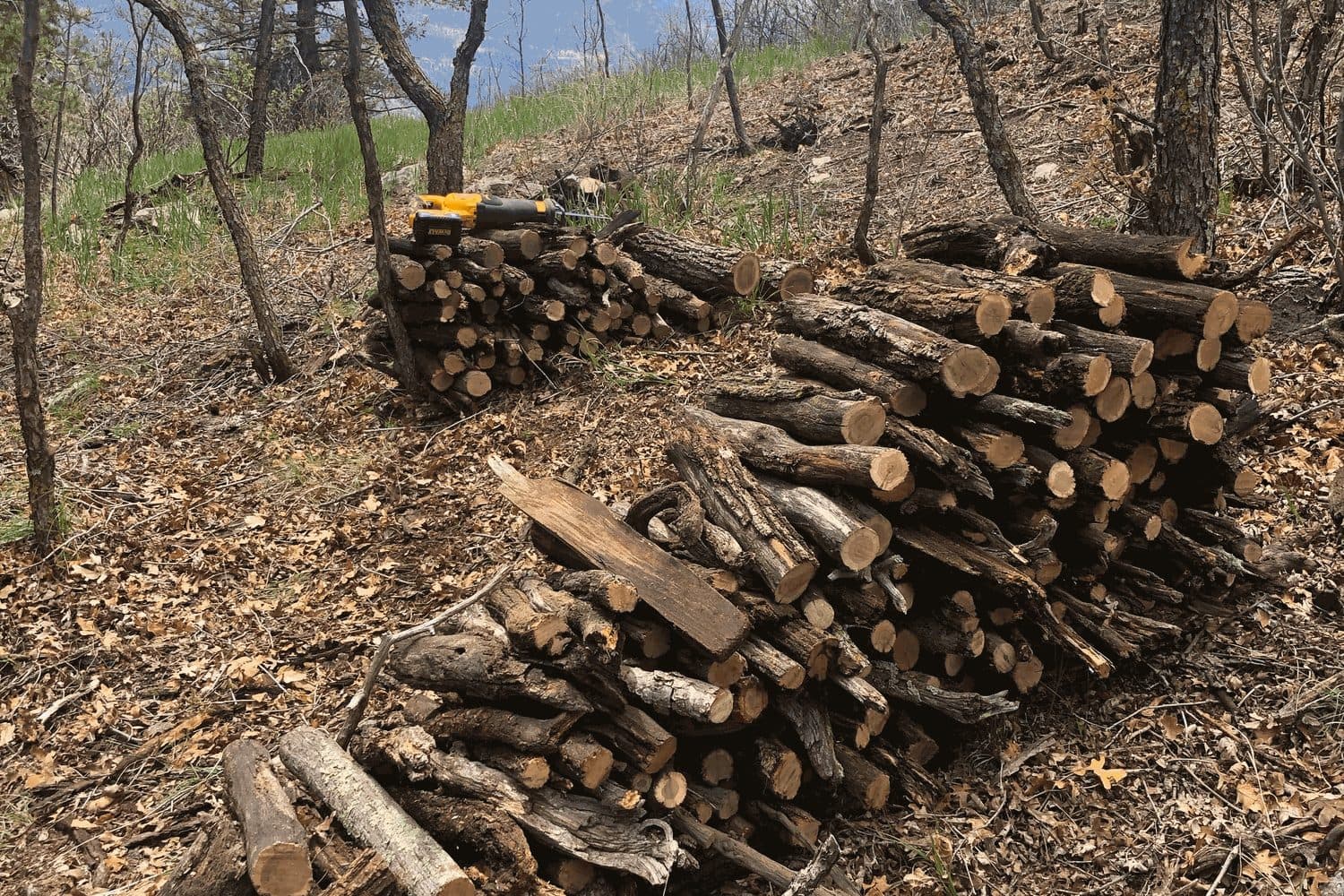
On a home lot that usually means thinning, limbing and then dealing with every branch that came down, because slash left where it falls is the fuel you just created. The options are compared in slash disposal options in Montana. Where an owner wants fire back on the land, prescribed fire on private land explains who does that work. Thinning and clearing are not the same thing either: our guide on defensible space without clearcutting shows what a well-thinned lot looks like.
How we approach a thinning job
Our fire mitigation work starts at the house and moves outward, so the first hours go to the 5 to 30 foot zone where the spacing matters most. Trees are marked on a walkthrough before anything is cut, measured crown edge to crown edge, with the distances widened on the downhill side and on steeper ground. Where trees sit near service lines, our line-clearance qualification lets us do tree work near power lines that a general crew has to leave.
If you want an outside opinion first, free assessments are available; see free wildfire risk assessments in western Montana. We are glad to work from an assessment's recommendations.
Call HJ Property Care & Tree Service at (406) 215-7319 or request a free estimate. One of our owners, Justin Johnson, is an ISA Certified Arborist (RM-8889A), and we will walk the property with you before any work is quoted.
Need help?
HJ Property Care & Tree Service is locally owned and ISA-certified. Call for a free estimate.
This article is part of the Montana Wildfire & Defensible Space Guide, our complete guide for western Montana property owners.
Explore our fire mitigation.
Sources
We cite primary sources: Montana State University Extension, the City of Missoula, and the ISA, so you can verify anything here yourself.
- Forest Landowner Guide, West-Central Montana (home ignition zone and forest fire history sections) (Montana Department of Natural Resources and Conservation). Last checked November 2, 2026.
- Preparing homes for wildfire (immediate, intermediate and extended zones) (National Fire Protection Association (Firewise USA)). Last checked November 2, 2026.
- The Home Ignition Zone: A guide to preparing your home for wildfire and creating defensible space (2021) (Colorado State Forest Service). Last checked November 2, 2026.
- Creating Wildfire-Defensible Zones, Fact Sheet 6.302 (F.C. Dennis, 5/2003), copy hosted by Jefferson County, Colorado (Colorado State University Cooperative Extension with the Colorado State Forest Service). Last checked November 2, 2026.
- Fire-Resistant Landscaping Considerations for Montana's Wildland Urban Interface (MontGuide MT202104AG) (Montana State University Extension). Last checked November 2, 2026.
- Tips for enhancing the fire resistance of your landscape (CAL FIRE spacing diagrams) (University of California Agriculture and Natural Resources). Last checked November 2, 2026.
- Pine engraver (Ips pini), Insect and Disease Management Guide, Northern and Intermountain Regions, Chapter 4.10 (revised 2025) (USDA Forest Service Forest Health Protection, hosted by Montana DNRC). Last checked November 2, 2026.
- Pinus ponderosa var. benthamiana, P. p. var. ponderosa: Ponderosa pine (Fryer 2018) (USDA Forest Service, Fire Effects Information System). Last checked November 2, 2026.
Ready to transform your outdoor space?
Get a free, no-obligation estimate within 48 hours. Locally owned and ISA-certified.