
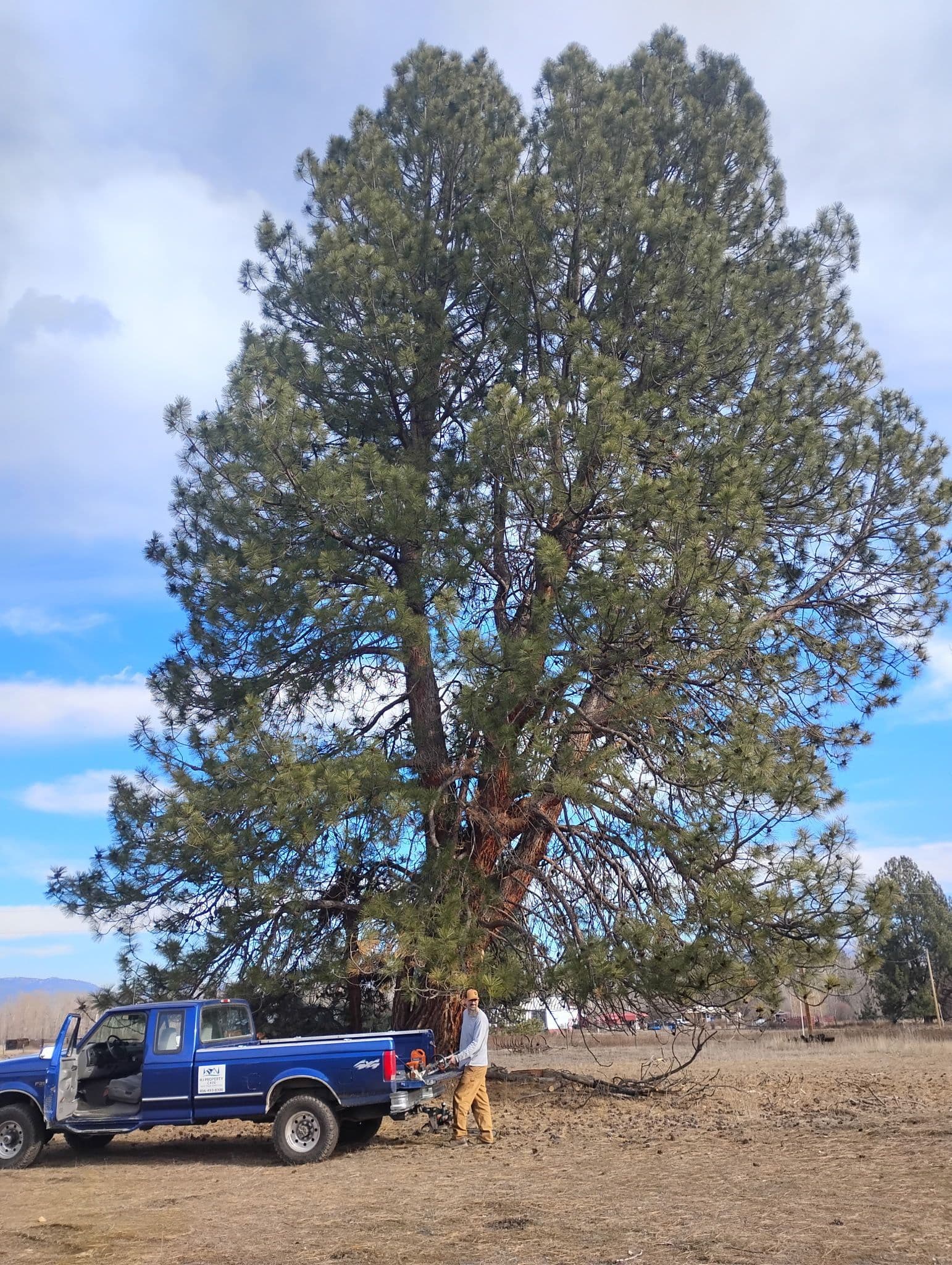
How High to Limb Up Trees for Fire Without Hurting Them
Reviewed by Justin Johnson, ISA Certified Arborist (RM-8889A)
Limbing up, or crown raising, removes the lowest branches so a fire burning on the ground cannot climb into the tree. It is some of the most straightforward fire work on a Montana property, and also some of the most often overdone. A pine stripped to a tuft at the top is stressed, wind-prone and attractive to beetles, and it is no safer than one pruned to the right height. This guide gives the height targets Montana DNRC, MSU Extension, NFPA and neighboring-state extension services publish, explains the one-third rule (there are two versions), and covers how the cuts should be made and when.
Why limb up trees for wildfire at all?
Low branches are ladder fuel. Oregon State University Extension's fuels-reduction pruning guide explains that increasing the distance between the ground and the lowest branches reduces the likelihood that a surface fire uses them as a ladder into the crowns, and that a crown fire is more difficult to control and can advance much faster than a surface fire. MSU Extension makes the same point for Montana: ground and surface fires are more manageable by firefighters than crown fires.
Nature used to do this job. The Forest Service's Fire Effects Information System notes that surface fires prune the lower branches of ponderosa pine, reducing the chance of a later crown fire. With fire largely excluded from the valleys around Missoula and the Bitterroot, the low limbs stay, and on Douglas-fir they stay even after they die. Limbing up is the mechanical substitute. The broader picture of how fuels connect is in ladder fuels explained, part of our Montana Wildfire Guide.
How high should you limb up trees near a house?
Montana DNRC's landowner guide for west-central Montana says to prune tree branches 10 feet high in the perimeter 5 to 30 feet around your home so they cannot act as ladder fuels. NFPA's Firewise guidance says to prune trees up to six to ten feet from the ground, and for shorter trees not to exceed one-third of the overall tree height. The Colorado State Forest Service uses 6 to 10 feet or a third of the total height of the tree, whichever is less, and Oregon State University Extension suggests 8 to 10 feet.
So the consistent target is about 10 feet for a tree that is tall enough to carry it. On a mature ponderosa or Douglas-fir 50 or 80 feet tall, 10 feet is a modest lift. On a 15-foot tree it is not possible without stripping the crown, which is where the one-third limit takes over.
What is the one-third rule for limbing up?
There are two versions in circulation, and both point the same way. The NFPA and Colorado versions are a ceiling: on a short tree, do not prune higher than one-third of its total height. A 15-foot pine is limbed to about 5 feet, not 10. MSU Extension's MontGuide words it as a target: low-hanging branches of individual trees should be pruned up one-third of the tree height. Either way, a short tree keeps its upper two-thirds.
The third version people mean is about live crown. Oregon State's guide says to leave every tree with at least a one-third live-crown ratio, meaning green crown covering at least one-third of the tree's total height, and to avoid removing more than 50 percent of the live crown at any one time. A young tree that cannot reach 10 feet of clearance under those limits gets there over several prunings as it grows; the Oregon guide suggests repeating every 3 to 5 years until the lowest branch is above the reach of a pole saw.
How much live crown does a tree need to keep?
Forestry and landscape guidance differ here, and the difference matters for yard trees. The Oregon State figure (at least one-third live crown) comes from woodland fuel work. Colorado State University's Master Gardener pruning notes, written for landscape trees, are more conservative: when removing lower branches, maintain at least one-half of the foliage in the lower two-thirds of the tree, and the lowest branch should originate in the bottom one-third of the tree's height.
The same Colorado notes warn that excessive removal of lower branches increases the potential for tree failure by decreasing trunk taper, causing trunk cracks and decay, and transferring weight to the top. For a pine standing over a roof, that is a real cost. In practice we limb yard trees toward the landscape standard and woodland trees farther from the house toward the forestry standard, and in both cases stop short of anything that would leave the tree top-heavy.
How should the cuts be made?
The industry standard for pruning is ANSI A300, which Colorado State's pruning notes cite. The principles are the same in every extension guide we checked: cut just outside the branch collar, the swollen ring where the branch joins the trunk, without cutting into the collar or the branch bark ridge above it. Oregon State's guide says to avoid both stubs and flush cuts, because each prolongs closure of the wound. Colorado's notes add that the collar contains a branch defense zone that limits the spread of decay into the trunk.
Any branch over about an inch in diameter should come off with three cuts, according to Colorado State: an undercut 12 to 15 inches out, a top cut a couple of inches beyond it that drops the weight, and a final cut at the collar. That keeps the falling limb from tearing bark down the trunk. Both universities say not to paint wounds: Oregon State says dressing is not effective and may seal in decay organisms, and Colorado State says to leave cuts dry and untreated. Topping a tree to lower its height is not limbing and not fire mitigation; see why topping hurts trees.
What if the lower branches are large?
Colorado State's notes say raising should ideally happen while a tree is young, before the branches to be removed exceed two inches in diameter, and that decay risk is high when a removed branch is larger than four inches or is more than half the diameter of the trunk at that point. On a mature tree with big lower limbs, the notes suggest considering whether the clearance can be reached with reduction cuts out along the branch rather than removing it entirely.
That is a judgment call on every big limb, and it is one reason limbing a mature tree over a house is arborist work. Where a large limb has to come off, it is often better to remove it cleanly once than to leave a stub that decays. Our dormant pruning service is where most of this work is scheduled.
When is the safest time to limb up pines and firs?
Timing is about insects. Oregon State's guide says to avoid pruning conifers in spring and early summer, when sap is flowing, and lists October through February as the best window because pitch flow that can attract harmful insects is minimal. In Montana the pine engraver is the main concern. The Forest Service's 2025 pine engraver guide rates green pine slash created April through July as an extreme infestation risk and slash created August through November as low to moderate, because it dries before the beetles fly the next spring.
MSU Extension's engraver beetle page adds that slash should be piled and burned before adult beetles emerge in May. Limbing makes slash, so the same calendar applies. Our Montana tree pruning calendar and the guide to pine engraver beetles and slash cover the details, and why fall and winter are the best time for fuel reduction puts it in the wider fire calendar.
Is Douglas-fir different from ponderosa pine?
Yes, and Douglas-fir usually needs the work more. The Fire Effects Information System review of Rocky Mountain Douglas-fir notes that its fire resistance from thick bark is often offset by low-growing branches that may be retained even when shaded out and no longer green. Ponderosa pine tends to shed its lower branches in a closed stand; Douglas-fir keeps a skirt of dead twigs to the ground.
The same review notes that Douglas-fir infected with dwarf mistletoe often accumulates dense brooms that increase the likelihood of bole charring or torching. Removing mistletoe brooms within reach is part of limbing a fir. The wider change in Montana's dry forests, where young fir has filled in under the pines, is explained in Douglas-fir encroachment and fire risk.
What about shrubs, the roof and the chimney?
Limbing only works if there is nothing tall underneath to bridge the gap. The CAL FIRE spacing diagrams reproduced by University of California Extension use a rule of three times the shrub height between the top of a shrub and the lowest tree branch: a 5-foot shrub needs 15 feet of clearance. In many yards it is easier to remove or lower the shrub than to raise the tree that far.
Near the house, DNRC says to remove branches overhanging or touching the roof to a distance of at least 10 feet, and the Colorado State Forest Service adds removing all fuels within 10 feet of the chimney. Branches over a roof also drop the needles that collect in valleys and gutters, a separate maintenance job covered in roofs, gutters and valleys. Spacing between the trees themselves is the subject of thinning conifers for defensible space.
What happens to the branches afterward?
Oregon State's guide is direct about it: pruning adds fuel to the forest floor, and the branches should be chipped and scattered or piled and burned. Green pine limbs left in a pile through spring are also beetle habitat. Our crews chip the material on site or haul it away as part of the job; the trade-offs are in chipping on site or hauling slash away.
Limbing is a standard part of our fire mitigation work and of our general tree services, pruned to ANSI A300 and scheduled around the beetle calendar.
Call HJ Property Care & Tree Service at (406) 215-7319 or request a free estimate. One of our owners, Justin Johnson, is an ISA Certified Arborist (RM-8889A), and we will walk the property with you before any work is quoted.
Need help?
HJ Property Care & Tree Service is locally owned and ISA-certified. Call for a free estimate.
This article is part of the Montana Wildfire & Defensible Space Guide, our complete guide for western Montana property owners.
Explore our fire mitigation.
Sources
We cite primary sources: Montana State University Extension, the City of Missoula, and the ISA, so you can verify anything here yourself.
- Forest Landowner Guide, West-Central Montana (home ignition zone and forest fire history sections) (Montana Department of Natural Resources and Conservation). Last checked November 2, 2026.
- Fire-Resistant Landscaping Considerations for Montana's Wildland Urban Interface (MontGuide MT202104AG) (Montana State University Extension). Last checked November 2, 2026.
- Preparing homes for wildfire (immediate, intermediate and extended zones) (National Fire Protection Association (Firewise USA)). Last checked November 2, 2026.
- The Home Ignition Zone: A guide to preparing your home for wildfire and creating defensible space (2021) (Colorado State Forest Service). Last checked November 2, 2026.
- Reducing hazardous fuels on woodland property: Pruning, EC 1576-E (August 2008) (Oregon State University Extension Service). Last checked November 2, 2026.
- The Science of Pruning, CMG GardenNotes 610-616 (revised May 2018) (Colorado State University Extension, Colorado Master Gardener program). Last checked November 2, 2026.
- Pine engraver (Ips pini), Insect and Disease Management Guide, Northern and Intermountain Regions, Chapter 4.10 (revised 2025) (USDA Forest Service Forest Health Protection, hosted by Montana DNRC). Last checked November 2, 2026.
- Engraver Beetles (Guide to Pests, Problems, and Identification of Ornamental Shrubs and Trees in Montana) (Montana State University Extension). Last checked November 2, 2026.
- Pinus ponderosa var. benthamiana, P. p. var. ponderosa: Ponderosa pine (Fryer 2018) (USDA Forest Service, Fire Effects Information System). Last checked November 2, 2026.
- Pseudotsuga menziesii var. glauca: Rocky Mountain Douglas-fir (Steinberg 2002) (USDA Forest Service, Fire Effects Information System). Last checked November 2, 2026.
- Tips for enhancing the fire resistance of your landscape (CAL FIRE spacing diagrams) (University of California Agriculture and Natural Resources). Last checked November 2, 2026.
Ready to transform your outdoor space?
Get a free, no-obligation estimate within 48 hours. Locally owned and ISA-certified.