
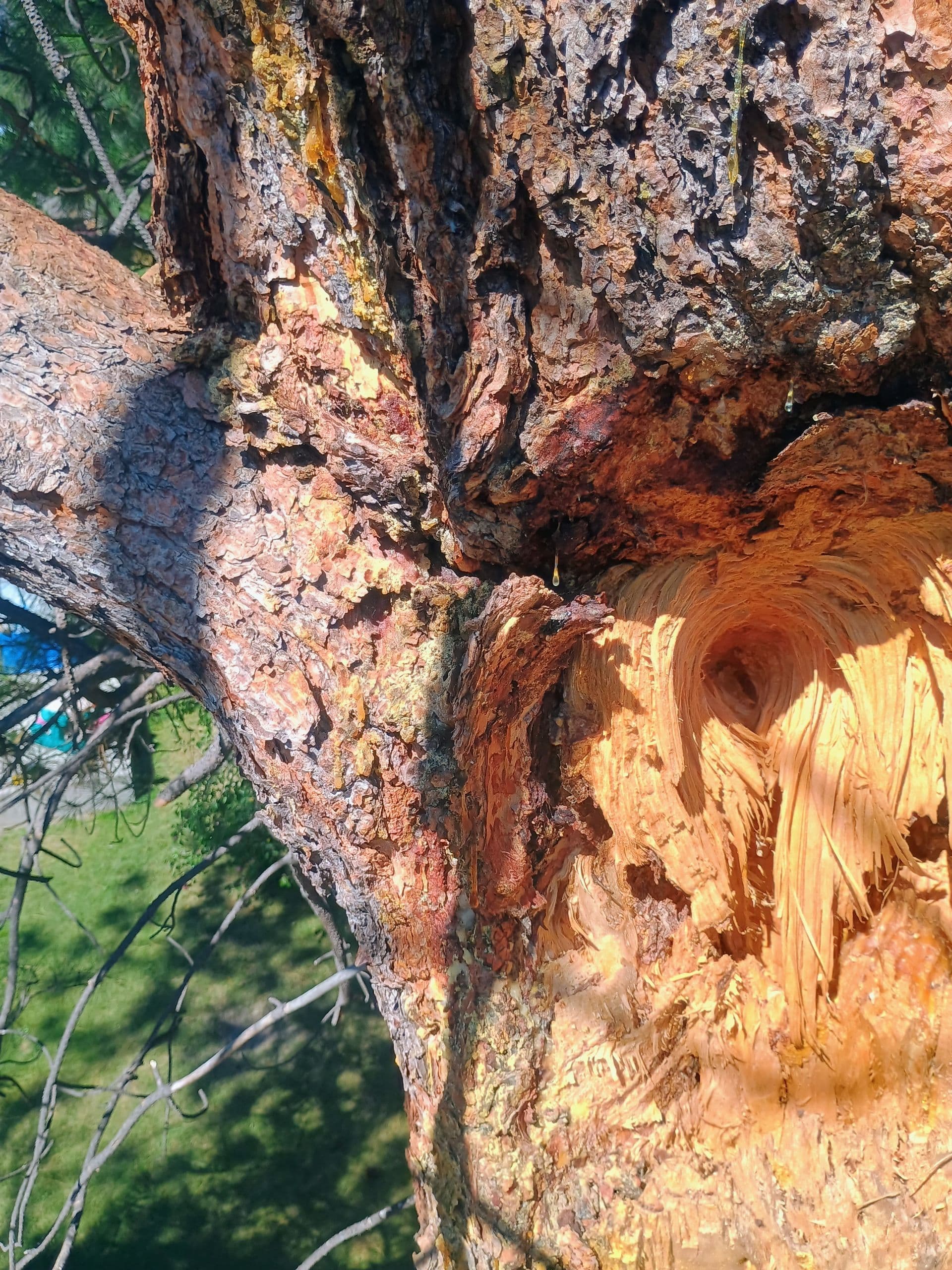
Pine Engraver Beetles and Fresh Pine Slash in Montana
Most tree pests arrive on their own. The pine engraver is one that property owners regularly invite, by cutting pine at the wrong time of year and leaving the green limbs and logs on the ground. The beetles breed in that fresh material, and the next generation flies out looking for more. If no more slash is available, the nearest standing pines are the alternative. On a wooded lot in the Bitterroot or the hills around Missoula, that is how a weekend of thinning turns into a cluster of red-topped ponderosas the following year. The fix is mostly a matter of timing and cleanup, and the Forest Service guidance that Montana DNRC distributes is specific about both.
What is a pine engraver beetle?
The pine engraver, Ips pini, is a native bark beetle that can infest any pine species. The USDA Forest Service management guide for the Northern and Intermountain Regions, revised in 2025 and hosted by Montana DNRC, says it is most often a management concern here in ponderosa pine and sometimes in lodgepole pine. Adults are cylindrical, dark reddish-brown to black, and an eighth to three-sixteenths of an inch long.
The same guide describes where it lives between outbreaks: in trees with limited defenses. That means wind, storm or fire damaged trees, trees weakened by heat or low soil moisture, and logging slash. Damage is most frequent in overstocked second-growth ponderosa stands, where sapling to pole-size trees of 2 to 10 inches in diameter are killed. Infestations usually involve small clusters of fewer than ten trees and often last one year.
How is it different from the mountain pine beetle?
The two are often confused, and the management is not the same. MSU Extension describes the mountain pine beetle as having one generation per year, with adults moving to new trees in July through August. It is a beetle of standing, mature trees, and our mountain pine beetle guide covers it.
The pine engraver runs faster and starts on the ground. The Forest Service guide reports two generations per year as most common in this region, with a third likely in warmer years, and a first generation that goes from egg to adult in 40 to 55 days. It prefers slash, and it tends to kill small trees outright and only the tops of larger ones.
Why does fresh pine slash cause the problem?
Because it is ideal habitat with no defenses. The guide identifies green pine slash larger than two inches in diameter, along with pines weakened by windthrow, ice breakage and drought, as ideal habitat for attack and population buildup. A living pine can push attacking beetles out with resin. A green limb on the ground cannot, yet its inner bark is still moist enough to feed a brood.
The sequence runs like this. Overwintering adults become active in late April to early May, once daytime temperatures exceed 63 degrees, and infest slash or winter-damaged trees. Their offspring emerge around June and fly, usually less than a quarter of a mile, to find new material. The guide says they prefer slash but attack nearby trees if beetle numbers are high enough and the remaining live pines have reduced vigor. In the guide's words, outbreaks are often associated with improper slash management.
When is it safe to cut pine in western Montana?
The guide gives a timing table based on beetle biology, and it is worth following closely. Slash created from August through November carries a low to moderate likelihood of infestation, because it has time to dry before the fall freeze and becomes less habitable. Slash created from December through March is rated high: under snow or frozen, it holds enough moisture to be attractive and suitable when the beetles wake in spring. Slash created from April through July is rated extreme, because the beetles are active and looking for exactly that.
The treatment timing follows from the ratings. For slash made in fall or winter, the guide's window for dealing with it is April to June 1. For slash made in April through July, the instruction is to treat it as it is created. The ratings shift with temperature and precipitation, which control how fast slash dries, so a cool wet spring stretches the risk. The guide also advises against creating new slash within half a mile of where slash was produced the previous year.
What should happen to the slash?
Several tactics appear in the guide, and for a home lot the first is the simplest: physically remove the material from the site. Where everything cannot go, it says to concentrate on the larger pieces, up to eight inches in diameter, because the beetles reproduce more successfully in them. Lopping slash into pieces shorter than 12 inches and scattering them in sunny openings speeds drying and is often effective where removal is impractical.
Chipping makes the material uninhabitable for breeding, with one caution. Fresh chips release volatiles that may attract pine engravers for up to two weeks, so the guide says chipping should be avoided before and during the spring beetle flight. Piling and burning is the other standard route. MSU Extension's version is that slash should be piled and burned before adult beetles emerge in May, and the Forest Service adds that piles should be small and placed so they do not scorch nearby pines, since fire-scorched trees are highly attractive to this beetle. Burning has its own rules, covered in our guide to burning tree debris and burn permits.
Does firewood count as slash?
Green pine firewood does. The guide's wording is direct: do not stack slash, fresh pine logs or green pine firewood against live, desirable pines. If you are keeping wood from a removal, our guide to firewood and wood chips after tree removal explains the options.
Storm debris counts too. The guide lists cleaning up or treating storm-damaged pine among its core recommendations, and for developed settings it says pine slash created near housing should be disposed of as soon as possible and not left near live pines. Pine tops and limbs broken by heavy wet snow are the same hazard as logging slash.
What does this mean for pruning and thinning pines?
It means the calendar and the cleanup plan belong in the same conversation as the cut. Late summer through fall is the lower-risk time to generate pine debris. Winter work is reasonable when the material leaves the property or is dealt with before spring. Pruning or thinning pines from April through July calls for same-day handling of everything green. MSU Extension gives a second reason to stay off pines in that period: Diplodia tip blight spores enter through wounds, so it advises against pruning from late spring to early summer.
Thinning is still worth doing. The guide states that thinned, vigorous stands are less attractive to pine engravers, while noting that a recently thinned stand can be temporarily more attractive if the remaining trees were damaged or the soil disturbed. That applies directly to fire mitigation work, where thinning ponderosa is the whole point. Our crews haul debris away as part of the job, which is the removal tactic the guide lists first. The timing of other species is in the Montana tree pruning calendar.
How do you spot an attack, and can a tree be saved?
The first sign, on slash or on a standing tree, is reddish-orange boring dust where beetles entered. On standing pines it collects in bark crevices, at branch junctions and around the base. Under the bark, the galleries form a Y, H or star shape. MSU Extension adds shot-hole sized exit holes and dieback at the top of the tree, with the caution that top dieback has many other causes.
Once the beetles are in, options narrow. MSU says it is hard to kill the beetle or correct the damage at that point, though surrounding trees can potentially be protected. Both MSU and the Forest Service describe preventive bark sprays for high-value trees that have not been attacked, and the Forest Service states that insecticides are not recommended for protecting or treating slash. Label directions are the law, and restricted products need a licensed applicator. Weakened or badly damaged pines near a home are better removed than left as breeding material.
If you have pines to prune, a stand to thin or a top that has turned red, start with an assessment so the work is timed around the beetle. It is part of our tree services, and the Montana Tree Guide has more on ponderosa care and the other bark beetles in this region.
Call HJ Property Care & Tree Service at (406) 215-7319 or request a tree assessment and an ISA Certified Arborist will look at the tree with you.
Need help?
HJ Property Care & Tree Service is locally owned and ISA-certified. Call for a free estimate.
This article is part of the Montana Tree Guide, our complete guide to trees in western Montana.
Explore our tree services.
Sources
We cite primary sources: Montana State University Extension, the City of Missoula, and the ISA, so you can verify anything here yourself.
- Pine Engraver (Ips pini), Insect and Disease Management Guide, Chapter 4.10 (revised 2025) (USDA Forest Service, Northern and Intermountain Regions, Forest Health Protection (hosted by Montana DNRC)). Last checked October 11, 2026.
- Engraver Beetles (MSU Extension, A Guide to Pests, Problems, and Identification of Ornamental Shrubs and Trees in Montana). Last checked October 11, 2026.
- Mountain Pine Beetle (MSU Extension, A Guide to Pests, Problems, and Identification of Ornamental Shrubs and Trees in Montana). Last checked October 11, 2026.
- Diplodia Tip Blight (MSU Extension, A Guide to Pests, Problems, and Identification of Ornamental Shrubs and Trees in Montana). Last checked October 11, 2026.
Ready to transform your outdoor space?
Get a free, no-obligation estimate within 48 hours. Locally owned and ISA-certified.