
Driveway Access for Fire Engines: Width, Clearance and Turnarounds
Reviewed by Justin Johnson, ISA Certified Arborist (RM-8889A)
A fire engine that cannot get up your driveway, or cannot turn around once it is there, is a fire engine that may not come in at all. On long private drives through the timber around Florence, Corvallis, Lolo and Clinton, access is part of whether a house can be defended. This guide sets out the numbers that Montana fire districts actually use for fire apparatus access, explains which of them are legal requirements and which are recommendations, and lists the work an owner can do in a weekend or hire out in a season.
Why does driveway access matter in a wildfire?
Montana DNRC's structure assessment form, the long checklist its assessors use on homes in the wildland-urban interface, has a whole section on access. It asks whether the address is visible, reflective and noncombustible, whether a locked gate blocks the drive and whether the fire department can open it, whether the community has one road in and out or two, and how wide and how long the driveway is. It also asks whether there is an adequate turnaround and whether any bridge has a weight limit.
DNRC explains why in plain terms: the length of a driveway, an adequate turnaround and bridge weight limits are what emergency personnel need to know to decide whether it is safe for them to enter. A crew facing a narrow, overgrown drive with no place to turn has to weigh the house against the chance of being trapped. The same form notes that two evacuation routes improve the odds of getting out, because one route can be blocked by a downed power line, emergency vehicles, fire or a fallen tree.
How wide does a driveway need to be for a fire engine?
The answer depends on which standard applies. The International Fire Code sets 20 feet of unobstructed width, exclusive of shoulders, for a fire apparatus access road. The Hamilton Rural Fire District printed that section word for word in the fire protection standards it adopted on October 12, 2016 for proposed new subdivisions, under authority of the Ravalli County Subdivision Regulations, and noted that Montana's administrative rules incorporate the International Fire Code as the state's minimum fire prevention code. The code edition referenced has been updated since 2016, so ask your district which one it uses today.
Single-home driveways are usually held to less. The 2020 Community Planning Assistance for Wildfire (CPAW) report to Missoula County recommended a minimum drivable width of 16 feet for driveways longer than 150 feet, citing NFPA 1141 (2017), with a reduction to 12 feet allowed on straight segments with clear lines of sight and pull-outs where needed so an engine can pass other vehicles. That was a recommendation to the county, not an adopted rule, but it is a useful planning target. DNRC's own assessment form simply sorts driveways into 15 feet or less and 16 feet or more.
How much overhead clearance does a fire truck need?
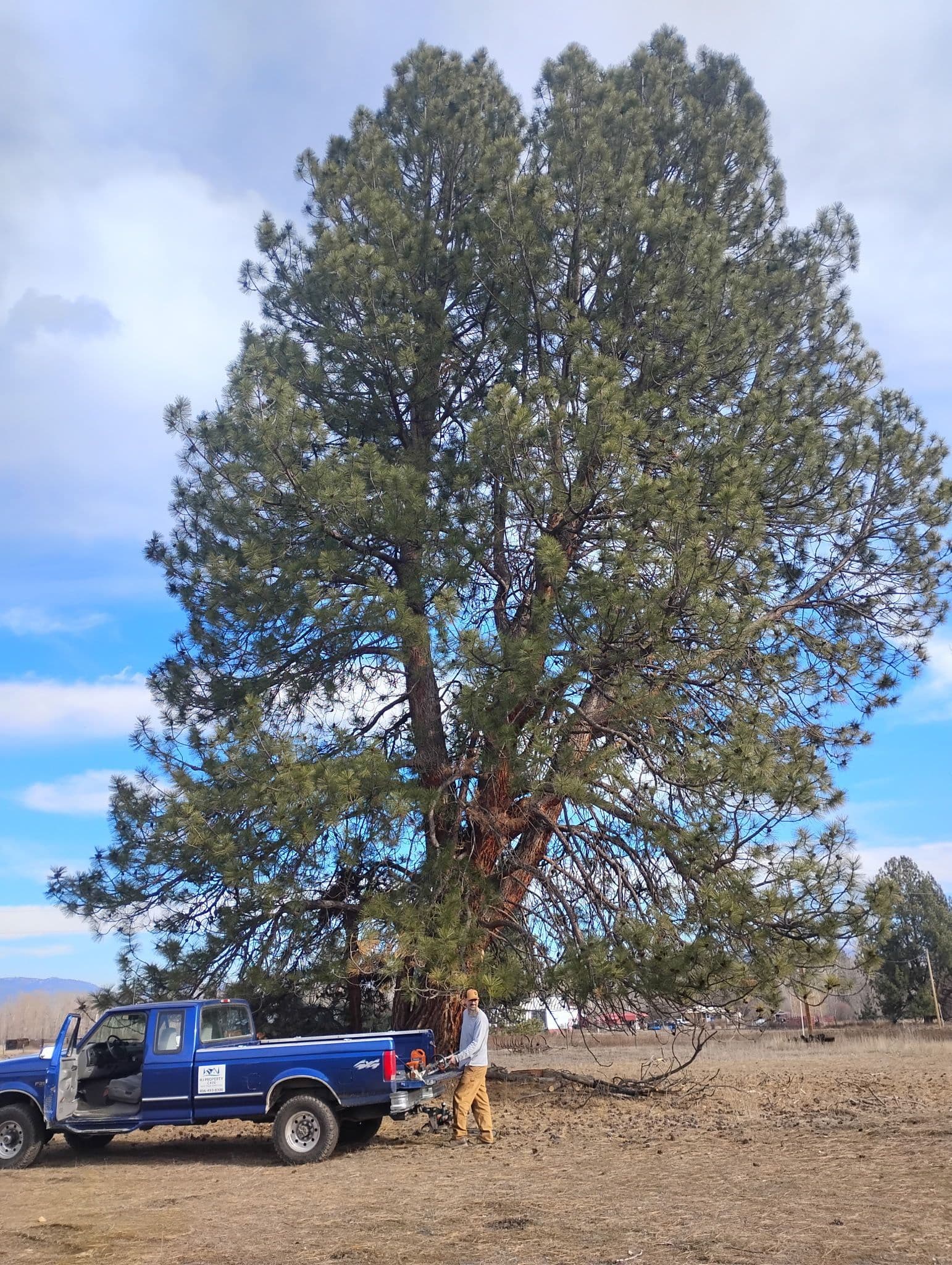
The International Fire Code calls for an unobstructed vertical clearance of not less than 13 feet 6 inches over a fire apparatus access road, and the Hamilton Rural standards include that figure. The CPAW recommendations for individual lots in Missoula County used the same 13.5 feet of vertical clearance plus 20 feet of horizontal clearance. Trees are the usual problem, because a limb that clears a pickup with room to spare can still be well below that height.
DNRC's practical advice is to make sure the driveway is clear of overhanging trees and that vegetation is cleared at least 5 feet on each side. The work is usually a mix of pruning limbs back to the trunk or a proper lateral branch, removing small crowded conifers that lean into the travel lane, and taking out the dead or failing trees that would block the road if they fell. Our guide to how high to limb up trees for fire covers how much of a tree's crown can safely come off.
When does a driveway need a turnaround?
Under the fire code as Hamilton Rural adopted it, a dead-end fire apparatus access road longer than 150 feet must have an approved turnaround. Appendix D's table, reproduced in the district's standards, requires a 20-foot width and a turnaround for dead ends of 151 to 500 feet: a 120-foot hammerhead, a 60-foot Y, or a 96-foot diameter cul-de-sac. From 501 to 750 feet the width goes to 26 feet with the same turnaround options. Over 750 feet needs special approval from the fire district.
For single lots, the CPAW report recommended that an engine be able to park within 150 feet of all parts of the buildings and that any driveway longer than 150 feet have a turnaround on the lot, built as a cul-de-sac, T or branch design to the dimensions in the Missoula County Public Works Manual. A turnaround does not have to be paved, but it has to be kept open. A turnaround that has become the place where the trailer, firewood and boat live is not a turnaround.
What about steep grades, soft surfaces and bridges?
Appendix D in the Hamilton Rural standards limits fire apparatus access roads to a 10 percent grade unless the fire chief approves steeper. It also requires an all-weather driving surface able to support fire apparatus weighing at least 75,000 pounds. Where a bridge is part of the route, the code requires it to be built and maintained to AASHTO HB-17 and designed for the live load of fire apparatus, with load limits posted at both entrances when the district requires it.
Most existing private drives in the valley were never engineered to those numbers, and nobody expects an owner to rebuild a half-mile road. What helps is knowing your limits and telling the fire district: a light bridge over an irrigation ditch, a steep pitch that turns to mud in spring, or a soft shoulder are all things a crew would rather learn about before they arrive. Those are questions for an engineer or excavation contractor, not for us, but we can clear what grows over and along the road.
What do firefighters need at a gate?
Gates are common on acreage and cabin properties, and the fire code addresses them directly. The Appendix D gate criteria in the Hamilton Rural standards call for a minimum gate width of 20 feet on fire apparatus access roads, swinging or sliding gates that one person can operate manually, and electric gates with a means of emergency opening approved by the fire district. Manual gates are not to be locked with a padlock or chain and padlock unless they can be opened with forcible entry tools or a key box holding the key is installed at the gate.
For an existing home, DNRC's advice is shorter: provide the local fire department or emergency responders with gate access. Call your district and ask what it uses, whether a key box, a code or a particular lock. If we are building or replacing a gate as part of a custom fencing job, the width and the way it opens are things to settle before the posts go in.
Can a fire engine find your house at night?
Address signs are the cheapest access improvement there is. Missoula Rural Fire District's address sign notice says a fire engine, ambulance or law enforcement can be delayed several minutes trying to find an unmarked or poorly marked address. The district's signs are aluminum with reflective 4-inch numbers, mounted on the building or a post. A home on a dead-end road where traffic comes from one direction can use a single-sided sign; otherwise a double-sided sign is needed.
Shared driveways, and drives that branch off agricultural or forest roads, may need additional signs with arrows. The district's Community Risk Reduction Division answers sign questions at (406) 549-6172, and it reminds owners that driving a post means calling 811 first for a free underground utility locate, which can take several days. The Hamilton Rural standards require a temporary or permanent address posted at the driveway as soon as construction begins on a new lot. DNRC's form adds that the sign should be reflective, noncombustible and visible from the road.
Do these rules apply to an existing driveway?
Usually not, at least not as a legal requirement. The Hamilton Rural standards apply to proposed new subdivisions in that district, and the CPAW individual-lot standards were recommendations to Missoula County. CPAW described the county's adopted subdivision regulations as requiring improved access, water supply and defensible space within 100 feet of roads and water supplies, with maintenance carried by developer agreements and homeowners association covenants. Building a new home, splitting land or getting a subdivision approved is when these standards come into play. Our guide to building in the WUI covers that side.
This is general information, not legal advice. The fire district that covers your address has the final say on what it requires and what it will drive into. The Ravalli County fire districts guide and Missoula County wildfire resources list who to call, and DNRC offers a free home wildfire risk assessment that covers access.
What can an owner do before next fire season?
Walk the driveway with a tape measure and a camera, ideally with a pickup and a ladder in the bed for scale. Note every limb lower than about 14 feet over the travel lane, every tree leaning into it, and every stretch narrower than 12 feet. Check the turnaround, the gate and the address sign at night with headlights. Then fix the cheap things first: the sign, the gate access, the brush.
The tree and brush work is ours to do. We lift limbs, thin the small conifers that crowd the shoulders, remove hazard trees that could fall across the only way out, and chip or haul the slash so it does not become a fuel bed along the road. Clearing the roadside is often the first piece of a larger fire mitigation plan, and it pairs with defensible space zones around the house. In winter, the same drive has to be open for an engine in snow too; see private road snow plowing. The rest of our Montana Wildfire Guide covers the house and yard.
Call HJ Property Care & Tree Service at (406) 215-7319 or request a free estimate and we will walk the property with you.
Need help?
HJ Property Care & Tree Service is locally owned and ISA-certified. Call for a free estimate.
This article is part of the Montana Wildfire & Defensible Space Guide, our complete guide for western Montana property owners.
Explore our fire mitigation.
Sources
We cite primary sources: Montana State University Extension, the City of Missoula, and the ISA, so you can verify anything here yourself.
- Structure Assessment Form (home assessment long form, May 2017) (Montana Department of Natural Resources and Conservation). Last checked November 2, 2026.
- Fire Protection Standards (adopted October 12, 2016), with IFC Section 503 and Appendix D (Hamilton Rural Fire District). Last checked November 2, 2026.
- Community Planning Assistance for Wildfire: Recommendations, Missoula County (2020) (Headwaters Economics / Wildfire Planning International (CPAW)). Last checked November 2, 2026.
- Address Sign Order Form and Address Signs Notice (Missoula Rural Fire District). Last checked November 2, 2026.
- Request a Home Wildfire Risk Assessment (Montana Department of Natural Resources and Conservation). Last checked November 2, 2026.
Ready to transform your outdoor space?
Get a free, no-obligation estimate within 48 hours. Locally owned and ISA-certified.