
Designing Outdoor Living Space for Montana's Climate
Reviewed by Adam Hurlbert, Owner & Founder, 15+ years in landscape & property care
A patio that looks great in a June photo can sit unused for most of a western Montana year if it was planned for some other climate. The usable season here is short, wind can make an exposed site miserable, wildfire smoke can linger through summer and into fall, and snow has to go somewhere every winter. Good outdoor living space is designed around those facts. This guide covers where to put a patio, how to handle sun and wind, how to keep it fire-safe and bear-safe, and how to make it easy to clear and maintain.
Where should a patio go on a Montana lot?
Start with how you will use it and when. A morning coffee spot wants early sun and shelter from the cool night air that drains down the valleys. An evening dining area wants shade from the low western sun and a view. A space you hope to use in April and October wants as much southern exposure as you can give it, close to the house where it gets reflected warmth.
Then look at the ground. A patio should sit where water drains away from it and away from the house, not in the low spot the yard already drains to. Our guide to grading a yard away from the foundation covers that, and the base underneath is explained in patio base preparation in frost country.
How do you plan for a short outdoor season?
Western Montana's frost-free season is short compared with much of the country, and it varies a lot between the valley floor and the benches. Our frost dates guide has the averages for Missoula and the Bitterroot. A patio that captures sun extends the shoulder seasons on both ends, which is often worth more than adding square footage.
Choose plants around the patio for the same reality. Containers of tender annuals give color for the warm months; the permanent planting should be hardy enough for our zones, covered in Montana hardiness zones. Hardscape that looks good under snow, such as stone, boulders and evergreens, gives the space a winter purpose too.
How do you deal with wind?
An exposed patio on a windy site can be pleasant in the morning and unusable by late afternoon. Windbreaks work best when they slow the wind rather than stop it. The USDA National Agroforestry Center says a windbreak density of 40 to 60 percent gives the greatest downwind protection for soil erosion, and the Nebraska Forest Service explains that as density falls, more air passes through, which moderates the low pressure and turbulence behind the barrier. That guidance is about tree rows on open land, not patios, but the idea carries over: a shrub row or slatted screen usually beats a solid wall.
Our guide to landscaping a windy yard goes into plant choices and placement. Where a screen or seat wall is part of the hardscape, build it to the same standard as the patio, with a proper footing, because a wall that catches wind and snow load is doing structural work.
How should shade be handled?
An unshaded stone patio gets hot in midday summer sun. Shade can come from trees planted at a sensible distance, a freestanding shade structure, or simply placing the patio on the east side of the house. Deciduous trees are the classic answer because they shade in summer and let sun through in winter.
Plant shade trees with their mature size in mind, and keep them far enough from the house that their crowns will not overhang the roof later. That matters for fire as much as for gutters, and our tree planting guide covers spacing.
How do you keep an outdoor living area fire-safe?
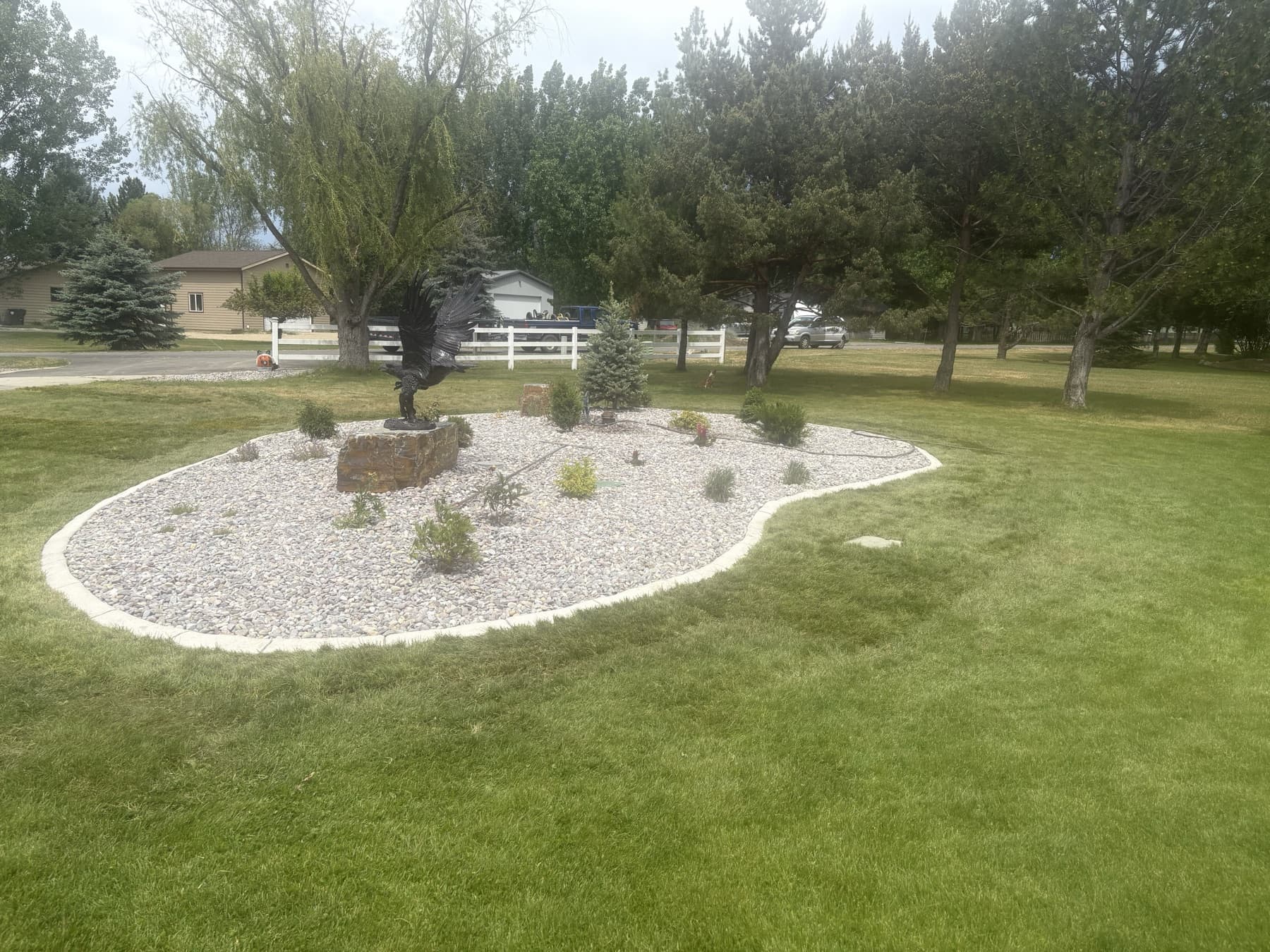
The Firewise USA fact sheet from the National Fire Protection Association (NFPA) describes three home ignition zones: the immediate zone 0 to 5 feet from the house, the intermediate zone 5 to 30 feet, and the extended zone 30 to 100 feet. It recommends crushed stone or gravel instead of flammable mulch in the immediate zone, trimming branches that overhang the home, porch and deck, and never storing flammable materials underneath decks or porches.
For a patio next to the house, that points toward stone or paver surfaces right against the walls, gravel rather than bark in the beds along the foundation, and a habit of bringing cushions in and keeping firewood away from the siding when fire danger is high. Our wildfire chapter covers this in depth in hardscape firebreaks, patios and paths and Zone 0: the first five feet. A fire pit has its own rules, summarized in backyard fire pit rules in Missoula and Ravalli County.
Do bears and other wildlife change the design?
In much of western Montana they should. Montana Fish, Wildlife & Parks' Living in Bear Country page tells residents to clean barbecues thoroughly after use, to avoid feeding birds during active bear season, to feed pets outside only during the day and clean up uneaten food, and to keep garbage and recycling in a secured building at all times. It also lists fruit-bearing trees and bushes, gardens and compost piles among the attractants.
In practice that means planning a place for the grill that is easy to keep clean, a secure spot for garbage that is not on the patio, and thinking twice before putting fruit trees or a compost pile right beside where people sit. Deer are the more everyday visitor; our guide to deer-resistant plants helps with the planting around the space.
What about smoke season?
Missoula Public Health says wildfire smoke can persist throughout the summer and into the fall, and can reach the county even when fires are hundreds of miles away. It points residents to Montana DEQ's Today's Air site for the daily air quality reading. That is an argument for a patio that also works in the shoulder seasons, when air is usually clearer, and for a covered or screened area close to the house that can be closed up. It is also a reason not to over-invest in features that only make sense in August.
Does outdoor living space need a permit or approval?
A ground-level patio often does not, but check. The 2024 residential code adopted in Montana exempts sidewalks and driveways from building permits in section R105.2, and retaining walls under its height limit, explained in our retaining wall permit guide. Raised structures are different. The City of Missoula's permit FAQ says a residential deck is exempt only if it is free-standing, 30 inches or less above the ground with no roof or arbor over it, no more than 200 square feet, and does not serve the required egress door. So a shade roof can change the answer. Call the office with jurisdiction before you build, and check any covenants, which our guide to HOA landscape approvals discusses.
Before any digging, Montana 811 says you can simply dial 811 and that the service is free. It warns that private underground facilities may not be located through the system, so mark private lines and irrigation yourself.
How do you design for snow?
Every winter, snow will land on the patio and the paths to it, and it has to go somewhere. Decide where it will be piled before the beds are planted: a pile of snow dumped on shrubs every winter breaks branches, and snow piled against the house melts toward the foundation. Our guide to where to pile snow covers placement.
Choose surfaces you can clear. Pavers, concrete and flagstone can all be shoveled or blown, though flagstone's irregular face catches steel blades. If a snow service will clear the space, talk about it at the design stage, and read pavers or poured concrete and walkway and path materials for how each surface behaves in winter.
How should outdoor lighting be planned?
Lighting extends the usable hours of a patio and makes steps and paths safe after dark. Low, shielded fixtures that light the ground rather than the sky are kinder to neighbors and to night skies, and they are easier on wildlife. Our landscape lighting service installs path, step and accent lighting, and the trade-offs are explained in low-voltage or solar landscape lighting and dark-sky friendly landscape lighting.
Should irrigation be planned with the patio?
Yes. Sprinkler heads that spray onto a patio waste water, stain stone and leave ice in shoulder seasons. Beds around the patio work best on drip, and any lawn next to it needs heads set back and aimed away from the hard surface. Lines need to be in place, or sleeved under the patio, before the hardscape goes in. Our irrigation systems work is planned together with hardscape for exactly this reason.
Building outdoor living space with HJ
We design and build patios, walkways, steps, seat walls, fire pits and the planting around them through our hardscaping and landscaping and design services, coordinated with irrigation and lighting. Larger projects can be built in stages, which our guide to phasing a landscape project explains. This guide is part of the Montana Landscaping, Lawn & Irrigation Guide.
Call HJ Property Care & Tree Service at (406) 215-7319 or request a free estimate and we will walk the site with you.
Need help?
HJ Property Care & Tree Service is locally owned and ISA-certified. Call for a free estimate.
This article is part of the Montana Landscaping, Lawn & Irrigation Guide, our complete guide for western Montana property owners.
Explore our landscaping & design.
Sources
We cite primary sources: Montana State University Extension, the City of Missoula, and the ISA, so you can verify anything here yourself.
- How to Prepare Your Home for Wildfires (Firewise USA fact sheet) (National Fire Protection Association (NFPA)). Last checked November 2, 2026.
- Living in Bear Country (Montana Fish, Wildlife & Parks). Last checked November 2, 2026.
- 3.2 Windbreaks for Wind Erosion (buffer guidelines) (USDA National Agroforestry Center). Last checked November 2, 2026.
- How Windbreaks Work (Nebraska Forest Service, University of Nebraska). Last checked November 2, 2026.
- Wildfire Smoke (Missoula Public Health). Last checked November 2, 2026.
- 2024 International Residential Code as adopted in Montana, R105.2 Work exempt from permit (International Code Council, via UpCodes). Last checked November 2, 2026.
- When is a building permit required? (City of Missoula Building Division). Last checked November 2, 2026.
- Montana 811: call before you dig (Montana811). Last checked November 2, 2026.
Ready to transform your outdoor space?
Get a free, no-obligation estimate within 48 hours. Locally owned and ISA-certified.