
Chipping on Site or Hauling Slash Away: Which Is Better?
Reviewed by Justin Johnson, ISA Certified Arborist (RM-8889A)
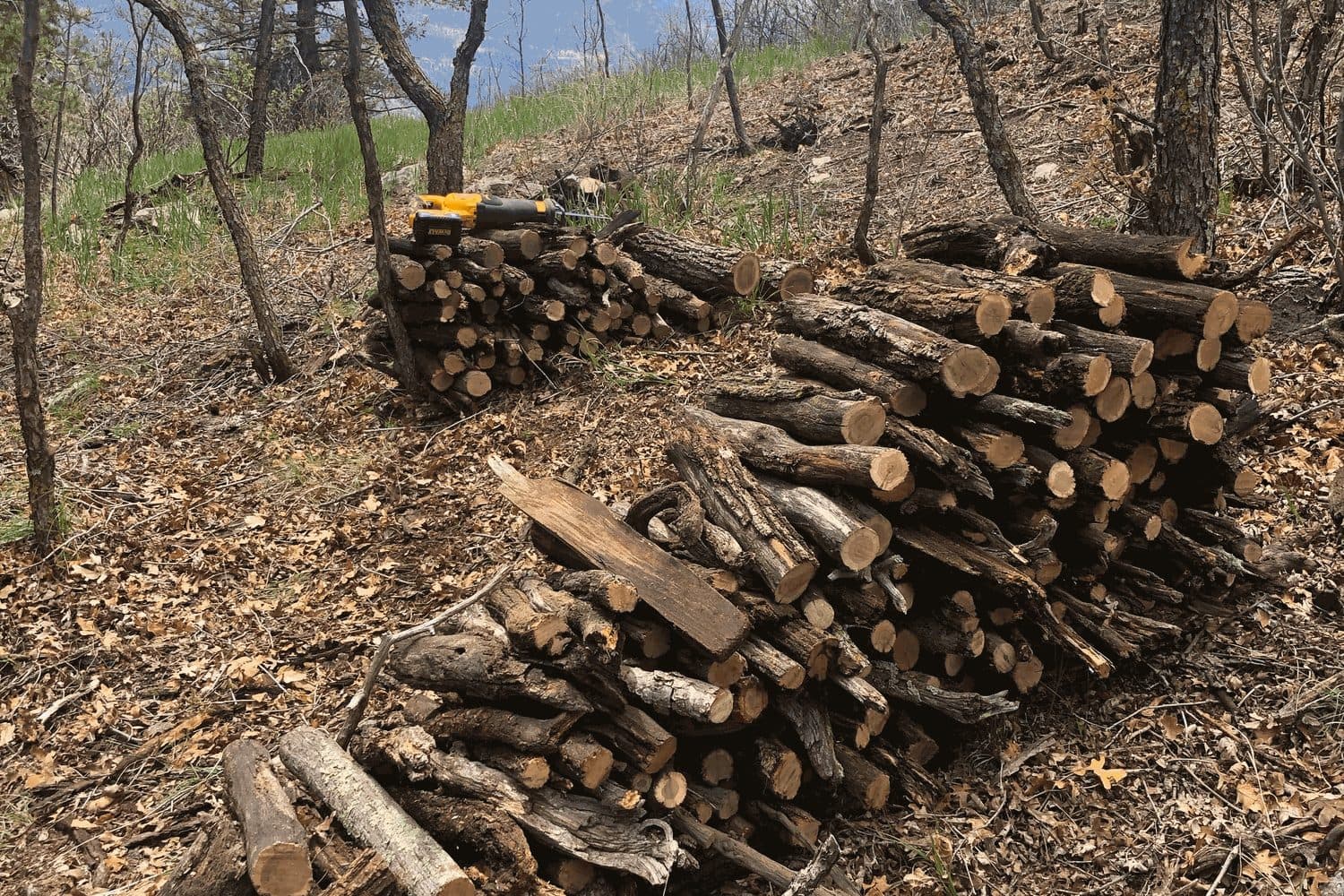
If you are not going to burn your slash, the choice comes down to two routes: run it through a chipper and leave the chips on the property, or take it away. Both are clean, both are fast compared with burning, and neither needs a burn permit. They are not equal, though. Chips are still fuel, and how much of a problem they are depends on where they land. This guide uses fire test data, Forest Service beetle guidance and local disposal rules to help you decide, and it often ends in a mix of the two. For the wider comparison that includes burning and lop and scatter, see [slash disposal options in Montana](/slash-disposal-options-montana).
Is it better to chip slash or haul it away?
Hauling removes more fire risk, because the fuel leaves. Chipping usually means less trucking, and it gives you a usable mulch for paths and outer beds. The Colorado State Forest Service treats both as acceptable disposal, along with piling in open areas for burning later, but it adds that any accumulation of slash, chipped or otherwise, should be 30 feet or more from the home. So the short answer is by location: near the house, haul, or chip and haul the chips; farther out, chipping is often the better value.
On a typical thinning, we end up doing some of each. The rest of this guide explains how to draw that line. It is part of our Montana Wildfire Guide, and both methods are included in our fire mitigation work.
Do wood chips burn?
They do, and how they burn depends on depth and kind. The best test we know of was run in Carson City, Nevada, by University of Nevada Cooperative Extension and partners and published in 2011. It burned eight mulch treatments in hot, dry, windy conditions. One of them is very close to what a chipper leaves behind: Tahoe chips, a by-product of Lake Tahoe Basin chipping operations made up of chips, needles, bark and other biomass.
With the exception of composted wood chips, every treatment showed active flaming. Spread 2 to 3 inches deep, the Tahoe chips burned with flame height and temperature similar to the same chips treated with retardant, and the retardant only delayed spread for 5 to 10 minutes. A single layer of the same chips gave the lowest temperatures in the test and relatively low flame heights and spread. Shredded rubber, pine needles and shredded western red cedar showed the most hazardous behavior. In other words, thin is much safer than deep, and fresh chips are still a real fuel.
How close to a house can wood chips go?
Not within 5 feet of it. The Nevada study says all the mulches tested are combustible and are not recommended within five feet of the house and other structures, where it calls for rock, gravel, concrete or pavers. From 5 to 30 feet, it rates chips among the better choices but says not to use them in a widespread or continuous manner and to separate them with noncombustible or ignition-resistant material such as concrete, gravel, rock and lawn.
The Colorado State Forest Service's guidance is somewhat stricter for chip accumulations: 30 feet or more from the home, and no continuous areas of chips, with breaks of noncombustible material or gaps of at least 3 feet. MSU Extension's MontGuide adds that embers can ignite mulch, and that any mulch should be kept moist or replaced with rock. We suggest following the stricter line: keep chips from a fuel job out of the first 30 feet. See mulch and wildfire and Zone 0: the first five feet for what to use close in.
How deep can chips be spread?
As thin as you can manage. A single layer gave the best fire results in the Nevada test, and 2 to 3 inches behaved like an active fuel bed. Depth also matters for tree health: the Forest Service's 2025 pine engraver guide warns that more than four inches of soil or mulch over roots stresses trees and makes them attractive to attacking beetles, and it says to avoid backfilling over the root flare. So a deep mound of chips around the base of a valued pine is wrong on both counts.
Volume is the catch. A big thinning can produce far more chips than the ground can take in a thin layer. If the chips would end up deep, or in a continuous bed across the zone you were trying to clear, the extra should leave the property.
Can chipping attract bark beetles?
It can, depending on timing. The engraver guide says chipping or mastication makes the material uninhabitable for beetle breeding, which is a major advantage over leaving tops whole. But it also says these treatments create abundant volatiles that may attract pine engraver beetles for up to two weeks, so they should be avoided before and during beetle flight in spring to avoid attacks on standing pines.
The Forest Service's Fire Effects Information System (FEIS) reports a related study from California's Tahoe National Forest: red turpentine beetles attacked 19 percent of residual stems in plots that were thinned and chipped, against 3.5 percent where fuels were lopped and scattered and 4 percent in untreated plots. The authors concluded that chipping may result in unacceptable levels of ponderosa mortality from beetle attacks. That is one study in a different forest, but it points the same way: in pine, chip in late summer through winter, and keep fresh chips off the base of the trees you want to keep. Overwintering engravers become active around late April to early May, the guide says, when daytime temperatures exceed 63 degrees.
When does hauling win?
Hauling is the better choice when the work is close to the house, the lot is small, there is more volume than the ground can take in a thin layer, or you want nothing left behind. For pine, the engraver guide lists physical removal as an effective tactic, and says if not all slash can be removed, concentrate on larger pieces up to eight inches in diameter, where the beetle's reproductive success can be higher. It also says pine slash created near housing should be disposed of as soon as possible and not left near live pines.
Access and destination set the limits. In Missoula, Garden City Compost at 1125 Clark Fork Lane lists brush and yard waste among its accepted materials and also has a rate for chipped material. It does not take wood waste over 6 feet long, painted or treated wood, or root balls with rocks or dirt, and stumps must be clean. Projects larger than 10 trees or stumps must call ahead at 406-552-6619. Loads must be secured. The city says the facility is open year round, with hours that change by season. We could not confirm a published brush drop-off in Ravalli County, so check with the county or a hauler if you are doing this yourself.
When does chipping win?
Chipping is usually better on acreage, where there is plenty of room beyond 30 feet to spread chips thin, and on sites where a truck cannot reach the cutting but a chipper or a drag line can. It also avoids many trips over a soft driveway. Some owners want the chips: for a path, or for a planting bed well away from the house, or to suppress weeds in an outer area. If you do, ask for the chips to be kept out of the first 30 feet and away from trunks.
Chips are a material for the outer zones rather than a free landscape product. Composted wood chips did best in the Nevada test, but the study cautions it does not know if that result carries over to other compost sources, and that smoldering may go unnoticed in a wildfire. For leftover chips after a tree removal, see firewood and wood chips after tree removal.
What affects the cost of each?
We do not publish prices, because the factors swing widely. For chipping: how far material must be dragged to the chipper, whether machinery can reach it, the size of the material, and how far and thin the chips must be spread. For hauling: the volume, the number of trips, the distance to the disposal site and its fees, and access for trucks and trailers. Some jobs that look cheaper to chip cost more once the chips have to be moved out of the near-house zone.
A common way to balance this is to chip everything for volume and then haul only the chips from the near-house zone, or to buck the larger logs for firewood. What drives the cost of fire mitigation covers this in more detail.
What should you ask a contractor?
Ask where the chips will go and how deep they will be. Ask whether anything will be left within 30 feet of the house. Ask what month the pine will be cut and chipped, and how that fits the beetle calendar. Ask where hauled material goes and whether disposal is included in the estimate. And ask what will remain on the ground when the crew leaves, because a job that stops at the cutting has only moved the fuel. Questions to ask before hiring for fuel reduction has the full list.
Call HJ Property Care & Tree Service at (406) 215-7319 or request a free estimate. One of our owners, Justin Johnson, is an ISA Certified Arborist (RM-8889A), and we will walk the property with you before any work is quoted.
Need help?
HJ Property Care & Tree Service is locally owned and ISA-certified. Call for a free estimate.
This article is part of the Montana Wildfire & Defensible Space Guide, our complete guide for western Montana property owners.
Explore our fire mitigation.
Sources
We cite primary sources: Montana State University Extension, the City of Missoula, and the ISA, so you can verify anything here yourself.
- The Combustibility of Landscape Mulches, SP-11-04 (Quarles and Smith, 2011), copy hosted by the Colorado State Forest Service (University of Nevada Cooperative Extension). Last checked November 2, 2026.
- The Home Ignition Zone: A guide to preparing your home for wildfire and creating defensible space (2021) (Colorado State Forest Service). Last checked November 2, 2026.
- Fire-Resistant Landscaping Considerations for Montana's Wildland Urban Interface (MontGuide MT202104AG) (Montana State University Extension). Last checked November 2, 2026.
- Pine engraver (Ips pini), Insect and Disease Management Guide, Northern and Intermountain Regions, Chapter 4.10 (revised 2025) (USDA Forest Service Forest Health Protection, hosted by Montana DNRC). Last checked November 2, 2026.
- Pinus ponderosa var. benthamiana, P. p. var. ponderosa: Ponderosa pine (Fryer 2018) (USDA Forest Service, Fire Effects Information System). Last checked November 2, 2026.
- Garden City Compost: drop-off information, what is not accepted, hours (City of Missoula). Last checked November 2, 2026.
Ready to transform your outdoor space?
Get a free, no-obligation estimate within 48 hours. Locally owned and ISA-certified.