
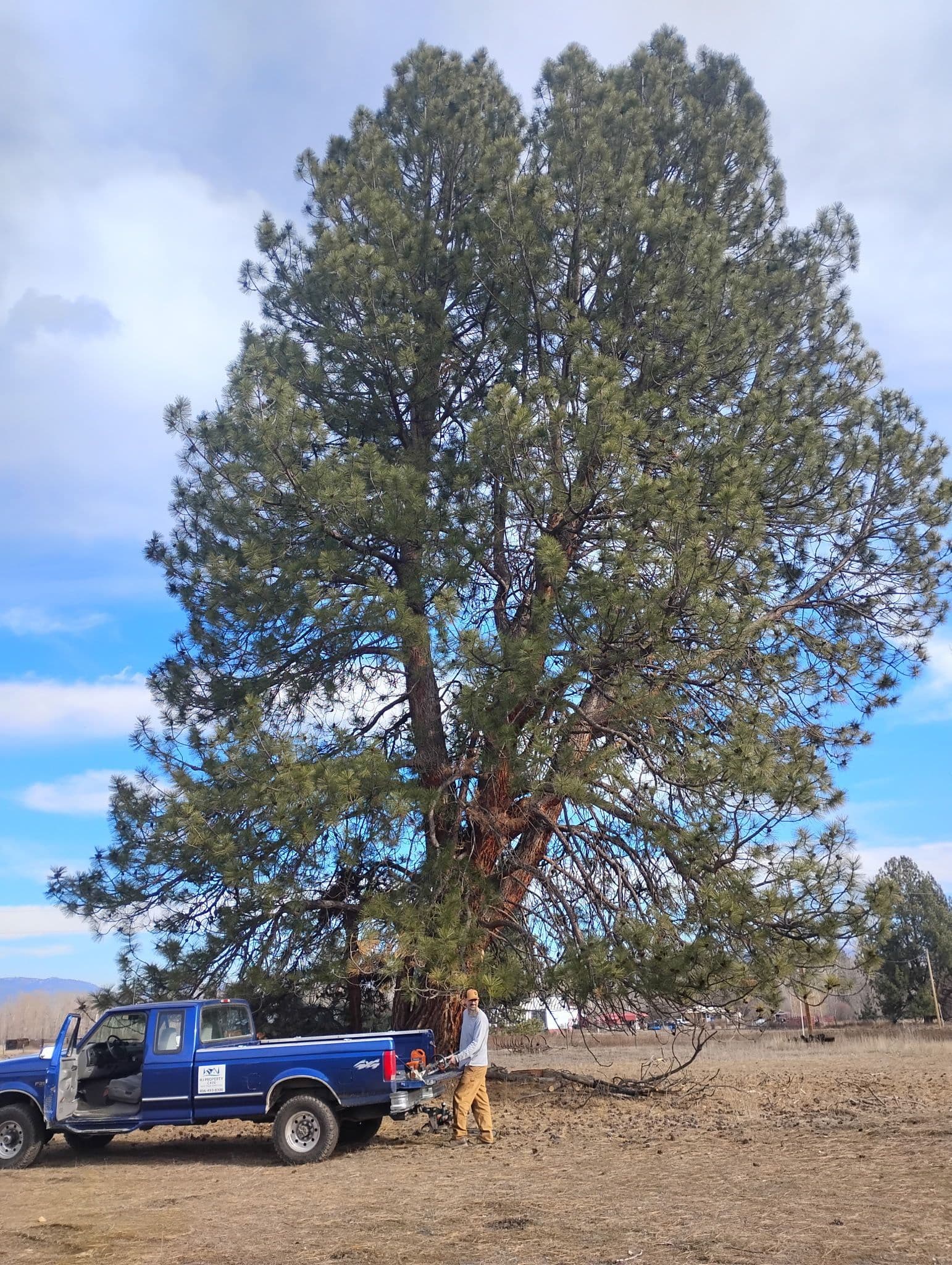
Dead, leaning, and beetle-killed trees taken down safely
Hazard and dead tree removal in Missoula & the Bitterroot Valley
Removal of dead, dying, leaning, and beetle-killed trees near homes and buildings across Missoula and the Bitterroot Valley, by an ISA Certified Arborist crew.
- Licensed & insured
- ISA-certified
- Free 48-hour estimates
Hazard & Dead Tree Removal
Dead, leaning, and beetle-killed trees taken down safely
A dead tree in the back forty is habitat. The same tree over a roof, a driveway, or the place the kids wait for the bus is a problem with a deadline, and it gets harder to deal with every season it stands. Dead wood dries, loses strength, and stops behaving predictably, which is exactly what a crew needs it to do when it is being taken apart above a house.
HJ Property Care & Tree Service LLC removes dead, dying, storm-damaged, and structurally unsound trees across Missoula and the Bitterroot Valley. The work is planned by an ISA Certified Arborist, and where a tree cannot simply be felled it is dismantled in sections and lowered on ropes so that nothing lands on what is underneath.
We will also tell you when a tree does not need to come down. Plenty of trees that look alarming are sound, and plenty of real defects can be managed by pruning. If you are not sure which you have, start with a tree health and risk assessment.
Have a tree you are worried about? Get it looked at.
Request ServiceTrees we are called to remove
Most hazard removals fall into one of these situations:
- Dead and dying trees within reach of a house, garage, or road
- Beetle-killed pines and firs
- Trees with trunk decay, cavities, or cracks
- Recent or worsening lean, or a lifting root plate
- Storm-broken tops and large hanging limbs
- Trees undermined by construction, trenching, or erosion
- Sectional dismantling where there is no room to fell
- Debris hauled away and the site left clean
Why a dead tree should not wait
There is a practical reason removal gets more difficult with time. A living tree holds a climber and takes rigging loads in ways a crew can predict. A tree that has been dead for several years is brittle, sheds limbs without warning, and may not be safe to climb at all, which changes the equipment and the time the job needs. The same tree is usually a simpler job in its first year than in its fifth.
Conifers killed by bark beetles are the common case in western Montana. Needles fade from green to red, and by the time the tree is gray the wood has been drying for a long while. Our mountain pine beetle guide explains the timing, and why a tree that still looks half alive may already be past saving.
What matters most is the target. A dead tree that can only fall into open ground can often be left, and we will say so. One that reaches a building, a line, a driveway, or a neighbor's property is the one to deal with first.
How a hazardous tree is taken down
The job starts on the ground with a plan: where the weight is, what the wood will hold, where pieces can land, and what has to be protected. Fences, roofs, septic lids, irrigation, and the lawn itself are all part of that, and so is anything overhead.
Where there is room and the tree is sound enough, it is felled in a chosen direction. Where there is not, it comes down in sections, with limbs and trunk pieces tied off and lowered under control. Trees that cannot safely be climbed are worked from a lift. Trees that are on or near energized lines are a separate matter covered on our tree work near power lines page, and nothing touching a live line is handled until the utility has made it safe.
Afterward the brush is chipped, the wood is hauled or left for you if you want it, and the stump can be ground so the spot can be replanted or seeded. See stump grinding for how that works.
Fire season, insurance, and neighbors
Standing dead trees close to a building are also fuel. If wildfire is the concern, removal is one part of a wider job, which is reducing what can carry fire to the house. That is covered under fire mitigation.
If the tree has already come down on something, that is an emergency call, not a scheduled removal. Our emergency tree and storm response page explains what to do first and when to call the utility or 911.
And if the tree is near a property line or in the strip between the sidewalk and the street, ownership is worth settling before any work is booked. We will help you work out whose tree it is before quoting.
Good to know
Hazard & Dead Tree Removal questions
Common questions about our hazard & dead tree removal in Missoula and the Bitterroot Valley.
Look at what changed and what it could hit. New lean, soil lifting at the base, cracks, large dead limbs, and mushrooms on the trunk or roots are reasons to call. An arborist assessment will tell you whether the tree can be kept, pruned, or should come down.
Yes. Trees close to buildings are taken down in sections, with each piece tied off and lowered, so nothing is dropped onto the roof or the yard below.
Usually, and more so the longer it has been dead. Dry, brittle wood is less predictable and may not be safe to climb, which is why it is better to deal with a dead tree near a building sooner.
Yes. Beetle-killed pines and firs are a large share of hazard removals here. We can also look at the trees around them and tell you which are at risk.
No. A dead tree that cannot reach anything you care about can often stay. We focus on the ones within reach of buildings, driveways, lines, and places people spend time.
Brush is chipped and hauled away. Larger wood can be hauled or left on site if you want it. Stump grinding is available so the area can be replanted or returned to lawn.
Yes. We look at the tree, explain what we would do and why, and give you a written estimate.
Read before you hire
Hazard & Dead Tree Removal guides
Written by our own crew: the questions Montana property owners ask us most.
Local coverage
Hazard & Dead Tree Removal in your area
We run crews across Missoula and the Bitterroot Valley. See what hazard & dead tree removal looks like in your town.
More from HJ Property Care
Explore our other services
Ready to transform your outdoor space?
Get a free, no-obligation estimate within 48 hours. Locally owned and ISA-certified.