
Should You Remove a Large Tree Close to Your House?
A big tree close to a house is the most valuable tree on most properties and the one that worries its owner most. Both feelings are reasonable. The shade, the screening and the look of the place took decades to grow and cannot be bought back. The same tree is also the one that could reach the roof. This guide is about making that decision well in the Missoula and Bitterroot valleys: what an arborist weighs, how our common species tend to behave, where wildfire fits, and what can be done short of cutting the tree down. If you think a tree is failing right now, start with [signs a tree is about to fail](/signs-a-tree-is-about-to-fail) instead.
Is a big tree near the house a problem by itself?
No. Distance alone does not make a tree dangerous. The International Society of Arboriculture (ISA) puts it this way in its guidance for tree owners: there is no such thing as a completely safe tree, all trees have the potential to fall, but only a small number actually hit something or someone, and the benefits of trees far outweigh the risks. ISA also notes that tree benefits increase with size and age, while older and larger trees are more likely to drop branches or cause root conflicts.
So the honest starting point is that a large tree near a house carries more of both: more value and more consequence if something goes wrong. The decision is about a specific tree in a specific spot, not about a rule of thumb for how many feet is too close.
What is an arborist actually weighing?
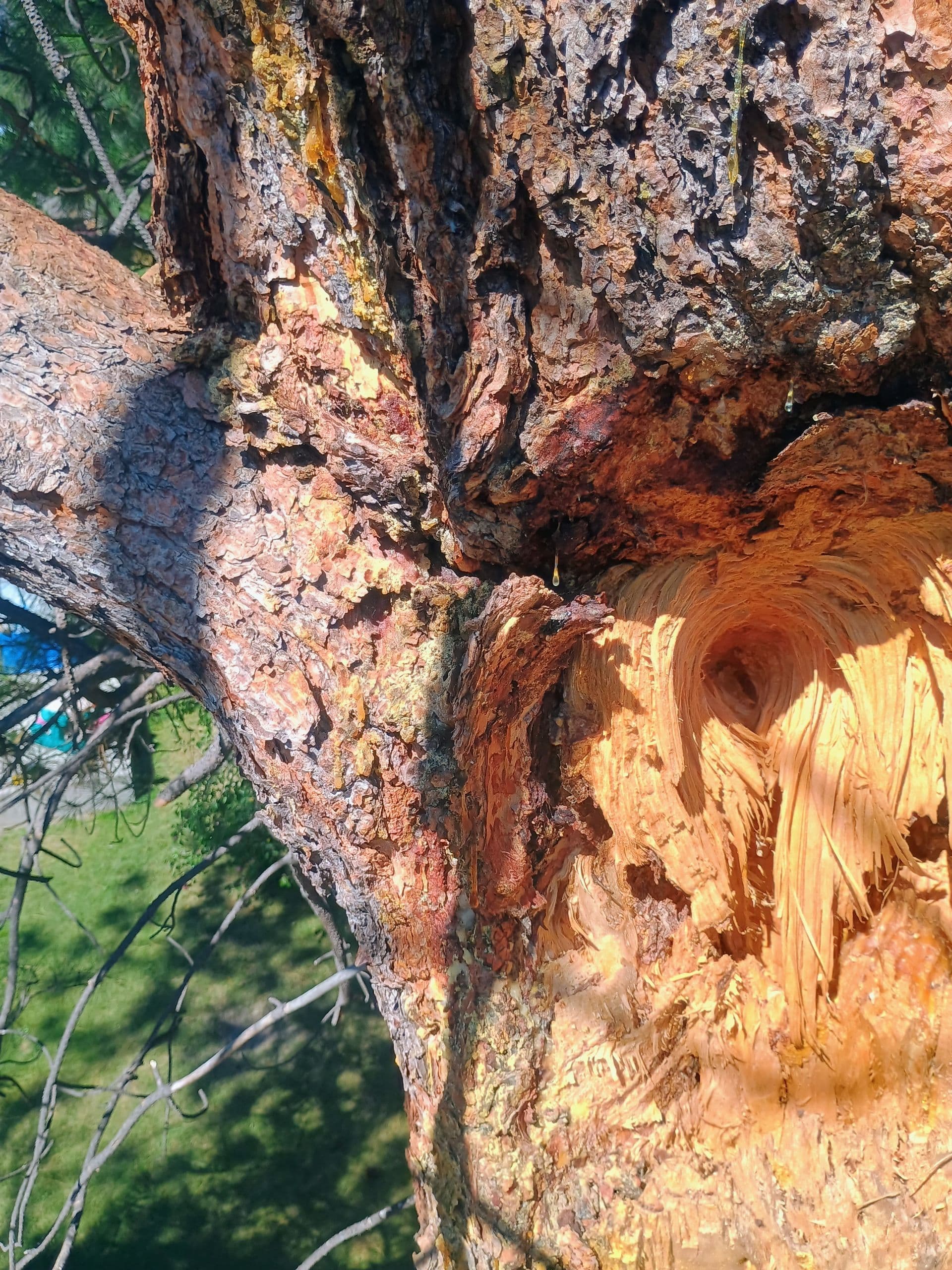
Three things, roughly in this order. First, how likely is it that the tree or a large part of it fails? That comes from the defects ISA lists for tree owners: large dead branches, cracks or splits in the trunk or at branch unions, codominant stems, cavities and decay, mushrooms at the base, soil cracking or heaving near a leaning tree, and a history of topping, root cutting or grade changes. Second, what would it hit? Third, how bad would that be?
The second and third questions are about targets. A limb over a back lawn and a limb over a bedroom are different risks even if the limbs are identical. A tree that leans away from the house toward open pasture is a different case from one that leans over the roof ridge. A proper tree health and risk assessment puts those pieces together and gives you a recommendation you can act on, not just a yes or no.
How do western Montana species tend to behave near a house?
Species is not a verdict, but it tells you what to watch for. The USDA Forest Service's silvics references describe tendencies worth knowing for the trees we see most beside homes here.
Black cottonwood, the big native of our river bottoms, is the one that earns its reputation. The Forest Service notes that ice storms and heavy snowfall cause considerable breakage in the species, that wind damage is common with tops breaking out, that frost cracks give decay fungi a way in, and that many different fungi cause decay in cottonwood. A mature cottonwood over a roof deserves regular inspection. Our guide to cottonwoods near houses covers them in depth.
Ponderosa pine is a different animal. The Forest Service describes vigorous taproots and lateral roots that can extend a very long way in open stands, which is part of why healthy ponderosas stand up well. Near a house, the questions are more often about bark beetles, needle litter and fire than about the tree tipping over.
Blue spruce, planted in yards all over the valley, has a shallow root system, yet the Forest Service calls it decidedly windfirm and also describes its wood as brittle. Douglas-fir is potentially deep rooting, but the same reference says it forms plate-like root systems in shallow soils or where the water table is high, and that tall slender trees with short crowns are highly susceptible to snow break and windfall once exposed. That last point matters when neighboring trees are removed and a tree that grew up sheltered suddenly stands alone.
Does wildfire change the decision?
Near the forest edge, yes. The Montana Department of Natural Resources and Conservation (DNRC) describes the Home Ignition Zone as a buffer around a home, typically up to 200 feet, and says that removing fuels within it significantly lowers the chance of a home igniting from embers, direct flame or radiated heat. A DNRC preparedness article breaks the zone into three areas: an immediate zone from the house out to 5 feet, an intermediate zone from 5 to 30 feet, and an extended zone from 30 to 100 feet.
DNRC calls the immediate zone the most important piece and focuses there on removing flammable material such as mulch and dried leaves. In the intermediate zone it says vegetation should have ample spacing and that ladder fuels, anything that can carry flame from the ground up into a tree's canopy, should be removed. In the extended zone the goal is healthy spacing that keeps fire on the ground.
Notice what that does and does not say. It does not say every tree within 30 feet has to go. It does mean a conifer with branches to the ground, touching the eaves, with a bed of dry needles underneath, is a fire question as well as a structural one. Often the answer is pruning up, clearing underneath and spacing, which is what our fire mitigation work is. DNRC also offers a free Home Wildfire Risk Assessment in which a local fire professional visits the property, and it is worth requesting before making a removal decision on fire grounds alone.
What can be done short of removal?
ISA lists the options an arborist familiar with risk assessment may suggest, and removal is the last of them. The first is to move the target. A house cannot move, but a parked vehicle, a play set or a seating area under a doubtful limb can. The second is pruning to remove the defective branches, with the warning that inappropriate pruning can weaken a tree. Reduction pruning to shorten an overextended limb above a roof is a common example.
The third is cabling and bracing to support weak branches and stems, which ISA is careful to say is not a guarantee against failure. We do not claim cable installation as a service, so ask us about it at an assessment. The fourth is routine care: water in dry summers, mulch and sensible pruning. A tree that is managed and re-inspected is a very different risk from one that is ignored.
What about roots and the foundation?
Root worries drive a lot of removal requests, and they are often a separate question from whether the tree will fall. ISA's risk guidance treats root loss from construction, grade changes and soil compaction as defects in the tree, which is to say that cutting roots to protect a walkway can create the hazard you were trying to avoid. If roots are the concern, read tree roots, foundations, sewer lines and sidewalks before deciding, and have the tree looked at before anyone trenches near it.
When is removal the right answer?
ISA's wording is that some trees with unacceptable levels of risk are best removed. In practice that usually means a combination: significant decay or a structural defect in the trunk or main stems, a target that is occupied and cannot be moved, and no pruning or support option that brings the risk down far enough. A dead tree within reach of the house belongs in the same group, because dead wood becomes less predictable to work in the longer it stands.
Close to a house, removal is rarely a matter of felling. The tree is taken apart in sections and lowered on ropes, which is what hazard tree removal involves. ISA adds a line worth keeping: if possible, plant a new tree in an appropriate place as a replacement.
How do you make the decision without regretting it?
Get the tree assessed while it is not an emergency, in writing, with the reasoning stated. Ask what the specific defect is, what the realistic options are, and what the arborist would do if the tree were theirs. Be cautious of a recommendation to remove a healthy tree that arrives with no defect named, and equally cautious of reassurance that comes without anyone looking closely at the base and the main unions. If the answer is to keep the tree, ask when it should be looked at again.
Assessment, pruning and removal are all part of our tree services across Missoula and Ravalli counties. For species by species detail, see the Montana Tree Guide.
Call HJ Property Care & Tree Service at (406) 215-7319 or request a tree assessment and an ISA Certified Arborist will look at the tree with you.
Need help?
HJ Property Care & Tree Service is locally owned and ISA-certified. Call for a free estimate.
This article is part of the Montana Tree Guide, our complete guide to trees in western Montana.
Explore our tree services.
Sources
We cite primary sources: Montana State University Extension, the City of Missoula, and the ISA, so you can verify anything here yourself.
- Recognizing Tree Risk (International Society of Arboriculture (TreesAreGood)). Last checked October 11, 2026.
- Managing Hazards and Risk (International Society of Arboriculture (TreesAreGood)). Last checked October 11, 2026.
- Black Cottonwood (Silvics of North America) (USDA Forest Service). Last checked October 11, 2026.
- Ponderosa Pine (Silvics of North America) (USDA Forest Service). Last checked October 11, 2026.
- Blue Spruce (Silvics of North America) (USDA Forest Service). Last checked October 11, 2026.
- Douglas-Fir (Silvics of North America) (USDA Forest Service). Last checked October 11, 2026.
- Fire Prevention and Preparedness (Montana Department of Natural Resources and Conservation). Last checked October 11, 2026.
Ready to transform your outdoor space?
Get a free, no-obligation estimate within 48 hours. Locally owned and ISA-certified.