
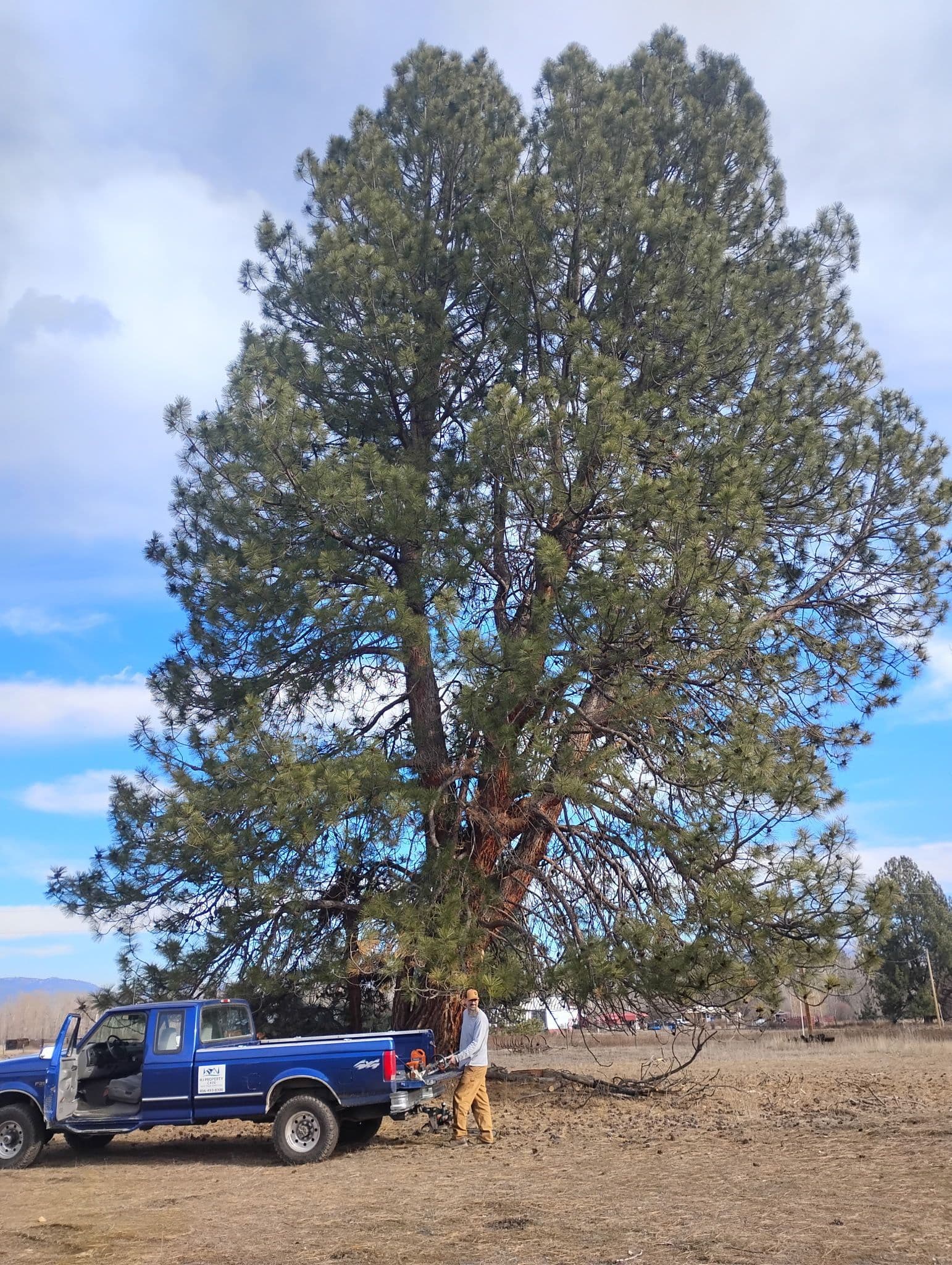
Fire mitigation versus tree removal: what you are actually buying
Reviewed by Justin Johnson, ISA Certified Arborist (RM-8889A)
A homeowner calls for a tree removal because a pine looks dangerous, and what the property really needs is fuel reduction. Another asks for fire mitigation and mostly needs three big dead trees taken down. The two services use the same saws and sometimes the same crew, but they answer different questions. Tree removal deals with a particular tree. Fire mitigation deals with how fire would move across the whole property to the house. This guide explains the difference so you can ask for the right thing and read an estimate with your eyes open.
What is the difference between fire mitigation and tree removal?
Tree removal is defined by the tree: this one comes down, safely, and the site is cleaned up. The reason might be that it is dead, leaning, diseased, in the way of a building, or crowding better trees. The International Society of Arboriculture recommends hiring an arborist for removal when a tree is dead, dying or an unacceptable risk, causing an obstruction that pruning cannot fix, crowding and harming more desirable trees, or in the way of new construction.
Fire mitigation is defined by the fuel: how much there is, how continuous it is, and how close it sits to the building. NFPA's Firewise checklist works outward from the house in zones, and most of its landscape tasks are not removals at all: clearing needles and dead vegetation, replacing wood mulch, pruning limbs, mowing, removing ladder fuels and spacing crowns. Removal is one tool among several, as our ladder fuels guide and zone guide show.
Does fire mitigation always include cutting down trees?
No. On some properties, the most important work involves no felling. Missoula County's first priority list includes clearing a five-foot buffer around the home, clearing roof and yard debris, clearing the deck and moving combustibles, and its second priority list includes removing branches that overhang the roof or touch the house. Those are cleanup and pruning jobs. Where a stand is crowded, trees will come out too, but selectively; see defensible space without clearcutting.
Does removing a tree reduce my fire risk?
It depends on which tree. Removing a dead pine beside the house clearly helps; the Colorado State Forest Service guide lists removing stressed, diseased, dead or dying trees and shrubs as a critical step in its 5 to 30 foot zone, and NFPA lists removing dead plant and tree material in the extended zone. Removing a healthy, well-spaced, limbed-up ponderosa 80 feet from the house may do little and costs you a tree. MSU Extension notes that thick-barked species such as ponderosa pine, western larch and Douglas-fir often escape severe fire damage.
A single removal also leaves everything else in place. If the needles are still in the gutter, the juniper is still against the wall and the firs under the remaining pines still reach into their crowns, the fire path is mostly intact. See beetle-killed trees and wildfire and dead trees near homes for the research on dead wood.
Why are they priced differently?
The time goes to different places. Tree removal cost is driven by the height and condition of the tree, what it could hit, and whether it can be felled or must be dismantled and lowered in sections. Fuel reduction is driven by how many small stems and limbs must be handled over how much ground, slope, access and how slash is disposed of. One large technical removal can take as long as a good deal of thinning. Our guides to tree removal cost and fire mitigation cost factors break down each one.
Does a cost-share program pay for tree removal?
This is where the difference can really matter. Missoula County's Wildfire Ready cost-share page says eligible projects include defensible space around homes and outbuildings, removal of hazardous vegetation along driveways and access routes, and long-term forest health and community wildfire resilience. It also lists as ineligible tree removal requiring advanced equipment such as ropes or aerial lifts, stump grinding or removal, and prescribed burning (slash pile burning is eligible).
So a project may have two parts: thinning that a program can share, and a technical removal over the garage that you pay for yourself. Ask the contractor to price them separately. Rules change, so confirm with the program, and see our cost-share and grants guide.
Which one do I need if a tree looks dangerous?
Deal with the tree first. New lean, soil lifting at the base, cracks, large dead limbs or a tree that could reach the house, a road or a line are tree risk questions, and they are not on a fire schedule. Our guide to signs a tree is about to fail and our tree health and risk assessment help you decide, and hazard tree removal explains the work. If a tree is already on a structure or a line, that is an emergency call, not an estimate.
Which one do I need if I got an insurance letter or a wildfire assessment?
Read what it actually asks for. A letter or assessment may name conditions rather than particular trees: branches over the roof, vegetation touching the house, fuel in the first five feet, dead trees nearby. That is a fire mitigation scope, which may include a few removals. Ask your insurer exactly what must change and by when, because we cannot speak for them, and keep records; see documenting mitigation for your insurer. If you have not had an assessment, the free options are the place to start.
How should each one read on an estimate?
A removal estimate should name the tree or trees, say how each comes down (felled, or dismantled in sections from a climber or a lift), and state what happens to the brush, the logs and the stump. A fuel reduction estimate should describe an area rather than a tree: how far out from the house the work goes, the crown spacing and limbing height, what happens to small conifers and brush, and the disposal method. If a fire estimate lists only a tree count, ask what is being done about ladder fuels and the first five feet. If a removal estimate promises wildfire protection, ask how the rest of the property fits in. Stumps belong on both: say whether they are cut low or ground, since Missoula County's program does not cover stump grinding or removal.
Should the same crew do both?
It is usually simpler when it can. On wooded lots the trees a fuel plan wants out are often next to a roof or a line, and OSHA's tree care guidance tells crews to keep work at least 10 feet from power lines or have the power company de-energize and ground the line. A crew that can only fell in the open has to leave those trees for someone else. On the other hand, a forestry contractor may be a better fit for acres of thinning far from buildings. If you use two companies, make sure one plan covers both, so the removal crew's slash does not land in the zone the other just cleared.
What about the trees that should stay?
Both services should start with that question. A removal should leave the remaining trees undamaged, and a fuel reduction plan should favor the best trees. Not every dead tree has to go, either: one that cannot reach anything you care about can often stay, as we explain under hazard tree removal. In the zones close to a building, though, dead material is fuel, and the guidance is clear about removing it. Remember too that limbing has limits: NFPA's checklist says not to exceed one third of the overall height on shorter trees.
What happens to the wood in each case?
A removal usually produces logs and brush from one spot, which can often be hauled, chipped or cut for firewood. Mitigation produces far more small material over a wider area, so disposal is a bigger part of the plan. Missoula County counts disposal as part of completing a cost-share project and lists chipping, hauling off site and pile burning as methods. See firewood and wood chips after tree removal and slash disposal options.
How do you decide which to ask for?
Ask yourself what you want to be different afterward. If the answer is "that tree is gone," call for a removal estimate, using our what to expect on removal day guide. If it is "a fire coming through would have a harder time reaching my house," ask for fuel reduction, and start with an assessment. If you are not sure, describe both worries and let the walkthrough sort it out. A contractor who offers only removals, or only thinning, may steer you toward what it sells, so compare.
This guide is part of our Montana Wildfire & Defensible Space Guide. We do both under one roof: fire mitigation and tree services. Call HJ Property Care & Tree Service at (406) 215-7319 or request a free estimate and we will walk the property with you.
Need help?
HJ Property Care & Tree Service is locally owned and ISA-certified. Call for a free estimate.
This article is part of the Montana Wildfire & Defensible Space Guide, our complete guide for western Montana property owners.
Explore our fire mitigation.
Sources
We cite primary sources: Montana State University Extension, the City of Missoula, and the ISA, so you can verify anything here yourself.
- Why Hire an Arborist? (International Society of Arboriculture (TreesAreGood)). Last checked November 2, 2026.
- Reducing Wildfire Risks in the Home Ignition Zone (checklist) (National Fire Protection Association (Firewise USA)). Last checked November 2, 2026.
- Prepare your property (Missoula County Office of Emergency Management). Last checked November 2, 2026.
- Wildfire Ready cost-share program (Missoula County Office of Emergency Management). Last checked November 2, 2026.
- The Home Ignition Zone: A Guide to Preparing Your Home for Wildfire and Creating Defensible Space (2021) (Colorado State Forest Service). Last checked November 2, 2026.
- Fire-Resistant Plants for Montana Landscapes (MT200101AG) (Montana State University Extension). Last checked November 2, 2026.
- Tree Care Work: Know the Hazards (OSHA 3752) (Occupational Safety and Health Administration). Last checked November 2, 2026.
Ready to transform your outdoor space?
Get a free, no-obligation estimate within 48 hours. Locally owned and ISA-certified.