
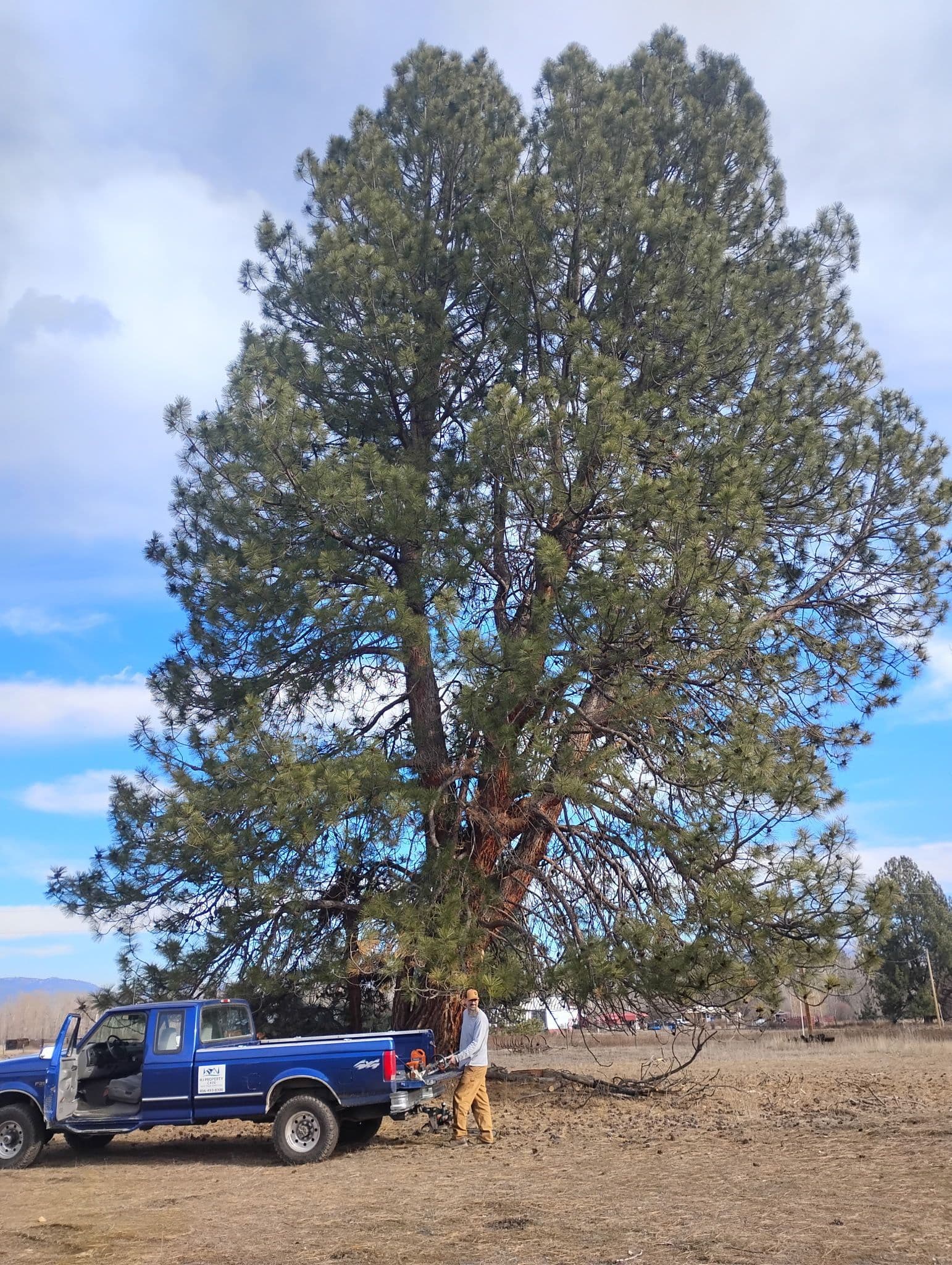
What drives the cost of fire mitigation in Montana
Reviewed by Justin Johnson, ISA Certified Arborist (RM-8889A)
Two properties of the same size in the Bitterroot can need very different amounts of work to reach the same level of wildfire safety. One is an open ponderosa stand on a gentle bench with a gravel drive to the back; the other is a north-facing slope of crowded Douglas-fir with a power line through it and no way in for a chipper. This guide explains the factors that move the size of a fuel reduction job in Missoula and Ravalli counties, so you can read an estimate, compare two of them, and decide where your own money and time go first. We do not publish prices, because no number means anything until someone has walked the ground.
Why is there no standard price per acre for fire mitigation?
Because fuel reduction is a list of different tasks, and every property needs a different mix of them. Clearing needles and woody material out of the first five feet around a house, pruning low limbs, thinning crowded conifers, removing dead trees and dealing with the slash are separate jobs with separate equipment and crew time. A lot that needs mostly the first two is a small job even if it is large; a small lot with tall dead trees over the roof is a big one.
Distance from the house also changes the work. NFPA's Firewise checklist divides the home ignition zone into an immediate zone from the house out to 5 feet, an intermediate zone from 5 to 30 feet and an extended zone from 30 to 100 feet, with work out to 200 feet suggested where the property allows. Missoula County encourages owners to maintain the area within 200 feet of the home, starting at the house and working outward. Every ring outward is more ground, but also less intensive treatment per square foot. Our home ignition zone guide explains what happens in each ring.
How much do acreage and the size of the treated area matter?
They set the outer limit of the job, but they are not the main driver on most home sites. The first questions are how far out the treatment needs to go and how dense the vegetation is in that area. A house in an open meadow with scattered pines may only need work close in. A house surrounded by a closed canopy on every side needs the full distance, and on a slope the treated area usually extends further downhill, because fire runs uphill toward the house.
For owners with larger parcels, the useful question is not "how many acres" but "which acres first." Work nearest the buildings and along the driveway buys the most protection per hour, and a fuel break further out can be a later phase. Our guide to planning a fuel break on acreage covers the outer work separately.
How does slope change a fuel reduction job?
In two ways. First, it raises the standard. NFPA's checklist recommends a minimum of 18 feet between tree crowns in the intermediate zone, with the distance increasing with the percentage of slope, and the Colorado State Forest Service guide notes that its spacing figures are minimums that should increase on slopes. More spacing means more trees come out. Second, slope slows everything down: crews move material by hand, equipment cannot go everywhere, and cut wood has to be carried or winched rather than driven out.
The west side of the Bitterroot and the hills around Missoula have plenty of ground where both apply. A steep, timbered lot is one of the clearest cases where a walkthrough changes the estimate more than anything on a map. The spacing tables themselves are in our guide to thinning conifers.
What about tree size, density and species?
Many small trees take longer than a few large ones. A dense stand of young Douglas-fir or pole-sized pine under bigger trees is classic ladder fuel, and removing it means a great many cuts and a great deal of slash for the area treated. NFPA's checklist lists removing small conifers growing between mature trees as a task in the extended zone. The Colorado guide adds species-specific cautions: older lodgepole stands do not respond well to selective thinning, and it suggests removing no more than 30 percent of the trees in a mature stand per thinning operation, which can turn one job into several over the years.
Large trees cost more per tree when they cannot simply be felled. A tall pine leaning over a roof, a garage or a neighbor's fence is taken down in pieces and lowered, which needs climbing or a lift and a bigger crew. That is tree removal work inside a fire mitigation job, and it is priced differently. Our guide to fire mitigation versus tree removal explains where the line falls.
Why does access matter so much?
Because almost every hour on a fuel reduction job is spent moving material. If a chipper or truck can reach the work area, brush goes straight from the saw into the machine. If the work is down a slope, behind a house, across a creek or past a fence with no gate, every limb is carried by hand. Soft ground in spring, a narrow private road and a long rural drive all add time. Firm, dry ground in fall is one reason it is the usual working season, as our page on why fall and winter are best for fuel reduction explains.
How does slash disposal change the cost?
It is often the largest single variable after the cutting itself. Material can be chipped on site, hauled away, lopped and scattered in the outer zone, or piled and burned. Each has different labor, equipment and timing. Missoula County's cost-share program counts disposal as part of a finished project and lists chipping, hauling off site and pile burning as methods.
Burning is not free just because there is no truck. In Missoula County, Missoula Public Health's 2026 notice says a permit must be bought and activated on each burn day, only natural vegetation and untreated wood generated on site may be burned, and outdoor burning typically closes in midsummer. In Ravalli County, Montana Public Radio reported on 10 September 2026 that a ban in place since 13 July had ended and fall burning was allowed day to day through 30 November. Piles have to wait for an open day, which affects scheduling. Timing also matters for bark beetles: the Forest Service pine engraver guide hosted by Montana DNRC rates green pine slash created from April through July as an extreme infestation risk and slash created from August through November as low to moderate. See slash disposal options and chipping versus hauling for the comparison.
Do power lines make fire mitigation more expensive?
Trees near energized lines need people qualified to work near them and more care, so yes, that part of the job takes longer. OSHA's tree care guidance tells crews to keep work at least 10 feet from power lines or have the power company de-energize and ground the line, and the federal standard for electric power work sets out separate rules for line-clearance tree trimming. Some trees near lines are the utility's responsibility and some are the owner's. We carry line-clearance qualification, which is why we can quote that work instead of excluding it; our tree work near power lines page explains how responsibility is sorted out.
Does the time of year change the price?
Season affects how efficiently the work goes rather than what it is. Fall and early winter usually offer firm ground, finished nesting season and slash that dries before the beetles fly. Summer work in hot, dry, windy weather carries an ignition risk from the equipment itself and can be stopped by fire restrictions. Spring work may have to pause around active nests. Booking ahead of the season rather than into it usually gives you more choice of dates.
Can cost-share programs cover part of the work?
Sometimes, and the rules shape the job. Missoula County's Wildfire Ready cost-share program, run with United Way of Missoula County and funded through a USDA grant, says it will pay up to 75 percent of eligible project costs, subject to a per-acre cap, directly to the contractor after a county mitigation specialist inspects the finished work. Its page says owners cannot be reimbursed for doing the work themselves, projects must be finished within one year, and tree removal requiring ropes or aerial lifts, stump grinding and prescribed burning are not eligible (slash pile burning is). In Ravalli County, the Bitter Root RC&D runs a hazardous fuels reduction program for the wildland-urban interface in Missoula, Mineral and Ravalli counties and says all cost-share projects are subject to grant funding availability.
Those terms were current when we checked them; confirm with the program before planning around one. The cost-share and grant guide collects the programs, and free wildfire risk assessments are usually the first step to qualifying.
What will a good estimate spell out?
Enough that you could compare it line by line with another one: the area treated, what is being removed and what is staying, the spacing or limbing height being worked to, how slash is handled, whether any removals need climbing or a lift, whether stumps are cut low or ground, and what the site looks like when the crew leaves. Two estimates that differ widely often differ in scope, not rates. Our questions to ask before hiring list helps you pin that down.
How can you keep the cost down?
Start with what you can do yourself. Missoula County's property checklist treats clearing roof and yard debris such as pine needles from gutters, the roof and around fences, and clearing under the deck, as do it yourself work. Get a free assessment so the paid work targets real exposures. Ask about phasing: the house and driveway first, the outer zone later. Keep up maintenance afterward, because a site that is touched up every year or two never goes back to the original job. Our DIY versus hiring guide sorts the tasks.
This guide is part of our Montana Wildfire & Defensible Space Guide. To see what the work itself involves, read our fire mitigation service page. Call HJ Property Care & Tree Service at (406) 215-7319 or request a free estimate and we will walk the property with you.
Need help?
HJ Property Care & Tree Service is locally owned and ISA-certified. Call for a free estimate.
This article is part of the Montana Wildfire & Defensible Space Guide, our complete guide for western Montana property owners.
Explore our fire mitigation.
Sources
We cite primary sources: Montana State University Extension, the City of Missoula, and the ISA, so you can verify anything here yourself.
- Reducing Wildfire Risks in the Home Ignition Zone (checklist) (National Fire Protection Association (Firewise USA)). Last checked November 2, 2026.
- The Home Ignition Zone: A Guide to Preparing Your Home for Wildfire and Creating Defensible Space (2021) (Colorado State Forest Service). Last checked November 2, 2026.
- Prepare your property (Missoula County Office of Emergency Management). Last checked November 2, 2026.
- Wildfire Ready cost-share program (Missoula County Office of Emergency Management). Last checked November 2, 2026.
- Hazardous Fuels Reduction (Bitter Root Resource Conservation & Development). Last checked November 2, 2026.
- Outdoor burning opens March 1 in Missoula County (27 Feb 2026) (Missoula Public Health). Last checked November 2, 2026.
- Open burning ban ends in Ravalli County following rainy weather (10 Sep 2026) (Montana Public Radio). Last checked November 2, 2026.
- Pine engraver (Ips pini) Insect and Disease Management Guide (rev. 2025) (USDA Forest Service Northern and Intermountain Regions, hosted by Montana DNRC). Last checked November 2, 2026.
- Tree Care Work: Know the Hazards (OSHA 3752) (Occupational Safety and Health Administration). Last checked November 2, 2026.
- 29 CFR 1910.269, Electric power generation, transmission, and distribution (scope, line-clearance tree trimming) (Occupational Safety and Health Administration). Last checked November 2, 2026.
Ready to transform your outdoor space?
Get a free, no-obligation estimate within 48 hours. Locally owned and ISA-certified.