
How Often Defensible Space Needs Maintenance
Reviewed by Justin Johnson, ISA Certified Arborist (RM-8889A)
The first round of defensible space is the expensive one. After that, the question owners ask is how often it needs doing again, and the honest answer is that different parts wear out at very different speeds. Needles in the gutters come back in weeks. Grass comes back every summer. Shrubs regrow over a few years, and trees close the gaps between their crowns over longer. This guide sorts the work into what recurs several times a year, once a year, and every few years, lays it out by season for the Missoula and Bitterroot valleys, and helps you decide what to do yourself and what to hand to a crew.
Is defensible space a one-time job?
No. Montana DNRC's landowner guide for west-central Montana asks owners to create and maintain the five-foot zone around a home, regularly clean the roof and gutters, and maintain spacing between trees. It notes that when landowners take responsibility for applying and maintaining risk reduction on their property, they greatly increase the chances of their homes surviving a wildfire.
The Colorado State Forest Service's home ignition zone guide is the most specific on frequency. It says wildfire risk reduction is not a one-time effort: some actions, such as removing pine needles from gutters and mowing grass and weeds, may need doing several times a year, while others need doing annually or only once. Its checklist explains why: trees, grasses and shrubs keep growing, dying and dropping leaves each season.
What needs doing several times a year?
The Colorado guide marks these tasks to be done as needed, more than once a year: clearing pine needles and debris from the roof, deck and gutters; mowing grass and weeds to four inches or less; raking needles and flammable debris out of the five feet around the foundation and deck; and keeping any accumulation of chipped or other slash 30 feet or more from the home.
The University of Nevada, Reno Extension's Wildfire Home Retrofit Guide agrees on gutters, recommending debris removal on a regular basis during fire season, and on the band from five to 30 feet, which it describes as lean, clean and green, with vegetative debris and dead material routinely removed. Under conifers in western Montana, these are the tasks that slip first.
What needs doing once a year?
Annual tasks are the resets. The Colorado guide says to remove dead stems from shrubs annually and to periodically prune shrubs to prevent excessive growth. A yearly walk-around also catches the things that creep: firewood moved back next to the house, new limbs reaching over the roof, plants grown into the five-foot zone, and damaged vent screens.
DNRC's guide gives the standards to check against each year: nothing that burns within five feet of the house, no branches overhanging or touching the roof within 10 feet, branches pruned 10 feet high in the zone from five to 30 feet, and at least 18 feet between trees or clumps there. The spring checklist is a good format for the annual pass.
What needs doing every few years?
Shrub regrowth and tree spacing. The Colorado guide recommends treating or mowing shrubs that resprout aggressively every three to five years or more, depending on growth rate. Its example species is Colorado's Gambel oak, but the principle applies to any vigorous resprouter in a Montana yard.
Trees change more slowly but they do change. Crowns widen, small trees grow up into ladder fuels, and lower branches that were out of reach of surface fire get closer as understory grows. The spacing and limb heights in DNRC's guide are the measures to recheck when you walk the property. When the gaps are closing, it is time for another round of selective thinning and limbing. Our guides on thinning conifers and how high to limb up trees explain the targets.
What does the year look like in western Montana?
Spring, after melt: clear roofs and gutters, reset the five-foot zone, cut broken limbs, mow last year's dead grass, start irrigation, and get any winter pine slash chipped, hauled or burned before beetles fly. The USDA Forest Service's 2025 pine engraver guide sets the treatment window for slash cut from December through March at April through June 1. Burning requires a permit and an open season; Missoula County's general outdoor burning season is March 1 to August 31.
Summer: mow early in the day, keep needles off the roof and out of the five-foot zone, keep the green zone watered, and keep firewood and furniture away from the house. Keep Montana Green advises clearing grass before 10 a.m. and notes that spark arrestors are required on portable gas equipment. Late summer through winter: bigger thinning and limbing, when the Forest Service guide rates new pine slash as lowest risk from August through November. Fall: a second roof and gutter clearing after the needle and leaf drop.
Do chips from the last round need attention?
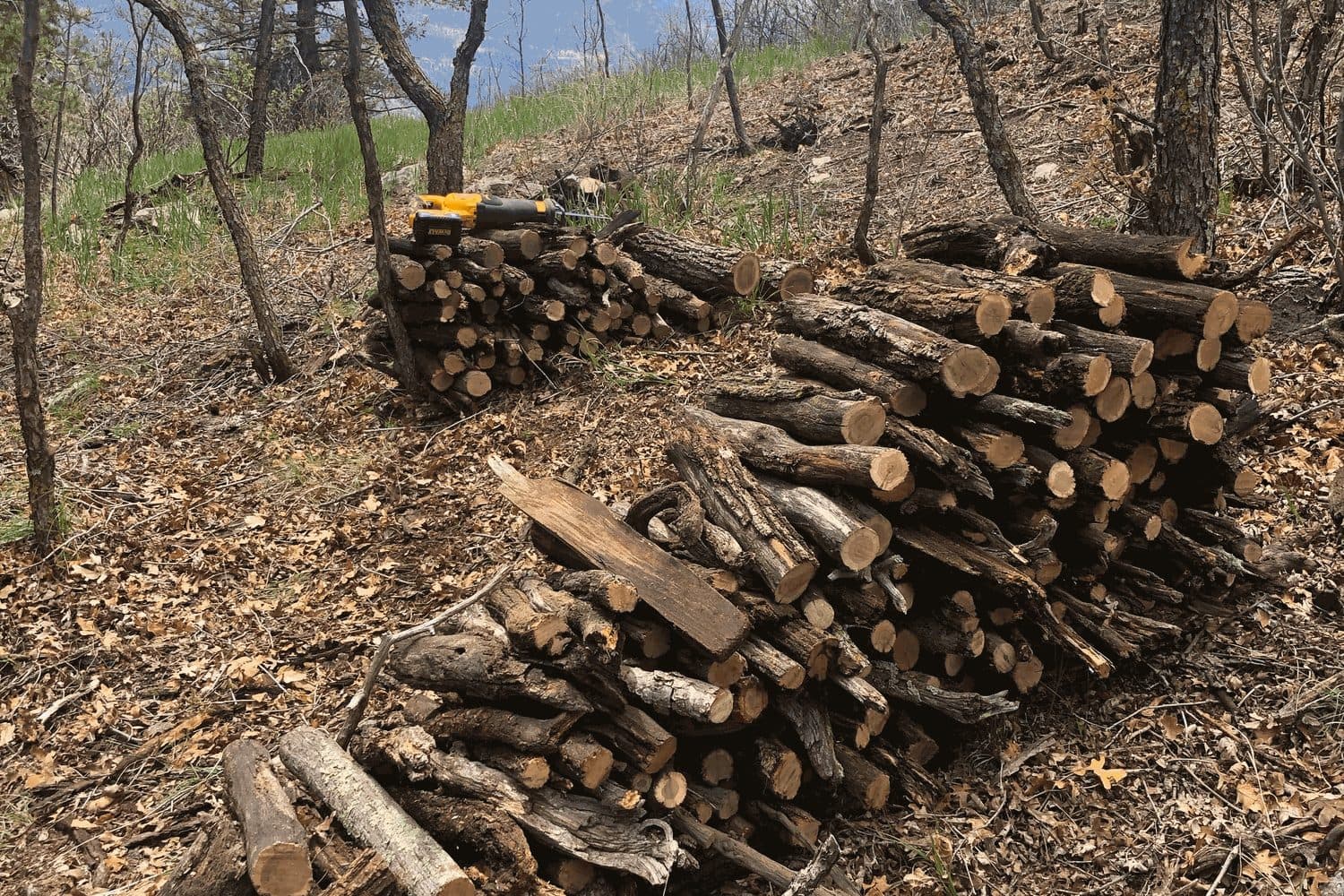
They can. The Colorado guide says to avoid creating continuous areas of wood chips on the ground, and to break them up with nonflammable material or leave gaps of at least three feet between chip accumulations. It also wants any accumulation of slash, chipped or otherwise, 30 feet or more from the home. Check where the chips from the last thinning ended up, because a job that was done well can leave a fuel bed if chips get spread back toward the house for convenience.
Piles are the same story. A slash pile kept for a burn that never happened is fuel sitting on the property, and it needs a date. Our guides on slash disposal options and chipping or hauling compare the choices.
Does a steep lot need more maintenance?
It needs a larger area kept up, which adds up to more work. The Colorado guide says its horizontal spacing recommendations are minimums that can be increased, particularly on slopes, and that the outer zone may be larger on steep ground or where the terrain calls for it. It also suggests working with adjoining owners when that zone runs past your property line.
The University of Nevada, Reno guide adds that decks overhanging a slope need defensible space maintained downslope, so flames from burning vegetation cannot reach the underside. If your house sits at the top of a slope, put the ground below the deck on the list. Our guide to slope, aspect and wind explains why it matters.
How do you keep track of it?
Write it down. A one-page list of the tasks, the season for each, and the date it was last done turns a vague intention into a routine. Take photos of the five-foot zone, the roofline and the tree spacing from the same spots each year, so you can see change over time.
Those records have a second use. If an insurer asks about wildfire mitigation, dated photos and invoices are a simple way to show what was done. Our guide to documenting wildfire mitigation for your insurer explains what to keep. This is not insurance advice; ask your insurer what it wants to see.
Which tasks are reasonable to do yourself?
Most of the frequent ones: raking, mowing, moving firewood and furniture, clearing gutters you can reach safely, and hand-pruning small limbs from the ground. These are the tasks that matter most and need doing most often, which is why owner upkeep is valuable.
Tree felling, limbing above ladder height, work near power lines, roof work on steep pitches and slash disposal at scale are where owners get hurt or create new problems. Keep Montana Green's advice on equipment applies to everyone: spark arrestors, early-morning work, and checking the area for rocks. Our comparison of DIY defensible space and hiring a crew goes through the tradeoffs.
What does a maintenance visit from a crew include?
It depends on the property, which is why it starts with a walk-around. On a typical lot under pines it covers roof and gutter needle clearing, cleanup of the five-foot zone and under decks, mowing or trimming dry grass in the zone around the house, removal of new ladder fuels and dead material, pruning limbs back from the roof, and chipping or hauling everything that comes off. Every few years it includes another round of selective thinning.
Our fire mitigation service covers this work, and seasonal cleanups and lawn care can carry the frequent tasks between visits. What to expect on a fire mitigation project explains how a visit runs.
Should you get the property reassessed?
After big changes, yes: a fire nearby, a storm that dropped trees, a new building, or a few years of growth since the last assessment. The Missoula Fire Department offers free defensible space consultations in the Missoula wildland-urban interface at 406-552-6210, and Montana DNRC takes requests for free wildfire risk assessments. Programs change; confirm when you call.
A fresh assessment updates the priority list. We are glad to work from it, and our guide to free wildfire risk assessments covers what is available locally.
Where this fits
Maintenance is the part of defensible space that decides whether the first round keeps working. The seasonal details are in our guides to spring prep, summer upkeep and fall and winter fuel reduction, all part of our Montana Wildfire Guide. Call HJ Property Care & Tree Service at (406) 215-7319 or request a free estimate and we will walk the property with you.
Need help?
HJ Property Care & Tree Service is locally owned and ISA-certified. Call for a free estimate.
This article is part of the Montana Wildfire & Defensible Space Guide, our complete guide for western Montana property owners.
Explore our fire mitigation.
Sources
We cite primary sources: Montana State University Extension, the City of Missoula, and the ISA, so you can verify anything here yourself.
- Forest Landowner Guide: West-Central Montana (Montana Department of Natural Resources and Conservation (DNRC)). Last checked November 2, 2026.
- The Home Ignition Zone: A guide to preparing your home for wildfire and creating defensible space (2021) (Colorado State Forest Service). Last checked November 2, 2026.
- Wildfire Home Retrofit Guide (SP-20-11, 2020) (University of Nevada, Reno Extension). Last checked November 2, 2026.
- Pine engraver (Ips pini), Insect and Disease Management Guide, Northern and Intermountain Regions (revised 2025) (USDA Forest Service, Forest Health Protection (hosted by Montana DNRC)). Last checked November 2, 2026.
- Outdoor Burning (Missoula County Public Health). Last checked November 2, 2026.
- Resources: equipment and debris burning fire prevention (Keep Montana Green). Last checked November 2, 2026.
- Wildfire Prevention (City of Missoula, Missoula Fire Department). Last checked November 2, 2026.
- Wildfire Prevention and Preparedness (Montana Department of Natural Resources and Conservation (DNRC)). Last checked November 2, 2026.
Ready to transform your outdoor space?
Get a free, no-obligation estimate within 48 hours. Locally owned and ISA-certified.