
What to expect on a fire mitigation project
Reviewed by Justin Johnson, ISA Certified Arborist (RM-8889A)
Most people who call about fire mitigation have never had it done, and the questions are practical. Will there be a crew on the property for a day or a month? Do you have to be home? What happens to all the branches? Will it look like a logging site afterward? This guide walks through a typical fuel reduction project in Missoula County or the Bitterroot, from the first visit to the last load of chips, so you know what each step is for and where your decisions come in.
Should the project start with a wildfire risk assessment?
If you can get one, yes, and in western Montana it costs nothing. The Missoula Fire Department offers free defensible space consultations in the Missoula wildland-urban interface, Missoula County's wildfire mitigation team offers free home assessments to county residents, and Montana DNRC lets anyone request a free wildfire risk assessment, after which a local fire professional contacts you to schedule a visit. In Ravalli County, the Fire in the Root council takes requests for free risk assessments. Our guide to free wildfire risk assessments lists them all.
An assessment matters for two reasons. It tells you which exposures are real, so the paid work is aimed at them, and some cost-share programs start with one. Missoula County's cost-share page describes the first step as a free visit from a county wildfire mitigation specialist who determines eligibility and drafts a customized treatment plan.
What happens at the contractor walkthrough?
We walk the property with you, starting at the house and working outward, the same order NFPA's checklist recommends: the structure and the first five feet, then the intermediate zone, then the extended zone. We look at what is touching or overhanging the building, where ladder fuels connect the ground to the crowns, how close the crowns are to each other, which trees are dead, dying or crowded out, how steep the ground is, and where equipment can get in. If you have an assessment or treatment plan, we work from it.
This is where you tell us what matters to you: the tree you planted, the screen from the road, the shade on the west side of the house. Defensible space is selective work, and the walkthrough is when the selection starts. Our guide to defensible space without clearcutting explains why keeping the right trees is part of the goal.
Do you need permits, or to tell anyone first?
Check three things before the saws start. If the tree stands in the strip between a Missoula sidewalk and street, read Missoula tree permits and the right of way first; the City of Missoula keeps a list of services permitted to work there. If burning is part of the plan, permits apply, as described below. If the work touches a shared boundary, talk to your neighbor. NFPA's checklist notes that home ignition zones often overlap adjacent properties and calls working with neighbors extremely important, so a neighbor may even want to join the project. Settle who owns a boundary tree before it is marked; our neighbor tree disputes guide covers that, and an HOA may have its own requirements, so ask.
What should the written estimate cover?
The area to be treated, what comes out and what stays, the limbing height and crown spacing being worked to, any removals that need climbing or a lift, how slash will be handled, how stumps are left, and the expected condition of the site at the end. If a cost-share program is involved, the estimate has to match its treatment plan. Missoula County's page says the landowner approves the estimate and plan, the county signs a contract with the contractor, and the landowner signs a separate contract with the contractor. The factors behind the number are covered in our cost factors guide.
Are trees marked before cutting?
On anything beyond simple limbing, it is worth doing. Flagging or marking the trees to be removed (or the ones to keep) lets you see the plan on the ground before anything is cut, and lets you change your mind about a particular tree while it is still standing. A tree cannot be put back, so we would rather walk the marked trees with you than have you discover a gap you did not expect.
When will the work be scheduled?
Usually in fall, winter or early spring. Ground is firmer, fire danger is lower, and slash timing works better for bark beetles: the Forest Service pine engraver guide hosted by Montana DNRC rates green pine slash created August through November as a low to moderate infestation risk and slash created April through July as extreme. Summer cutting in hot, dry, windy weather carries an ignition risk from the equipment, and spring work has to account for nesting birds, which our nesting season calendar covers. Our fall and winter timing guide goes further.
What does a work day look like?
The crew arrives, reviews the plan, and sets up a work area. OSHA's tree care guidance calls for a drop zone at least twice the height of the tree being felled, and its chainsaw fact sheet says other workers should be twice as far away as the height of the trees being felled, so expect parts of the property to be closed off while trees come down. Vehicles may need moving, pets kept inside and children kept away from the work.
Work generally moves from the house outward. Close to the building it is pruning, clearing and careful removals; further out it is thinning, ladder fuel removal and limbing. Trees that cannot be felled safely because of a roof, line or fence are taken down in sections. You do not have to be home all day, but being reachable helps when a question comes up about a particular tree.
How long does a fire mitigation project take?
Anything from a day on a small town lot to a series of visits on a timbered acreage. Slope, density, access and disposal method set the pace more than acreage does. Weather can interrupt the schedule: wind, rain on steep ground or a burn closure can all push a day. Ask for an estimated number of crew days and what could change it.
What happens to the branches and trees that are cut?
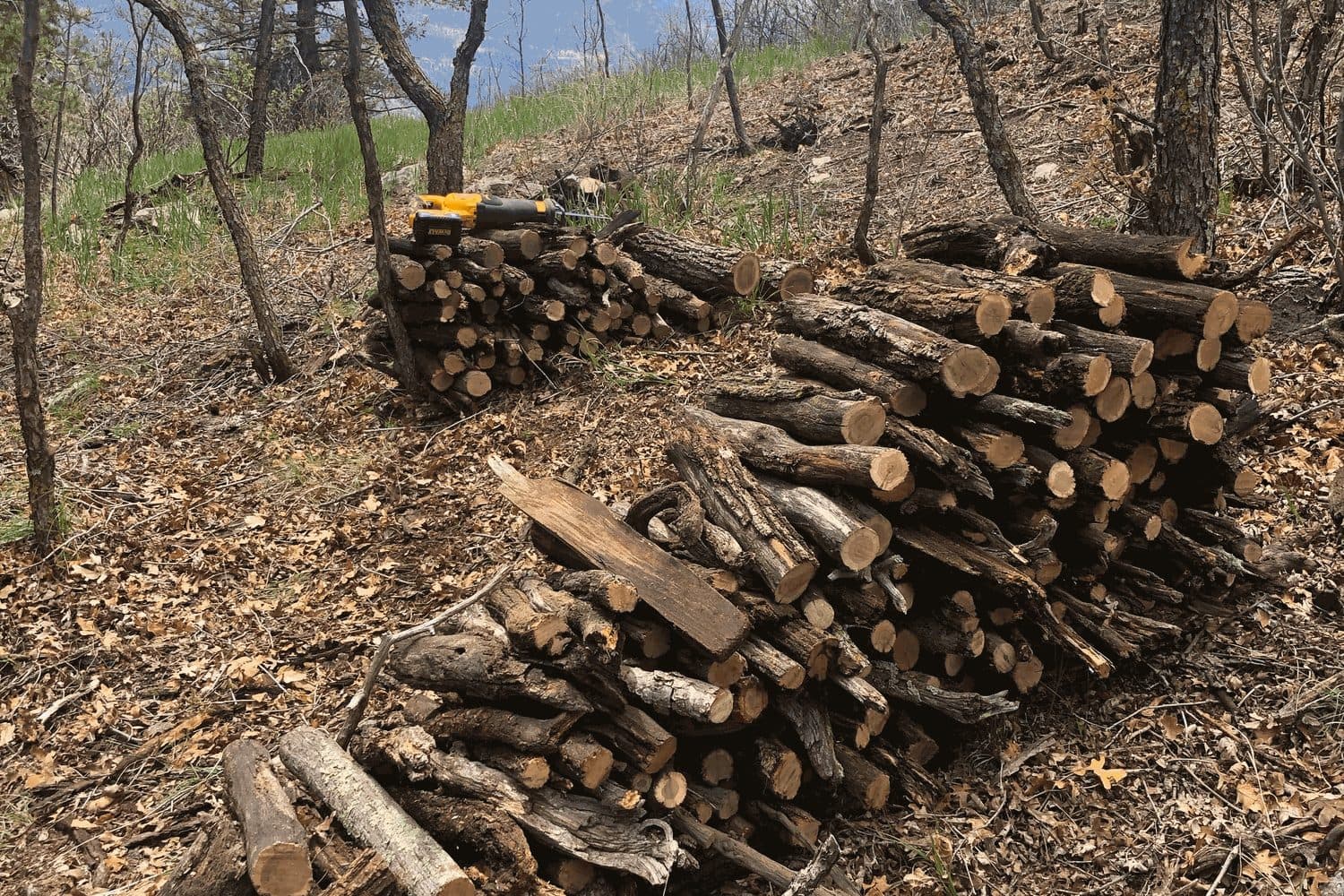
They are dealt with as part of the job, not left for later. Slash left lying is fuel in the area you were trying to clear. The usual options are chipping on site, hauling material away, lopping and scattering it thinly in the outer zone, or piling it for burning. Chips are placed away from the house rather than spread through the first five feet, which NFPA's checklist says should use non-combustible mulch such as crushed stone or gravel. Our slash disposal guide compares the options.
If you want to keep firewood from the job, say so at the walkthrough. Green pine firewood should not be stacked against live pines, according to the Forest Service pine engraver guide, and wood stacked against the house defeats the point of the project. See where to stack firewood.
Will burning be part of it?
Only if the plan calls for piles and the permit system allows it. In Missoula County, Missoula Public Health's 2026 notice says burners must buy a permit and activate it each day they burn, burning may start after 9 a.m. and must be out by 4 p.m., and outdoor burning typically closes in midsummer. In Ravalli County, Montana Public Radio reported that fall burning in 2026 was allowed day to day through 30 November after a summer ban. Piles may sit for weeks waiting for a legal day. The rules are explained in burning slash piles in Montana.
What does the property look like when the crew leaves?
More open, not bare. Remaining trees have space between crowns and their lower limbs pruned, the understory of small conifers and brush is gone near the house, the roof and gutters are clear, and the first five feet around the building is free of woody material. Stumps are cut low unless grinding was part of the scope. Some owners are surprised by how much more of their best trees they can see.
Is there an inspection at the end?
If a cost-share program is paying part of the cost, yes. Missoula County's page says the county pays its share directly to the contractor after a county mitigation specialist inspects the completed work, and that completion includes both cutting and disposal of material. Even without a program, walk the site with the crew lead before they leave and check it against the estimate. Photos before and after are worth taking for your own records; our guide to documenting mitigation for your insurer explains what to keep.
What maintenance comes after?
The Colorado State Forest Service guide says the home ignition zone requires regular, ongoing maintenance to be effective, because trees, grasses and shrubs keep growing, dying and dropping leaves. Needles land in gutters every year, grass grows back, and small conifers fill in. Plan on a yearly check and periodic touch-ups; our maintenance schedule sets out how often. Our seasonal cleanups cover the needle and debris side.
For the full set of fire guides, see the Montana Wildfire & Defensible Space Guide, and for the service itself, our fire mitigation page. Call HJ Property Care & Tree Service at (406) 215-7319 or request a free estimate and we will walk the property with you.
Need help?
HJ Property Care & Tree Service is locally owned and ISA-certified. Call for a free estimate.
This article is part of the Montana Wildfire & Defensible Space Guide, our complete guide for western Montana property owners.
Explore our fire mitigation.
Sources
We cite primary sources: Montana State University Extension, the City of Missoula, and the ISA, so you can verify anything here yourself.
- Wildfire Prevention (City of Missoula Fire Department). Last checked November 2, 2026.
- Schedule a home assessment (Missoula County Office of Emergency Management). Last checked November 2, 2026.
- Wildfire Ready cost-share program (Missoula County Office of Emergency Management). Last checked November 2, 2026.
- Wildfire Prevention and Preparedness (Montana DNRC). Last checked November 2, 2026.
- Fuel Mitigation Programs (Fire in the Root (Ravalli County fire council)). Last checked November 2, 2026.
- Reducing Wildfire Risks in the Home Ignition Zone (checklist) (National Fire Protection Association (Firewise USA)). Last checked November 2, 2026.
- Pine engraver (Ips pini) Insect and Disease Management Guide (rev. 2025) (USDA Forest Service Northern and Intermountain Regions, hosted by Montana DNRC). Last checked November 2, 2026.
- Tree Care Work: Know the Hazards (OSHA 3752) (Occupational Safety and Health Administration). Last checked November 2, 2026.
- Working Safely with Chainsaws (fact sheet) (Occupational Safety and Health Administration). Last checked November 2, 2026.
- Outdoor burning opens March 1 in Missoula County (27 Feb 2026) (Missoula Public Health). Last checked November 2, 2026.
- Open burning ban ends in Ravalli County following rainy weather (10 Sep 2026) (Montana Public Radio). Last checked November 2, 2026.
- The Home Ignition Zone: A Guide to Preparing Your Home for Wildfire and Creating Defensible Space (2021) (Colorado State Forest Service). Last checked November 2, 2026.
- Local Certified Arborists List (City of Missoula Parks & Recreation). Last checked November 2, 2026.
Ready to transform your outdoor space?
Get a free, no-obligation estimate within 48 hours. Locally owned and ISA-certified.