
Spring Wildfire Prep Checklist for Montana Homes
Reviewed by Justin Johnson, ISA Certified Arborist (RM-8889A)
Spring is the one stretch of the year when a western Montana property tells you exactly what the next fire season will be working with. The snow has gone, the winter's needles and broken limbs are lying where they fell, last year's grass is flat and dead, and nothing has greened up enough to hide it. Every hour spent in April and May is worth several in August, when the same jobs are hotter, riskier and competing with fire restrictions. This checklist runs from the house outward, in the order that matters most, and flags the two spring deadlines western Montana owners most often miss: treating pine slash before beetles fly, and burning piles while the season is open.
Why does spring matter so much for wildfire prep?
Because it is the reset point. Montana DNRC's landowner guide for west-central Montana frames defensible space as something you create and then maintain, and the maintenance has the most to work with right after melt. A winter of wind drops needles into gutters and onto roofs, snow load breaks limbs, and dead grass from last year is still standing or matted against fences and foundations. None of it will get greener before summer.
The Missoula Fire Department notes that wildfires can happen in Montana at any time of year, with risk peaking in the hot, dry summer. Spring work gets you ahead of that peak while the ground is still damp, burning is still allowed with a permit, and crews and equipment are not working around restrictions. The Colorado State Forest Service's home ignition zone guide makes the same point a different way: wildfire risk reduction is not a one-time effort, and some tasks need doing several times a year. Spring is the first pass.
Step 1: the roof and gutters
Start at the top. DNRC's guide calls the roof the most vulnerable part of a home and tells owners to regularly clean the roof and gutters. The University of Nevada, Reno Extension's Wildfire Home Retrofit Guide explains why: wind-blown embers gather in the same places vegetative debris collects, so a valley full of pine needles or a gutter packed with last fall's leaves is a ready-made ember bed sitting against the fascia and roof sheathing.
Look at roof valleys, the joints where a roof meets a wall or dormer, the area around the chimney, and behind any gutter guards, which the UNR guide notes can push debris back onto the roof. We go into detail in roofs, gutters and valleys. If you do it yourself, work from a stable ladder on a calm day and leave steep or icy roofs to someone with fall protection.
Step 2: reset the first five feet
DNRC asks owners to create and maintain an area five feet out from the house that is free of anything that will burn, naming woodpiles, dried leaves and lawn furniture. The Insurance Institute for Business & Home Safety (IBHS) calls clearing combustibles from that five-foot zone the most effective defensible space action a homeowner can take, and lists vegetation, combustible mulch, wood fences and outdoor furniture among the fuels to remove.
Winter undoes this zone quietly. Firewood gets stacked by the back door for convenience, leaves drift against the foundation, and wood mulch slumps against siding. Spring is when the woodpile goes back out and the beds against the house get raked to mineral soil or rock. Our guide to zone 0, the first five feet covers what belongs there and what does not.
Step 3: limbs over the roof and ladder fuels
Walk around the house and look up. DNRC's guide says to remove branches overhanging or touching the roof to a distance of at least 10 feet, and to prune tree branches 10 feet high in the area five to 30 feet from the house so they cannot act as ladder fuels. The same guide calls for at least 18 feet between trees or clumps of trees in that five to 30 foot band.
Spring is when snow-bent and broken limbs show up. A limb hanging by a strip of bark over a roof is both a fire problem and a falling hazard, and it should come down before anyone walks under it. Raising crowns on a short tree is a target to grow into, not a reason to strip the tree; our ladder fuels guide explains how to break vertical continuity without over-pruning.
Is there a deadline for dealing with winter slash?
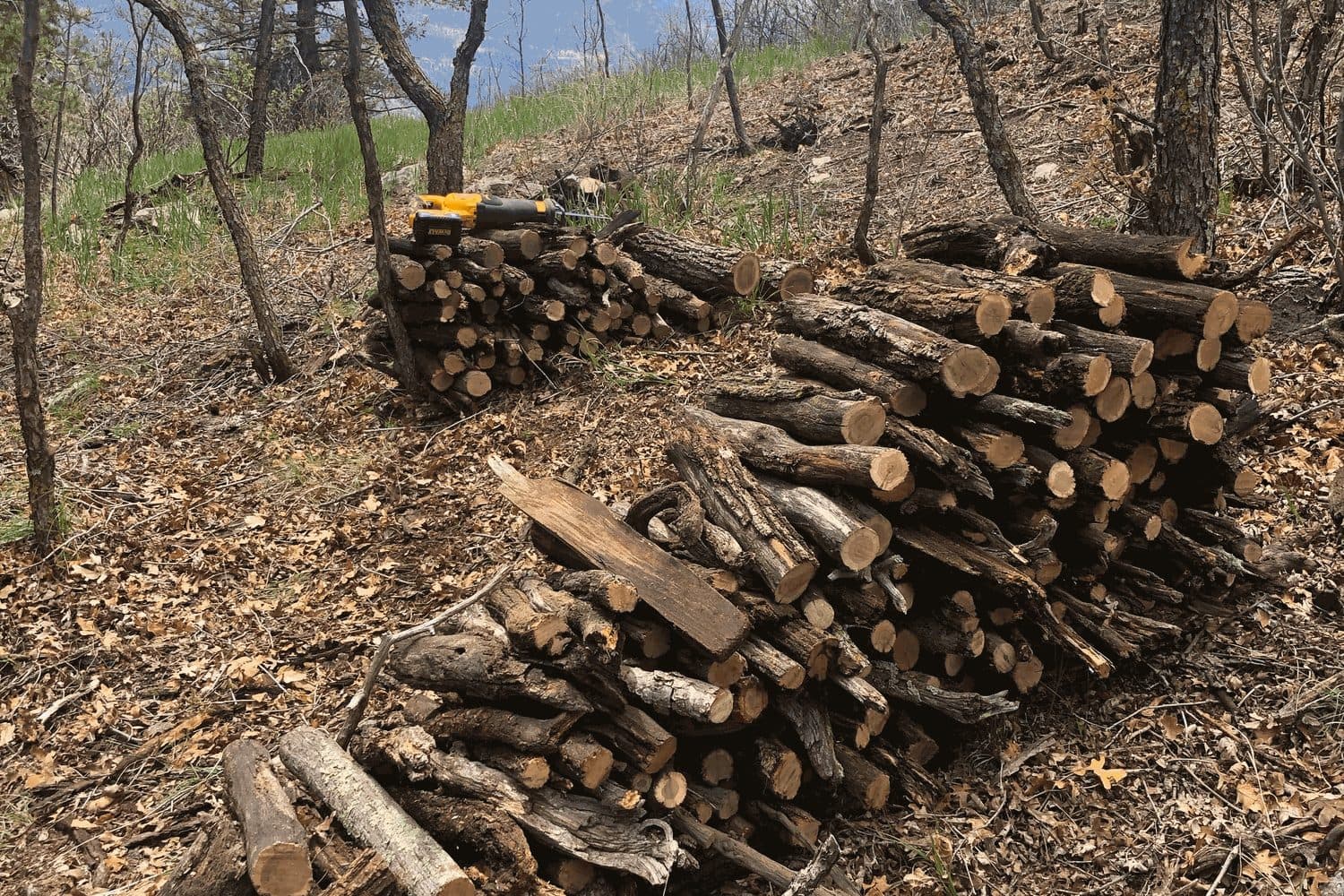
Yes, and it is the one people miss. If you or a crew cut pine over the winter, the slash is prime breeding material for the pine engraver beetle. The USDA Forest Service's 2025 pine engraver management guide for the Northern and Intermountain Regions rates pine slash created from December through March as high risk, because slash covered by snow or frozen stays moist enough to attract beetles in spring. Its recommended treatment window for that slash is April through June 1.
The guide says overwintering adults become active in late April to early May, once daytime temperatures pass 63 degrees, and that green pine slash over two inches in diameter is ideal habitat. It also warns not to stack slash, fresh pine logs or green pine firewood against live pines you want to keep. Chip it, haul it, or burn it in small piles before the flight. Our pine engraver and slash guide covers the beetle in more depth.
When can you burn slash piles in spring?
It depends on the county, and the rules are specific. Missoula County Public Health lists the general outdoor burning season as March 1 to August 31, with every burn needing a permit obtained and activated online through the Montana DEQ system. Ravalli County runs its burn permit process from March 1 to November 30: you get a one-time permit through the state burn permit site, renew it each year, and activate it every day you plan to burn.
Keep Montana Green's debris burning advice is simple and worth following: burn early in the day, check the forecast for afternoon and next-day winds, keep piles small, have help and water on hand, and check the site the next day because stumps and roots can hold heat. Our post on burning tree debris and burn permits walks through both counties.
Step 4: last year's grass and weeds
In spring last year's dead grass is still there. The Colorado State Forest Service guide says grass catches fire easily, that grass fires often spread rapidly, and that grass can readily ignite a structure right next to it. It recommends mowing grasses to four inches or less in the zone around the home, and raking needles and debris within five feet of the house and deck. It notes that raking much farther out does little to reduce ignition and can hurt trees.
Weeds add to the same fuel. We cover that in cheatgrass and dry grass and in noxious weeds as wildfire fuel. If you mow, Keep Montana Green advises walking the area first and removing rocks, since a metal blade striking a rock can start a fire.
Step 5: start the irrigation and check the green zone
The UNR guide describes the five to 30 foot band as a lean, clean and green zone: not much vegetation, dead material routinely removed, and what remains kept green and well irrigated through fire season where that is appropriate. In practice that means the sprinkler system needs to be running and running properly before the dry weeks arrive.
A spring startup is the time to find broken heads and dead zones, not July. See spring sprinkler startup in Montana and lawns and irrigation as fire breaks. Our irrigation team handles startups and repairs across Missoula and Ravalli counties.
Step 6: vents, screens and the garage door
Walk the outside of the house and look at the vents. DNRC says every vent opening should be covered with 1/8-inch corrosion-resistant metal mesh, and the UNR guide adds that torn screens and quarter-inch mesh should be repaired or replaced. Check that the garage door seals at the bottom and sides, since DNRC notes that gaps under garage doors let embers in.
These are construction items, not landscaping, and we do not do them. A handy owner or a general contractor can. Our guide to vents, screens and eaves explains what to look for.
Should you get a free assessment before fire season?
If you have not had one, spring is a good time. The Missoula Fire Department offers free defensible space consultations in the Missoula wildland-urban interface; call 406-552-6210 during business hours. Montana DNRC lets property owners request a free wildfire risk assessment, after which a local fire professional contacts them to schedule a visit. Programs change, so confirm the details when you call.
An assessment gives you a priority list. We do the work on it: ladder fuel removal, selective thinning, limb pruning, needle and debris clearing, and chipping or hauling what comes down. More on what is available locally is in free wildfire risk assessments.
Step 7: the household plan
The property is half the job. The Missoula Fire Department points residents to the Ready, Set, Go program for evacuation preparedness. Spring, before anyone is watching a smoke column, is the time to agree on routes, a meeting place and what goes in the car. Our Ready, Set, Go guide has the details.
Where does spring prep fit in the bigger plan?
Spring is the first visit of the year, not the only one. Grass grows back, needles keep falling, and trees keep growing toward each other. The summer maintenance guide picks up where this one leaves off, and the defensible space maintenance schedule lays out the full year. All of it is part of our Montana Wildfire Guide.
If the spring list is longer than your weekends, our fire mitigation service covers the near-structure cleanup, limbing and thinning, and our seasonal cleanups handle the needles and debris. Call HJ Property Care & Tree Service at (406) 215-7319 or request a free estimate and we will walk the property with you.
Need help?
HJ Property Care & Tree Service is locally owned and ISA-certified. Call for a free estimate.
This article is part of the Montana Wildfire & Defensible Space Guide, our complete guide for western Montana property owners.
Explore our fire mitigation.
Sources
We cite primary sources: Montana State University Extension, the City of Missoula, and the ISA, so you can verify anything here yourself.
- Forest Landowner Guide: West-Central Montana (Montana Department of Natural Resources and Conservation (DNRC)). Last checked November 2, 2026.
- Wildfire Prevention (City of Missoula, Missoula Fire Department). Last checked November 2, 2026.
- The Home Ignition Zone: A guide to preparing your home for wildfire and creating defensible space (2021) (Colorado State Forest Service). Last checked November 2, 2026.
- Wildfire Home Retrofit Guide (SP-20-11, 2020) (University of Nevada, Reno Extension). Last checked November 2, 2026.
- Noncombustible Zone 0: Minimizing Pathways to Home Ignition (Insurance Institute for Business & Home Safety (IBHS)). Last checked November 2, 2026.
- Pine engraver (Ips pini), Insect and Disease Management Guide, Northern and Intermountain Regions (revised 2025) (USDA Forest Service, Forest Health Protection (hosted by Montana DNRC)). Last checked November 2, 2026.
- Outdoor Burning (Missoula County Public Health). Last checked November 2, 2026.
- Burning Permits (Ravalli County). Last checked November 2, 2026.
- Resources: equipment and debris burning fire prevention (Keep Montana Green). Last checked November 2, 2026.
- Wildfire Prevention and Preparedness (Montana Department of Natural Resources and Conservation (DNRC)). Last checked November 2, 2026.
Ready to transform your outdoor space?
Get a free, no-obligation estimate within 48 hours. Locally owned and ISA-certified.