
What Affects the Cost of Christmas Light Installation?
This guide does not contain a price, and that is deliberate. Holiday lighting is a new service for HJ Property Care & Tree Service in 2026, and our packages and pricing are still being finalized. What can be explained honestly today is what any installer is measuring when they look at a property, so that a quote makes sense when you get one and two quotes can be compared fairly.
Why is there no flat price for a house?
Because two houses of the same size can be entirely different jobs. One has a single-story eave across the front and an outlet beside the door. The other has three roof levels, steep gables, a tall spruce and no exterior outlet on the side that faces the street. The footprint is the same and the work is not. Installers price the work, which is why a real quote follows a look at the property.
Almost every quote is built from the same few inputs: how much is being lit, how hard it is to reach, what materials are needed and who provides them, and how many visits the season involves. The sections below take those one at a time. None of them is a secret, and knowing them lets you shape the job to your budget before anyone measures anything.
How does roofline length affect the price?
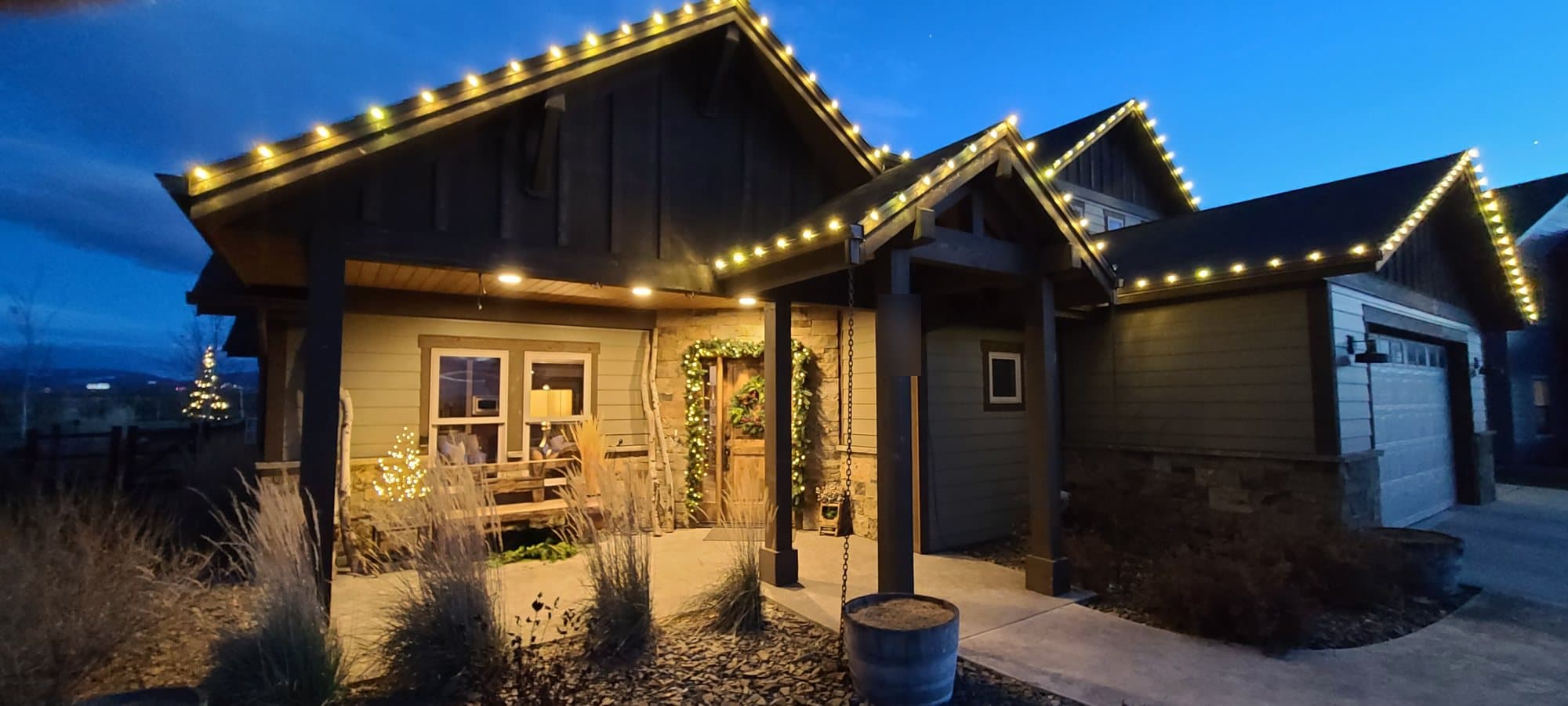
Linear feet of roofline is usually the first number an installer wants. It sets how many strands, clips and bulbs the job needs and how much ladder time it takes. It is also the number homeowners most often underestimate, because a roofline is longer than the front of the house: gables rise and fall, eaves wrap around corners, and dormers and porch roofs add runs that are easy to overlook from the yard.
You control this more than any other factor. Lighting the street-facing eaves and the main gable gives most of the visual effect of lighting the whole house, for a fraction of the length. Deciding which lines matter and which can stay dark is the most useful decision you can make ahead of a quote, and it is the kind of thing a design walkthrough is for.
Why do roof height and pitch matter so much?
Access is the labor multiplier. A single-story eave can be reached from a stepladder or a short extension ladder, moved quickly along the house. A second-story eave needs a taller ladder, more setup at each position and more care. A steep pitch, or a ridge line that has to be reached from the roof surface, changes the equipment and the safety measures required and slows everything down.
The ground matters as well as the roof. A ladder needs firm, level footing, so a house on a slope, a walkout basement side, deep beds against the foundation or a deck in the way can all add time at every ladder position. The details of safe setup are in our outdoor light safety guide. For pricing, the point is simply that the same length of roofline costs more to light the higher and steeper it is.
How do trees and shrubs change the quote?
Trees are priced differently from rooflines because they use lights differently. A trunk and main limbs wrapped closely take a surprising number of strands, far more than the same tree loosely draped. So the number of trees, their size, and how fully each one is to be wrapped all matter. A small ornamental by the door and a mature shade tree in the front yard are different orders of work.
Height matters here too. A tall conifer lit to the top needs equipment and skills a roofline does not. Shrubs and hedges are generally the quickest plant material to light. If trees are part of your plan, it helps to know what good practice looks like, and our guide to putting lights on trees without damage covers which trees and branches should be lit at all.
Does it matter who supplies the lights?
Yes, and it is one of the bigger differences between installers. Some supply the lights as part of the service, either leased for the season or sold to you outright. Others will install lights you already own. Supplied lights are typically bought in bulk, cut to fit your roofline and kept consistent in color, and the installer is responsible when a strand fails. Customer-owned lights lower the materials side but shift that risk back to you.
For HJ, this is not settled yet. Whether existing lights can be used will depend on their condition and whether they are rated for outdoor use, and it is one of the things our packages will decide. If you have lights you would like used, tell us what you have when you get in touch. Bulb type affects the figure too, and our LED and incandescent comparison explains the options.
Is takedown part of the price?
It should be clear either way, because takedown is a second visit with its own labor, and it happens in the worst weather of the year. Some quotes include it. Some list it separately. Some leave it out, and the homeowner finds that out in January. When comparing two prices, check that both cover the same number of visits before deciding which one is lower.
HJ's service is being built around both visits: we install, and we come back to take the lights down after the holidays. Mid-season service is a related question worth asking any installer. If a strand goes dark or wind pulls a section loose in December, a quote that includes a return visit is worth more than one that does not, even if the headline figure is higher.
What about storage between seasons?
Storage is an add-on with real value where it is offered. Lights that are taken down, labeled by location, tested and kept until the next year go back up faster and fit the house they were cut for. Where an installer provides this, it may be folded into the package or priced on its own. Where they do not, the boxes go to your garage and stay your responsibility until next fall.
We want to be straightforward about where HJ stands: storage between seasons is something we are looking at, not something we are promising for 2026. If it would matter to you, say so when you join the interest list. That feedback is part of how the packages are being put together.
How do power access and timers affect cost?
Every display has to plug in somewhere. A house with protected exterior outlets near each lit area is simple. A house whose only outlet is at the back, or a tree far out in the front yard, needs longer outdoor-rated cord runs, more protected connections and more thought about routing cords clear of walks and plowed areas. Timers or other controls add a small amount of material and setup. None of this is dramatic, but it is real.
If you find you want lighting in a spot with no practical power, or lighting you would enjoy all year, it may be worth pricing permanent landscape lighting instead. That is a low-voltage installation with its own wiring, and it is a different kind of investment from a seasonal display.
How is a commercial or HOA display different?
Mostly in scale and in what surrounds the work. A storefront, an office building or a subdivision entrance usually means longer runs, taller structures, larger trees and sometimes monument signs or fences. It can also mean working around business hours, customer parking and snow operations, and an approval step with an owner, a manager or a board. Those jobs take more lead time, so the conversation needs to start earlier.
It often makes sense to plan lighting together with the winter work already contracted for the site, such as commercial snow removal, so cord routes and snow storage do not conflict. Businesses and HOA entrances are part of what we are planning, and commercial holiday lighting has its own page. See the Christmas light installation page and our other fall and winter services for where things stand.
Call HJ Property Care & Tree Service at (406) 215-7319 or join the holiday lighting interest list and you will hear first when install dates open.
Need help?
HJ Property Care & Tree Service is locally owned and ISA-certified. Call for a free estimate.
Explore our christmas & holiday light installation.
Ready to transform your outdoor space?
Get a free, no-obligation estimate within 48 hours. Locally owned and ISA-certified.