
LED vs Incandescent Christmas Lights: A Plain Guide
Most of the look of a holiday display is decided in the store aisle, before a single clip goes on the house. Bulb shape sets the style, the technology inside the bulb sets how much power the display needs and how it holds up outside, and color decides whether the whole thing looks like one design or three. Here is what the labels mean and how to choose.
What do C9, C7 and mini actually mean?
They are bulb shapes and sizes. C7 and C9 are the traditional cone-shaped bulbs, each screwed into its own socket along a cord. C9 is the larger of the two and C7 the smaller, and the two use different socket sizes, so bulbs from one will not fit the other. These are the bulbs most people picture on a roofline: big, evenly spaced points of light that read clearly from the street.
Mini lights are the small bulbs on thin green or white wire, usually pushed into their sockets, not screwed, and sold in long strings. They are meant to be seen in quantity, as texture and sparkle, where C9 and C7 bulbs are meant to be seen one at a time. Most other formats you see on a shelf, including icicle sets and nets for shrubs, are mini lights arranged on a different wire layout.
What are icicle lights, and where do they work?
Icicle sets have a horizontal main wire with short strands of mini lights hanging down from it at varying lengths. Hung along an eave they imitate the thing they are named for. They suit a long, straight, level eave with a clear drop below it, such as a porch roof or the front edge of a single-story house. They are less successful on steep gable rakes, where the drops hang at an angle to the roofline.
In a place with real snow and wind, the hanging drops are the weak point. They tangle with each other, freeze to the gutter and catch on anything nearby. A set with shorter, stiffer drops fares better than one with long thin ones. If the eave collects actual icicles in winter, expect the two to end up frozen together, and expect to wait for a thaw before the lights can be taken down.
How do LED and incandescent bulbs differ?
An incandescent bulb makes light by heating a thin wire filament inside a glass envelope until it glows. Most of the electricity becomes heat. An LED makes light from a semiconductor, with no filament, and is usually sealed inside a plastic lens. That one difference drives almost everything else: how much power the set draws, how warm it runs, how easily it breaks and how long it lasts.
ENERGY STAR, the federal efficiency program, describes certified LED light strings as having no moving parts, filaments or glass, which makes them much more durable and shock-resistant than other strings. It also describes them as cool to the touch, which reduces fire risk, and as able to last up to ten times longer than traditional incandescent strands. Certified sets are independently tested and carry a manufacturer warranty of at least three years.
Which holds up better in cold and snow?
LED, for mechanical reasons more than electrical ones. Glass bulbs and fine filaments are the parts that fail when a strand is knocked against a gutter, dropped on frozen ground or whipped by wind. A sealed plastic LED has neither part. That durability matters most at takedown, when strands are being handled in the cold.
What decides whether any set survives outside, of either type, is whether it was built for it. ENERGY STAR notes that its products labeled for outdoor use are subjected to weathering tests. An indoor-only set, LED or not, has no business on a roofline. Our outdoor light safety guide covers what to look for on the label and how to keep connections out of snow.
How much less power do LEDs use?
A great deal less. ENERGY STAR states that its certified decorative light strings use approximately 92 percent less energy than conventional incandescent strings. The exact saving depends on the sets being compared, but the direction is never in doubt, and the gap is widest on the large C9 and C7 bulbs, where the incandescent versions draw the most.
The practical benefit is not only the electric bill. Lower draw means more lights can run from one outlet and one circuit without overloading it. The Consumer Product Safety Commission's rule for incandescent sets is never to string more than three together. LED sets generally allow far more to be connected end to end, though the number on the package is the one to follow, as extension guidance stresses. On a large display, that is the difference between one tidy cord run and a web of them.
Should you choose warm white or cool white?
Warm white is the yellowish, candle-like color of a traditional incandescent bulb. Cool white is a crisper, bluer white that reads as icy. Neither is better. Warm white tends to flatter wood, stone, brick and earth-toned siding, and looks traditional. Cool white tends to suit gray, white and modern exteriors, and it looks sharp against snow. Colored and multicolor sets are their own decision and follow the same logic about consistency.
The mistake to avoid is mixing them by accident. Warm white from one manufacturer does not always match warm white from another, and an older LED set next to a new one can look like two different colors. Buy everything for one visible area in one purchase, from one product line, and buy a spare set at the same time so a failed strand can be replaced with a match.
What works best on a roofline?
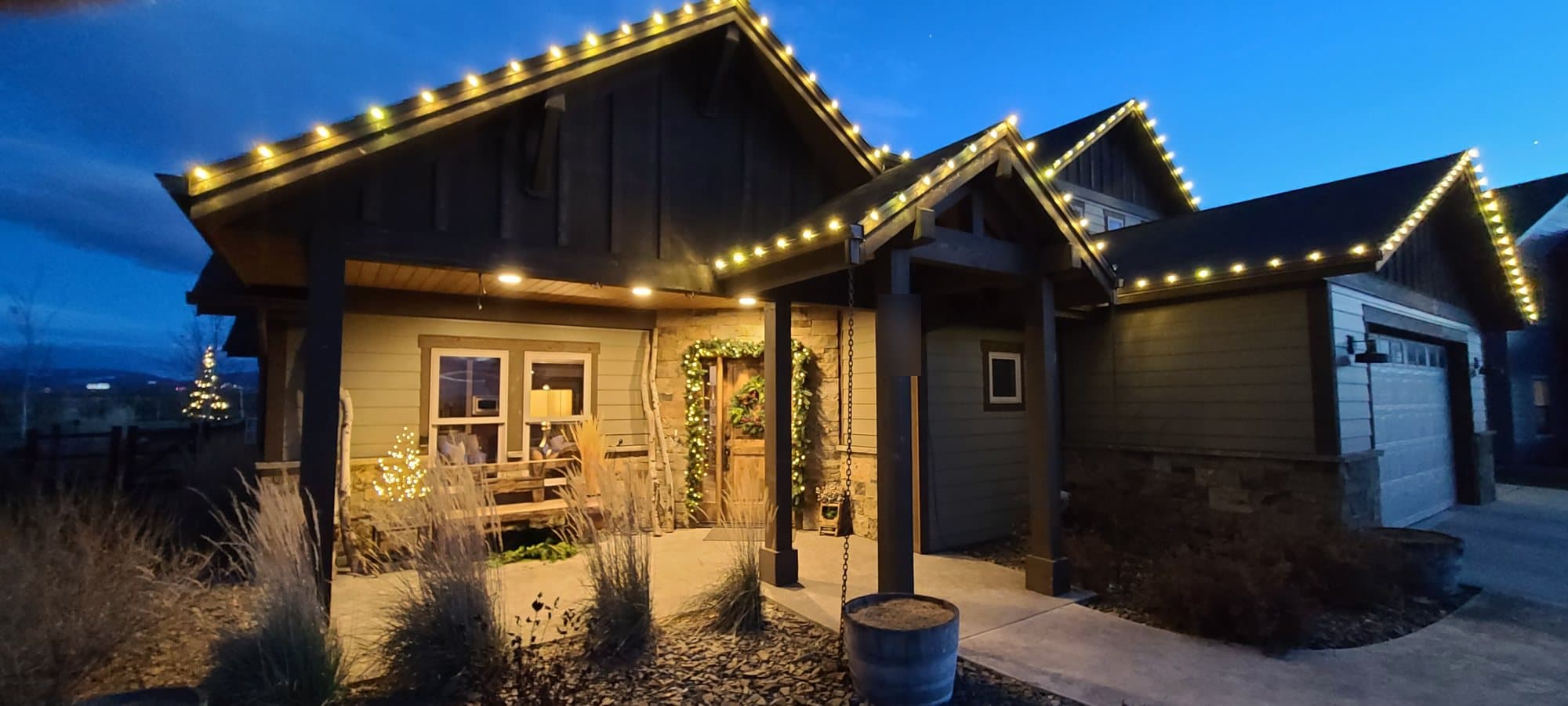
C9 bulbs are the usual choice for rooflines, and for good reason. The house is viewed from a distance, and large bulbs at regular spacing draw a clean line along eaves, rakes and ridges that smaller lights cannot. C7 gives the same effect at a slightly smaller scale, which can suit a low or small house. On a roofline the straightness of the line matters more than the bulb count.
Roofline lights are also the hardest to reach once they are up, which is the strongest practical argument for LED there. A failed bulb above a second-story gutter in December is not something you want to climb up for. Timing the install so the eave is still clean and dry is covered in when to hang Christmas lights in western Montana.
What works best on trees and shrubs?
Mini lights. Their thin wire wraps trunks and branches closely, and their small bulbs give the dense, even sparkle that makes a wrapped tree look finished. Nets of mini lights cover rounded shrubs quickly. LED minis are the better choice on living plants because they run cool and weigh little. How to wrap without harming the tree is its own subject, covered in our guide to Christmas lights on trees.
A common and effective combination is C9 on the roofline, minis on trees and shrubs, and everything in the same white. HJ's holiday lighting service is new for 2026, and which products our packages will include is still being finalized, along with pricing. The Christmas light installation page has the current details, and the rest of what we do before winter is on the fall and winter services page.
Call HJ Property Care & Tree Service at (406) 215-7319 or join the holiday lighting interest list and you will hear first when install dates open.
Need help?
HJ Property Care & Tree Service is locally owned and ISA-certified. Call for a free estimate.
Explore our christmas & holiday light installation.
Sources
We cite primary sources: Montana State University Extension, the City of Missoula, and the ISA, so you can verify anything here yourself.
- Decorative Light Strings (ENERGY STAR (U.S. Environmental Protection Agency)). Last checked October 11, 2026.
- Holiday Safety Education Center (U.S. Consumer Product Safety Commission). Last checked October 11, 2026.
- Festoon Your House Safely (Utah State University Extension). Last checked October 11, 2026.
Ready to transform your outdoor space?
Get a free, no-obligation estimate within 48 hours. Locally owned and ISA-certified.