
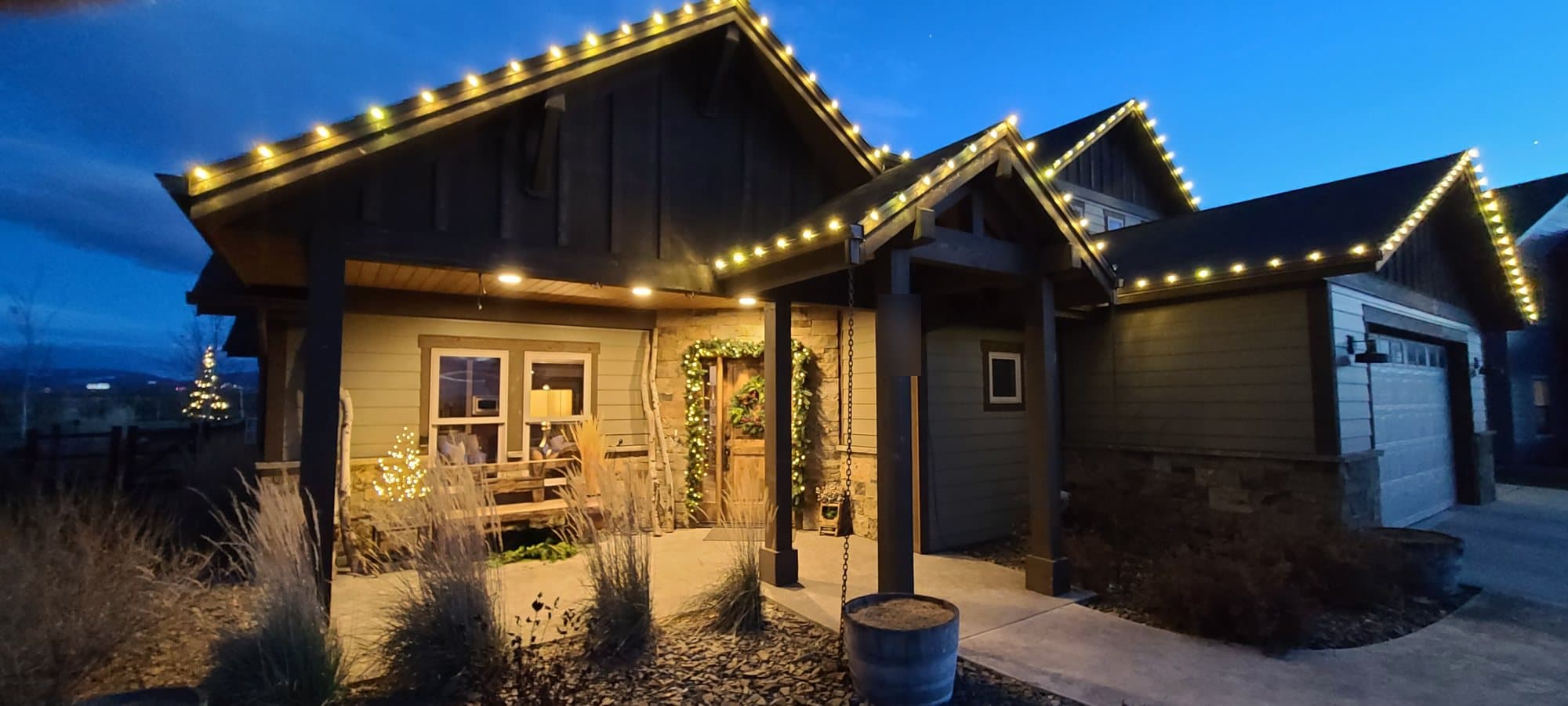
Outdoor Christmas Light Safety in Snow and Cold
Outdoor holiday lighting has two separate ways to hurt someone: electricity in a wet place, and a ladder on a bad surface. Snow and cold make both worse. What follows is the practical version of what the Consumer Product Safety Commission, federal ladder rules and university extension guidance say, applied to a yard that will be under snow for most of the time the lights are on.
How common are holiday decorating injuries?
Common enough that the Consumer Product Safety Commission publishes a warning most years. In a 2018 release the agency put the figure at 14,700 emergency-room-treated holiday decorating injuries for the season it reported on, which it described as an average of about 240 a day through November and December. Falls were the most frequent type of incident, at 41 percent, and the same release recorded three deaths involving ladder falls.
Those are national figures and several years old, so treat them as a sense of scale and not a forecast. The pattern is what matters for planning: the ladder is the larger risk, and the electrical side is the one that goes wrong quietly, days after the person who set it up has stopped thinking about it.
What makes a light set or cord outdoor-rated?
A label that says so. The CPSC advises using only lights tested for safety by a nationally recognized testing laboratory, and checking outdoor lights for a label showing they have been certified for outdoor use. Utah State University Extension adds the practical detail: look for the UL or ETL mark, and make sure the packaging states the set is designated for outdoor use. It also advises against buying used lights or sets that are not in their original package.
The same test applies to extension cords. An indoor cord has lighter insulation that is not made for wet ground or cold. USU Extension is blunt about it: use outdoor cords with three-prong plugs, never an indoor cord and never one without the third prong, and use the shortest length that does the job. If a cord has no outdoor marking you can find, assume it is an indoor cord.
Why does GFCI protection matter so much outdoors?
A ground-fault circuit interrupter cuts power when it detects current leaking somewhere it should not go, such as through wet ground or through a person. Outdoors in winter, moisture is a certainty, so this is the one piece of protection that should not be optional. The CPSC says to plug outdoor lights only into a GFCI-protected receptacle or a portable GFCI.
Many exterior outlets already have this protection, and on those that do, the test button on the outlet or the breaker is worth pressing before the season. If an outlet is not protected, portable outdoor GFCI units are sold at hardware stores, as USU Extension notes. A GFCI that trips repeatedly is doing its job: it is telling you that water has reached a connection, and resetting it over and over is not a fix.
Where should cord connections sit when it snows?
Up, and somewhere you can still find them in January. The point where a light strand plugs into a cord, or one cord into another, is the weakest spot in the whole setup, because it is the only place where metal contacts are close to the open air. USU Extension's advice is to keep outdoor electrical connections above the ground and out of snow and water. Remember that a connection lying on bare lawn in November will be under the snowpack by the new year.
Think about where snow is going to be put, too. A cord across a walk gets shoveled into. A connection at the edge of a driveway ends up inside the pile if the drive is cleared by machine. Route cords along the building, not across open ground, wherever you can, and where one has to cross a walkway, extension guidance is to secure it so nobody trips. When strands hang from a roofline, pointing sockets downward where possible helps keep moisture from collecting in them.
How many strands can share one outlet?
Fewer than most people assume, at least with older lights. The CPSC's holiday guidance says never to string together more than three sets of incandescent lights and never to overload electrical outlets. USU Extension gives the general rule: check the manufacturer's guidelines for how many strings can be safely connected end to end, and if the package does not say, do not connect more than three.
Past that, the question is what else is on the circuit. An exterior outlet often shares a breaker with a garage or another room, and winter is when engine block heaters, space heaters and heat cables get plugged in too. A tangle of cords and splitters fed from a single outlet is the arrangement extension guidance specifically warns against. Spreading a display across more than one circuit is safer than stacking it on one. LED sets ease the problem considerably, and our LED and incandescent comparison explains why.
How should a ladder be set up on frozen ground?
Federal workplace ladder rules are written for job sites, but they are a sound benchmark for a homeowner. They call for ladders to be used only on stable and level surfaces unless secured, and not on slippery surfaces unless secured or fitted with slip-resistant feet. They also state that slip-resistant feet are no substitute for care in placing or holding the ladder. On frozen ground that means clearing snow and ice down to a firm surface first, and having a second person hold the ladder.
For a leaning ladder, the same rules put the base about one quarter of the ladder's working length out from the wall, and require the side rails to extend at least three feet above a roof edge you intend to step onto. Keep one hand on the ladder while climbing and do not carry a load that could cost you your balance. In practice, haul light strands up on a line or have them passed to you. Move the ladder often instead of leaning out to reach.
What should be checked before anything is plugged in?
Every set, every year, new or old. The CPSC's list is broken or cracked sockets, frayed or bare wires and loose connections, and its advice for a damaged set is to throw it out. The U.S. Fire Administration says the same: inspect holiday lights each year before they go up and discard strands with frayed or pinched wires. Check extension cords the same way and do not use any with cuts or signs of fraying.
How the lights are fastened matters for the wiring as well as the house. Nails and staple guns can easily cut or damage the insulation and conductors, which is why extension guidance recommends hooks or other fasteners that do not pinch the wire. Before any ladder goes up, look overhead as well. NorthWestern Energy's guidance is to assume every power line is energized and never to touch a line or anything in contact with one. The service line running to the house is a power line.
Should the display run on a timer?
Yes. USU Extension recommends appropriately sized timers and says lights should be off when nobody is home and should not be left on overnight. A timer rated for outdoor use, with a load rating that covers what is plugged into it, does this without anyone going out in slippers at eleven at night. It should sit on the protected side of the GFCI and off the ground, like every other connection.
If all of this reads like more than you want to manage from a ladder in November, that is a reasonable conclusion and the reason we are adding professional Christmas light installation to our fall and winter services this year. For timing, see when to hang lights in western Montana, and if trees are part of the plan, read the guide to lighting trees without harming them first.
Call HJ Property Care & Tree Service at (406) 215-7319 or join the holiday lighting interest list and you will hear first when install dates open.
Need help?
HJ Property Care & Tree Service is locally owned and ISA-certified. Call for a free estimate.
Explore our christmas & holiday light installation.
Sources
We cite primary sources: Montana State University Extension, the City of Missoula, and the ISA, so you can verify anything here yourself.
- Put Safety at the Top of Your List When Decorating this Holiday Season (U.S. Consumer Product Safety Commission). Last checked October 11, 2026.
- Holiday Safety Education Center (U.S. Consumer Product Safety Commission). Last checked October 11, 2026.
- Festoon Your House Safely (Utah State University Extension). Last checked October 11, 2026.
- Ladders: construction industry safety standard (Occupational Safety and Health Administration). Last checked October 11, 2026.
- Holiday Fire Safety Outreach Materials (U.S. Fire Administration). Last checked October 11, 2026.
- Electric Safety and Power Line Safety (NorthWestern Energy). Last checked October 11, 2026.
Ready to transform your outdoor space?
Get a free, no-obligation estimate within 48 hours. Locally owned and ISA-certified.