
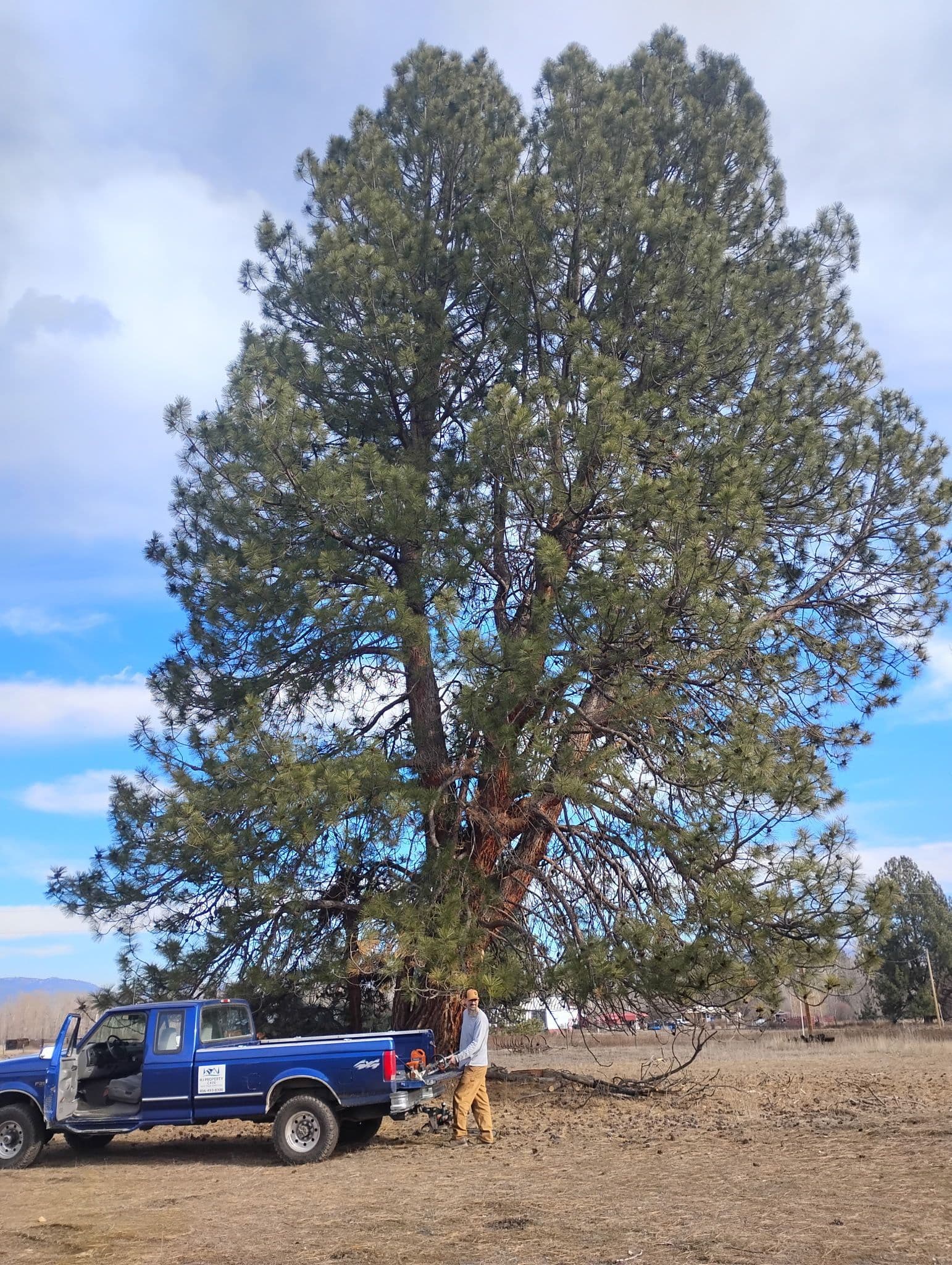
Tree Rules in Hamilton, Stevensville and Bitterroot Valley Towns
Inside Hamilton or Stevensville, the trees along the street come with rules, and many owners learn that only when a limb comes down or a pruning job is half planned. This guide reports what the City of Hamilton and the Town of Stevensville publish in their municipal codes and on their own pages, as we read them on 11 October 2026. It is general information, and codes are amended, so confirm the current requirement with the city or town before any work on a street tree. Missoula's rules are different and are covered separately.
Which trees do town rules apply to?
Mostly the ones in the public right-of-way. Hamilton's municipal code defines the public right-of-way as the entire width between the dedicated boundaries of public streets, roads, boulevards and alleys, including sidewalks and parking strips, and states that the City is the owner of all property in it. The strip between the sidewalk and the street, which the City's planting guide calls the boulevard, is the usual place a homeowner meets these rules.
Hamilton's Urban Forestry page describes the city's urban forest as the trees lining its boulevards, parks and river corridors, and says the department manages it through pruning, planting, hazard removals and other treatments. Trees wholly inside a private yard are treated differently, with a few exceptions covered below.
Who maintains a boulevard tree in Hamilton?
The code splits the job. The owner of the property next to the right-of-way is responsible for normal lawn care there, for keeping away debris or substances that could harm the trees, and for regular watering of boulevard trees. The City is responsible for all safety related tree pruning and removal in the boulevard or alley next to the owner's property.
Owners are allowed to prune boulevard trees at their own expense, as long as the pruning does not affect more than 25 percent of the tree. Beyond that, the code says the work must be done by a licensed arborist or professional tree company that holds a city business license and has a permit from the public works department. The code also provides for a hardship request to the City by owners who cannot meet their part.
When is a permit required in Hamilton?
The code names two situations. A permit is needed for any pruning, trimming or major work that removes more than 25 percent of the live tissue of a tree on city-owned property, including boulevards, and that work must be done by a qualified professional tree service with a city business license. A permit is also required before planting any tree, shrub or other vegetation in a public right-of-way. No permit is needed when the public works department itself ordered the work.
The City's 2022 planting guide gives the practical step: if a tree is going into the public right-of-way, contact the Parks, Cemetery and Urban Forestry Director for a permit and preapproval before buying it. The code text and the guide name different offices for the permit, so call City Hall and ask which one handles it now.
What does Hamilton say about planting and clearance?
The code limits what goes under wires: only small trees with a mature height of 20 feet or less may be planted under or within ten lateral feet of a utility line, or within five feet of an underground gas, sewer or power line, and it applies that to public land, right-of-way and private property. It includes a list of recommended species for the right-of-way, and the City's separate guide, Suggested Trees for Boulevards and Residences, marks which trees suit boulevards and which have under wire potential. Our list of the best trees to plant in western Montana is a companion to it.
Clearance is the other requirement that reaches private yards. Vegetation overhanging the right-of-way is to be kept at least 7.5 feet above sidewalks and 13.5 feet above streets, and the code says an owner must correct a tree on private property that hangs lower. Hedges and other vegetation in the right-of-way are capped at 2.5 feet, and corners and driveways must keep a clear view triangle.
Is topping a street tree allowed?
Not as a normal practice in either town. Hamilton's code makes it unlawful for any person, tree service or city department to top a tree in a public area, except where a tree is storm damaged and other pruning practices are impractical, and then public works is to be notified before the work, with before and after photographs. Stevensville's code makes it unlawful as a normal practice to top any street tree, park tree or other tree on public property, with a similar exception for severe storm damage and certain trees under utility wires.
That matches arboricultural practice. HJ does not top trees, and our guide to why tree topping fails and what to do instead explains the alternatives.
How do you report a dangerous tree, and what if it is in your yard?
For a dead or dangerous tree in a Hamilton boulevard or city park, the City's Urban Forestry section has a report page that routes through its official complaint form. Since the code makes safety pruning and removal in the boulevard the City's job, reporting is the right first step, not hiring someone to cut it.
A private tree can also become the City's concern. The Hamilton code allows the city council to declare a tree on public or private property a public hazard if it endangers a public street, utility line or sidewalk, and says removal or mitigation of a hazard on private property is the owner's responsibility, with a hardship request available. If you have a tree leaning toward the street, a tree health and risk assessment tells you where it stands, and hazard tree removal is the next step if it has to come out.
What does Stevensville require?
Stevensville's code has a municipal trees article. It defines street trees as trees lying between property lines on either side of streets, avenues or ways in town. Owners are responsible for watering and care of street trees next to their property, must not damage them, and must not prune or remove any street tree without permission from the town. The town keeps the right to plant, prune, maintain and remove trees in the streets and public grounds.
The article creates a three-member tree board that includes an arborist, sets an approved street tree species list, and sets minimum spacing by mature size, with large trees farthest apart. Only small trees approved by the tree board may be planted under or within ten lateral feet of an overhead utility wire. Owners of private trees overhanging a street must keep a clear space of eight feet above the street or sidewalk and remove dead, diseased or dangerous trees or limbs that menace public safety. Anyone in the business of pruning, treating or removing street or park trees needs a town business license and proof of liability insurance.
One caution: the town's boards and commissions page we loaded did not list the tree board among its current boards, so ask Town Hall who is handling street tree permission today.
Is Hamilton a Tree City USA, and what about Darby?
Montana DNRC, which administers Tree City USA in the state for the Arbor Day Foundation, lists the standards: a tree board or department, a tree care ordinance, a minimum annual budget per resident for community forestry, and an Arbor Day observance. Hamilton's 2015 Urban Forestry Strategic Management Plan states that the city had then been a Tree City USA for over 14 years. We did not load a current roster, so we are not stating its status for this year. The City or DNRC can confirm it.
We could not load any tree rules published by the Town of Darby, so this guide does not describe them. In Darby, Victor, Corvallis and Florence, call the town office or Ravalli County before work on a tree near a street. Where lines run through the canopy, see our guide to trees and power lines in Montana.
What should you do before hiring anyone?
Work out whether the tree is in the right-of-way or in your yard, then call the city or town with the address and ask what permission the work needs. If you are across the county line, our Missoula boulevard tree and permit guide covers that city's process. Then ask the company you hire whether it holds the local business license the code calls for.
HJ's tree services cover the Bitterroot from Florence to Darby, and we would sooner confirm a permit question with you up front than discover it mid-job. More local guides are in the Montana Tree Guide.
Call HJ Property Care & Tree Service at (406) 215-7319 or request a tree assessment and an ISA Certified Arborist will look at the tree with you.
Need help?
HJ Property Care & Tree Service is locally owned and ISA-certified. Call for a free estimate.
This article is part of the Montana Tree Guide, our complete guide to trees in western Montana.
Explore our tree services.
Sources
We cite primary sources: Montana State University Extension, the City of Missoula, and the ISA, so you can verify anything here yourself.
- Hamilton Municipal Code, Title 12: Trees and Parkways (City of Hamilton (Municode Library)). Last checked October 11, 2026.
- Urban Forestry (City of Hamilton). Last checked October 11, 2026.
- Suggested Trees for Boulevards and Residences (updated February 2022) (City of Hamilton). Last checked October 11, 2026.
- Urban Forestry Strategic Management Plan (2015) (City of Hamilton). Last checked October 11, 2026.
- Report a Dead / Dangerous Tree (Streets, City & Parks) (City of Hamilton). Last checked October 11, 2026.
- Stevensville Code of Ordinances, Chapter 22: Municipal Trees (Town of Stevensville (Municode Library)). Last checked October 11, 2026.
- Urban and Community Forestry education resources: Tree City USA (Montana Department of Natural Resources and Conservation). Last checked October 11, 2026.
Ready to transform your outdoor space?
Get a free, no-obligation estimate within 48 hours. Locally owned and ISA-certified.