
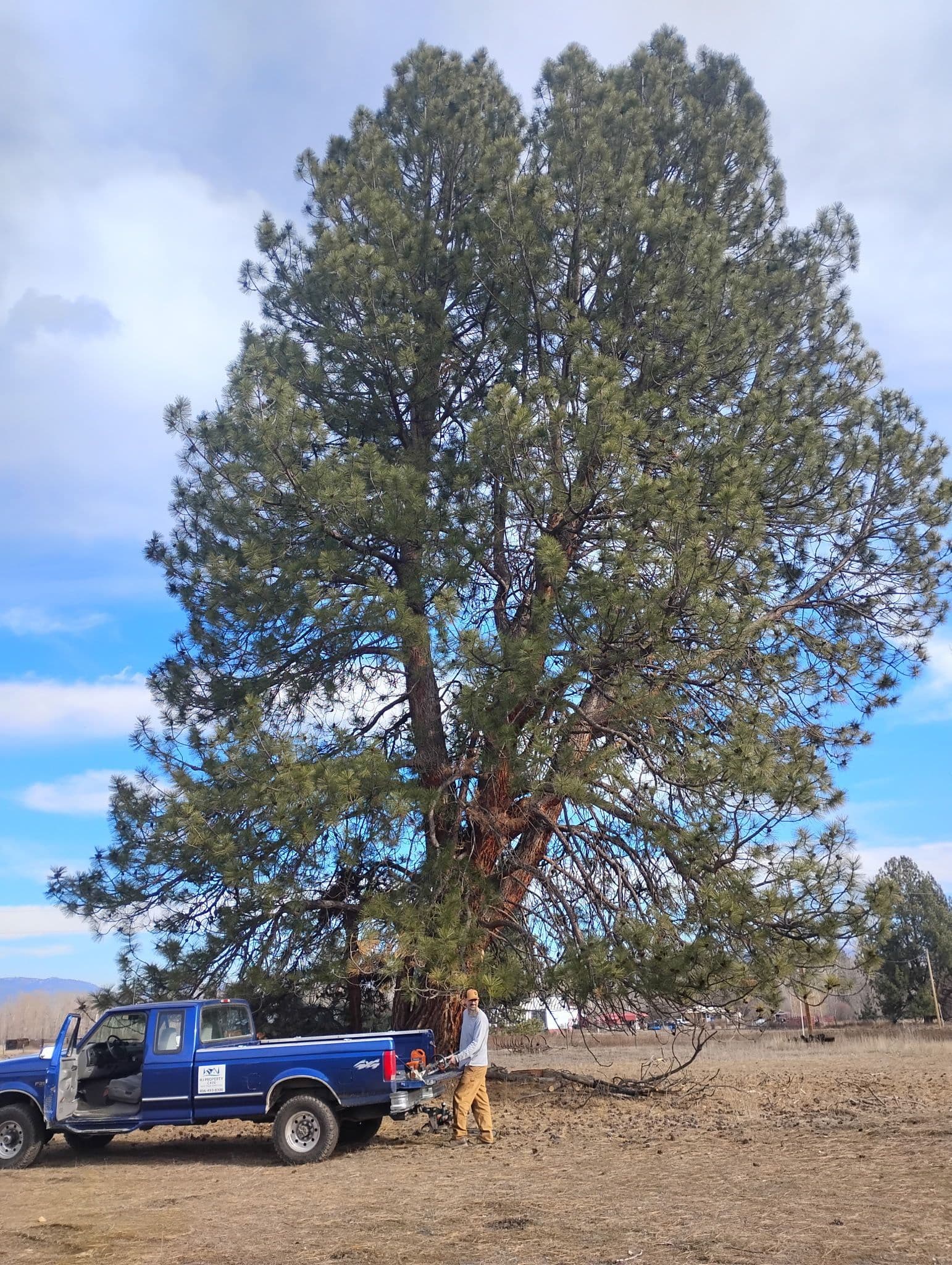
Douglas-Fir Problems in Western Montana
Douglas-fir covers the hillsides above Missoula and the Bitterroot Valley and comes down into yards wherever a lot backs onto timber. It is a tough tree, but it has a short list of serious enemies, and two of them, Douglas-fir beetle and root disease, tend to work together. A fir that turns red has usually been in trouble for a year or more before anyone noticed. This guide explains what the color means, what is actually going on under the bark and below ground, and when a fir close to a house needs a decision.
How do you know the tree is a Douglas-fir?
The cone settles it. Montana State University Extension describes Douglas-fir cones as hanging from the branch tips, tan, three to four inches long, with obvious three-pronged bracts sticking out between the scales. The needles are flat, about an inch long, with two white bands on the underside. Mature bark is thick, fissured and reddish-brown, and the lower branches droop.
It matters because the tree's problems are specific to it. A pine with red needles and a fir with red needles are different diagnoses with different beetles.
What do red needles on a Douglas-fir mean?
It depends on how much of the tree is red and where. A whole crown fading from green to yellow to orange to reddish-brown points to a tree that has been killed, most often by bark beetles, root disease or both. Red or brown confined to the newest growth at the branch tips points to a defoliator such as western spruce budworm, which has its own guide. Spotted older needles on the lower branches point to a needle disease.
Some color is harmless. MSU Extension notes that conifers shed older interior needles in late summer to early fall and that spruce and fir hold many years of growth, so the shed is usually only visible on inner branches. Tips that brown on the south and southwest sides in spring are typically winter injury after a dry, open winter.
How does Douglas-fir beetle kill a tree?
The Forest Service management guide hosted by Montana DNRC calls Douglas-fir beetle the most destructive bark beetle of Douglas-fir in the northern and central Rocky Mountains. Adults usually emerge from mid-April to early June, bore through the bark and lay eggs in galleries in the layer that feeds the tree. There is one generation a year.
The early evidence is easy to miss. The guide describes orange-brown boring dust in bark crevices on the lower trunk or on the ground at the base, which wind and rain can remove, and sometimes clear streams of resin from attacks 30 to 35 feet up. The crown stays green at first. Typically trees begin to fade the year after attack, though in dry years they can turn yellowish-green to orange later the same year. By the time a fir is red, the beetles that killed it may already have left.
Which firs are most at risk from the beetle?
Big, old trees in dense stands. According to the same guide, the average age of Douglas-fir killed by the beetle exceeds 120 years, larger dominant trees are more susceptible than smaller ones, and the denser the stand, the higher the risk.
Outbreaks are usually triggered by a disturbance: windthrow, snow breakage, fire scorch or defoliation by budworm or tussock moth. Beetles build up in the downed and damaged trees, then the next generation attacks green trees nearby. Outbreaks typically last two to four years and can be prolonged by drought. For a landowner the practical point is that fir blown down in a storm should not be left lying beside standing fir through the following spring. That cleanup is part of our emergency tree and storm response.
What is root disease, and why does it matter near a house?
Root diseases are fungi that decay roots and spread from tree to tree through root contact. The Forest Service root disease guide hosted by DNRC calls them the most damaging group of tree diseases and says they are most common in Douglas-fir, grand fir and subalpine fir in Montana and Idaho. It lists Douglas-fir as highly susceptible to Armillaria, one of the main root pathogens in western Montana, and larch and pines as least susceptible.
Two facts from that guide matter to homeowners. First, there is no cure, and the fungi persist for decades in old stumps and dead roots. Second, only a fraction of infected trees can be detected by above-ground symptoms at any given time. A fir with decayed roots can carry a green crown. The guide notes that in developed areas root disease makes trees hazardous to people and property, and that bark beetles find root-diseased trees long before they look weak. A group of firs dying outward from a center over several years is the classic pattern.
Needle diseases and defoliators
MSU Extension describes two needle diseases on Douglas-fir in Montana landscapes. Rhabdocline needle cast shows as yellow to brown spots with distinct margins on current-year needles in late summer to fall, turning reddish-brown by spring, worst on lower branches. Swiss needle cast turns needles dull green or yellow with brown tips and leaves only the newest needles on the branch ends. Both spread in cool, wet spring weather, and both are helped by spacing, raking and keeping sprinklers off the foliage.
Douglas-fir tussock moth is the other defoliator MSU lists. Feeding starts on new foliage at the top of the tree and works downward. Natural enemies normally keep it in check.
How does drought stress show up?
The Montana DNRC nursery rates Douglas-fir as highly drought tolerant once established, but poor in alkaline or saline soil, and preferring moist, well-drained ground. A fir on a hot, south-facing valley lot is at the dry edge of its range. MSU Extension lists the signs of drought stress as reduced growth, early needle drop and symptoms concentrated on the sunny side of the crown, and warns that stressed trees lose resistance to pests.
That is the link between a dry summer and red firs two years later. Deep, slow watering in dry spells and again in fall is the inexpensive part of the answer. See the guide to watering trees through drought.
Can a Douglas-fir be protected or treated?
Once beetles have successfully colonized a fir, there is no treatment that saves it. Prevention is where the options are. The Forest Service guide describes an anti-aggregation pheromone known as MCH, which signals to arriving beetles that a tree is already full. It has given short-term protection to high-value trees and must be applied before beetles fly in spring. Thinning dense fir lowers risk too, although the root disease guide cautions that partial cutting in a root-diseased stand can make the disease worse.
For needle diseases, MSU lists protective fungicides applied in spring as new needles expand. With any product, the label directions are the law, and restricted-use products need a licensed applicator. If you want to talk through protection for particular trees, ask us at an assessment.
When is a fir near a house a concern?
Treat these as reasons to have the tree looked at soon: a crown that is fading or red, boring dust at the base, a fir standing at the edge of a patch where others have died, a new lean, or mushrooms and soft wood at the root collar. Dead conifers do not improve with time, and a fir with failed roots can go over whole. Our guide to the signs a tree is about to fail covers what to watch for.
A tree health and risk assessment will tell you which trees are worth protecting and which are hazard tree removal candidates. Both are part of our tree services, and the rest of the species guides are in the Montana Tree Guide.
Call HJ Property Care & Tree Service at (406) 215-7319 or request a tree assessment and an ISA Certified Arborist will look at the tree with you.
Need help?
HJ Property Care & Tree Service is locally owned and ISA-certified. Call for a free estimate.
This article is part of the Montana Tree Guide, our complete guide to trees in western Montana.
Explore our tree services.
Sources
We cite primary sources: Montana State University Extension, the City of Missoula, and the ISA, so you can verify anything here yourself.
- Plant Identification: Douglas-fir (Guide to Pests, Problems, and Identification of Ornamental Shrubs and Trees in Montana) (Montana State University Extension). Last checked October 11, 2026.
- Douglas-fir Beetle Management (Forest Health Protection and State Forestry Organizations management guide) (USDA Forest Service, hosted by Montana DNRC). Last checked October 11, 2026.
- Management Guide for Root Disease (Forest Health Protection and State Forestry Organizations) (USDA Forest Service, hosted by Montana DNRC). Last checked October 11, 2026.
- Seasonal Needle Drop (Guide to Pests, Problems, and Identification of Ornamental Shrubs and Trees in Montana) (Montana State University Extension). Last checked October 11, 2026.
- Common Issues with Conifer Trees in Montana (Montana State University Extension). Last checked October 11, 2026.
- Rhabdocline Needle Cast (Guide to Pests, Problems, and Identification of Ornamental Shrubs and Trees in Montana) (Montana State University Extension). Last checked October 11, 2026.
- Swiss Needle Cast (Guide to Pests, Problems, and Identification of Ornamental Shrubs and Trees in Montana) (Montana State University Extension). Last checked October 11, 2026.
- Douglas-fir Tussock Moth (Guide to Pests, Problems, and Identification of Ornamental Shrubs and Trees in Montana) (Montana State University Extension). Last checked October 11, 2026.
- Douglas-fir (West) (Montana DNRC Conservation Seedling Nursery). Last checked October 11, 2026.
- Drought Stress (Guide to Pests, Problems, and Identification of Ornamental Shrubs and Trees in Montana) (Montana State University Extension). Last checked October 11, 2026.
Ready to transform your outdoor space?
Get a free, no-obligation estimate within 48 hours. Locally owned and ISA-certified.