
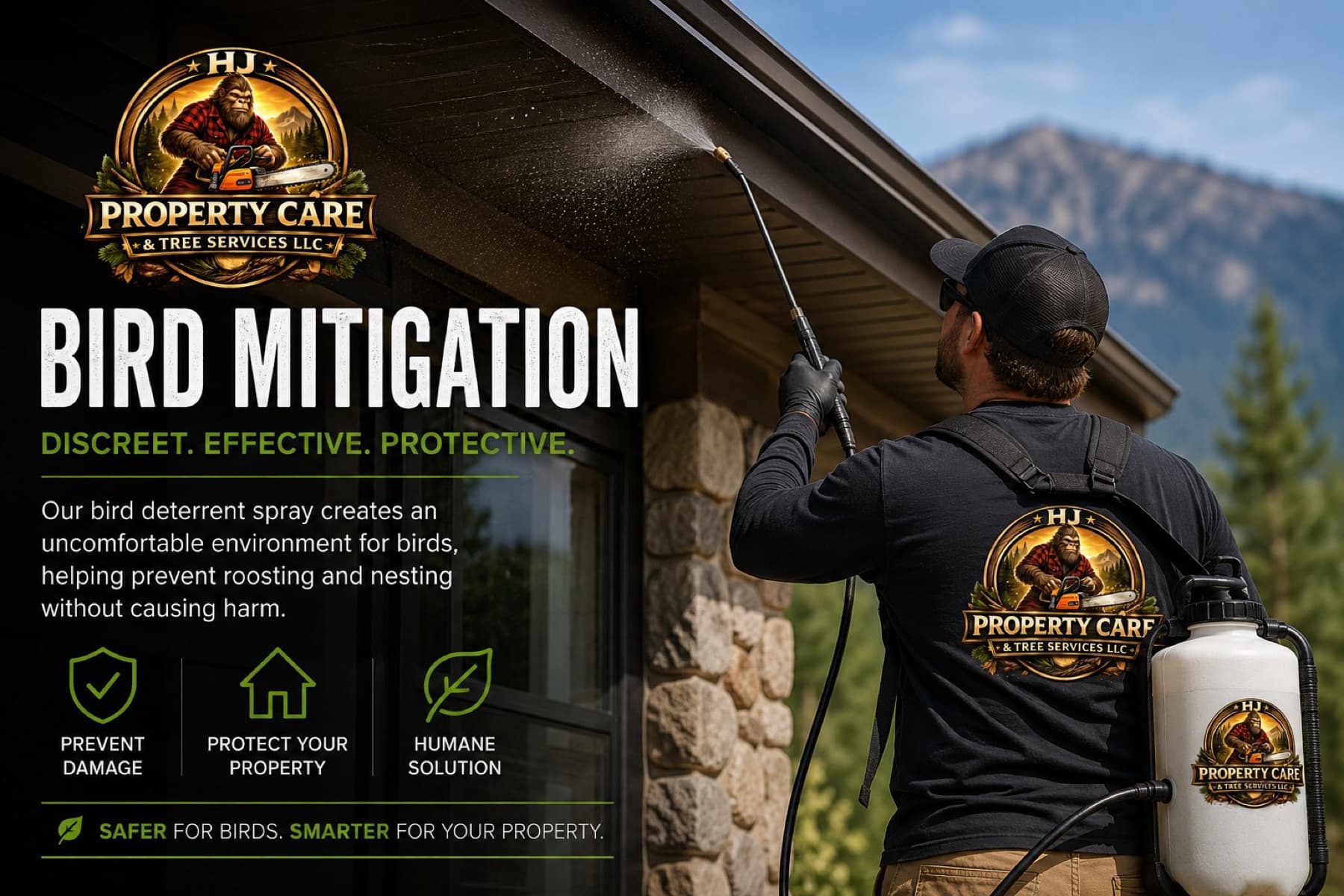
Making the surface unusable, not the bird unwelcome
Bird netting & exclusion in Missoula and the Bitterroot Valley
Bird netting, mesh, and ledge modification across Missoula and the Bitterroot Valley — permanent exclusion installed outside the nesting season.
- Insured
- ISA-certified
- Free 48-hour estimates
Bird Netting & Exclusion
Making the surface unusable, not the bird unwelcome
Reviewed by Adam Hurlbert, Owner & Founder, 15+ years in landscape & property care
Deterrents ask a bird to go somewhere else. Exclusion removes the choice, and it is the only part of bird work that reliably survives a second season. Netting across an open face, mesh over a vent or gap, a closed soffit, an angled cover on a ledge — the surface stops being usable and the problem stops rather than moving a meter along the wall.
The difficulty is never the material. It is fit. A net that is not tensioned and closed at every edge will let a bird in behind it, and a bird trapped behind netting is a far worse outcome than the roost you started with — worse for the bird, and worse for you when it has to come down again. This is closer to outdoor construction than to pest control, which is how we treat it.
We survey the building first, because exclusion only works if it covers every access point rather than the obvious one. A vent screened while the soffit gap beside it stays open has not solved anything.
Book an exclusion survey now and the install lands in the right window.
Request ServiceWhat an exclusion job covers
Scoped from a survey of the building rather than from a photograph, and installed while nothing is nesting:
- Full access-point survey, not just the visible roost
- Tensioned netting across open faces, courtyards & beams
- Mesh and screening on vents, gaps, soffits & flue openings
- Angled ledge covers where netting would be impractical
- Fixings and color matched to a customer-facing frontage
- Post-install check that nothing is closed in behind the work
Why the calendar matters more than the specification
Most native birds are federally protected under the Migratory Bird Treaty Act, and that protection covers an active nest. Exclusion physically covers the nesting surface, so it cannot go up over an occupied nest — which makes this a scheduling problem before it is a product problem.
There are two windows: before the birds arrive, or after the young have fledged and the site is genuinely empty. In practice that means late winter to early spring, or autumn. A survey booked in July is normal and useful; the install lands in one of those windows.
House sparrows, European starlings, and rock pigeons are the exception. All three are non-native and none is protected, so work involving those species is not held to the same calendar. That is why identification is the first thing we do rather than the last.
Netting, mesh, spikes — which one a surface actually needs
Netting suits an open face with a defined perimeter to fix to: a recessed entry, the underside of a beam, a courtyard, the gap beneath an eave. It is the most complete answer where the geometry allows it, because it removes access to a volume rather than to a surface.
Mesh and screening are for openings — vents, flue terminals, soffit gaps, and the holes that let starlings and sparrows inside a structure. This is often the highest-value part of a job and the least visible, because a bird inside a roof void is doing damage nobody sees until the ceiling stains.
Spikes and angled covers change a surface rather than closing a space, which is what a parapet, a sign top, or a light fitting needs. Scare devices — visual or audible — have a limited role: birds habituate to them quickly, so we treat them as a supplement to physical work rather than an alternative to it.
Good to know
Bird Netting & Exclusion questions
Common questions about our bird netting & exclusion in Missoula and the Bitterroot Valley.
It does not have to. On a customer-facing frontage the fixings, mesh color, and sightlines all get considered as part of the specification, and on many buildings the net is genuinely hard to see from the pavement. A solution that makes the frontage look worse than the droppings did has not solved the problem, so if netting is wrong for a particular elevation we will say so and use ledge modification instead.
Properly installed netting and mesh are a multi-year fix rather than a seasonal one, because they remove access rather than relying on a bird's judgement. What shortens that life is fixings working loose, a net losing tension, or a new gap opening as the building moves or gets altered. An annual look at the edges is worth more than any product upgrade.
Often, but it needs a conversation about what the building is for. Netting across an open bay works where the bay is not in daily use by machinery; where it is, ledge and beam treatment inside the structure is usually the better route. Barns and shops with swallows are one of the most common jobs we see in the Bitterroot, and the answer varies more by how the building is used than by what species is in it.
The work waits, unless the species is one of the three that are not protected. An active nest belonging to a native bird cannot be disturbed, and an occupied nest can look empty from ground level, so we check before scheduling rather than after arriving. If a nest turns up mid-install, that section stops and the rest continues.
It is quoted alongside, and the sequence matters: cleanup belongs after the surface has been made unusable, not on repeat instead of it. Clearing an accumulation is also usually the moment the real entry point becomes obvious, which is why we prefer to do both rather than one. See bird dropping and nest cleanup for how that side is handled.
Read before you hire
Bird Netting & Exclusion guides
Written by our own crew: the questions Montana property owners ask us most.
Local coverage
Bird Netting & Exclusion in your area
We run crews across Missoula and the Bitterroot Valley. See what bird netting & exclusion looks like in your town.
More from HJ Property Care
Explore our other services
Ready to transform your outdoor space?
Get a free, no-obligation estimate within 48 hours. Locally owned and ISA-certified.