
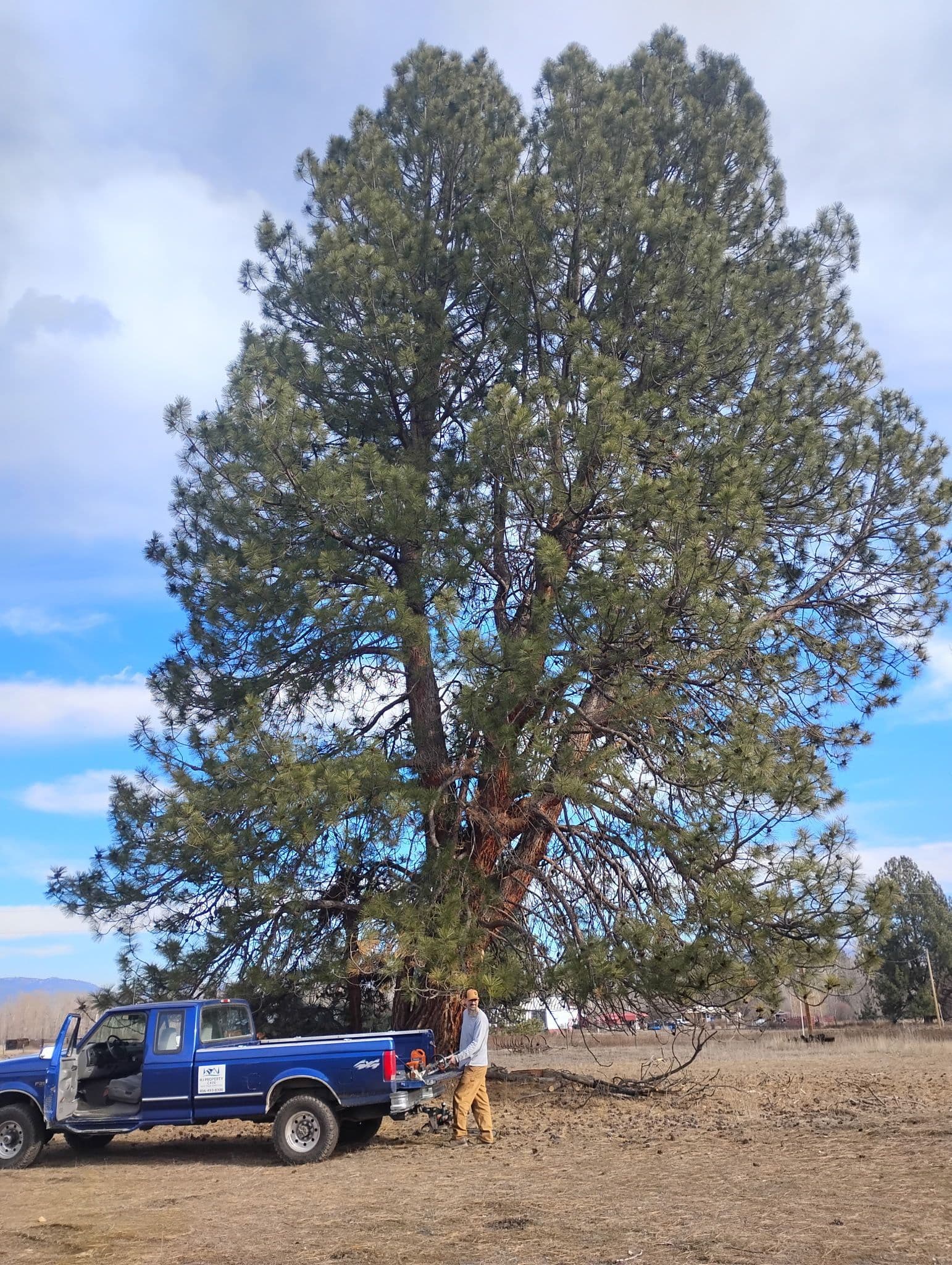
Western Larch: Gold in Fall, Bare in Winter, Not Dead
Every October the hillsides west of Missoula and up the Bitterroot canyons turn gold in patches, and every November people who have just bought a wooded lot call about a stand of dead conifers. They are western larch, known locally as tamarack, and they are doing what larch do. This guide explains the fall color and winter bareness, shows how to tell a dormant larch from a dead one, and covers the few things that really do harm the tree in western Montana.
Why does a larch turn gold and drop its needles?
Because it is a deciduous conifer. It bears cones and needles like a pine or fir, but it sheds all of its needles each fall and grows a new set in spring. Montana State University Extension puts it plainly in its note on seasonal needle drop: larch and tamarack trees lose all of their needles every fall. The Montana DNRC nursery's description of western larch says the same, that the needles turn yellow and drop in the fall.
A University of Idaho extension bulletin on larch, written in 1954 and still accurate on this point, calls larch our only conifer that sheds its needles each year and says the brilliant yellow is perfectly normal and must not be confused with disease.
Is a bare larch in winter dead?
No. From late fall until spring a healthy western larch is a bare trunk with bare branches. The Forest Service species review for western larch puts bud swell and bud opening in late March and April, with active growth from May through August. Until then there is nothing green to see.
This is why a larch should never be condemned in winter on looks alone. If a tree was green in summer and gold in October, assume it is alive. If you did not see it in leaf, wait for spring, or have someone check the buds and twigs before anything is cut.
How do you tell a healthy larch from a dying one?
Look at timing and evenness. A healthy larch turns color in fall along with the other larch around it, and the whole crown turns together. It drops clean, leaving the short knobby spur shoots that the needles grow from. In spring those spurs each push a tuft of soft green needles.
A larch in trouble breaks that pattern. It browns in June or July instead of October. It fails to leaf out in spring when its neighbors do, or leafs out only on some branches. The top stays bare while lower limbs green up. In winter, live twigs are flexible and carry plump buds, while dead ones are brittle and snap. Our guide to the signs a tree is dying explains how to check whether a branch is still alive.
What turns a larch brown in spring or early summer?
Most often, a needle disease. The Forest Service lists two on western larch: larch needle cast and larch needle blight. Both are fungi that infect new needles in wet spring weather.
The University of Idaho bulletin describes the effect: soon after the needles reach full length, infected ones turn brown almost all at once, and the tree looks scorched, with a red-brown cast as though fire had passed through. With needle blight, the dead needles cling to the spur shoots through the following winter, which can give the impression that the tree is dead. The bulletin's reassurance is that losing one year of needles does no more than reduce that year's growth. It warns of severe damage only when heavy needle loss repeats for more than two years in a row.
What is larch casebearer?
It is a small moth whose larva mines out larch needles and lives inside a hollowed needle that it carries like a case. According to the Forest Service leaflet on the insect, it is native to Europe and was found on western larch near St. Maries, Idaho, in 1957. The damaging feeding happens in spring, starting two to three weeks after bud break. At high numbers it leaves trees with a conspicuous burnt, reddish-brown look.
The leaflet reports that parasitic wasps released as biological control collapsed casebearer populations in western larch forests in the 1970s, and that defoliation since has mostly been localized and of low severity, with some outbreaks since the late 1990s. It takes about five years of severe, repeated defoliation to cause significant decline and death, and young, open-grown trees are the most likely to be killed. That describes a yard larch, so it is worth watching one that browns several springs running.
Do larch problems need treatment?
Usually not. Because larch is deciduous, it tolerates losing foliage better than an evergreen does. The Forest Service species review notes that a defoliated larch can produce a second set of needles later in the season, and the casebearer leaflet says pesticide management may not be necessary unless defoliation repeats.
Where a high-value tree in a yard is being hit year after year, the leaflet says insecticide is most effective in mid-spring shortly after budburst, and advises seeking professional advice first. With any product, the label directions are the law, and restricted-use products need a licensed applicator. The first step is confirming what is causing the browning, since casebearer and the needle diseases look alike from the ground and often occur together.
What else affects western larch in Montana?
The Forest Service review names dwarf mistletoe as the most serious parasite of western larch, and casebearer and western spruce budworm as the most damaging insects. It says budworm affects the form of larch in western Montana by feeding on new growth. We cover that insect in the guide to western spruce budworm.
On the other side of the ledger, larch is one of the more durable conifers here. The Forest Service root disease guide lists larch among the species least susceptible to Armillaria, the root disease that kills so many firs. The Douglas-fir beetle guide notes that the beetle only occasionally attacks larch and has only been recorded raising brood in downed ones. Mature larch also have very thick bark at the base, which is why old ones survive fires that kill their neighbors.
Is western larch a good yard tree?
On the right site, yes. The Montana DNRC nursery lists it as native to mountain slopes and valleys of western Montana, a full sun tree with high wind tolerance and moderate drought tolerance that prefers moist, well-draining, acidic to neutral soil. It rates the tree's tolerance of alkaline or saline soil as poor and its minimum precipitation at 15 inches a year. That makes larch a better fit for a forested lot or a cooler slope than for a hot, alkaline valley-floor lawn.
It is also a big tree. The Forest Service gives typical mature heights of 100 to 180 feet, so give it room away from roofs and lines. Because it drops its needles, it lets winter sun through, and its bare branches hold less snow than an evergreen's. It is on our list of the best trees to plant in western Montana for those reasons.
If you have a larch you are unsure about, a tree health and risk assessment in the growing season settles it. That and the rest of our tree services cover Missoula and Ravalli counties, and more species guides are in the Montana Tree Guide.
Call HJ Property Care & Tree Service at (406) 215-7319 or request a tree assessment and an ISA Certified Arborist will look at the tree with you.
Need help?
HJ Property Care & Tree Service is locally owned and ISA-certified. Call for a free estimate.
This article is part of the Montana Tree Guide, our complete guide to trees in western Montana.
Explore our tree services.
Sources
We cite primary sources: Montana State University Extension, the City of Missoula, and the ISA, so you can verify anything here yourself.
- Seasonal Needle Drop (Guide to Pests, Problems, and Identification of Ornamental Shrubs and Trees in Montana) (Montana State University Extension). Last checked October 11, 2026.
- Western Larch (Montana DNRC Conservation Seedling Nursery). Last checked October 11, 2026.
- Needle Cast Diseases of Western Larch, Bulletin No. 21 (1954) (University of Idaho Agricultural Extension Service). Last checked October 11, 2026.
- Larix occidentalis (western larch) species review (USDA Forest Service, Fire Effects Information System). Last checked October 11, 2026.
- Larch Casebearer, Forest Insect and Disease Leaflet 96 (revised August 2021) (USDA Forest Service). Last checked October 11, 2026.
- Management Guide for Root Disease (Forest Health Protection and State Forestry Organizations) (USDA Forest Service, hosted by Montana DNRC). Last checked October 11, 2026.
- Douglas-fir Beetle Management (Forest Health Protection and State Forestry Organizations management guide) (USDA Forest Service, hosted by Montana DNRC). Last checked October 11, 2026.
Ready to transform your outdoor space?
Get a free, no-obligation estimate within 48 hours. Locally owned and ISA-certified.