
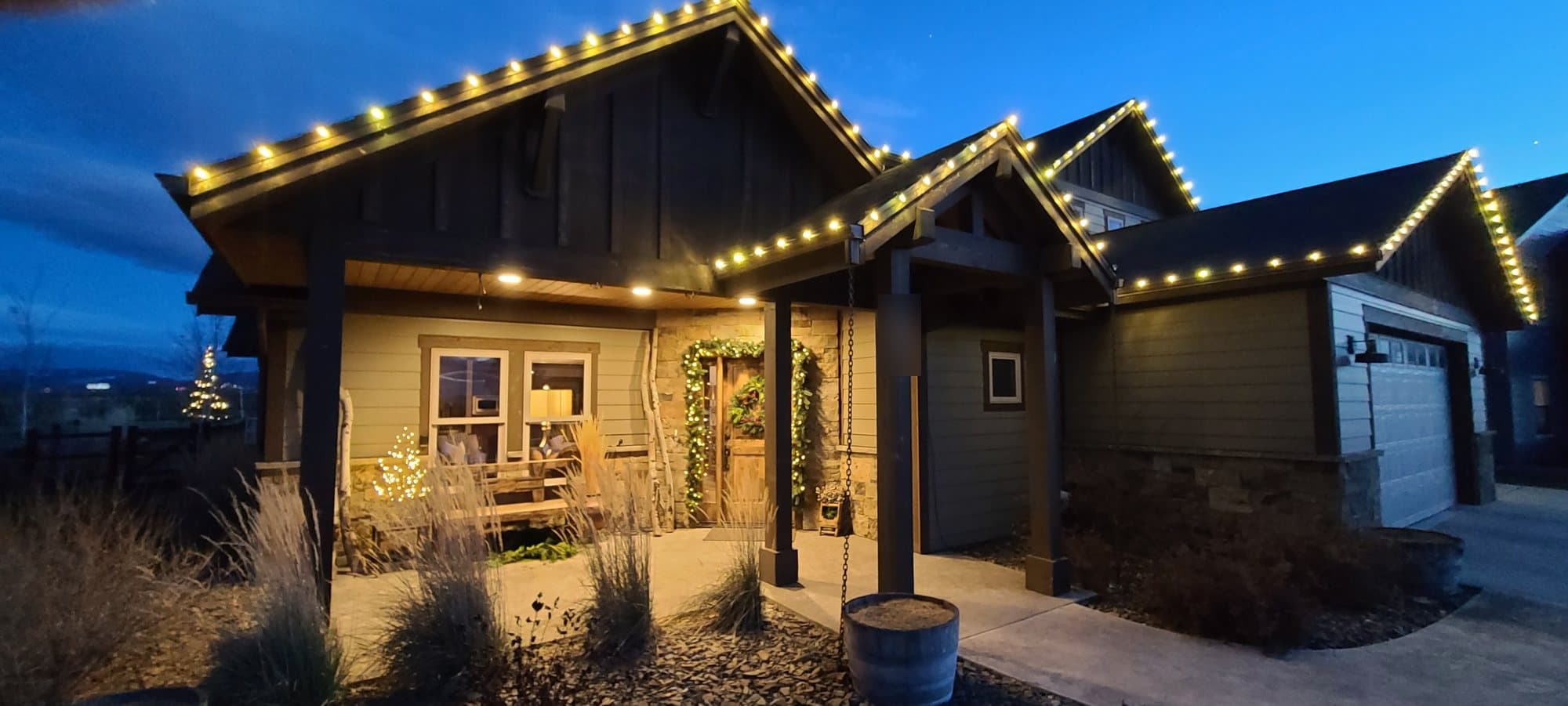
Holiday Lights and HOA Rules: What Montana Homeowners Should Check
Reviewed by Adam Hurlbert, Owner & Founder, 15+ years in landscape & property care
Most HOAs do not ban holiday lights, but many have something to say about when they go up, when they come down, how bright they are, and what you can attach to the house. Those rules live in your community's governing documents, so the answer varies street by street. This guide explains what such rules typically cover, how to find yours in Missoula or Ravalli County, and how to ask for approval without starting a neighborhood argument. It is general information, not legal advice. For a real dispute, talk to a Montana attorney.
Can an HOA restrict Christmas lights in Montana?
Generally an HOA's power comes from its own governing documents, so that is the place to look first. We did not find a Montana statute written specifically about holiday lights or decorations in an HOA, though that is not the same as saying there is no law that could apply, and it is worth asking an attorney if the stakes are real. Amundsen Davis, a law firm writing generally (not about Montana), says a board is limited to the provisions of its governing documents and other legal considerations, and that it stands on its strongest ground when it follows the text closely and applies it uniformly and consistently.
That firm also points out that aesthetic or nuisance language in existing covenants might cover decorations even if the word holiday never appears. So the absence of a Christmas rule does not mean there is no rule that applies. This article is part of our Montana Winter Property Guide.
What do HOA holiday rules usually cover?
Associa, a national community association manager, lists seven common types of rule. Yours may have some, all or none of them:
Time frame for installation and removal, often from the start of the season until soon after the new year. Time of day for operating lights and music. Size of displays, since oversized ones can limit walkways or views. Placement, so that items do not block sidewalks, driveways or common areas, sometimes with limits on how close they sit to the street. Limits on brightness, including flashing lights. Noise from musical or animated decorations. And decorating shared areas, which often needs prior approval.
Associa also says LED or low-voltage lights are often preferred, and that inflatables, large lawn figures, noisy decorations and flashing or strobe lights are among the items some communities prohibit. Those are examples from a national manager rather than Montana rules, so treat them as a list of questions to check.
Where do I find my HOA's covenants in Missoula or Ravalli County?
Start with your board or property manager, who should be able to send you the covenants, bylaws and any rules or architectural guidelines. You likely also received them at closing, so look through your closing packet or ask your title company. One thing to look out for: the covenants may be a separate document from the board's rules, and the rules can change more often.
If you cannot get a copy, try the county. Covenants are generally recorded with the county, as Steadily's guide to Montana HOA rules describes. Missoula County's Clerk & Recorder has a Property Records & Deeds page with a documents and surveys section and a land records search. In Ravalli County, the Clerk and Recorder's office in Hamilton can be reached at 375-6555 or recorder@ravallicounty.gov. Search by your subdivision name, or ask staff how to find the covenants for your lot. If you are unsure which documents control, that is a question for an attorney.
What should I look for in the documents?
Read for the words that do the work. Look for architectural control or review, exterior alterations, attachments, signs and displays, lighting, nuisance, and seasonal or holiday. Note any date windows or quiet hours. Look at who decides (a board, an architectural committee or a manager), how quickly they must respond and whether silence counts as anything. Check too for what happens on a violation: notices, fines, or a chance to be heard.
Then look at the installation itself. Does the attachment count as an exterior alteration? A strand on clips that comes off in January is easier to defend than a track fastened permanently to the fascia. Our comparison of permanent and seasonal lights covers the differences, and a permanent system is the one to clear with the board in writing before you pay a deposit.
Are religious displays protected?
Rules that treat holidays differently can create problems, and federal fair housing law is the place this usually comes up. Associa says that if a community permits secular decorations for holidays such as St. Patrick's Day or Halloween, it must also allow religious displays for holidays such as Christmas, Hanukkah and Kwanzaa, citing the Fair Housing Act. Amundsen Davis cautions that date windows should not exclude particular religious holidays, noting that a window beginning two weeks before Christmas will sometimes miss Hanukkah. It suggests reference points that use the earliest and latest holiday dates.
Those are general statements from an association manager and an out-of-state firm. If you believe a rule is being applied against you because of religion, get advice from a Montana attorney rather than relying on a blog, including this one.
How should I ask the board for approval?
Ask early and in writing, with enough detail that a volunteer can say yes without a meeting. Say what you are installing and where, including a phone photo marked up with the runs. State the bulb type, how it attaches, how it is powered, the dates it goes up and comes down, and the hours it will run. If a contractor is doing the work, mention that and offer proof of insurance.
September or October is not too early, since a board may meet only once a month. Keep a copy of your request and the reply. If the answer comes by phone, send a short email confirming what you understood. For a shared entrance or common area, this runs the other way: the board is the customer, and our commercial holiday decor timeline covers how to plan it.
What if snow makes it impossible to remove lights by the deadline?
Tell the board before the deadline, not after. A roof with ice on it in January is a real safety issue, and Associa quotes one of its managers saying a board may wish to allow a grace period, with permission, until conditions warm up. You can usually at least switch the display off, which removes most of what the neighbors noticed. Our guide to taking down lights and storing them covers what a safe takedown day looks like, and when to hang lights in Montana covers what to do if one does not come.
That is also an argument for agreeing a takedown window with your installer in advance, so that the date and the HOA's deadline line up.
What if a neighbor complains about my lights?
Start with the neighbor if you can. Most complaints are about hours or a light pointed at someone's bedroom window, and a timer or a slight change to the aim costs nothing. Keep your display on reasonable hours, and avoid flashing effects if your rules mention them. If you get a notice, read exactly what it says, reply in writing and ask what rule it relies on. An attorney can tell you what your options are if it goes further.
Do city rules apply on top of HOA rules?
Yes, HOA covenants are separate from local law, so you may have both. In the city of Missoula, the outdoor lighting ordinance says exterior residential lighting installed after its effective date may not spill onto adjacent property, with a limited exception for seasonal lighting or fixtures jointly owned by adjoining owners. The city says it looks at existing fixtures on a complaint basis. No fixture or device may be operated in a way that is a hazard to people or to safe driving, and that is a reasonable rule of thumb outside the city too: do not aim anything bright at a road or a neighbor's window.
Electrical safety is on you either way. Use outdoor-rated lights and GFCI-protected outlets, as we cover in outdoor Christmas light safety, and keep cords and displays out of shared walkways and plow paths. That matters more if your community has shared drives, and our guide to what an HOA should expect from a snow contractor explains how the snow side works.
Can a contractor help with HOA requirements?
A good one can make the paperwork easier, but the approval is still between you and your association. We can do a walkthrough, agree what gets lit, put the layout and dates in writing for you to send to the board, and work with clips rather than fasteners. We cannot tell you what your covenants mean, since we are not attorneys. Our Christmas light installation service is taking interest for 2026, with no obligation while packages are finalized.
Call (406) 215-7319 or join the interest list, and mention that you are in an HOA so we can plan the extra lead time.
Need help?
HJ Property Care & Tree Service is locally owned and ISA-certified. Call for a free estimate.
This article is part of the Montana Winter Property Guide, our complete guide for western Montana property owners.
Explore our christmas & holiday light installation.
Sources
We cite primary sources: Montana State University Extension, the City of Missoula, and the ISA, so you can verify anything here yourself.
- Homeowner Association Regulation of Holiday Decorations (Amundsen Davis (law firm blog)). Last checked November 2, 2026.
- Can You Decorate for the Holidays in an HOA? (Associa (community association manager)). Last checked November 2, 2026.
- Montana HOA laws and regulations, 2026 guide (Steadily (insurance publisher)). Last checked November 2, 2026.
- Property Records & Deeds (Missoula County Clerk & Recorder/Treasurer). Last checked November 2, 2026.
- Clerk and Recorder (Ravalli County). Last checked November 2, 2026.
- Ordinance 3582, Missoula Outdoor Lighting (Chapter 8.64, Missoula Municipal Code) (City of Missoula). Last checked November 2, 2026.
- Lighting Information (City of Missoula, Community Planning, Development & Innovation). Last checked November 2, 2026.
Ready to transform your outdoor space?
Get a free, no-obligation estimate within 48 hours. Locally owned and ISA-certified.