
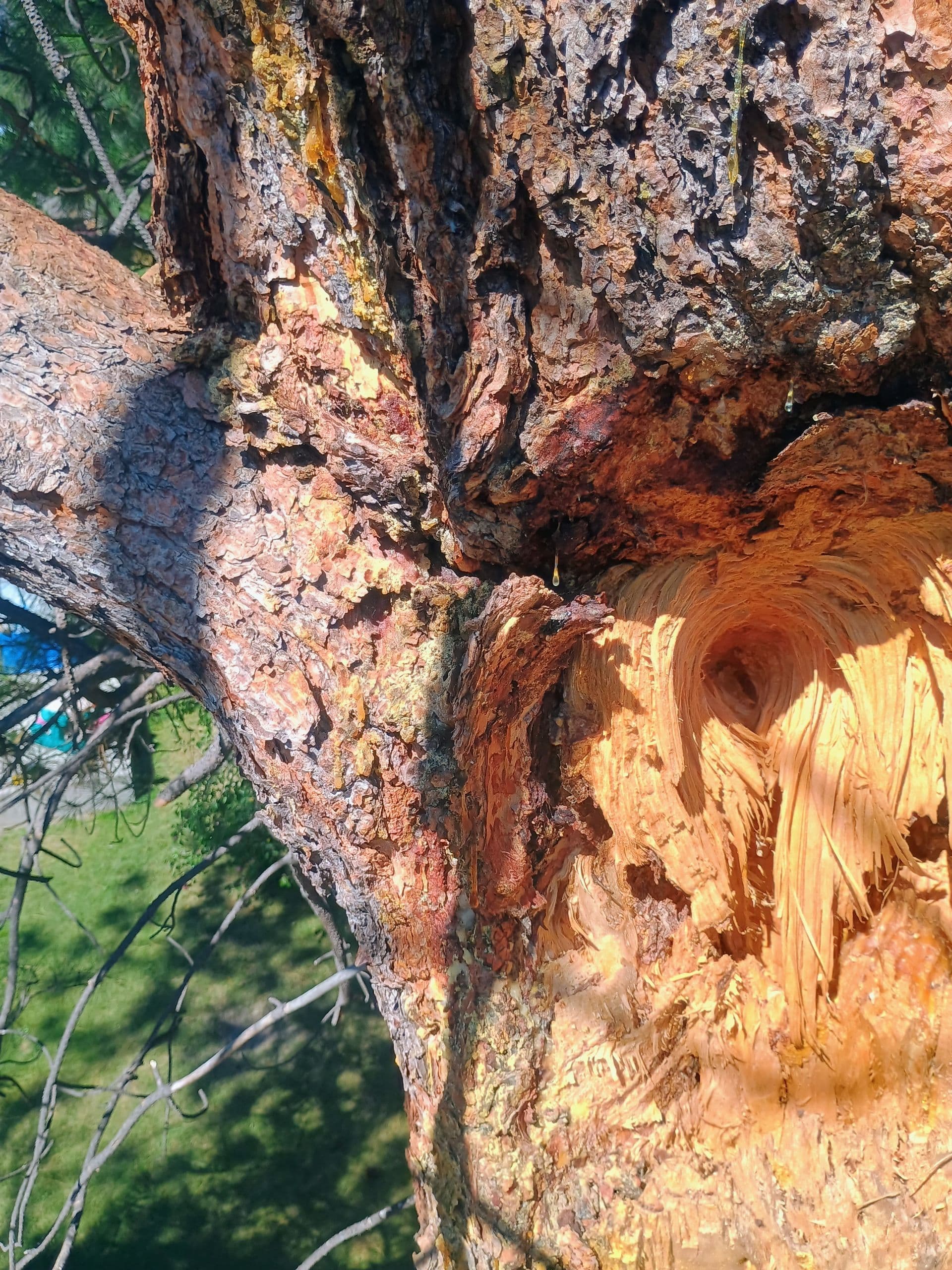
How Lawn and Pasture Weed Killers Injure Trees in Montana
Weed control is a fact of life in western Montana. Lawns get treated for dandelions, pastures and roadsides for knapweed and leafy spurge, and fence lines and gravel for everything. Most of that work is done without harming a single tree. When a tree is injured, the cause is usually one of three things: spray that drifted, vapor that lifted off on a hot day, or a product that moved through the soil to roots nobody knew were there. Herbicide injury is often mistaken for disease, and the reverse happens too. This guide explains what the injury looks like, how it happens, and what Montana State University Extension says to do about it.
What does herbicide injury look like on a tree?
The classic picture is distorted new growth. For the synthetic auxin group, which includes 2,4-D and dicamba, MSU Extension describes twisting, cupping and curling of leaves, stems and twigs on broadleaf trees, and notes that conifers can show symptoms as well. The Nebraska Forest Service adds strap-like narrow leaves, clusters of stunted shoots, off-color foliage in yellow, white or reddish tones, leaf browning and drop, and in severe cases the death of branches or the whole tree.
Glyphosate injury reads differently. MSU describes leaves that appear narrow and yellowed, branches that die back from the tip, and distorted, yellowed growth with excessive sprouting, called witch's broom, from the buds below the dieback. In either case, the symptoms tend to be concentrated on the growth that was expanding when the exposure happened.
Which products cause most of the trouble?
The reason is botanical. An MSU Extension weed post on this subject explains that most noxious weeds are broadleaf plants, and selective herbicides work by controlling broadleaf plants while sparing grasses. Trees are also broadleaf plants, so the same chemistry can injure them. MSU's Pesticide Education Program lists the growth regulator active ingredients in wide use: picloram, triclopyr, dicamba, clopyralid, 2,4-D and aminopyralid.
Non-selective products such as glyphosate are active on all plants. Around trees, MSU notes, glyphosate is commonly used and usually safe, because it is not generally absorbed by roots or mature bark. The injury comes when it contacts leaves, root suckers, young bark or exposed tissue. The lesson from both groups is that the active ingredient on the label matters more than the product name, and that the label lists what it can harm.
How does spray reach a tree that was never sprayed?
Through the air, in two ways. MSU Extension defines drift as herbicide moving through the air as spray particles during application, or as a gaseous vapor when the product volatilizes afterward. Particle drift is a wind problem. Vapor drift is a heat problem, and the Nebraska Forest Service notes that volatile herbicides can form vapor during and following application, sometimes even days later, and travel long distances.
Formulation plays a part. MSU's weed post explains that synthetic auxin herbicides are commonly formulated as amines and esters, and that ester formulations have a higher vapor pressure and volatilization potential, while amines are generally safer around sensitive plants. It also warns against spraying during a temperature inversion, when fine droplets are trapped near the ground and can move significant distances. MSU's Pesticide Education Program lists the signs of one: early morning or late evening, no wind and clear skies.
Can weed killer travel through the soil to tree roots?
Yes. The Nebraska Forest Service describes tree damage through root uptake from soil-applied herbicides, such as those used to keep ground bare long term along fence lines, near buildings and on driveways, and from many products used for woody brush control or stump treatment. It names picloram as one that easily moves out of the roots of treated stumps or brush into the soil, where the roots of desirable trees pick it up, and says this can cause serious damage or death. MSU's weed post notes that labels for picloram and aminocyclopyrachlor products carry language about potential tree injury.
Distance is deceptive. The same Nebraska publication notes that some tree roots extend two to three times the height of the tree, well beyond the canopy, so a tree some way from the treated strip can be affected. It adds that root uptake can occur with many lawn herbicides when they are applied at too high a rate. On a small acreage, that puts the shade trees near a treated pasture edge or driveway within reach.
Is it herbicide, or something else?
Several things mimic it. Late frost, leaf-curling aphids, drought scorch and some diseases all distort or brown new leaves, so pattern and history carry the diagnosis. Herbicide injury usually affects more than one kind of plant in the same area, often with a gradient that is worst on the side facing the source. It follows an application by days to weeks. Tomatoes, grapes and other sensitive garden plants nearby often show it first.
For a second opinion, MSU Extension's Schutter Diagnostic Lab lists visual assessment of herbicide injury to plants among its services, along with diagnosis of plant diseases, insect damage and environmental problems, and it accepts photos by email before asking for a physical sample. An arborist can also rule out the look-alikes on site. If leaves are yellow between the veins without being twisted, the cause is more likely the soil; see our guide to iron chlorosis and yellow leaves.
What should you do if a tree has been exposed?
Mostly, wait and reduce stress. MSU Extension's management advice for synthetic auxin injury is to wait and see if the tree recovers, support tree health and limit further exposure. For glyphosate injury it is more specific: to limit stress during recovery, do not prune or fertilize the tree for one growing season. For both, MSU cautions that injury symptoms may occur for more than one year, so a second season of odd growth does not by itself mean a second exposure.
Supporting tree health in a dry valley mostly means water. Deep, regular watering through summer and into fall gives an injured tree the best chance, and our guide to watering trees through a Montana drought covers the method. Keep notes and dated photos from the first day you notice symptoms, including what was sprayed nearby and when, if you know.
Who do you report suspected drift to?
The Montana Department of Agriculture. Its pesticide compliance page says a person suffering loss or damage from the improper use of pesticides should file a report of loss with the department by telephone, email or written correspondence. The helpful details it lists include the type and location of the property affected and the name of the owner or occupant for whom the application was made.
This is general information, not legal advice. The department can tell you how its process works, and questions about responsibility between neighbors or with an applicator belong with your insurer or an attorney. A calm conversation with the neighbor or the applicator is usually the right first step, and it often answers the question of what product was used.
How do you keep it from happening?
Follow the label and respect heat and wind. MSU Extension's prevention advice for synthetic auxins is to read and follow product labels, avoid applying these herbicides under tree canopies, and avoid using them during windy weather or when temperatures are forecast to be above 80 degrees. The Nebraska Forest Service sets its threshold at 85 degrees for the 24 hours following application. It also suggests a coarse spray to limit drift, spot-spraying instead of blanket treatment, and shifting broadleaf weed control to fall, when many weeds are better controlled and trees are at less risk.
Around the trunk, MSU advises protecting all desired plants from contact with glyphosate, and Nebraska adds not to spray root suckers, exposed roots or thin young bark. One more caution from MSU's Pesticide Education Program: grass clippings or manure carrying residues of persistent growth regulator herbicides should not be added to compost or used as mulch.
Label directions are the law, and restricted-use products need a licensed applicator. HJ is certified and licensed for weed control. If you have trees you care about, tell us when you ask about fertilizer and weed control so the treatment can be planned around them. If a tree is already showing symptoms, a tree health and risk assessment is the place to start. It is part of our tree services, and the Montana Tree Guide covers other causes of decline.
Call HJ Property Care & Tree Service at (406) 215-7319 or request a tree assessment and an ISA Certified Arborist will look at the tree with you.
Need help?
HJ Property Care & Tree Service is locally owned and ISA-certified. Call for a free estimate.
This article is part of the Montana Tree Guide, our complete guide to trees in western Montana.
Explore our tree services.
Sources
We cite primary sources: Montana State University Extension, the City of Missoula, and the ISA, so you can verify anything here yourself.
- Herbicide Injury: Synthetic Auxins (MSU Extension, A Guide to Pests, Problems, and Identification of Ornamental Shrubs and Trees in Montana). Last checked October 11, 2026.
- Herbicide Injury: Glyphosate (MSU Extension, A Guide to Pests, Problems, and Identification of Ornamental Shrubs and Trees in Montana). Last checked October 11, 2026.
- Monthly Weed Post, March 2024: herbicide selectivity and trees (MSU Extension Invasive Plants). Last checked October 11, 2026.
- Many Reports of Plant Injury due to Non-target Drift and Carryover (MSU Extension Pesticide Education Program). Last checked October 11, 2026.
- Protecting Your Trees From Herbicide Damage (Nebraska Forest Service and University of Nebraska-Lincoln (Backyard Farmer)). Last checked October 11, 2026.
- Schutter Diagnostic Lab (MSU Extension). Last checked October 11, 2026.
- Pesticide Compliance and Enforcement (Montana Department of Agriculture). Last checked October 11, 2026.
Ready to transform your outdoor space?
Get a free, no-obligation estimate within 48 hours. Locally owned and ISA-certified.