
New Concrete and De-Icers: How to Protect a Driveway
Reviewed by Adam Hurlbert, Owner & Founder, 15+ years in landscape & property care
If your driveway was poured this year, the most useful thing you can do this winter is keep salt off it. The National Ready Mixed Concrete Association says not to use deicing salts in the first year after placing concrete, and the City of Missoula goes further on its new sidewalks, asking for two years. This guide explains why fresh concrete flakes, why people call it spalling, what actually causes it, which products to keep off a driveway forever, and what to do about a surface that has already started to go.
What is the flaking on my concrete driveway?
Many people call it spalling. The term the concrete industry guidance we read uses for this is scaling, defined by the National Ready Mixed Concrete Association (NRMCA) as local flaking or peeling of a finished surface of hardened concrete as a result of exposure to freezing and thawing. It generally starts as small patches that later merge and can expose large areas.
NRMCA grades it by what you can see. Light scaling does not expose the coarse aggregate. Moderate scaling exposes the aggregate and may involve loss of up to 1/8 to 3/8 inch of the surface mortar. In severe scaling, more surface has gone, and the aggregate is clearly exposed and stands out. If your slab looks like that, or if pieces are lifting away, the guidance below on repair applies more than anything about salt. NRMCA also notes that concrete can peel for reasons other than freezing, such as finishing problems, so not every flaky slab is a winter problem.
How long should you wait before using de-icer on new concrete?
The sources give different answers, so choose the cautious one that applies to you. NRMCA says do not use deicing salts such as calcium or sodium chloride in the first year after placing the concrete, and elsewhere in the same document it says not to use deicers in the first winter. University of Maryland Extension says sodium and calcium chloride are particularly damaging to newly poured concrete. The City of Missoula says not to use deicing agents on vulnerable new sidewalks for two years after installation, and to try sand or other non-corrosive materials instead.
Our suggestion is to treat new work conservatively: no melting products at least through the first winter and ideally through the first full year, and two years if it is a public sidewalk in Missoula, because that is what the City asks for. Ask whoever poured your concrete, too. They know the mix and the timing, and their guidance may come with a warranty attached. NRMCA recommends clean sand for traction during that period, and our guide to sand, salt or both covers how to use it.
Why does salt damage new concrete more?
The NRMCA document lists the conditions that lead to scaling, and most of them are about how the concrete was made and finished, with salt as the trigger. Too little entrained air is the first: it says adequate air entrainment is required to protect against freezing and thawing damage. Next is excessive calcium or sodium chloride on concrete with inadequate strength, air entrainment or curing. Finishing while bleed water is on the surface makes a weak top layer, and overworking the surface reduces air in that layer. Insufficient curing leaves a weak surface skin.
You cannot tell how well any of that went by looking at a new slab. That is one reason for caution in the first winter. NRMCA also points out that even air-entrained concrete will scale if the other precautions are not observed, and it notes that poor drainage, which lets water or salt and water stand on the surface, greatly increases the severity of the exposure. Our article on freeze-thaw cycles covers the general mechanism.
Which de-icers should never go on a driveway?
Ammonium nitrate and ammonium sulfate. NRMCA is unusually direct: never use ammonium sulfate or ammonium nitrate as a deicer, because they are chemically aggressive and destroy concrete surfaces. It says those are components of most fertilizers, so do not throw lawn fertilizer on an icy drive, even if it melts a little. Wisconsin Extension independently says not to use fertilizers as deicers.
Beyond that, the picture is mixed, and a label saying safe for concrete should be read with care. University of Maryland Extension's table rates sodium and calcium chloride as damaging, potassium chloride as acceptable on old concrete, and magnesium chloride as not damaging. But research summarized for Iowa's transportation agencies found that calcium chloride and magnesium chloride react with cement paste to form calcium oxychloride, an expansive material, while sodium chloride is less reactive, and recommended limiting those two on concrete pavements. That research concerns highway joints and not home driveways, but it means we would not treat magnesium chloride as harmless because one table says so. Maryland also says sodium and calcium chloride should not go on brick or stone. Our ice melt guide compares products by working temperature.
What about salt that comes in on the car?
It counts. NRMCA advises hosing off accumulated salt deposited by cars on newly placed driveways and garage slabs when conditions permit. On a road treated with brine or salted sand, as paved Missoula County roads can be, the underside of a vehicle brings some of that home and drops it on the slab where you park. A warm spell is the time to rinse it, so that the water runs off and does not freeze on the surface. Check the drainage first, since you do not want to create the ice you were trying to avoid.
Should you seal a new driveway before winter?
It is one of the steps NRMCA recommends. It says it is important to prevent newly placed concrete from becoming saturated with water before winter freeze and thaw cycles, and to apply a commercially available silane or siloxane-based breathable concrete sealer or water repellent designed for concrete slabs, following the maker's directions on application and frequency. It gives another option as well, a 1:1 mixture of boiled linseed oil and mineral spirits in two layers, with a caution that linseed oil darkens concrete and has to be applied uniformly.
Timing matters. NRMCA says the concrete should be reasonably dry first and that late summer is the ideal time for surface treatment. In November in Montana, that window has probably passed for this winter, so plan on next year, and ask the installer or a concrete contractor what they would use for your slab. We do not pour or seal concrete. That advice should come from the people who do, and from the label on the product.
What should you ask for when pouring a new driveway?
If a driveway or apron is still ahead of you, this is where most of the protection comes from. NRMCA says concrete exposed to freezing and thawing cycles must be air-entrained, with severe exposures requiring air contents of 6 to 7 percent in freshly mixed concrete made with 3/4-inch or 1-inch aggregate, and 4 to 6 percent in moderate exposures where deicing salts will not be used. It says a concrete strength of 3,500 psi for freezing and thawing exposure and 4,000 psi when deicers are used should generally be adequate to prevent scaling.
It also asks for proper curing with a liquid membrane compound or wet burlap, no finishing operations with water present on the surface, and avoiding steel trowels on exterior slabs. In cold weather, its rules say the concrete temperature should be at least 50°F, with an accelerating admixture and a lower slump. Ask your contractor how they handle those points, and think about drainage so water does not pond on the finished slab. Good grading at the edges matters for this too, and our yard drainage and spring melt article explains how that works around a drive.
How should you clear snow from new concrete?
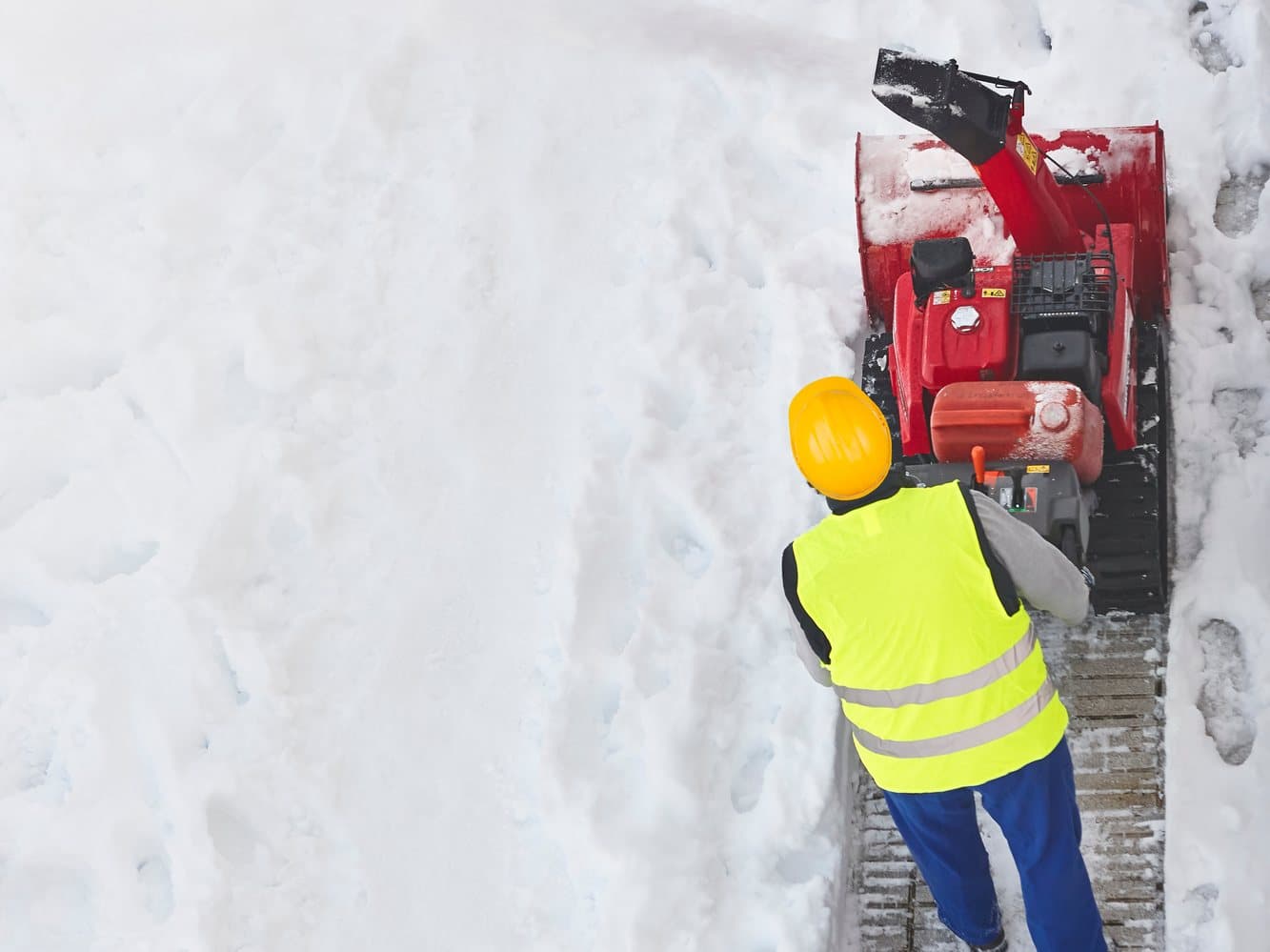
The goal is to keep the slab from sitting wet and salty. NRMCA notes that scaling is often noticed in gutters and sidewalks where snow from plowing keeps the surface wet for long periods. Do not stack piles on a new slab, and do not let snow sit on the low edge. Clear early, before traffic packs it down, and move snow somewhere it will not melt back across the surface. Our where to pile snow guide goes through the options.
Use sand on the slick spots instead of melting product, and sweep it up after the thaw. Tell whoever clears your property about any concrete under two years old, including its boundaries, because a contractor treating a walk the same way as the rest of the site will not know otherwise. Mark new work before the first storm. The same applies to hardscaping such as pavers and stone, where treatment should follow what the installer recommends. Avoid anything sharp on a new surface, and our guide to snow plow damage covers how to mark edges.
Can scaled concrete be repaired?
Yes, but the base has to be sound. NRMCA says the repaired surface will only be as strong as the base it is bonded to, so the surface must be free of dirt, oil or paint and, most importantly, must be sound. It describes removing all weak or unsound material with a hammer and chisel, sandblasting, a high-pressure washer or a jackhammer, which leaves a clean, rough surface ready for a thin bonded resurfacing, such as portland cement concrete, latex modified concrete, or polymer-modified cementitious repair mortar.
A patch over crumbling concrete is likely to fail. This is a job for a concrete contractor, who can also tell you if a slab is past resurfacing and needs replacing. If scaling is only light and has not exposed the aggregate, stopping the things that cause it, such as salt, standing water and piled snow, is a sensible first step while you get an opinion.
Does this apply to my existing driveway?
Less strictly, but yes. NRMCA says that after the first year you should use salt sparingly. Maryland suggests following the label, and using even less than recommended if you can still cover the surface thinly and evenly. On an older slab that already shows wear, a thin melting application only where ice really forms, sand elsewhere, and keeping water from standing on the slab will all help it last. For a broader view of what salt does around a house, see how de-icing salt damages plants and concrete.
Can HJ work around new concrete?
Yes, and tell us about it. Ice management is part of our snow and storm services, and what goes on a surface depends on what the surface is. A new driveway is easy to plan around if we know about it before the season, whether on a residential route or a commercial account. This article is part of our Montana Winter Property Guide. It is general information, and your concrete contractor's instructions for your own slab come first.
Call HJ Property Care & Tree Service at (406) 215-7319 or reserve a spot on a 2026-27 snow route before the first storm.
Need help?
HJ Property Care & Tree Service is locally owned and ISA-certified. Call for a free estimate.
This article is part of the Montana Winter Property Guide, our complete guide for western Montana property owners.
Explore our snow & 24-hour storm services.
Sources
We cite primary sources: Montana State University Extension, the City of Missoula, and the ISA, so you can verify anything here yourself.
- CIP 2, Scaling Concrete Surfaces (1998 revision, copy hosted by Prairie Material) (National Ready Mixed Concrete Association). Last checked November 2, 2026.
- Sidewalk Snow Removal (City of Missoula, Public Works & Mobility). Last checked November 2, 2026.
- Melting Ice Safely (University of Maryland Extension). Last checked November 2, 2026.
- Guide to the Prevention and Restoration of Early Joint Deterioration (TR-697) (Institute for Transportation, Iowa State University). Last checked November 2, 2026.
- Winter Salt Injury and Salt-tolerant Landscape Plants (University of Wisconsin-Madison Division of Extension). Last checked November 2, 2026.
- Snow Plowing (Missoula County Public Works). Last checked November 2, 2026.
Ready to transform your outdoor space?
Get a free, no-obligation estimate within 48 hours. Locally owned and ISA-certified.