
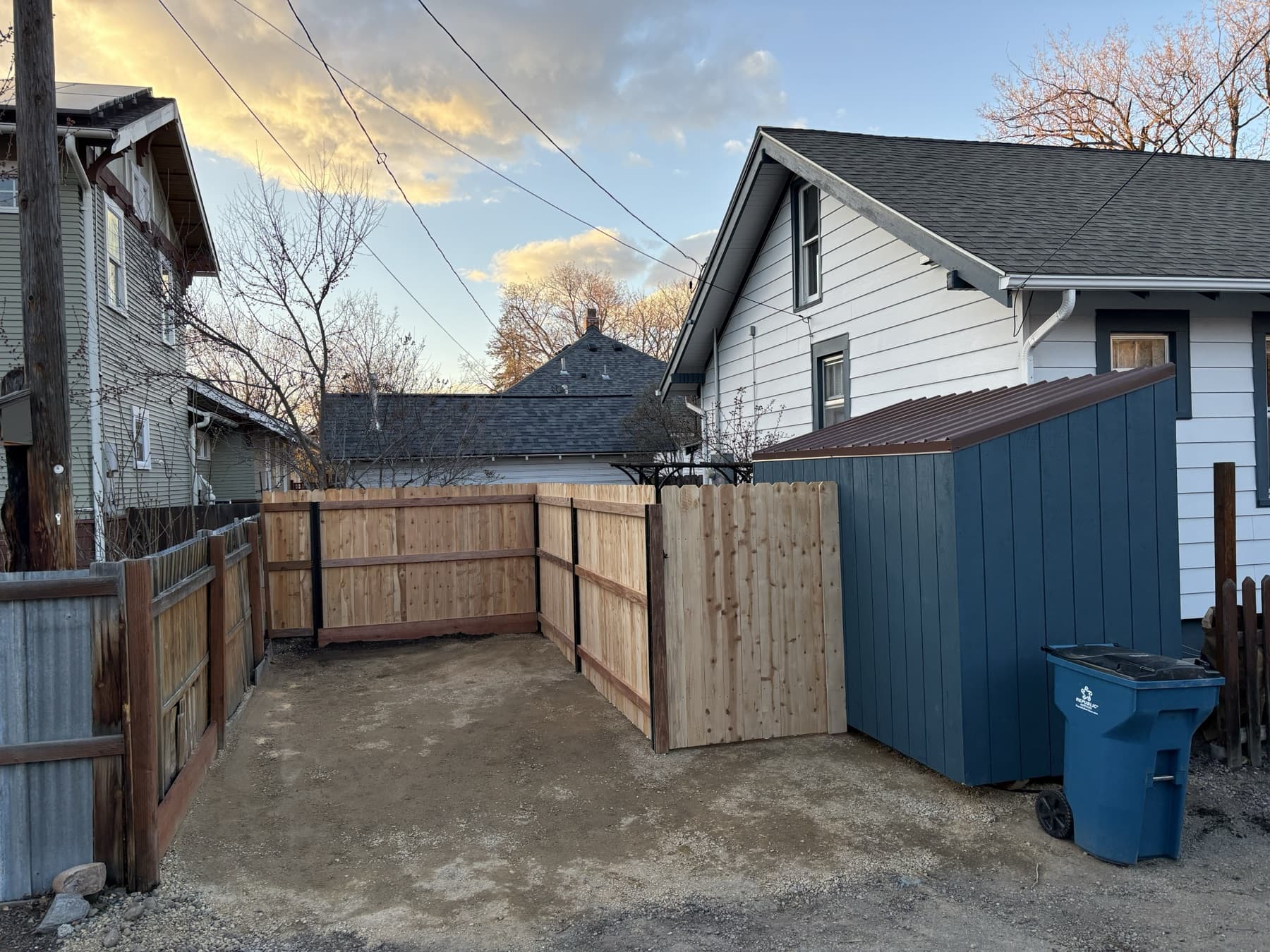
Wood, Vinyl, Metal or Composite Fencing in Montana
Reviewed by Justin Johnson, ISA Certified Arborist (RM-8889A)
Most fence comparisons rank materials from best to worst. That is not very useful, because each one is the right answer to a different question. The better starting point is what the fence has to do at your address: hold a dog, stop a neighbor's view, keep a horse in, let elk through, or survive the plow. Our older guide on [choosing a fence for Montana weather](/choosing-right-fence-montana) introduces cedar, vinyl and chain link. This one goes further, into how to make the decision: what the job demands, what each material asks of you over time, how local rules narrow the options, and what to ask before you sign.
What should decide your fence material?
Start with five questions, in this order. What is the fence for: privacy, pets, livestock, security, looks, or marking a line? What do local rules allow at your address? How exposed is the site to wind, drifting snow and plows? How much upkeep will you really do, year after year? And what happens when part of it gets damaged: can it be patched, or does it need a matching panel?
Purpose rules out more options than climate does. Chain link will not give you privacy. A solid panel fence will not help a migrating elk. A short front yard limit may rule out a fence as a dog barrier at all. Once you know the job, the list often shrinks to two materials, and the rest of this guide helps you choose between them.
When does wood make sense?
Wood suits people who want a natural look, privacy, and a fence that can be repaired a board at a time. The Forest Products Laboratory lists western redcedar among the woods with the best paint-holding characteristics, and among the most resistant to cupping and to conspicuous checking in its comparison table. Treated wood can also perform well: the lab says above-ground service life of naturally durable and preservative-treated wood is quite comparable, while posts in the ground must be treated or naturally durable.
The cost of wood is attention. The lab says wood fully exposed to the weather needs protection with a finish, and that weathering is as much a factor in long-term life as decay. Whole Dog Journal adds that wood panels tend to need more maintenance, especially in harsh climates. If you enjoy keeping it up or you are happy with weathered gray, that is fine. See staining and sealing a wood fence for what the work involves.
When does vinyl make sense?
Vinyl suits owners who want clean lines and privacy without staining. The University of Georgia's fencing bulletin notes PVC rails do not need painting because the color runs through the material, and do not leave a jagged end if they break, but that white PVC needs periodic washing with mildew remover. Whole Dog Journal says vinyl is lower maintenance and longer lasting than wood, and slippery enough to discourage climbing, but can be more expensive and harder to repair.
The cold question is real but easy to overstate. Vinyl manufacturer Gardner Fence says vinyl becomes less flexible in colder weather, and that it will not break or crack unless subjected to unusual impact. Remember that this is a manufacturer's statement about its own product. A plow strike or thrown chunk of ice on a very cold day is a fair example of unusual impact, so think about where the vinyl runs. Gardner also says wind performance depends more on installation than on the fence itself. Ask whether matching panels will still be available years from now.
When does chain link or other metal make sense?
Chain link is the practical choice when containment or security matters more than looks. Whole Dog Journal calls chain link and other metal mesh durable, low maintenance and often budget friendly, but climbable and flexible, and often gappy at gates or corners. Wind passes through it, which matters on an exposed site. The University of Georgia bulletin points out that zinc coatings on fence wire come in classes, with heavier coatings lasting longer, so compare like with like when pricing wire products.
Decorative metal is a different case. Montana FWP warns that wrought iron and other fences with spikes or points above the top bar can catch or impale deer that misjudge the jump, so choose a flat top rail and narrow bars if wildlife pass through. Missoula's code also limits materials with sharp points next to public sidewalks. Keep the tops of any pipe posts capped: FWP notes open pipes trap birds and small animals.
When does composite make sense?
Composite fencing appeals to those who want a wood look with less finishing. It is the option we have the least independent data on. Twenty years of research from the Forest Products Laboratory, summarized in a 2024 report, says early failures in wood-plastic composites created uncertainty about their durability outdoors. The report suggests that after initial outdoor exposure, moisture-driven expansion of wood particles creates microcracks in the plastic matrix, which can give decay fungi access to the wood.
That research covers wood-plastic composites generally, not any specific fence brand, and it explored ways of improving durability. So composite is not maintenance free by definition. Ask the manufacturer specifically about ground contact, cold weather performance and how long a warranty covers fading and structural failure. Missoula County's zoning lists composite among the allowed materials where its fence standards apply.
How do wind and snow change the choice?
Exposure can matter as much as material. Solid fences catch wind, and the wind load goes into the posts, so a privacy fence that does fine on a sheltered lot may lean on open ground. A fence over 7 feet in Missoula must be engineered for wind load, the city code says, which shows how seriously the issue is taken at that height. Open styles such as post and rail, or wider gaps between boards, let more air through.
Snow works the same way, with drifting and plowed banks pressing on solid panels. FWP notes rounded rails shed snow better than flat ones. See how snow and frost heave damage fences. Whatever you choose, posts are the common denominator: our guide to frost depth and fence post footings applies to every material here.
What do local rules rule out?
More than people expect. Inside Missoula city limits, fences need a permit, front yards are limited to 4 feet and rear yards to 6 feet, and barbed wire is not allowed in residential areas. In Hamilton, whether a fence is sight obscuring changes the height limit on the front and side lines, with 25 percent obstruction as the dividing line, so a solid fence and an open one are treated differently. Covenants may go further and name materials and colors.
Read fence height and permit rules in Missoula and the Bitterroot and our guide to HOA landscape and fence approval before you pick. If you are in livestock country, Montana's legal fence statute, MCA 81-4-101, lists what counts as a legal fence, and it may decide the question for you.
Which material suits which job?
Privacy in a backyard: cedar, treated wood or vinyl. Dogs: see fencing a yard for dogs; chain link for durability, vinyl or wood if your dog reacts to what it can see. Horses: rail or mesh, as covered in horse fencing. Rural boundary with wildlife: post and rail or smooth wire to FWP's heights, as covered in wildlife-friendly fencing. Garden protection: a taller exclusion fence around the small area that needs it.
Mixing is normal. A property might have vinyl or cedar privacy along the back, chain link around a dog run, and post and rail on the road frontage. There is no need to choose one material for everything, provided the transitions and gates are planned.
What should you ask a fence contractor?
Ask how deep the posts will go and why, and how they will be backfilled. Ask what size the corner and gate posts are, and how gates will be braced. Ask what fasteners and hardware are being used, and whether wood posts are rated for ground contact. Ask who handles the permit, utility locates and the property line question. Ask what the warranty covers, what it excludes, and whether replacement panels will be available later.
Our guide to what drives fence installation cost helps you compare bids on the same terms. Confirm the property line before anything else, and if it is unclear, hire a licensed surveyor.
Ready to compare options for your property?
We install cedar, privacy, chain link and vinyl fencing, and we repair existing fences, across Missoula and Ravalli counties. An onsite visit lets us measure, look at the ground and exposure, and give you a real recommendation rather than a generic one. See our custom fencing page, and the rest of our Montana Landscaping, Lawn & Irrigation Guide for related projects. Estimates are free.
Call HJ Property Care & Tree Service at (406) 215-7319 or request a free fence estimate and we will walk the line with you.
Need help?
HJ Property Care & Tree Service is locally owned and ISA-certified. Call for a free estimate.
This article is part of the Montana Landscaping, Lawn & Irrigation Guide, our complete guide for western Montana property owners.
Explore our custom fencing.
Sources
We cite primary sources: Montana State University Extension, the City of Missoula, and the ISA, so you can verify anything here yourself.
- Finishing of Wood, Chapter 15 of the Wood Handbook (FPL-GTR-113, R. Sam Williams) (USDA Forest Service, Forest Products Laboratory). Last checked November 2, 2026.
- Fences for Horses, Bulletin 1192 (Worley and Heusner) (University of Georgia Cooperative Extension). Last checked November 2, 2026.
- How to Keep a Dog from Jumping the Fence (Kate O'Connor) (Whole Dog Journal). Last checked November 2, 2026.
- Frequently Asked Questions (vinyl fence in cold weather, wind) (Gardner Fence (manufacturer)). Last checked November 2, 2026.
- A Landowner's Guide to Wildlife Friendly Fences, Second Edition (C. Paige, 2012) (Montana Fish, Wildlife & Parks, Private Land Technical Assistance Program). Last checked November 2, 2026.
- Fungal and moisture durability of wood-plastic composites: summarizing 20 years of Forest Products Laboratory research (FPL-GTR-303, Ibach and Clemons, 2024) (USDA Forest Service, Forest Products Laboratory). Last checked November 2, 2026.
- Missoula County Zoning Regulations, Chapter 6 Site Design Standards (fence and wall standards, Table 11) (Missoula County). Last checked November 2, 2026.
- Missoula Unified Development Code, Title 22 Article 6.4 Fences (City of Missoula). Last checked November 2, 2026.
- Fence FAQs (City of Missoula). Last checked November 2, 2026.
- Fence Permit Application, with Hamilton Municipal Code 17.20.040 Fences (City of Hamilton, MT Planning Department). Last checked November 2, 2026.
- MCA 81-4-101, Legal fences defined (Montana Code Annotated 2025 (Montana Legislature)). Last checked November 2, 2026.
Ready to transform your outdoor space?
Get a free, no-obligation estimate within 48 hours. Locally owned and ISA-certified.