
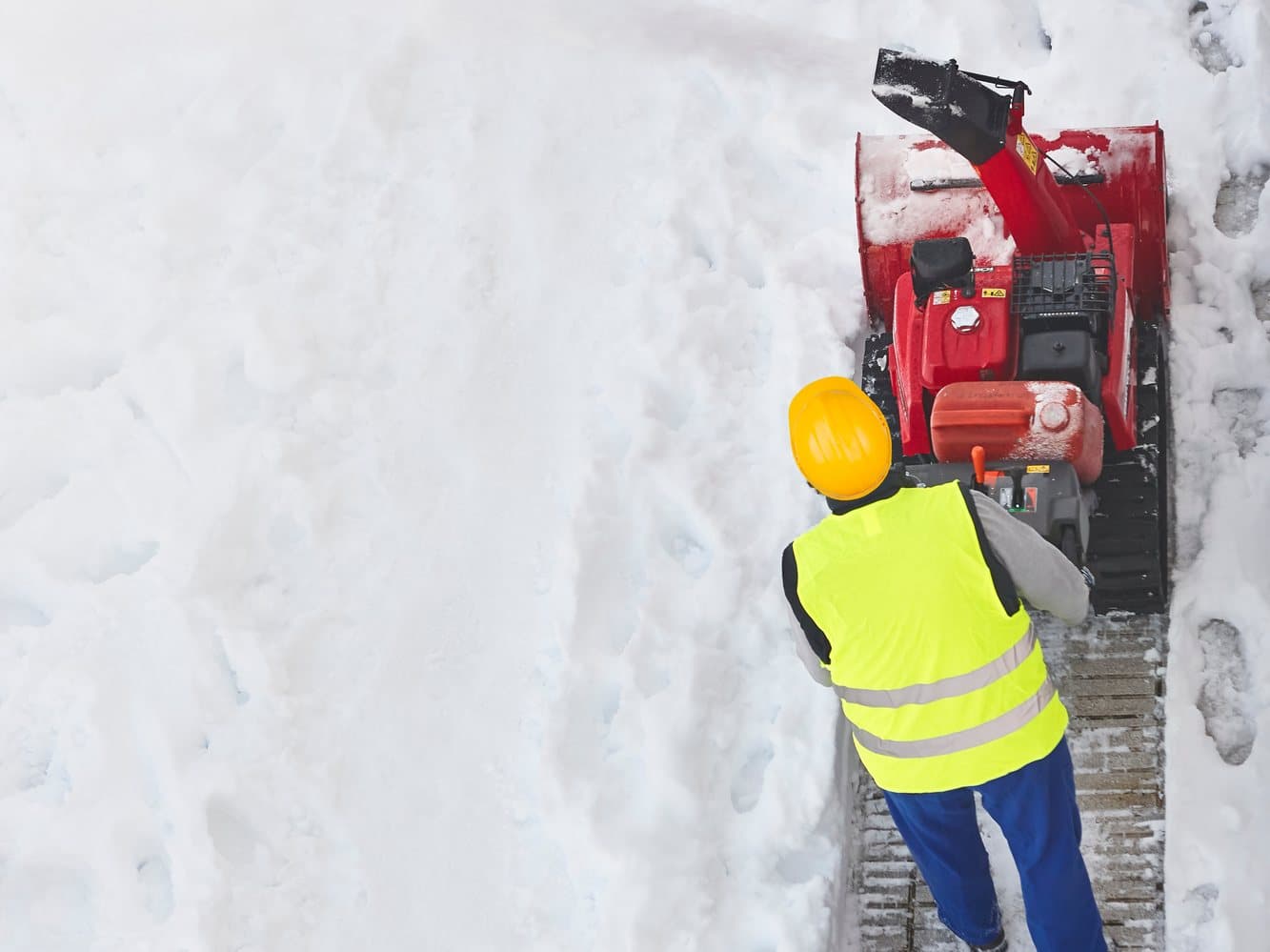
Plowing a gravel driveway without wrecking it
Reviewed by Adam Hurlbert, Owner & Founder, 15+ years in landscape & property care
Gravel driveways are common across the Bitterroot Valley and the edges of Missoula, and they are the surface most often damaged by snow removal. Scrape too hard and the gravel ends up in the lawn, the beds and the ditch; clear too little and the drive turns into ruts of packed ice. The fix is not a secret technique. It is understanding how a gravel surface behaves when it is soft, when it is frozen, and when it thaws, and clearing it to match. This guide draws on the Federal Highway Administration's gravel road guidance and on how road agencies plow gravel, scaled down to a driveway.
Why is gravel harder to plow than pavement?
A paved drive has a hard, continuous top. The goal is to scrape it clean, and a blade that rides on it does no harm. A gravel drive is loose stone over a compacted base, and the stone is the surface. Any blade that rides on it moves some of that stone, and every pass that moves stone off the drive and into the margins is surface you have to replace in spring.
Gravel also changes with temperature. When the ground is unfrozen, the top layer is soft and easy to cut. Once the drive freezes solid, the same surface is hard enough for a blade to run on it without digging. Most gravel damage happens in the gap between those two states: the first storms of the season, mid-winter thaws, and the spring melt.
How high should the blade be on unfrozen gravel?
High enough to leave a layer of snow behind. A road agency presentation from the Barry County Road Commission in Michigan, shared through Michigan Tech's Center for Technology and Training, describes plowing non-frozen gravel roads once wet, heavy snow reaches about 3 inches, carrying the blade about half an inch above the road surface to minimize gravel loss. That is one agency's practice for public roads, not a standard, but the principle carries straight to a driveway: on soft gravel, the blade should not touch the stone.
The thin layer left behind is doing work. It protects the stone, it gives traction, and it packs into a base that later passes can ride on. Homeowners sometimes read it as a poor job. On gravel early in the season it is the correct one.
What changes once the ground is frozen?
The same Barry County presentation describes plowing frozen gravel roads at about 1 inch, with the blade contacting the road and the crown kept bare. Frozen gravel holds together, so a blade can run on it without lifting stone, and clearing to the surface prevents snow from being packed into ice ruts.
The difficulty is knowing which state the drive is in. A drive can be frozen in the shade and soft in the sun, frozen in the morning and soft by afternoon. When in doubt, treat it as soft. A little snow left on a frozen drive is a minor annoyance; a blade dropped onto a soft one can take out a season of surface in one pass.
What is the crown, and why does it matter in winter?
The crown is the slight hump that sheds water off the surface. The FHWA's Gravel Roads Construction and Maintenance Guide explains that without a crown, water collects on the surface during rain or snowmelt and softens the crust, leading to rutting that can reach the subgrade. It says supervisors and operators recommend about half an inch of crown per foot of width, roughly 4 percent, for gravel roads, and warns that too much crown is a hazard where snow and ice make vehicles slide toward the edge.
For a driveway, the lesson is that winter clearing should keep the shape of the drive rather than cutting into it. Snow packed into a flat or dished surface holds meltwater in the middle of the drive, where it freezes every night. Clearing the high center first and pushing snow off to the sides keeps the water moving off the surface when the melt starts.
Why do windrows and banks cause spring problems?
Every pass pushes some gravel to the edge along with the snow. Over a winter that gravel builds into a ridge at the shoulder. The FHWA guide describes these berms, or secondary ditches, as one of the most common problems on gravel roads and lists winter plowing, and the sand from winter sanding in northern regions, among the causes. The berm traps water on the surface instead of letting it drain off.
On a driveway the result is a drive that is lower than its edges, holds water, and turns to mud or ice in spring. Keeping banks set back from the edge, and pulling recovered gravel back onto the drive when it is reshaped, prevents most of it. Our guide to where to pile snow covers storage along a long drive.
Should you use ice melt or sand on gravel?
Sparingly, and with thought. The Barry County presentation says not to treat non-frozen gravel roads at all, and to use a mix of nine parts sand to one part salt on frozen ones, applied on the crown. Salt on a soft gravel surface keeps it soft and can turn it to mud. Sand adds material that eventually has to come back off the edges in spring.
For most driveways the answer is traction where it matters (the grade, the low spot, the turn by the garage) rather than treating the whole surface. Our ice melt guide explains what each product does, and the comparison of sand, salt or both covers abrasives in detail.
Can you use a snow blower on gravel instead?
Only a machine whose auger stays off the ground. Consumer Reports calls single-stage blowers a poor choice for gravel because the auger contacts the surface and can throw stones, and recommends a two-stage model for gravel because its auger does not touch the ground. Thrown stone breaks windows and chips vehicles, so this is a safety point as much as a surface one. Our comparison of plowing and snow blowing covers when each method fits.
What should you mark on a gravel drive before winter?
The edges. On pavement, the edge is obvious even under snow because the blade finds it. On gravel, the edge of the drive and the edge of the lawn feel the same under a foot of snow, and a blade that wanders a foot off the drive peels turf and drops gravel into it. Stakes along both edges, especially on curves and at the bottom of a slope, are the single best protection. Our guide to snow stakes and markers explains height, spacing and timing.
Mark culvert ends, irrigation heads near the drive and any landscape lighting as well. Snow plow damage prevention lists what gets hit most often.
What happens to a gravel drive in spring?
Spring is when a gravel drive is weakest. The FHWA guide notes that roads carrying heavy loads can fail in wet conditions or during the spring thaw in cold regions, and that spring is the best time for reshaping the surface and shoulders because vegetation is minimal and moisture is usually present. For a driveway that means keeping heavy deliveries off it while it is soft if you can, and planning any regrading for when it has drained enough to work.
Potholes that appear over winter are best filled or bladed when conditions allow, not while the drive is saturated. Recovering the gravel that migrated to the edges, and restoring the crown, usually puts most of it back. Our spring snowmelt yard cleanup guide covers the rest of the property after the melt.
Why do potholes and washboard show up after a winter?
Mostly because water could not get off the surface. The FHWA guide shows potholes and corrugation forming on a road that lacks adequate crown, and explains that when the middle of a road flattens into a rounded, parabolic shape, water does not drain from the center and potholes and ruts form. It describes washboarding as caused by things like lack of moisture, hard acceleration, aggressive braking and poor quality gravel, and on public roads by grading too fast.
A winter of snow packed into the middle of a drive, banks along the edges and meltwater sitting on the surface creates exactly those conditions. That is why clearing that keeps the crown and keeps banks back from the edge pays off in spring, and why a drive that comes out of winter rutted usually needs its shape restored rather than just more gravel dumped on top.
What about shared gravel roads?
Many Bitterroot homes sit on a private gravel road shared with neighbors, and everything above applies at a larger scale with more people involved. The road needs one agreed approach to blade height, crown and where snow is stored, or each neighbor's contractor undoes the last one's work. Our guide to who is responsible for plowing a private road covers how neighbors usually split the job and the cost factors.
How do we handle gravel drives?
Gravel is cleared with the blade set slightly high, which leaves a thin compacted layer by design, and early-season storms before the ground freezes get the most conservative treatment. That is part of our residential snow removal setup and our private road snow plowing for shared gravel roads. You can see the full list of snow and 24-hour storm services we provide. This guide is part of our Montana Winter Property Guide.
To get a gravel drive on our winter route, or to walk it and mark the edges before the snow, call (406) 215-7319 or request a free estimate.
Need help?
HJ Property Care & Tree Service is locally owned and ISA-certified. Call for a free estimate.
This article is part of the Montana Winter Property Guide, our complete guide for western Montana property owners.
Explore our snow & 24-hour storm services.
Sources
We cite primary sources: Montana State University Extension, the City of Missoula, and the ISA, so you can verify anything here yourself.
- Gravel Roads Construction & Maintenance Guide (FHWA-OTS-15-0002) (Federal Highway Administration). Last checked November 2, 2026.
- Gravel Road Winter Maintenance (Barry County Road Commission, Winter Operations 2024) (Michigan Tech Center for Technology & Training). Last checked November 2, 2026.
- Which type of snow blower should I buy? (Consumer Reports). Last checked November 2, 2026.
Ready to transform your outdoor space?
Get a free, no-obligation estimate within 48 hours. Locally owned and ISA-certified.