
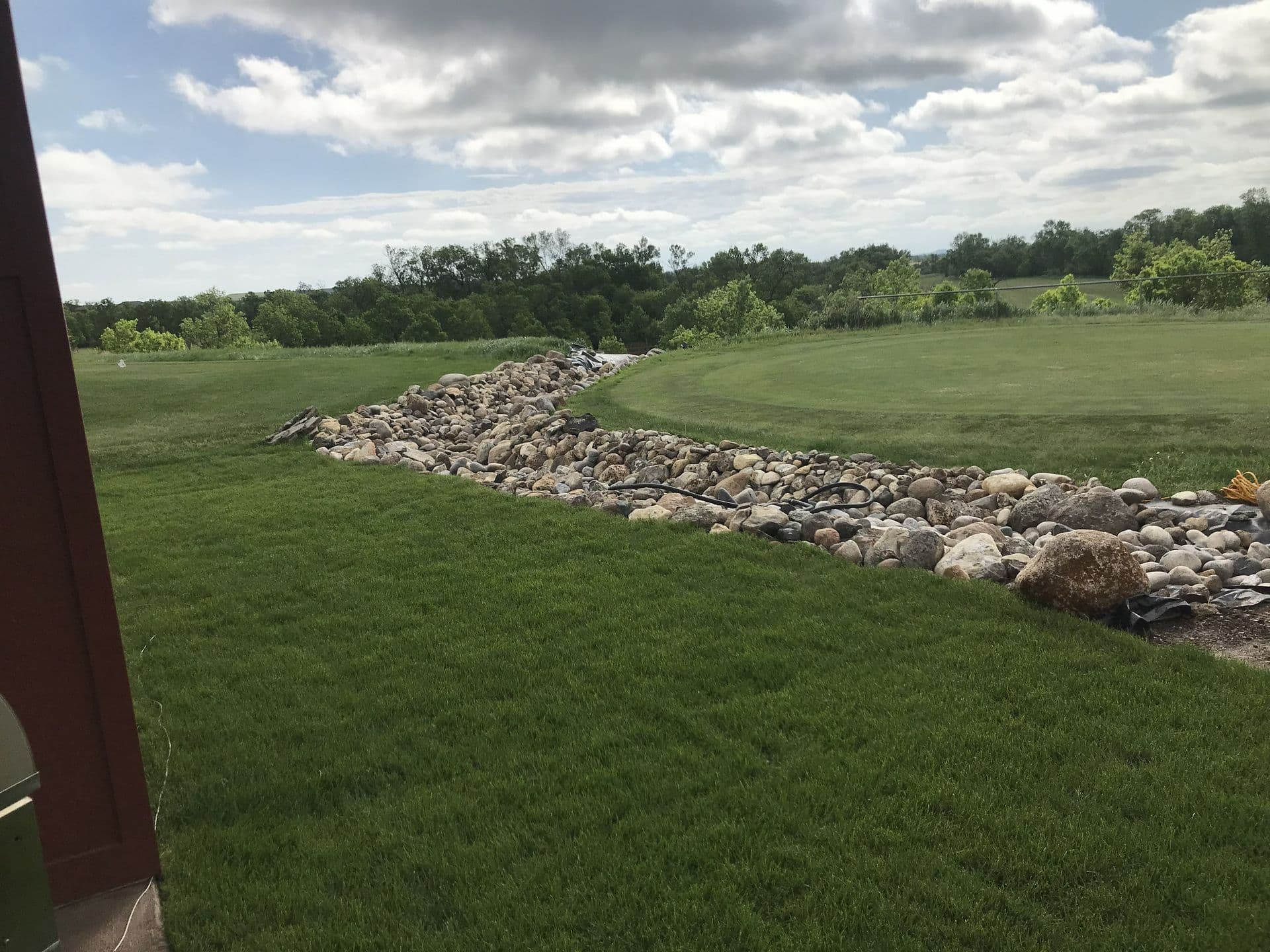
Irrigation Systems in Victor, MT
Reviewed by Adam Hurlbert, Owner & Founder, 15+ years in landscape & property care
Victor is a small Ravalli County community of 789 people at the 2020 census, sitting at about 3,416 feet on US 93 between Stevensville and Hamilton, below St. Mary's Peak. Around the small town center, most properties are acreages, and the first irrigation question on almost every one is the same: where does the water come from? This page covers how HJ Property Care plans irrigation for Victor properties around that answer.
Where does irrigation water come from on a Victor property?
Usually one of three places: a community water connection, a private well, or a ditch. Many Victor acreages have more than one, such as a well for the house and yard and a ditch for pasture. The source decides almost everything else about the system: how many heads can run at once, whether you need a pump and filter, and when in the season water is available.
Valley-wide, a 2024 Bitterroot Star report on a groundwater presentation found that the number of wells in the Bitterroot grew from about 3,100 in 1970 to 25,375 in 2023, that most irrigation in the valley still comes from surface water, and that only about 4 percent of well use is for irrigation. In other words, wells mostly serve houses and yards, and that is the situation we design for on most Victor lots.
Can I run sprinklers off my well in Victor?
Usually yes, within limits. Montana DNRC explains that you do not need a permit to develop a groundwater well that uses 35 gallons per minute or less and no more than 10 acre-feet a year. That volume cap covers everything the well supplies, house and yard together. Since 1 January 2026, DNRC requires a Notice of Intent (Form 602I) before water from an exempt well is put to use, followed by a Notice of Completion (Form 602) to obtain a certificate of water right. If you are drilling, adding a well or unsure how the rules apply to an existing one, ask DNRC's water resources office; this is general information, not legal advice.
The practical limit is usually lower than the legal one: it is what your well and pump actually deliver. We measure the flow and pressure available at the point where the irrigation tees in and size each zone so it never asks for more than the well gives, leaving room for the house. A system designed to the well runs well. One designed to a catalog flow figure starves the last heads on every zone. Our guide to irrigating from a well in Montana goes deeper.
What does a ditch-fed system need?
Three things a well or city system does not. A legal right to the water, first: ditch water in the Bitterroot is tied to water rights and, in some places, to district or ditch company shares, so check what came with the property (see irrigation ditches and water rights and irrigation district shares in Ravalli County). Second, a pump, because ditch water arrives without pressure. Third, filtration, because sediment and plant debris will clog nozzles and drip emitters fast.
Ditch water also runs on its own schedule. Many owners keep the ditch for pasture and a well for the yard, or set up a system that can switch between them. We design ditch-fed systems around the delivery schedule you actually have rather than assuming water every day.
How much water does a Victor lawn actually need?
Less than most systems put down. MSU Extension's lawn MontGuide says a well-maintained bluegrass lawn in most of Montana uses about 1 to 1.5 inches of water a week early and late in the season and up to about 2.5 inches a week in mid-summer, minus any rain since the last watering. It recommends watering in the early morning, as deeply and infrequently as the soil allows, and notes that sandy soils drain quickly and need more frequent watering while clay soils take water slowly but hold it longer.
MSU's Yard and Garden Water Management MontGuide adds that lawns watered under the hot midday sun can lose as much as 30 percent of the water to evaporation, and suggests measuring sprinkler output with cans set out on the lawn. On a well, that efficiency is the difference between a system that keeps up in August and one that does not. A smart controller helps adjust run times as the season changes.
How should a system be zoned on a Victor acreage?
By what is being watered, not by distance from the valve. A typical Victor acreage might have a lawn by the house, shrub beds, a vegetable garden, a windbreak and some young trees. Those want very different water: lawn on rotors or sprays, beds and garden on drip, and trees on deep, infrequent drip out at the root zone. Putting them on separate zones lets each run correctly.
Head type matters too. Spray heads put water down faster than rotors, so mixing them on one zone guarantees one is wrong. On sloped ground toward the foothills, short repeated cycles let water soak in rather than run off. Our guides to irrigation zone design, sprinkler head types and drip irrigation explain the details.
Does a Victor system need a backflow preventer?
Yes. Any irrigation system tied to drinking water needs protection against water being drawn back from the yard into the supply, and that applies to a private well as much as a community system. The required type and any testing depend on your water supplier and local rules; our guide to backflow preventers and testing in Montana covers it. The backflow assembly is also the part most often cracked by freezing, which is why a proper fall blowout matters.
What does an irrigation project in Victor involve with HJ?
We start with the water source and a walk of the property, then lay out zones, run lines and install with professional-grade parts. On existing systems we fix what is failing and rework zoning where it no longer fits the property. If you are not sure whether your current system needs repair or replacement, read signs your irrigation needs repair in Victor first, and see our spring startup guide for the start of the season.
HJ Property Care designs, installs and repairs irrigation systems in Victor and across the Bitterroot Valley, and plans the landscaping in Victor the water supports. For more on lawns, planting and water in this valley, see our Montana Landscaping, Lawn & Irrigation Guide. Call (406) 215-7319 or request a free estimate.
Need help in Victor, MT?
HJ Property Care & Tree Service is locally owned and ISA-certified. Call for a free estimate.
Explore our irrigation systems, or see everything we handle in Victor, MT.
Sources
We cite primary sources: Montana State University Extension, the City of Missoula, and the ISA, so you can verify anything here yourself.
- Victor census-designated place, 2020 Census population (POP100), TIGERweb (U.S. Census Bureau). Last checked November 2, 2026.
- Victor, Montana (Explore the Bitterroot). Last checked November 2, 2026.
- A look at groundwater in the Bitterroot (30 April 2024) (Bitterroot Star). Last checked November 2, 2026.
- Exceptions to Permit Requirements (groundwater exemption, Forms 602I and 602) (Montana DNRC Water Resources Division). Last checked November 2, 2026.
- Exempt Well Updates and Information (HB 681 Notice of Intent) (Montana DNRC Water Resources Division). Last checked November 2, 2026.
- Maintaining Successful Lawns in Montana (MontGuide MT202004AG, revised 08/23) (Montana State University Extension). Last checked November 2, 2026.
- Yard and Garden Water Management (MontGuide MT198915AG) (Montana State University Extension). Last checked November 2, 2026.
- Plant hardiness zone for ZIP 59875 (PRISM data behind the 2023 USDA map; not the official USDA map) (PHZM API / PRISM Climate Group, Oregon State University). Last checked November 2, 2026.
Ready to transform your outdoor space?
Get a free, no-obligation estimate within 48 hours. Locally owned and ISA-certified.