
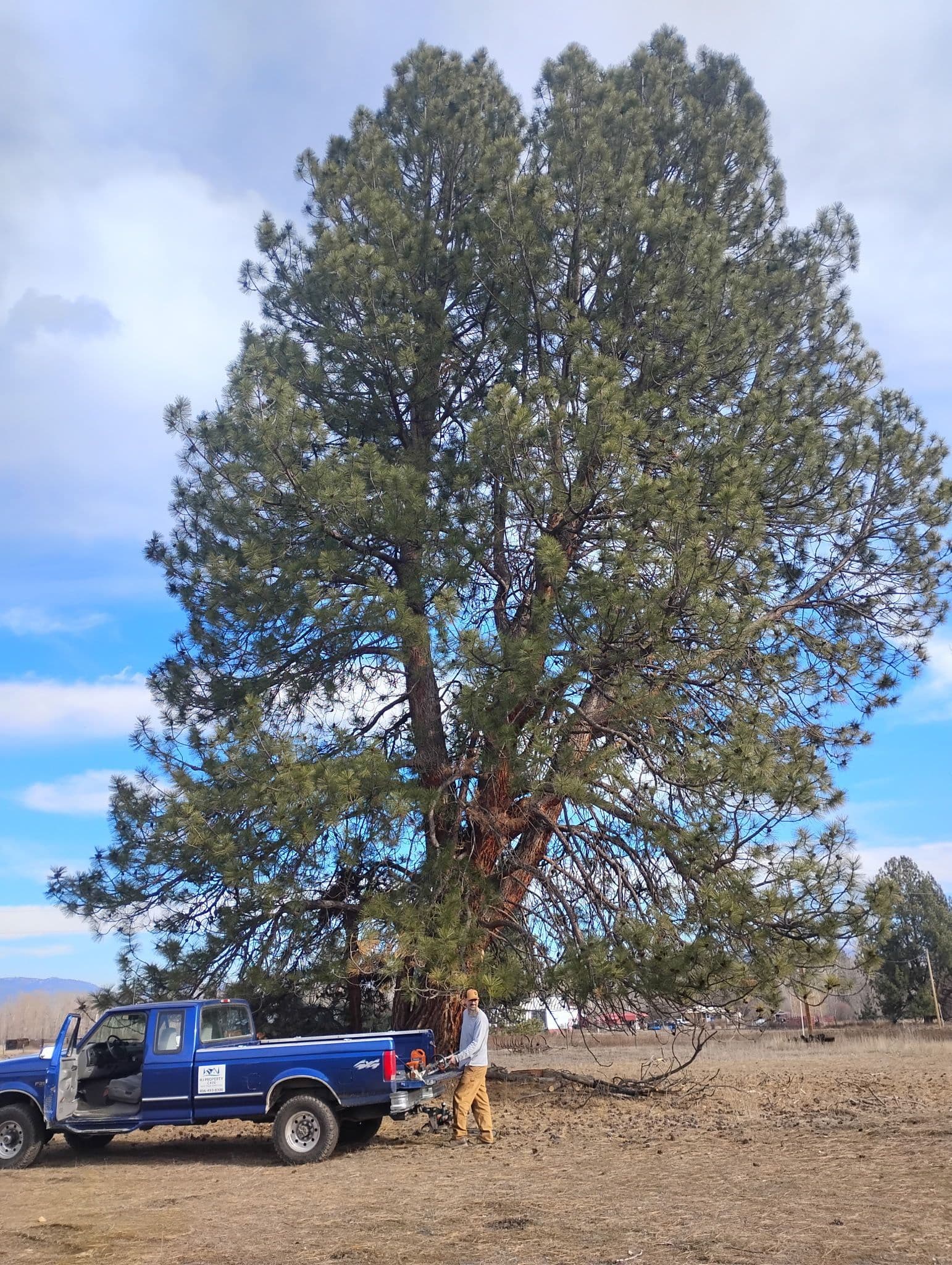
Fire mitigation in Corvallis, MT
Reviewed by Justin Johnson, ISA Certified Arborist (RM-8889A)
Corvallis sits on the irrigated east side of the Bitterroot, among farms, hay ground and pasture with the Sapphire Mountains behind it. Fire risk here looks different from the timbered west side: more grass, more outbuildings and equipment, and fewer dense stands of timber. The most instructive local fire was not a forest fire at all. This page is part of our [Montana Wildfire Guide](/montana-wildfire-guide).
What happened at Corvallis Hills Estate in 2013?
On 3 April 2013, KMPT reported that a controlled burn near Corvallis Hills Estate quickly went out of control late in the afternoon. About 10 homes were evacuated, several vehicles and a couple of outbuildings burned, and residents were allowed back by about 7 p.m. No one was hurt and no homes were damaged. Corvallis Fire called for mutual aid from Hamilton and Victor, and Ravalli County Sheriff's Office personnel helped with the evacuation.
The date is the point: wildfire is not only a summer problem. This fire happened in early April, and it started with deliberate burning. A burn that gets away in spring grass moves to whatever is next to it, and around Corvallis that is usually sheds, equipment, hay and vehicles. If you burn, check the current rules and conditions first (see Montana fire restrictions and burning slash piles safely).
Is farm ground really counted as wildfire fuel?
Yes. Ravalli County's 2024 wildfire protection plan lists hay and pasture, cultivated crops and herbaceous land among the land cover types it treats as wildland fuel, alongside forest and shrubland. The same plan says about 15.8 percent of the county is farmland, mostly used for grazing and hay. Corvallis sits in the middle of that.
Irrigated, green fields are not a big problem in midsummer. The risk is cured grass along fence lines, ditch banks, field edges and around buildings, and stacked hay close to barns and shops. Mowed or grazed strips next to structures, weeds kept down along fences, and hay stored away from buildings are the core of fire mitigation on a Corvallis place. Our guides to barns, hay and livestock, cheatgrass and dry grass and noxious weeds as fuel go into detail.
How do the Sapphire foothills change the risk east of town?
The county plan describes the Sapphire Mountains as having more moderate slopes and more foothills than the Bitterroot Mountains across the valley, reaching roughly 7,500 to 9,000 feet. Where homes are built up on those foothill benches, the ground below them matters. Fire moves faster uphill, so a home on a foothill bench with dry grass below it is in a more exposed spot than the same house on flat ground (see slope, aspect and wind).
On public land, the county plan lists a Forest Service Eastside Fuels Treatment project (hazardous fuel reduction and prescribed burning) with expected completion in 2029. That helps at the landscape scale but does not reach your own lot.
Who fights fire in Corvallis?
The Corvallis Rural Fire district, one of 14 fire districts the county plan lists, served mainly by volunteers. The plan says mutual aid agreements exist between all firefighting entities in the county, which is exactly what the 2013 response looked like. Corvallis is also on the plan's list of federally identified wildland-urban interface communities at high risk. Our Ravalli County fire districts guide lists the districts.
Fire in the Root, which the plan names as a preparedness lead, offers a free in-person home wildfire risk assessment for Ravalli County residents, and Montana DNRC offers a free assessment statewide. Its program page also lists the Bitter Root RC&D hazardous fuels grants for WUI residents and an NRCS forest thinning cost-share that ran 2022 to 2024, starting with the east side in 2022. Ask both what is available now (see cost-share and grants).
What fire mitigation does a Corvallis property usually need?
Most Corvallis jobs are a mix. Around the house: needles and leaves out of gutters, bark mulch and firewood moved off the foundation, junipers pulled back from siding, and the lawn or a gravel strip kept as a buffer (see lawns and irrigation as firebreaks). Around outbuildings: clear the base of shops, sheds and barns, and keep fuel and equipment storage separated (see sheds and outbuildings and propane and fuel clearance).
Trees are usually windbreaks and yard trees rather than forest. Conifer windbreaks planted tight against a house are a ladder straight to the eaves; thinning a row, limbing it up within ANSI A300 limits or removing the trees closest to the structure changes that without losing the wind protection. For foothill properties with real timber, the work is thinning conifers and slash disposal.
Can irrigation help with fire risk in Corvallis?
It helps where it keeps vegetation green next to buildings. A well-maintained irrigated lawn or green strip around the house and outbuildings is much harder to ignite than cured grass. What it cannot do is make up for fuel piled against a wall or needles in a gutter. We install and repair irrigation systems, and on Corvallis properties we often plan the irrigated zone and the fuel work together.
When should Corvallis owners schedule the work?
Fall, after the fields are done and the ground is firm, or late winter before spring burning starts. That keeps cutting equipment out of dry summer grass and finishes the work before the season.
See our fire mitigation service and our Corvallis service area page, then call (406) 215-7319 or request a free estimate.
Need help in Corvallis, MT?
HJ Property Care & Tree Service is locally owned and ISA-certified. Call for a free estimate.
Explore our fire mitigation, or see everything we handle in Corvallis, MT.
Sources
We cite primary sources: Montana State University Extension, the City of Missoula, and the ISA, so you can verify anything here yourself.
- Brush fire near Corvallis leads to evacuations, outbuildings and vehicles burned (3 April 2013) (KMPT 930). Last checked November 2, 2026.
- Ravalli County Community Wildfire Protection Plan (January 2024; approved 20 February 2024) (Ravalli County / Montana DNRC). Last checked November 2, 2026.
- Fuel Mitigation Programs and free wildfire risk assessment (Fire in the Root Council (Ravalli County)). Last checked November 2, 2026.
- Wildfire Prevention and Preparedness (free wildfire risk assessment) (Montana DNRC). Last checked November 2, 2026.
Ready to transform your outdoor space?
Get a free, no-obligation estimate within 48 hours. Locally owned and ISA-certified.