
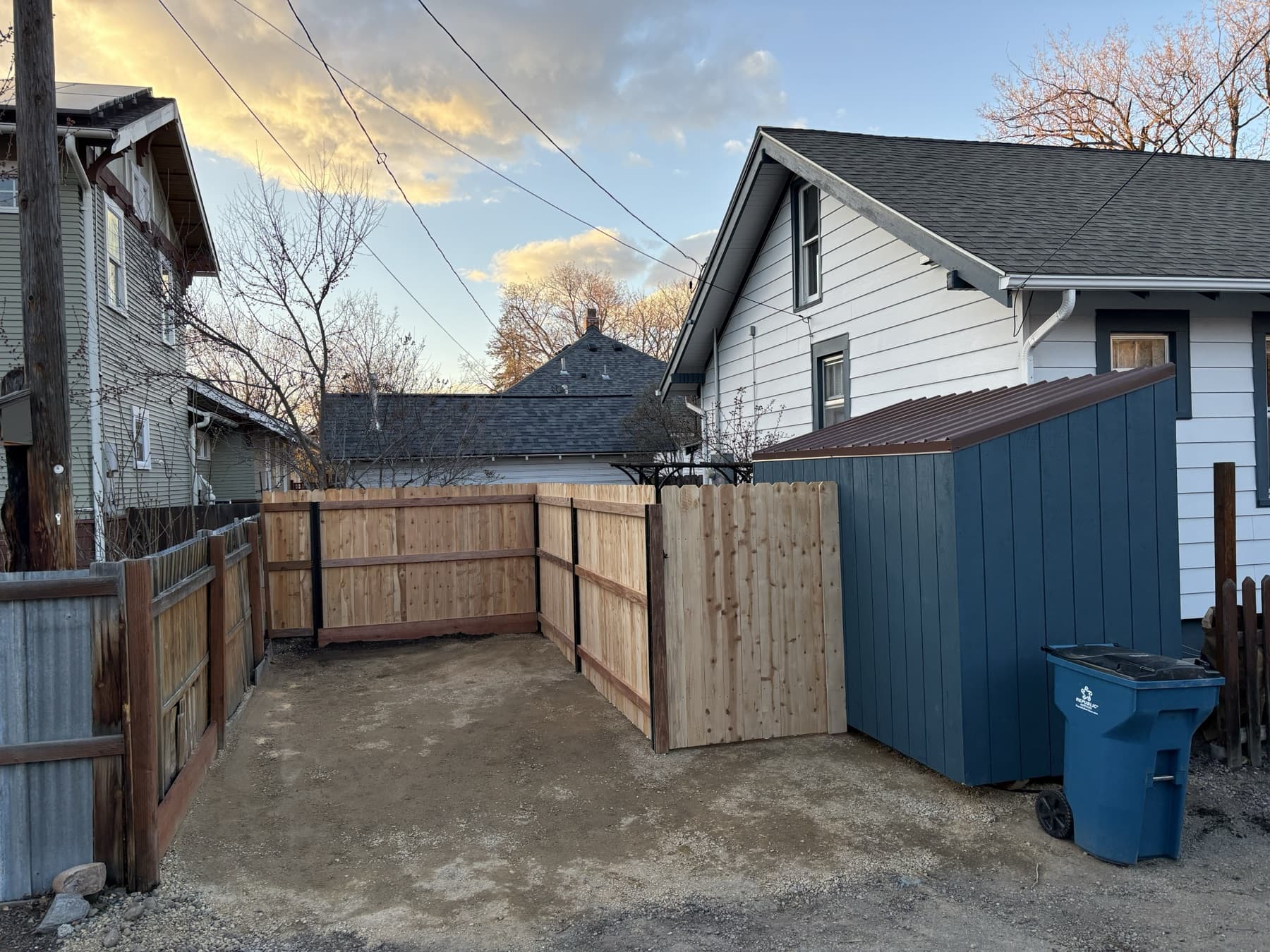
Fences and Property Lines: Surveys Before You Build
Reviewed by Justin Johnson, ISA Certified Arborist (RM-8889A)
The most expensive fence mistake is not a bad post or the wrong stain. It is a good fence in the wrong place. A fence built a few feet onto a neighbor's land, into a city right-of-way, or across a utility easement can end up moved at the owner's cost, and both the City of Missoula and the City of Hamilton say plainly that finding the line is the property owner's job. This guide explains what records exist, what a surveyor does, when a survey is worth it, and what to do when an old fence and the real line disagree. It is general information, not legal advice.
Is an existing fence the property line?
Not necessarily, and the cities say so. Hamilton's fence permit application states that the position of a current fence or structure should not be assumed to be an accurate boundary line, and that if you are not sure about the exact boundaries your property should be surveyed before construction. The City of Missoula's guide to finding a property line notes that older neighborhoods are particularly difficult, because property and street dimensions may have been changed by street or alley vacations and street improvements.
Old fences were often built for convenience: along a ditch, a row of trees, or wherever the ground was easiest to dig. Replacing one in the same holes repeats whatever error it had. If a fence is coming out anyway, that is the cheapest moment to find out where the line actually is.
What do Missoula and Hamilton require?
Missoula's fence code (Unified Development Code, Article 6.4) requires every fence to be inside the property line so that no component, post, footing or other part extends beyond it. If the line is unknown or unclear, the code recommends at minimum a retracement survey by a Montana licensed professional land surveyor before installation. A fence the City Engineer finds off-property or in the right-of-way without an encroachment permit must be relocated, or the owner must provide a survey with corners marked by a licensed surveyor, and the code says no existing fence is exempt.
Hamilton's code (17.20.040, printed on the city's fence permit application) makes the owner responsible for providing proof of property boundaries before building, requires fences on front and rear lines to be set back 6 inches, and prohibits fences in rights-of-way, streets and alleys. Both cities treat boundary disputes between neighbors as civil matters. We cover the height side of these codes in fence height and permit rules.
How do you find your property line?
The City of Missoula's handout ranks the options. Its best choice is hiring a professional land surveyor to locate and mark the edges of the property, noting that a surveyor can also identify easements and other features that affect the lines. Its good choice is getting a copy of the recorded plat or Certificate of Survey (COS) that created the parcel and using it to find the existing property pins.
Plats and certificates of survey are filed with the county Clerk and Recorder, which also keeps easement records. The Missoula handout says pins are typically a metal stake such as rebar, iron pipe or steel rod, sometimes with a yellow plastic or aluminum cap. Some parcels are described by metes and bounds in the deed rather than on a plat, and the city notes those descriptions can be complicated enough to need a surveyor. In Ravalli County the same records are kept by the Ravalli County Clerk and Recorder in Hamilton.
Can you use online parcel maps instead?
Only as a rough guide. Montana's statewide Cadastral Framework is built from tax appraisal data. The Montana State Library's description says the parcel data come from the Department of Revenue's database, that Ravalli and Missoula counties maintain their own, and that parcels were aligned to public land survey coordinates or digitized from paper maps and transformed to fit. That is useful for finding a parcel number, not for placing a post within inches.
Missoula's handout calls do-it-yourself measuring from street centerlines or sidewalks a last resort and warns in capitals that the method is not very accurate. It also warns that some streets are not centered in their right-of-way. Its disclaimer makes the property owner solely responsible for an approximate line located that way.
What does a land surveyor do for a fence project?
A surveyor researches the recorded documents for your parcel and its neighbors, finds or sets the corner monuments, and marks the line on the ground. For a fence, the useful products are found or reset pins at the corners and, on a long or curving line, intermediate stakes so the fence crew can string a line between known points. Ask whether easements, encroachments and existing improvements near the line will be shown.
In Montana, land surveyors are licensed by the Board of Professional Engineers and Professional Land Surveyors under the Department of Labor and Industry. The board's page points to its Licensee Lookup System as the primary source for verifying a license, and says licenses renew every two years. Check the license before you hire.
When is a survey worth it for a fence?
Our rule of thumb is: when the fence is on or within a few feet of a line, when the pins cannot be found, when the lot was created long ago or by metes and bounds, when a neighbor has questioned the line, or when the fence is expensive enough that moving it would hurt. Missoula's handout makes the same point from the other side, saying property line disputes often need both a surveyor and an attorney to resolve.
A survey is often not needed when all the pins are found and clearly match the plat, or when you plan to set the fence well inside your line on purpose. Setting a fence a short distance inside the line also leaves room to maintain and stain both faces without stepping onto a neighbor's lawn, which is worth considering for a wood fence; see staining and sealing a wood fence.
What if the old fence is on the wrong side of the line?
Talk to the neighbor before anything comes down, and get legal advice if the fence has been there a long time or the neighbor disagrees, because long use can raise legal questions a contractor cannot answer. If you both agree, put in writing where the new fence goes and who maintains it. Montana has default rules for shared fences between adjoining owners, covered in our guide to Montana fence law and partition fences.
Inside Missoula, a fence found in the public right-of-way without an encroachment permit has to be moved or permitted, and when 25 feet or more of an existing encroaching fence is replaced, a new encroachment permit is required. A replacement is the natural time to fix that.
What else should be on the site plan?
Easements and buried lines. Missoula's code says owners and fence contractors should review the plat and any easement documents before applying, and that fences in easements can be removed at any time without notice. Hamilton's application asks for every easement and its dimensions on the site plan. Before digging, call 811: under Montana law the excavator must notify the notification center, and facility owners generally have 2 business days to mark their lines. Private lines such as irrigation, low-voltage lighting and septic are not marked by 811, so tell your installer where they are.
How is the fence line laid out once the corners are known?
With the corners marked, the layout is simple but worth doing carefully. A string line is pulled tight between the two known points, offset to the inside by whatever distance you have chosen, and post locations are marked along it. On a long run the string sags and drifts in wind, so intermediate stakes from the surveyor, or a measured offset checked at several points, keep the line true. Corner, end and gate posts get marked first, because they carry the fence and everything else is spaced between them.
Decide two details before the first hole. Which face of the fence points out: check your covenants, which sometimes address it, and remember the neighbor looks at that face every day. And where gates go, since a gate post on the line itself can swing a gate onto the neighbor's side. Both are easier to settle on paper than after posts are set.
What should you tell your neighbor?
Even when no notice is required, a short conversation saves trouble. Tell the neighbor when the work is planned, show them where the pins or survey stakes are, and say which side the fence will sit on. If you are replacing a shared fence, settle who pays for what in writing first. People are far more relaxed about a fence when they have seen the marks before the auger arrives, and a neighbor who doubts the line can hire their own surveyor before the posts are in rather than after.
How HJ works with your survey
We do not survey or decide boundaries. What we do is build to the marks: we string the line between the surveyor's or found pins, set posts inside it, and keep footings off the neighbor's side. If we find pins that do not match the plan, we stop and tell you. Our custom fencing page describes the fences we build, and what to expect on fence installation day walks through the job itself. This guide is part of our Montana Landscaping, Lawn & Irrigation Guide.
Call HJ Property Care & Tree Service at (406) 215-7319 or request a free fence estimate and we will walk the line with you.
Need help?
HJ Property Care & Tree Service is locally owned and ISA-certified. Call for a free estimate.
This article is part of the Montana Landscaping, Lawn & Irrigation Guide, our complete guide for western Montana property owners.
Explore our custom fencing.
Sources
We cite primary sources: Montana State University Extension, the City of Missoula, and the ISA, so you can verify anything here yourself.
- Fence Permit Application, with Hamilton Municipal Code 17.20.040 Fences (City of Hamilton, MT Planning Department). Last checked November 2, 2026.
- How to Find your Property Line (City of Missoula). Last checked November 2, 2026.
- Missoula Unified Development Code, Title 22 Article 6.4 Fences (City of Missoula). Last checked November 2, 2026.
- Montana Cadastral Framework map service description (Montana State Library). Last checked November 2, 2026.
- Professional Land Surveyor license information and Licensee Lookup (Montana Board of Professional Engineers and Professional Land Surveyors (Department of Labor and Industry)). Last checked November 2, 2026.
- MCA 69-4-503, Notification, locating and marking (excavations near underground facilities) (Montana Code Annotated 2025 (Montana Legislature)). Last checked November 2, 2026.
Ready to transform your outdoor space?
Get a free, no-obligation estimate within 48 hours. Locally owned and ISA-certified.